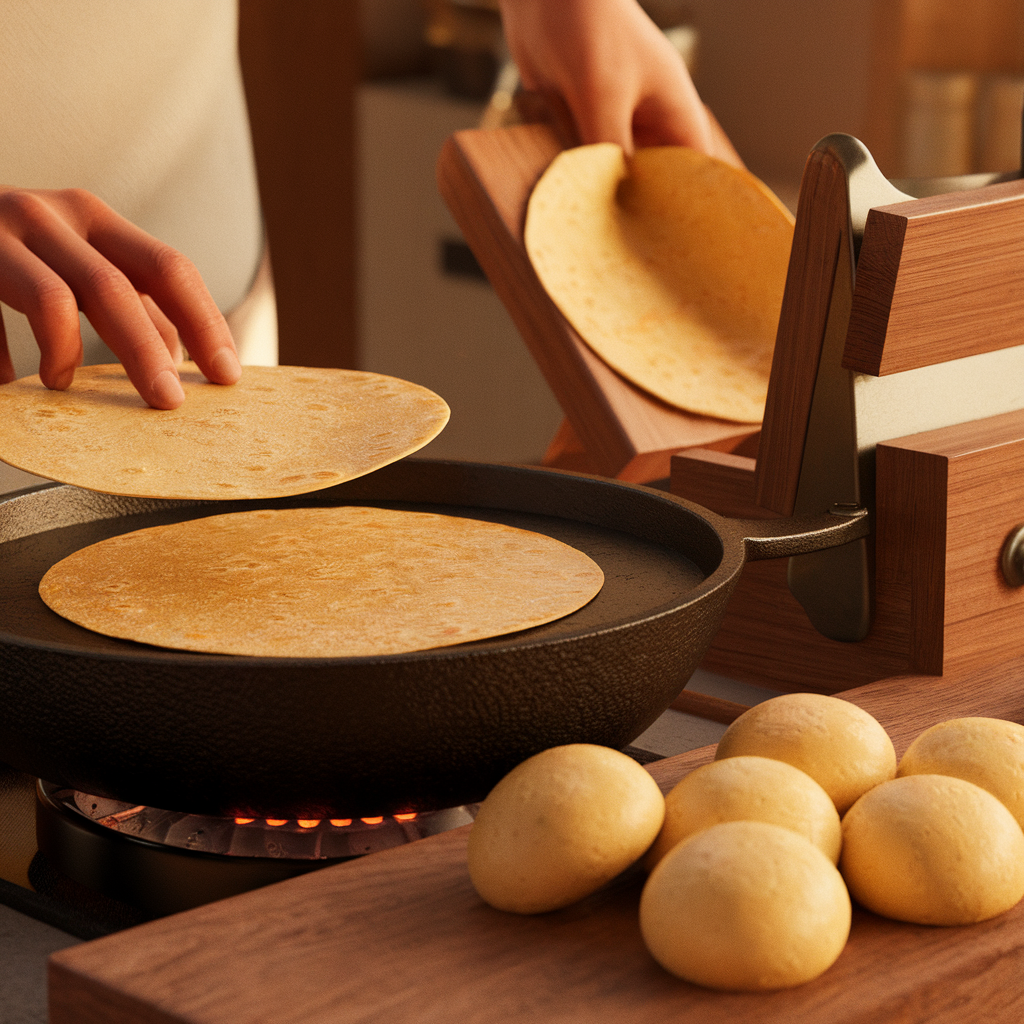
Are you still serving tacos on those stiff, store-bought tortillas that crack and crumble the second you fold them? Stop! You deserve the warm, pliable, earthy, and totally authentic experience of a Homemade Corn Tortilla. Seriously, if you’ve never tasted a tortilla fresh off the griddle, you haven’t truly experienced taco night.
I used to buy the pre-made stack, too, thinking making them at home was too messy or difficult. Then I discovered masa harina and the tortilla press, and my life changed. This recipe is ridiculously simple—it uses only three ingredients! The resulting homemade corn tortillas are tender, flexible, and infused with that deep, savory corn flavor that makes real Mexican food irresistible. I love how fast and satisfying this process is. Ready to ditch the preservatives and master the art of the best corn tortillas? A darle! (Let’s go!)
🌽 The Three Ingredient Magic: Ingredients for 12 Tortillas
The genius of Homemade Corn Tortillas is their simplicity. You need only three basic components, but the type of flour is paramount. This recipe makes 12 standard 6-inch tortillas.
H3: The Core Ingredients
- 2 cups (240g) Masa Harina: This is non-negotiable! Masa harina is corn flour treated with an alkaline solution (nixtamalization). It is different from regular cornmeal or corn flour and is the only way to make authentic corn tortillas.
- 1 1/2 cups (360ml) Warm Water: Used for mixing the dough. Warm water helps the dough hydrate quickly.
- 1/2 teaspoon Fine Sea Salt: For necessary flavor (the store-bought ones are often overly salty).
🥣 Part I: Mastering the Masa Dough (The Right Texture)
Unlike wheat flour, masa harina does not develop gluten. Instead, the dough relies on perfect hydration and a short rest to become pliable.
H3: Mixing and Hydrating
- Combine Dry Ingredients: In a large bowl, whisk together the masa harina and salt.
- Add Water: Gradually add the warm water to the dry mixture. Use your hands to mix everything together until a shaggy dough forms.
- Knead Briefly: Gently knead the dough in the bowl for about 3 to 5 minutes. You are not developing gluten; you are ensuring every single particle of masa is fully hydrated.
- The Play-Doh Test (Crucial!): The dough should feel like soft, pliable play-doh. It should not stick to your hands, but it also shouldn’t have any dry, crumbly bits. If it’s too dry, add a teaspoon of water. If it’s too sticky, add a teaspoon of masa harina.
H3: The Rest and Divide
- The Rest: Cover the bowl tightly with a kitchen towel or plastic wrap. Let the dough rest at room temperature for 20 to 30 minutes. Resting allows the masa to fully absorb the moisture, which is key to preventing cracked edges when pressing.
- Divide: Roll the dough into a log and divide it into 12 equal pieces. Roll each piece into a smooth ball about 1 1/2 inches in diameter.
🖨️ Part II: The Pressing Perfection (Tortilla Press vs. Rolling Pin)
A tortilla press is incredibly helpful for consistency, but you can certainly make beautiful Homemade Corn Tortillas without one.
H3: The Pressing Method (Fastest and Easiest)
- Prep the Press: Line your tortilla press with two squares of plastic wrap or cut-open zipper-lock bags. This prevents sticking and allows for easy removal.
- Press Gently: Place one masa ball between the plastic sheets, slightly off-center toward the hinge. Close the press and press down firmly but gently. You want an even, flat circle about 6 inches in diameter.
- Check Edges: The edges should be mostly smooth, not crumbly or cracked. Cracks mean your dough is too dry (add water!).
- Peel: Open the press. Carefully peel the plastic wrap off the tortilla.
H3: The Rolling Pin Method (No Press, No Problem)
- Use Plastic: Place the masa ball between two sheets of plastic wrap or parchment paper.
- Roll Thin: Use a rolling pin to roll the dough out into an even, thin circle (about 1/8 inch thick). Rolling between plastic prevents sticking and makes the rolling job easier.
🔥 Part III: The Griddle and the Puff
The final step—cooking the Corn Tortillas on a hot griddle—is what transforms the dough into a pliable, flavorful wrapper. A comal (traditional Mexican griddle) is best, but a cast-iron skillet works perfectly.
H3: Cooking for Pliability
- Heat the Griddle (Crucial!): Heat a dry cast-iron skillet or griddle (comal) over medium-high heat until it is smoking hot. Do not add any oil!
- First Side (15-20 seconds): Place the tortilla on the hot griddle. Cook for about 15 to 20 seconds. The tortilla will firm up slightly. Flip it.
- Second Side (45-60 seconds): Cook the second side for 45 to 60 seconds. It should start changing color and showing a few toasted spots. Flip it again.
- The Puff (The Final Magic): Cook the third side for about 30 seconds. The tortilla should start to puff up dramatically into a balloon. The puff is the goal! It steams the interior, making the tortilla soft and pliable. If it doesn’t fully puff, press down gently with a spatula.
🏆 Troubleshooting: Why Your Tortilla Cracks or Won’t Puff
Tortilla making is simple, but physics plays a crucial role. If your tortilla breaks when you press it or refuses to puff, here’s the likely culprit.
H3: Common Tortilla Flaws
| Flaw | Probable Cause | Active Solution |
| Cracks When Pressed | Dough is Too Dry or Not Rested | Add a teaspoon of warm water to the dough and knead briefly; ensure the dough rests for 30 minutes. |
| Won’t Puff Up | Griddle Not Hot Enough or Rolled Unevenly | Increase the heat to medium-high; roll the tortilla to an even thickness (1/8 inch). |
| Pita-Like Puff (Too Airy) | Rolled Too Thin | Roll them slightly thicker next time; corn tortillas should be thin, but not paper-thin. |
| Hard/Stiff Tortilla | Overcooked | Cook for less time! Total cook time should be under 2 minutes per tortilla. |
- Humor Note: Did you try rolling this dough out without the plastic wrap? You probably spent the next ten minutes scraping masa off your counter!
🥇 Nixtamalization: Why It’s Not Just Cornmeal
Masa Harina is the only way to make authentic Corn Tortillas. It is corn that has been treated with an alkaline bath (nixtamalization) before being ground.
H3: The Chemical Necessity
- Gluten-Free Pliability: The nixtamalization process changes the corn’s structure, allowing it to form a dough that is both pliable and cohesive without gluten.
- Nutrition: Nixtamalization releases niacin (Vitamin B3), making the corn nutritionally available for humans. This historical process is what allowed corn to become a dietary staple.
- Flavor: Masa harina has a distinctive earthy, savory, and slightly alkaline flavor that cornmeal lacks.
🍽️ Serving Suggestions: Beyond Taco Night
Homemade Corn Tortillas are tender, versatile, and perfect for far more than just stuffing with seasoned meat.
- Taco Al Pastor: The ultimate companion for Al Pastor or Carnitas.
- Enchiladas: Use them fresh for rolling up enchiladas and baking in sauce.
- Tostadas: Fry the tortillas briefly until crisp and use them as the base for tostadas.
- Quesadillas: Fold and fill with melting cheese for a quick quesadilla or simple snack.
📊 Nutritional Information (Per Serving)
This information is based on the full recipe yielding 12 servings (1 tortilla per serving). Corn tortillas are a good source of fiber and are naturally gluten-free. 🌮🔥
| Nutrient | Amount (Per Tortilla) |
| Calories 🔥 | 85 kcal |
| Total Fat 🧈 | 0.5 g |
| Saturated Fat | 0.1 g |
| Sodium | 100 mg |
| Total Carbs | 18 g |
| Fiber | 2 g |
| Protein | 2 g |
🎉 Conclusion: The Taste of Authenticity
You successfully mastered the technique for creating warm, tender, and perfectly pliable Homemade Corn Tortillas. You learned the secret of the three-ingredient dough, the importance of the masa harina rest, and the crucial high-heat puff. You now possess the key to authentic Mexican cuisine.
Remember the golden rule of the tortilla: Proper hydration and high heat equal a perfect pocket!
Now that you’ve mastered the tortilla, are you filling it with spicy chicken tinga or slow-cooked carnitas? 🎯