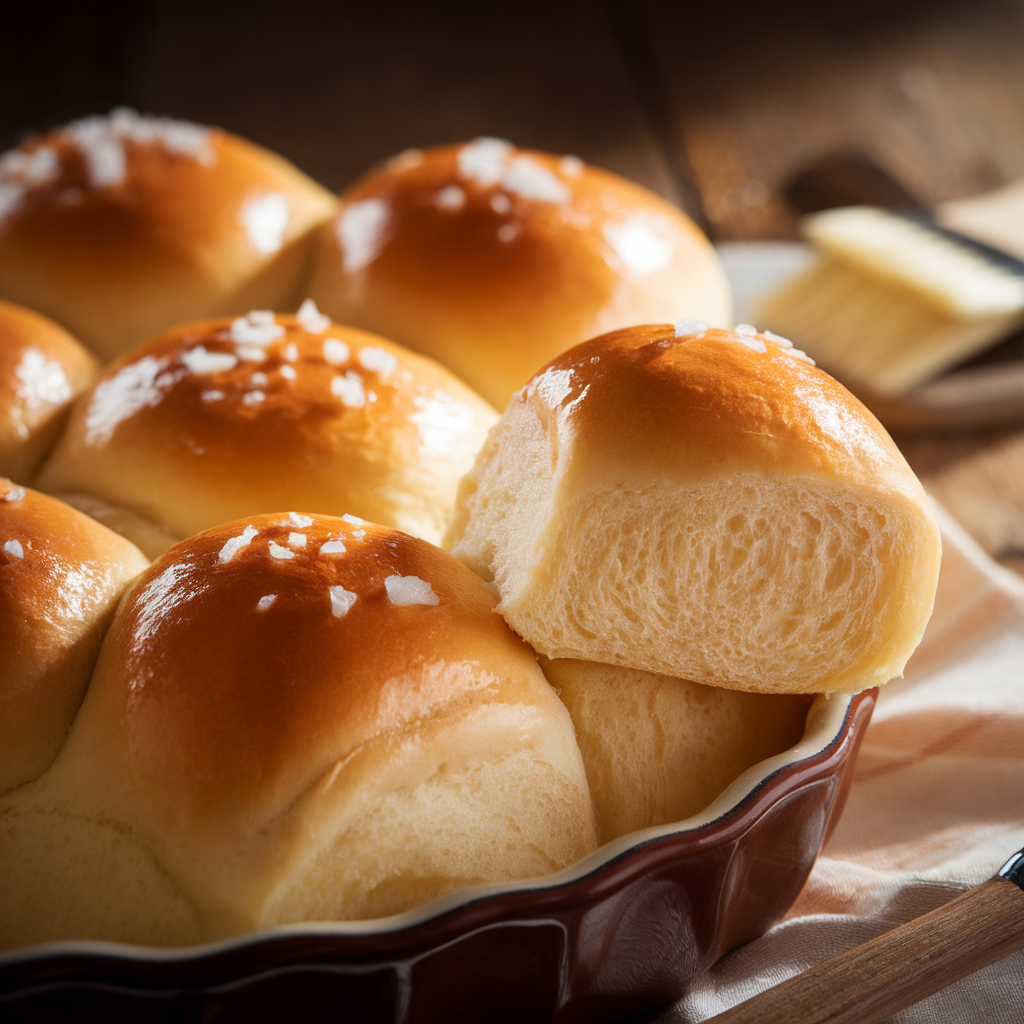
Are you searching for a dinner roll recipe that is so unbelievably soft, so rich with butter, and so effortlessly pillowy that it instantly steals the show from the main course? I know I am. For years, I made standard yeast rolls, and while nice, they lacked that signature Parker House Roll tenderness and rich flavor.
I’m here to tell you that mastering Homemade Parker House Rolls is simpler than you think, and the result is a truly extraordinary side dish. These are the original “pull-apart” rolls, famous for their unique folded shape and their incredible, almost cake-like tenderness.1 The secret? High-fat milk and a heavy dose of butter, both in the dough and brushed on the rolls. I love the simple elegance and the sheer indulgence of these rolls. Ready to ditch the bland dinner rolls and learn the secrets to the ultimate buttery, folded classic? Let’s get kneading!
🧈 The Buttery Blueprint: Ingredients for 16 Rolls
The rich, delicate texture of Parker House Rolls comes from using an enriched dough, meaning it has a high content of fat (butter) and dairy.2 This recipe makes 16 standard-sized rolls.
H3: The Enriched Dough Core
- 4 cups (480g) All-Purpose Flour: Provides the necessary structure.
- 1 cup (240ml) Whole Milk: Lukewarm, adds richness and tenderness.
- 1/2 cup (115g or 1 stick) Unsalted Butter: Melted and cooled for incorporating into the dough.3
- 1/4 cup (50g) Granulated Sugar: Feeds the yeast and adds sweetness.
- 1 large Egg: For richness and binding.
- 1 1/2 teaspoons (5g) Active Dry Yeast: The leavening agent.
- 1 teaspoon Salt: Controls fermentation and balances the richness.
H3: The Finishing Butter (The Essential Glaze)
- 4 tablespoons (56g or 1/2 stick) Unsalted Butter: Melted for brushing the baked rolls.
- 1/2 teaspoon Coarse Sea Salt: For sprinkling on top.
🥣 Part I: Mixing and Kneading the Rich Dough
Parker House dough is soft and enriched. It requires thorough kneading to develop a strong, elastic gluten structure capable of supporting the high content of butter and milk.4
H3: The Initial Mix
- Activate Yeast: In a large bowl, whisk together the lukewarm milk, sugar, and yeast. Let it sit for 5 to 10 minutes until foamy.
- Combine Wet Ingredients: Whisk the melted butter, salt, and egg into the yeast mixture.
- Add Flour: Gradually add the flour to the wet ingredients. Mix until a shaggy dough forms.
H3: The Essential Knead
- Knead Thoroughly: Turn the dough out onto a lightly floured surface (or use a stand mixer). Knead for 6 to 8 minutes. The dough should be smooth, elastic, and soft. Proper kneading is mandatory for the final tenderness.
- The Windowpane Test: Check if the dough passes the windowpane test—it should stretch thinly without tearing.
H3: The First Rise
- Bulk Fermentation: Place the dough in a lightly oiled bowl. Cover tightly and let it rise in a warm spot for 1 to 1.5 hours, or until it has doubled in size.
🔪 Part II: Shaping the Signature Fold (The How-To)
The Parker House Roll is defined by its unique folded shape, created by rolling the dough thinly and brushing it with butter before folding.5 This shape encourages them to tear apart perfectly.
H3: Roll, Cut, and Butter
- Punch Down and Rest: Gently punch the dough down to release the air. Turn it out onto a lightly floured surface and let it rest for 10 minutes.
- Roll and Square: Roll the dough out into a large rectangle, about 1/4 inch thick.
- Cut the Shapes: Use a round cookie cutter (about 2.5 to 3 inches) to cut out 16 dough rounds. Reroll the scraps and cut the remaining rolls.
- The Middle Crease: Place each round on a parchment-lined baking sheet. Gently press a deep crease just off-center across the middle of each round using the dull side of a knife or the edge of a spoon handle.
H3: The Final Fold and Butter Brush
- Melt Butter: Melt 2 tablespoons of the finishing butter.
- Brush and Fold (Crucial!): Brush the surface of the round with the melted butter (the side of the crease you want to fold). Fold the dough over onto itself along the crease line, pressing gently to seal. This classic fold makes the Parker House Roll famous!
♨️ Part III: Proofing and the Final Butter Glaze
We arrange the folded rolls closely together in the pan so they bake up touching—this creates the soft, “pull-apart” sides.
H3: The Close Proof
- Prep the Pan: Arrange the folded rolls closely together on a 9×13-inch baking dish (or two smaller dishes) lined with parchment paper. They should be just touching.
- Second Proof: Cover the dish loosely and let the rolls proof for 30 to 45 minutes. The rolls should look visibly puffy and be snuggly pressing against each other.
- Preheat and Bake: Preheat your oven to 375°F (190°C). Bake for 15 to 20 minutes. The rolls are ready when they are puffed, golden brown, and smell incredible.
H3: The Final Butter Bath (Mandatory!)
- The Immediate Glaze: Remove the rolls from the oven. While they are piping hot, immediately brush them generously with the remaining 2 tablespoons of melted butter and sprinkle with coarse sea salt. The butter soaks into the soft crust, making them irresistible.
🏆 Troubleshooting: Why Your Rolls Were Dry
The goal is an incredibly tender, moist roll. If your rolls came out dry, tough, or flat, here is what likely went wrong.
H3: Common Parker House Flaws
| Flaw | Probable Cause | Active Solution |
| Dry/Tough Rolls | Too much flour or Overbaked | Measure flour precisely; reduce kneading time; bake for max 20 mins. |
| Did Not Rise | Milk was too hot or Yeast was old | Ensure milk is lukewarm (105-115°F); check yeast activity before starting. |
| Tough Texture | Insufficient Fat | Use whole milk, not skim milk; use the full amount of butter specified in the recipe. |
| Uneven Folding | Skipped the middle crease | Press the crease deeply enough so the rolls hold their folded shape when baking. |
- Humor Note: Did you try to skip the final butter brush? Shame! That last coat of butter is what elevates them from good rolls to Parker House Rolls legend status!
🥇 The Secret History: Where the Roll Began
Parker House Rolls originated at the Parker House Hotel in Boston in the 1870s.6 The legend (which is hilarious, IMO) suggests the unique shape was created by a frustrated baker who threw a half-finished batch of rolls into the oven, causing them to fold over!7
H3: Enriched Dough vs. Water Dough
- Enriched Dough: Contains high levels of fat (butter), sugar, and dairy, resulting in a soft, tender, and moist crumb.8 This prevents the rolls from drying out quickly.
- Water Dough: Typically results in a crustier exterior and a chewier interior (like a baguette).
- Key Takeaway: The extra fat in Parker House Rolls makes them the perfect dinner companion because they remain soft even when cool.
🍽️ Serving Suggestions: The Ultimate Dinner Companion
Parker House Rolls are mandatory for Thanksgiving, Christmas, or any grand family meal, but they work beautifully with a simple weeknight soup, too.
- Holiday Staple: Serve warm alongside roast turkey, glazed ham, or prime rib.
- The Sop: They are the perfect roll for soaking up savory gravy or the remnants of a beef stew sauce.
- The Sandwich: Use leftover rolls for small, elegant ham and cheese sliders.
📊 Nutritional Information (Per Roll)
This information is based on the full recipe yielding 16 rolls. These are rich, satisfying, and buttery rolls. 🧈🔥
| Nutrient | Amount (Per Roll) |
| Calories 🔥 | 210 kcal |
| Total Fat 🧈 | 9 g |
| Saturated Fat | 5 g |
| Sodium | 190 mg |
| Total Carbs | 28 g |
| Fiber | 1 g |
| Protein | 5 g |
🎉 Conclusion: The Buttery Pull-Apart Perfection
You successfully created an exquisite batch of Parker House Rolls. You mastered the enriched dough, the unique folded shape, and the crucial double butter brush (in the middle and on top!). You now possess the secret to the softest, most buttery dinner roll legend.
Remember the golden rule: Don’t skip the final butter brush! It’s the crown for the Queen of Rolls.
Now that you’ve mastered the pull-apart roll, are you making these for a holiday dinner or using the leftovers for tiny sliders? 🎯