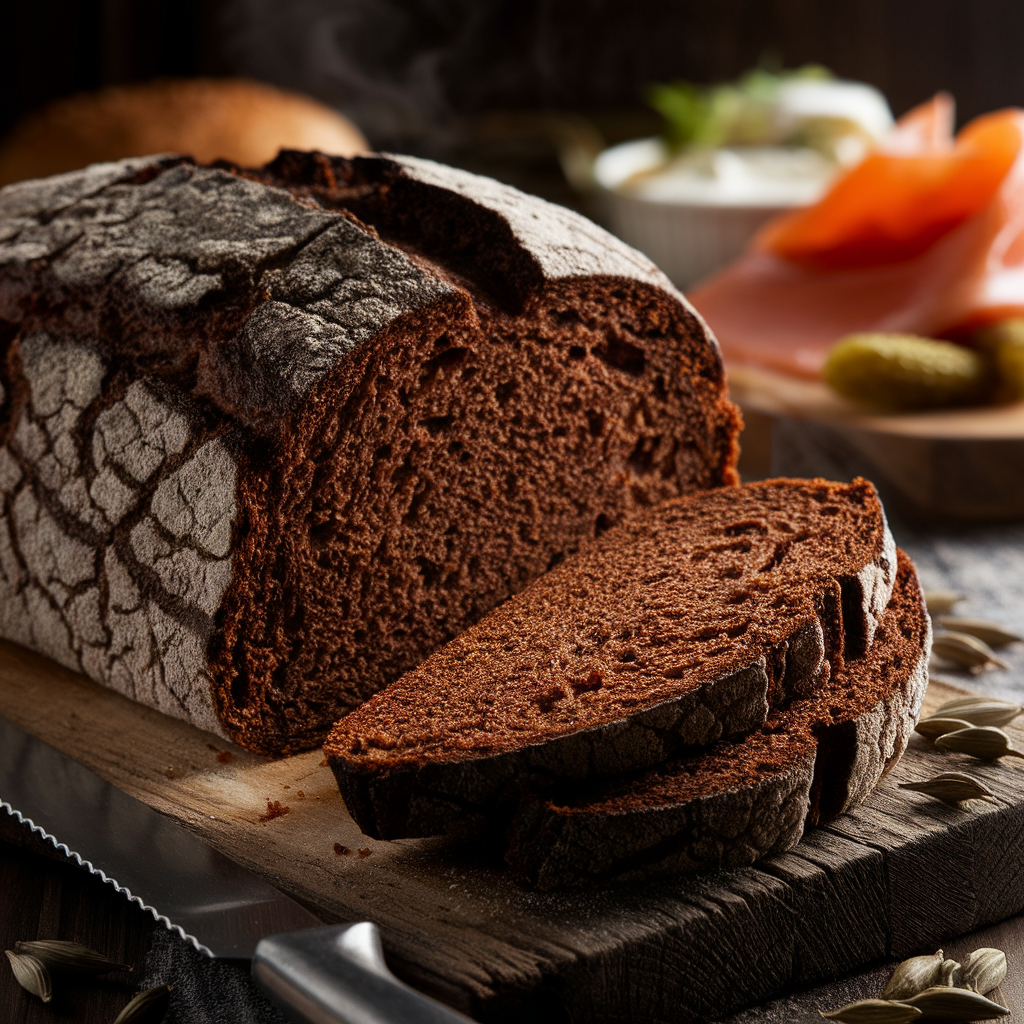
Are you searching for a loaf of bread that offers incredible depth of flavor, a dense, moist crumb, and a connection to centuries of European baking tradition? I am, especially when I crave a sturdy base for salty meats or smoked fish. For years, I thought Pumpernickel Bread was just dark, dry rye bread, assuming the store-bought versions were the best I could do. I was wrong.
I’m here to tell you that mastering Homemade Pumpernickel Bread is a slow-burn labor of love that rewards you with an incredibly rich, sweet-and-sour loaf. True Pumpernickel is a German classic, often steamed or baked at low temperatures for up to 24 hours.1 This slower, simplified method captures that intense, malty, earthy flavor and signature moist crumb. I love how the dark color and complex flavor instantly elevate a simple sandwich. Ready to ditch the fake dyes and learn the secrets to the ultimate dark rye bread? Guten Appetit! (Enjoy your meal!)
🖤 The Westphalian Secret: Ingredients for One Rich Loaf
The signature qualities of Pumpernickel Bread—its dark color, deep flavor, and moist crumb—come from the coarse rye flour, the molasses/caramel color, and a long, slow process. This recipe makes one standard 9×5-inch loaf (about 12 slices).
H3: The Core Rye Dough
- 2 cups (240g) Medium or Dark Rye Flour: Rye flour is mandatory! It gives the bread its distinct flavor and dense texture.
- 1 1/2 cups (180g) Bread Flour (or All-Purpose Flour): Used to supplement the rye, which is low in gluten, to provide necessary structure.
- 1 1/2 cups (360ml) Warm Water: Activates the yeast and hydrates the coarse rye flour.
- 1 tablespoon Active Dry Yeast: The leavening agent.
- 1 1/2 teaspoons Salt: Controls fermentation and balances the sweetness.
H3: The Color and Flavor Darkeners (Crucial!)
- 1/4 cup (80g) Molasses (or Blackstrap): Essential for color, moisture, and deep, malty flavor.
- 2 tablespoons Cocoa Powder (Unsweetened): Enhances the dark color without adding significant chocolate flavor.
- 1 tablespoon Instant Coffee or Espresso Powder: Deepens the earthy, dark flavor.
- 1 tablespoon Caraway Seeds: Traditional and non-negotiable for that classic, sharp, savory rye flavor.
🥣 Part I: Hydration and Flavor Infusion
Rye flour behaves very differently from wheat flour.2 It requires extra liquid and a quick process to prevent the final loaf from becoming overly dense and gummy.
H3: The Rye Soak (Sponge)
- Activate Yeast: In a large bowl, whisk together the warm water and molasses. Sprinkle the yeast over the top and let it sit for 5 to 10 minutes until foamy.
- Add Rye Flour: Stir in the rye flour. Mix until a shaggy sponge forms. Let this sponge rest for 20 minutes. This soak is vital; it allows the coarse rye flour to fully hydrate before kneading.
H3: Mixing the Heavy Dough
- Add Remaining Ingredients: Stir in the bread flour, salt, cocoa powder, coffee powder, and caraway seeds. Mix until a shaggy dough forms.
- Knead Gently: Turn the dough out onto a lightly floured surface (or use a stand mixer). Knead for only 5 to 7 minutes. Rye dough should be kneaded less than wheat dough. Over-kneading rye activates too much starch, resulting in a gummy crumb. Knead until smooth and slightly sticky.
☀️ Part II: The Single Rise and Shaping (Rye Specifics)
Rye dough does not rise as dramatically as wheat dough.3 We expect a slower, denser rise and use a tight shaping technique for the best loaf structure.
H3: Bulk Fermentation
- First Rise (Slow and Low): Place the dough in a lightly oiled bowl. Cover tightly and let it rise in a warm spot for 1.5 to 2 hours, or until it has increased in size by about 50%. Rye dough will not double!
- Punch Down: Gently punch the dough down to release the air. Turn it out onto a clean, lightly floured surface.
H3: Shaping for the Pan (The Tight Roll)
- Roll and Flatten: Gently flatten the dough into a rough rectangle. Fold the dough into thirds like a letter. Turn it 90 degrees.
- The Tight Roll: Starting from the top, roll the dough tightly into a cylinder. Pinch the seam closed tightly. A tight final roll is essential for supporting the heavy rye dough during the final rise.
- Place in Pan: Place the dough log, seam-side down, into a lightly greased 9×5-inch loaf pan.
♨️ Part III: Baking for Moisture and Darkness
To capture the moist, dense crumb of true Pumpernickel Bread, we use a slightly lower temperature and a longer bake time than typical sandwich bread.
H3: Final Proof and Bake
- Second Proof: Cover the loaf pan loosely. Let the dough rise in a warm spot for 45 minutes to 1 hour. The dough should crest just above the rim of the pan.
- Bake Low and Slow: Preheat your oven to 350°F (175°C).4 Bake for 40 to 45 minutes. The crust should be dark and firm.
- Check Doneness: The Pumpernickel Bread is done when the internal temperature reaches 200°F (93°C).
- Cooling (Crucial): Immediately remove the loaf from the pan and transfer it to a wire rack. Let it cool completely for at least 2 hours before slicing. Slicing Pumpernickel warm results in a gummy, wet interior.
🏆 Troubleshooting: Why Your Pumpernickel is Gummy
The greatest challenge with Dark Rye Bread is preventing a gummy or excessively sticky crumb. This is a direct result of improper handling of the rye flour.
H3: Common Pumpernickel Flaws
| Flaw | Probable Cause | Active Solution |
| Gummy/Wet Crumb | Over-kneading (Activating starch) or Sliced too soon | Knead gently for max 7 mins; Wait 2+ hours to slice; ensure rye flour is well-hydrated. |
| Loaf is Too Dense | Insufficient hydration or Under-proofed | Ensure the rye sponge rests fully; allow the dough to rise for the full time. |
| Light Color | Used light molasses or Skipped cocoa powder | Use dark molasses and the cocoa powder; the dark color is part of the tradition. |
| Lacking Rye Flavor | Used Caraway Seeds | Use the full amount of caraway seeds; they provide the classic savory bite. |
- Humor Note: Did you try to slice the bread while it was warm? If the knife got sticky, you sliced too soon! Patience is the Westphalian secret.
🥇 The Rye Factor: Gluten vs. Starch
Rye flour is low in gluten compared to wheat flour.5 Its structure relies more on its starch content, which is why we treat the dough gently and avoid excessive kneading.
H3: Rye’s Unique Structure
- Lower Gluten: Rye creates fewer gluten bonds, which results in the signature dense, tight crumb of Pumpernickel.
- Starch Content: Rye starch has a high water absorption capacity. Over-mixing the rye damages the starch structure, releasing too much moisture, which leads to that undesirable gummy texture.
🍽️ Serving Suggestions: Perfect Pairings
Pumpernickel Bread is rich, hearty, and pairs beautifully with savory, sharp, and smoky flavors.6
- Classic Pairings: Serve with smoked salmon, cream cheese, sharp cheddar, or liver pâté.
- Sandwiches: Perfect for hearty Reuben or pastrami sandwiches.7
- Soup Companion: The dense crumb is ideal for soaking up the broth from Goulash or Split Pea Soup.
📊 Nutritional Information (Per Serving)
This information is based on the full recipe yielding 1 loaf (12 slices). Pumpernickel is high in fiber and low on the glycemic index due to the rye grain.8 🍞🔥
| Nutrient | Amount (Per Slice) |
| Calories 🔥 | 180 kcal |
| Total Fat 🧈 | 4 g |
| Saturated Fat | 2 g |
| Sodium | 290 mg |
| Total Carbs | 35 g |
| Fiber | 4 g |
| Protein | 5 g |
🎉 Conclusion: The Triumph of the Dark Loaf
You successfully invested the time and care to create a rich, moist, and deeply flavorful Pumpernickel Bread (Dark Rye). You mastered the crucial steps of the rye sponge soak, gentle kneading, and the long, slow bake. You now possess the secret to a true European baking masterpiece.
Remember the golden rule of Pumpernickel: Handle it gently, and let it cool completely!
Now that you’ve mastered the dark rye, are you slicing your loaf for smoked salmon and cream cheese or a classic Reuben sandwich? 🎯