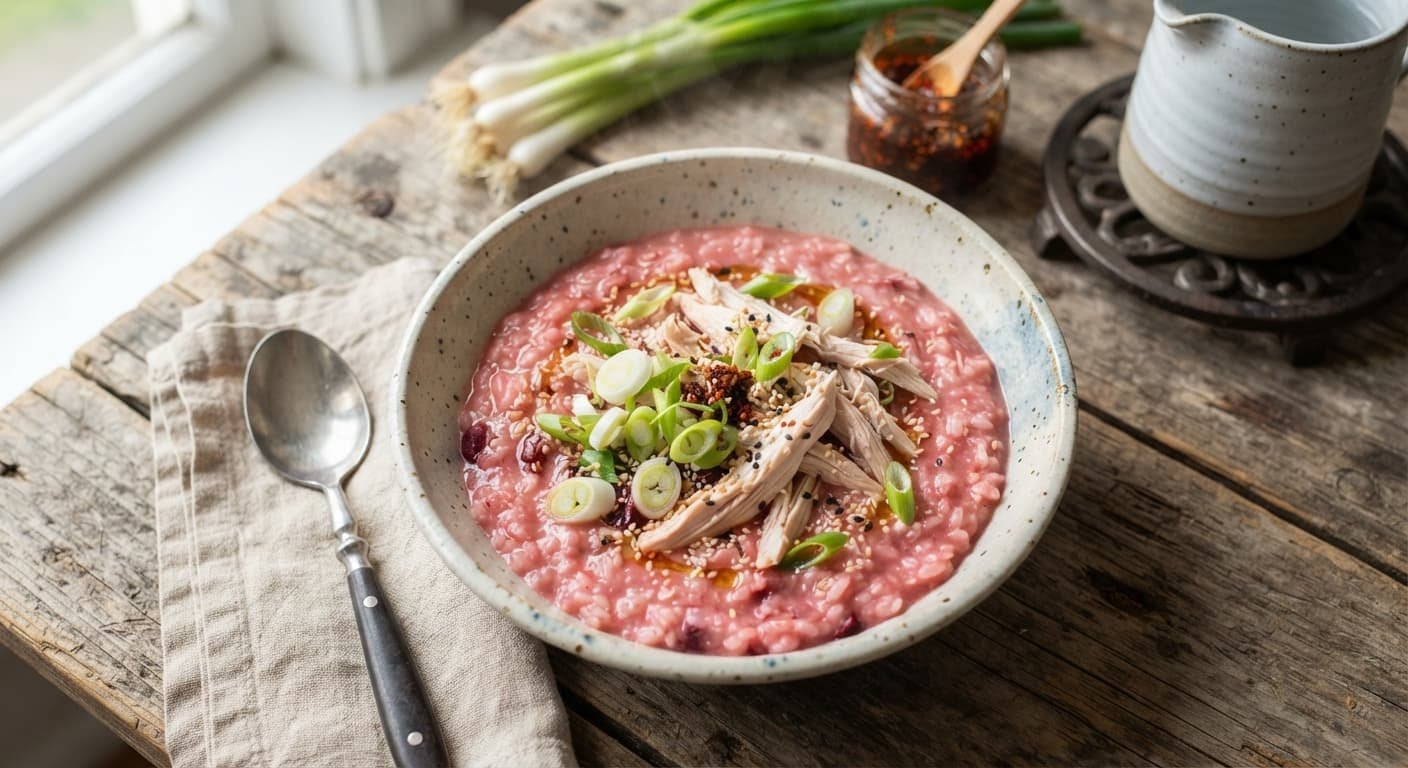
Congee gets its signature creaminess from a process happening at the level of individual starch granules: as rice simmers in a large volume of liquid for an hour or more, water works its way into each grain, causing it to swell and eventually rupture, releasing starch molecules into the surrounding broth. Chicken and Beets Congee with Gochujang leans on that same slow starch breakdown, just with beets added early enough to bleed their color and sweetness into the rice as it cooks, and a spoonful of gochujang stirred in at the end for heat and depth.
Chicken congee is one of the most common versions of this dish across Chinese, Vietnamese, and Korean cooking, and Korean-style juk specifically is often finished with gochujang for exactly the kind of savory heat this recipe uses. Root vegetables like pumpkin or sweet potato are a familiar addition to congee in several regional traditions, which is what makes beets a reasonable, logical swap here rather than an invented pairing.
Key Techniques for Chicken and Beets Congee with Gochujang
This congee takes about 60 to 70 minutes, most of it unattended simmering. Rice starch begins gelatinizing around 140°F (60°C) and keeps breaking down the longer it simmers, which is why congee needs a long, gentle cook rather than a hard boil that breaks grains apart unevenly.
Beets contain betalains, water-soluble pigments that leach readily into any liquid they’re cooked in, which is exactly why they turn congee a deep pink-red rather than staying contained in their own pieces the way a less pigmented vegetable would. Stirring the beets in early, alongside the rice, lets that color develop evenly through the whole pot rather than pooling only around the vegetable itself. Gochujang, on the other hand, is a fermented paste whose flavor compounds are heat-sensitive enough that prolonged simmering dulls its complexity, so it’s stirred in only at the very end, off or near the heat, to preserve its full character.
Ingredients
This serves 4.
For the Congee
- 1 cup short-grain or jasmine rice, rinsed until the water runs mostly clear
- 8 cups chicken stock
- 1 lb (about 450g) boneless, skinless chicken thighs
- 2 medium beets, peeled and cut into 1/2-inch cubes
- 1-inch piece ginger, thinly sliced
- 1 teaspoon salt, plus more to taste
For Finishing
- 2 to 3 tablespoons gochujang (Korean red chili paste)
- 2 scallions, thinly sliced
- 1 tablespoon toasted sesame oil
- Toasted sesame seeds, for serving
How to Make Chicken Congee with Beets and Gochujang
- Combine the rinsed rice, chicken stock, chicken thighs, beets, ginger, and salt in a large pot. Bring to a boil over high heat.
- Reduce heat to low so the mixture holds a gentle simmer, not a boil. Cover partially and cook for 45 minutes, stirring every 10 minutes or so to prevent sticking.
- After 30 minutes, check the chicken; remove it once cooked through, shred it with two forks, and set aside.
- Continue simmering the rice and beets for the remaining time, until the congee has thickened to a creamy, porridge-like consistency and the beets are fully tender.
- Return the shredded chicken to the pot and stir to combine. Remove from heat.
- Stir in the gochujang a tablespoon at a time, tasting as you go, until the heat and depth suit your preference.
- Ladle into bowls and finish with sliced scallions, a drizzle of sesame oil, and a scatter of sesame seeds.
Good vs. Excellent: The Details That Matter
A good bowl of this congee still tastes fine. An excellent one comes down to a handful of specific calls.
- Rinse the rice until the water runs mostly clear. Skipping this leaves excess surface starch that can make the finished congee gluey rather than smoothly creamy.
- Keep the simmer gentle, not rolling. A hard boil breaks rice grains apart unevenly and can scorch the bottom of the pot before the center thickens properly.
- Add the gochujang off the heat, gradually. Dumping it all in at once risks oversalting and dulls its flavor if the pot is still at a hard simmer.
- Cut the beets small and even. Uneven pieces mean some turn mushy while others stay firm by the time the rice has broken down properly.
Troubleshooting Common Problems
Why is my congee too thin? It likely hasn’t simmered long enough for the starch to fully break down. Continue cooking uncovered for another 10 to 15 minutes, stirring occasionally, and it will thicken as more liquid evaporates and more starch releases.
Why did it turn gluey instead of creamy? This usually traces back to unrinsed rice or too little liquid relative to rice. Rinse thoroughly next time, and don’t hesitate to add more hot stock or water if the pot looks too thick partway through.
Why does the gochujang taste flat instead of sharp? It was probably stirred in too early and simmered too long, which mutes its fermented complexity. Add it only in the final few minutes, closer to serving than to the start of cooking.
Variations and Substitutions
Bone-in chicken thighs work well in place of boneless, and actually add more flavor to the broth as they simmer, though they’ll need to be removed and the bones discarded before shredding. Pumpkin or sweet potato can replace the beets for a milder color and sweeter flavor, using the same cooking time, making a fine gochujang chicken congee with beets alternative for anyone who wants a less earthy vegetable.
For a vegetarian version, vegetable stock and a firm tofu added in the last 10 minutes of cooking work in place of the chicken, though the broth will taste noticeably lighter. If gochujang isn’t available, a mix of miso paste and a pinch of chili flakes approximates some of its savory heat, though the flavor won’t be identical.
Serving and Pairing
This congee is filling enough on its own, but a side of quick-pickled cucumber or radish adds welcome crunch and acidity against the soft rice. A soft-boiled egg spooned on top turns it into an even heartier meal. Extra gochujang and sesame oil at the table let everyone adjust richness and heat to their own taste.
Storage and Reheating
Store leftovers in an airtight container in the refrigerator for up to 3 days. Congee thickens considerably as it cools, so reheat gently on the stovetop with a splash of water or stock stirred in to loosen it back to a spoonable consistency. This dish freezes reasonably well for up to a month, though the texture softens slightly further once thawed and reheated.
Nutritional Information
Values below are estimates per serving and will vary depending on exact brands and quantities used.
| Calories | 315 kcal |
| Protein | 26 g |
| Carbohydrates | 38 g |
| Fat | 7 g |
| Fiber | 3 g |
Final Thoughts
This recipe was tested and refined in the bebup.org kitchen, including several rounds spent specifically on timing the gochujang addition so its flavor stays sharp rather than muted.
Chicken and Beets Congee with Gochujang rewards patience more than any special skill — the rice needs its full hour to break down properly, and rushing that process is the one shortcut that never actually pays off. Once the technique is down, the color and heat can be adjusted endlessly, but the basic starch science underneath stays exactly the same bowl after bowl.
Mastering the Technique
The skill that carries over from this dish to congee-making generally is reading the pot rather than the clock. Starch gelatinization doesn’t happen on a fixed schedule; it depends on rice variety, pot size, and how gentle the simmer actually is, so the same recipe can take 45 minutes in one kitchen and closer to 70 in another. Learning to judge doneness by texture — does a spoonful hold its shape and fall slowly off the spoon, rather than running thin like soup — transfers directly to any congee variation, whatever vegetables or proteins end up in the pot.
Chicken and Beets Congee with Gochujang
Ingredients
Method
- Combine the rinsed rice, chicken stock, chicken thighs, beets, ginger, and salt in a large pot. Bring to a boil.
- Reduce heat to low for a gentle simmer. Cover partially and cook 45 minutes, stirring every 10 minutes.
- After 30 minutes, remove the chicken once cooked through, shred with two forks, and set aside.
- Continue simmering the rice and beets until thickened to a creamy consistency and the beets are tender.
- Return the shredded chicken to the pot and stir to combine. Remove from heat.
- Stir in the gochujang a tablespoon at a time, tasting as you go.
- Ladle into bowls and finish with scallions, sesame oil, and sesame seeds.