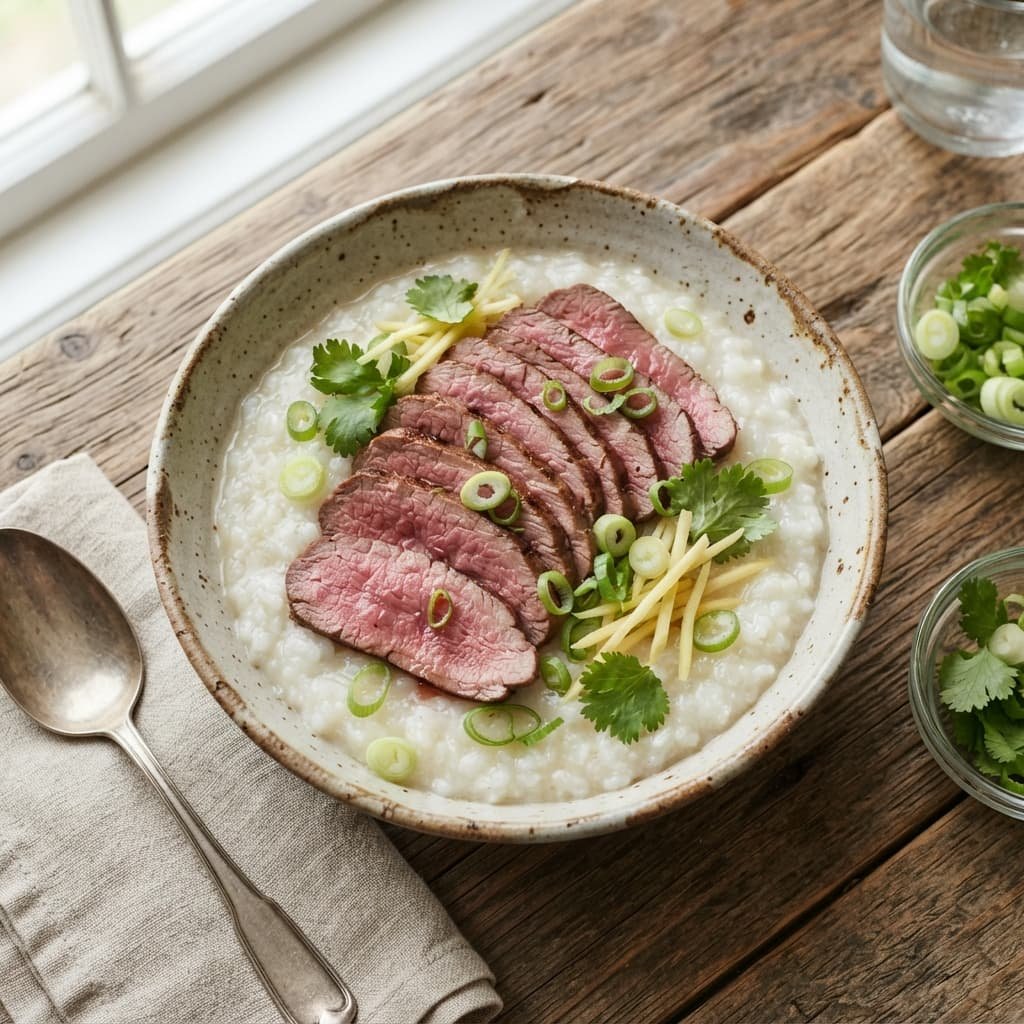
Lean venison goes from tender and rosy to dry and livery across a very narrow band of temperature, a few degrees in either direction. A grill or skillet cannot hold that band, because the outside is always much hotter than the center. A water bath can: held at one steady temperature, the whole piece of meat reaches the same doneness from edge to center and cannot overshoot. Winter Sous Vide Venison Congee uses that precision for the meat and the opposite approach, a long, slow simmer, for the rice, then brings them together in one warming bowl.
Sous vide is a documented and well-liked method for venison backstrap, often at 52 to 55°C (125 to 131°F) followed by a quick sear. Congee topped with thin slices of cooked meat, such as beef, is a classic in Cantonese home cooking. This recipe combines the two, with ginger, white pepper, and scallions for a winter bowl that is deeply warming and clean-tasting.
| Prep Time | 20 minutes |
| Cook Time | 2 hours (venison and congee cook at the same time) |
| Total Time | 2 hours 20 minutes |
| Servings | 4 |
| Difficulty | Moderate, needs a sous vide cooker |
Key Techniques for Sous Vide Venison and Congee
The venison cooks for 1 1/2 to 2 hours in a bath at 55°C (131°F) while the congee simmers for about 60 minutes. Sear the meat for 1 minute per side in a very hot pan, slice it thin, and add it to the congee at the table, so it stays rosy.
Sous vide works by heating a sealed bag in water held at a precise temperature. The center of a backstrap about 1.5 inches (4cm) thick takes close to two hours to reach the bath temperature, and holding it there tenderizes the meat without overshooting. A brief sear on a dry, very hot pan afterward browns the surface through the Maillard reaction, which the low-temperature bath cannot do, and it takes only about a minute per side, so the interior stays rosy.
The congee is the opposite kind of cooking. Rice simmered in about eight times its volume in liquid swells, bursts, and releases starch, which thickens the liquid into a smooth porridge. Stirring from the bottom prevents scorching. Keeping the venison out of the pot until serving is deliberate: simmering it in the congee would cook it far past medium-rare.
Ingredients
This serves 4.
For the Sous Vide Venison
- 12 oz (340g) venison backstrap or loin, silverskin removed, in 1 or 2 whole pieces
- 1 teaspoon kosher salt
- 1/2 teaspoon black pepper
- 2 slices fresh ginger
- 1 tablespoon (15ml) neutral oil, for searing
For the Congee
- 1 cup (200g) jasmine rice, rinsed
- 8 cups (1.9L) low-sodium chicken or vegetable broth, plus hot water as needed
- 3 slices fresh ginger
- 1 teaspoon salt, or to taste
- 1/2 teaspoon white pepper
For Serving
- 3 scallions, thinly sliced
- 1-inch (2.5cm) piece fresh ginger, cut into fine matchsticks
- 2 tablespoons (30ml) soy sauce
- 2 teaspoons toasted sesame oil
- 1/4 cup (10g) cilantro leaves
How to Make Sous Vide Venison Congee
- Heat a water bath with a sous vide cooker to 55°C (131°F) for medium-rare. Pat the venison dry, season with salt and pepper, and seal in a bag with the ginger, using a vacuum sealer or the water-displacement method.
- Lower the bag into the bath and cook for 1 1/2 to 2 hours, until the center reaches the bath temperature. For safety, cook for at least 1 1/2 hours.
- About 70 minutes before the venison is done, combine the rice, broth, and ginger slices in a large pot and bring to a boil. Reduce to a gentle simmer with the lid slightly ajar.
- Simmer for 60 minutes, stirring from the bottom every 8 to 10 minutes, until the grains have burst and the congee looks creamy and coats the back of a spoon. Add hot water if it thickens too much. Remove the ginger, then season with salt and white pepper.
- Remove the venison from the bag and pat it very dry with paper towels. Heat the oil in a cast-iron skillet over high heat until it just begins to smoke.
- Sear the venison for about 1 minute per side, until a deep brown crust forms, with a loud sizzle. Transfer to a cutting board and rest for 3 minutes.
- Slice the venison across the grain into thin slices, about 1/4 inch (6mm) thick. The center should look evenly rosy from edge to edge.
- Ladle the hot congee into bowls and fan the slices over the top. Finish with scallions, ginger matchsticks, a drizzle of soy sauce and sesame oil, and cilantro.
Good vs. Excellent: The Details That Matter
- Remove the silverskin. It will not soften and makes slices chewy.
- Keep the cut whole in the bag. Pieces cut up before cooking lose juices and cook unevenly.
- Dry the meat before searing. Surface moisture slows browning and overcooks the outer layer.
- Slice thin and across the grain. Thin slices warm quickly in the congee without cooking through.
- Season the congee boldly. Plain rice needs more salt than seems reasonable.
Troubleshooting Common Problems
Problem: The venison was gray and dry. Cause: the bath was too hot, or the sear lasted too long. Solution: check the bath with a separate thermometer, and sear for no more than 1 minute per side.
Problem: The venison looked pale after searing. Cause: it was wet or the pan was not hot enough. Solution: pat dry thoroughly and wait until the oil smokes lightly.
Problem: The congee scorched. Cause: the starch settled at the bottom and burned. Solution: stir from the bottom, keep the simmer gentle, and do not scrape any burnt layer into the pot.
Problem: The congee was too thick or too thin. Cause: the ratio of liquid to rice was off or it was cooked for too short a time. Solution: add hot water to loosen, or simmer longer, stirring often, to thicken.
Mastering the Technique
The idea that carries over is matching the cooking method to how forgiving the food is. Lean, tender cuts such as venison, duck breast, and pork tenderloin reward precise, low, steady heat. Tough, collagen-rich cuts reward long cooking. Rice sits in its own category, rewarding time and stirring. Choosing the right method for each component, rather than cooking everything the same way, is what lets a single bowl have such different textures.
A useful check at the end of sous vide cooking is the slice test: a properly cooked backstrap should be evenly pink from the crust to the middle, with no gray band beneath the sear.
A Note on Food Safety
The USDA recommends 63°C (145°F) for whole cuts of meat. Cooking at 55°C (131°F) for an extended time is a common sous vide practice, but it sits below that figure and relies on time at temperature plus searing the surface. Pregnant women, older adults, young children, and anyone with a weakened immune system should raise the bath to 63°C (145°F), which gives a firmer, less rosy result, and should eat the dish promptly. Use clean, fresh game meat that was handled and chilled properly after the hunt.
Variations, Substitutions, and Serving
Beef tenderloin or sirloin, duck breast, or lamb loin can replace venison, with adjusted bath temperature. Brown rice makes a nuttier, thicker congee but needs about 30 minutes longer. A soft-boiled egg, fried shallots, or a spoonful of chili crisp make good additions. Leftover rice can shorten the congee: simmer about 2 cups (300g) cooked rice in 5 cups (1.2L) broth for 20 to 25 minutes.
Serve piping hot in wide bowls. A side of quick-pickled cucumbers or blanched greens brings freshness. Hot tea suits the dish better than heavier drinks. Let each person add soy sauce, sesame oil, and white pepper at the table.
Storage and Reheating
Refrigerate the congee and venison separately within 2 hours. The congee keeps for up to 3 days and thickens considerably; loosen it with hot water when reheating, stirring until smooth and hot. The seared, sliced venison keeps for up to 2 days and should be served cold or added to hot congee off the heat just before eating, to avoid overcooking. The congee freezes well for up to 2 months without the meat.
Nutritional Information
Values below are estimates per serving and will vary depending on exact brands and quantities used.
| Calories | 400 kcal |
| Protein | 31 g |
| Carbohydrates | 50 g |
| Fat | 8 g |
| Fiber | 1 g |
Frequently Asked Questions
Can I make the venison without a sous vide cooker? Yes, but the result is less even. Sear the backstrap in a hot pan and finish in a 150°C (300°F) oven until it reads 54°C (130°F) in the center, then rest it for 5 minutes.
Can I use frozen venison? Yes. Add about 30 to 60 minutes to the bath time for frozen backstrap, and season after cooking if needed.
Why not cook the venison in the congee? Simmering would take the meat well past medium-rare, leaving it dry and chalky. Adding thin slices at the end only warms them.
Winter Sous Vide Venison Congee is a dish of two tempos: a patient, precise bath for the lean meat and a slow, steady simmer for the rice. Bringing them together at the last moment gives a bowl of silky porridge topped with rosy, tender slices, and a well-earned warmth on a cold night.
Winter Sous Vide Venison Congee
Ingredients
Method
- Heat a water bath with a sous vide cooker to 55°C (131°F) for medium-rare. Pat the venison dry, season with salt and pepper, and seal in a bag with the ginger, using a vacuum sealer or the water-displacement method.
- Lower the bag into the bath and cook for 1 1/2 to 2 hours, until the center reaches the bath temperature. For safety, cook for at least 1 1/2 hours.
- About 70 minutes before the venison is done, combine the rice, broth, and ginger slices in a large pot and bring to a boil. Reduce to a gentle simmer with the lid slightly ajar.
- Simmer for 60 minutes, stirring from the bottom every 8 to 10 minutes, until the grains have burst and the congee looks creamy and coats the back of a spoon. Add hot water if it thickens too much. Remove the ginger, then season with salt and white pepper.
- Remove the venison from the bag and pat it very dry with paper towels. Heat the oil in a cast-iron skillet over high heat until it just begins to smoke.
- Sear the venison for about 1 minute per side, until a deep brown crust forms, with a loud sizzle. Transfer to a cutting board and rest for 3 minutes.
- Slice the venison across the grain into thin slices, about 1/4 inch (6mm) thick. The center should look evenly rosy from edge to edge.
- Ladle the hot congee into bowls and fan the slices over the top. Finish with scallions, ginger matchsticks, a drizzle of soy sauce and sesame oil, and cilantro.