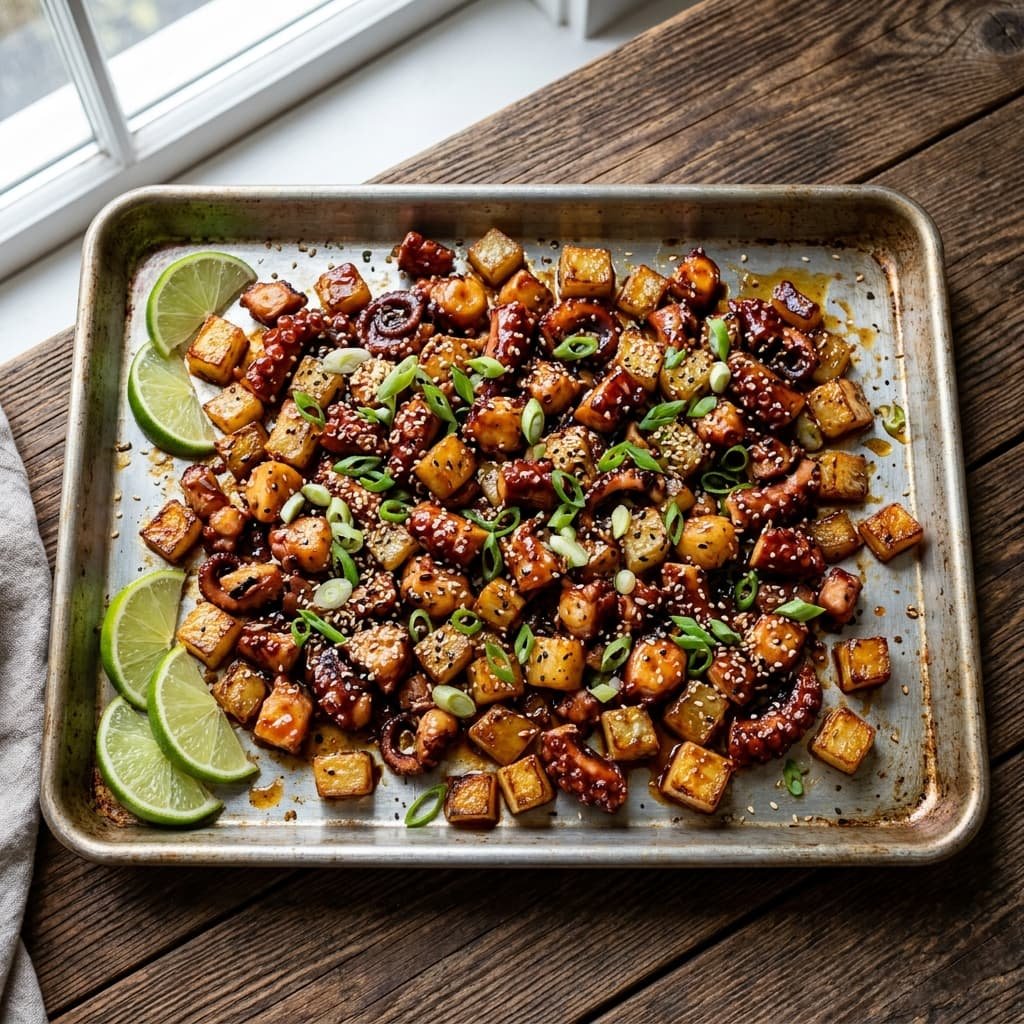
Octopus is mostly muscle laced with connective tissue, and that tissue is the reason it turns rubbery when cooked fast and hot. It softens only with long, gentle, moist heat. That one fact shapes this sheet pan octopus with kohlrabi and gochujang: the tenderizing happens first, in a pot of barely simmering water or in a package that did it for you, and the sheet pan comes second, doing only what a hot oven does well, which is to warm, char, and glaze.
A note on what is documented and what is a variation. Poaching octopus until tender and then finishing it over high heat is a standard approach, and a published method uses a bare simmer for 1 hour to 1 hour 15 minutes. Roasting kohlrabi in a hot oven is also well documented. Putting the two on one sheet pan with a gochujang glaze is my own adaptation, so the oven timings below are untested in your oven and should be judged by sight.
| Prep Time | 15 minutes (with cooked octopus) |
| Cook Time | 30 minutes |
| Total Time | 45 minutes (add about 1 1/2 hours if you poach raw octopus) |
| Servings | 4 |
| Difficulty | Easy with cooked octopus, moderate from raw |
How Long Does Sheet Pan Octopus Take, and Why Cook It Twice?
Sheet pan octopus with kohlrabi and gochujang takes about 45 minutes when you start with cooked octopus. Roast the kohlrabi at 220°C (425°F) for about 15 minutes, add the octopus for 10 more, then brush on the gochujang glaze for the last 4 minutes.
Cooking octopus twice sounds like extra work, but each pass has one job. The first, a long gentle simmer, softens the connective tissue. The second, a short blast of oven heat, adds color and flavor to the surface. Try to do both at once on a sheet pan from raw, and the outside will toughen long before the inside is tender.
The test for the first pass is a knife. When a paring knife slides easily into the thickest part, where the head meets the tentacles, the octopus is ready to be cooled and roasted. Precooked tentacles, sold frozen or vacuum-packed, have already been through this step, which makes this a very manageable dinner.
Ingredients
For the sheet pan
| Cooked octopus tentacles thawed if frozen | 1 1/2 lb (680 g) |
| Kohlrabi peeled, cut into 1/2-inch (1.3 cm) pieces | 3 medium bulbs (about 680 g) |
| Neutral oil | 2 tbsp (30 ml) |
| Salt cooked octopus is already salty | 1/2 tsp (3 g) |
For the gochujang glaze
| Gochujang | 3 tbsp (about 55 g) |
| Honey | 1 tbsp (21 g) |
| Soy sauce | 1 tbsp (15 ml) |
| Rice vinegar | 1 tbsp (15 ml) |
| Toasted sesame oil | 1 tsp (5 ml) |
| Garlic cloves grated | 2 |
| Warm water to loosen | 1 tbsp (15 ml) |
To finish
| Sliced green onions | 2 tbsp (12 g) |
| Sesame seeds | 1 tsp (3 g) |
| Lime wedges | 4 |
Starting from raw? Use a cleaned octopus of about 2 1/2 lb (1.1 kg), which will shrink as it cooks. That yield is my estimate, and sizes vary, so buy a little extra. You will also need water to cover, a few smashed garlic cloves, 2 bay leaves, a halved lemon, and 2 tbsp (36 g) of salt for the poaching liquid.
How to Make Sheet Pan Octopus with Kohlrabi and Gochujang
- If starting from raw, poach the octopus (1 hour to 1 hour 15 minutes). Bring the poaching liquid to a boil, dip the octopus in and out three times so the tentacles curl, then submerge it and keep the water at a bare simmer. Weigh it down with a small heatproof plate if it bobs up. It is ready when a paring knife slides in easily at the thickest part. Turn off the heat, let it sit in the liquid for 15 minutes, then cool it on a board. Skip this step if your octopus is already cooked.
- Heat the oven. Place a rack in the middle and heat the oven to 220°C (425°F). Line a large sheet pan with parchment.
- Prep the kohlrabi (about 10 minutes). Cut off the stems and roots, peel off the tough outer skin with a vegetable peeler, and cut the bulbs into 1/2-inch (1.3 cm) pieces. Toss them with the oil and salt, and spread them in a single layer with space between pieces.
- Roast the kohlrabi (15 minutes). The pieces should begin to turn golden at the edges and smell sweet and nutty.
- Mix the glaze and dry the octopus. While the kohlrabi roasts, whisk the gochujang, honey, soy sauce, vinegar, sesame oil, garlic, and warm water until smooth. Cut large tentacles into 3-inch (7.5 cm) pieces and pat everything very dry with paper towels. Dry octopus chars. Wet octopus steams.
- Add the octopus (10 minutes). Push the kohlrabi aside and add the octopus to the pan. Roast until the tentacle tips look darker and slightly crisp and the thicker parts are hot.
- Glaze (about 4 minutes). Brush the octopus with about half of the glaze and roast until it turns glossy, sticky, and deep red-brown at the edges. Watch closely, because honey and gochujang darken fast.
- Finish and serve. Toss the octopus and kohlrabi with the remaining glaze, sprinkle with green onions and sesame seeds, and serve with lime wedges. The kohlrabi should be tender in the center and golden at the edges.
Mastering the Sheet Pan: Space, Dryness, and the Glaze Window
Three habits decide how this turns out. First, spacing: crowded pieces trap steam and turn soft, so use two sheet pans if the first looks packed. Second, dryness: moisture on the octopus has to evaporate before any browning happens, and with a short roasting time you cannot afford that delay. Third, the glaze window: gochujang contains sugar and burns, so it goes on only at the end.
I have not tested this in every oven, and ovens vary. Treat the minutes as a guide and let the color tell you when to move on. If the octopus looks dark before the glaze goes on, pull it out and glaze it off the heat.
Troubleshooting: Problem, Cause, Fix
Problem: the octopus is chewy.
Cause: it was not tender before it hit the oven, or it roasted too long.
Fix: if poaching raw, do the knife test before roasting. Keep the oven time short, since the oven only needs to heat and brown it.
Problem: the kohlrabi is pale and soft.
Cause: the pan was crowded or the pieces were too large.
Fix: spread the pieces in a single layer and keep them near 1/2 inch (1.3 cm). If they are not crisp at 25 minutes, roast a few minutes more and watch them.
Problem: the glaze burned.
Cause: it went on too early or the oven runs hot.
Fix: glaze only in the last few minutes.
Problem: it tastes too salty.
Cause: cooked octopus, soy sauce, and gochujang all carry salt.
Fix: skip the added salt on the kohlrabi and finish with the lime.
Variations, Substitutions, and Serving
No kohlrabi. Turnips or broccoli stems are the closest roasted stand-ins. I haven’t tested them in this recipe, so watch the time.
Heat level. Gochujang varies by brand in both heat and sweetness. Taste a bit of the glaze before brushing it on, and add more honey if yours is very hot.
Alcohol-free. Nothing here contains alcohol.
Serving. Serve over steamed rice, or with a cold cucumber salad to offset the heat. The lime matters, so don’t skip it.
Storage and Reheating
Octopus is best straight from the oven, while the edges are still crisp. Refrigerate leftovers within 2 hours and eat them within 2 days, my own conservative window rather than an official one. Reheat in a hot oven or skillet for a few minutes, just until hot, since repeated or long heating can toughen it. Reheat to 74°C (165°F), the USDA’s figure for leftovers. I haven’t tested freezing.
Nutritional Information
These values are estimates per serving (one quarter of the recipe). They vary with the brand of octopus and gochujang and how much oil is used, so use a nutrition calculator if you need exact numbers.
| Calories | 380 kcal |
| Protein | 42 g |
| Carbohydrates | 22 g |
| Fat | 10 g |
| Fiber | 6 g |
Frequently Asked Questions
Can I roast raw octopus directly on the sheet pan?
I wouldn’t. The published method I found cooks the octopus first until a knife slides in easily, and only then finishes it over high heat.
Do I need to peel kohlrabi?
Yes. The outer skin is tough, so peel it with a vegetable peeler before cutting.
Where do I buy cooked octopus?
Look in the frozen seafood section or at a fishmonger. Follow the package instructions for thawing.
What the Two Passes Teach
The lesson of this dish is patience in the right place. Do the slow work slowly and the fast work fast, and a tough ingredient becomes tender. Whatever you cook next, the sheet pan is the short, hot ending of a story that started somewhere gentler.
Sheet Pan Octopus with Kohlrabi and Gochujang
Ingredients
Method
- If starting from raw, poach the octopus (1 hour to 1 hour 15 minutes). Bring the poaching liquid to a boil, dip the octopus in and out three times so the tentacles curl, then submerge it and keep the water at a bare simmer. Weigh it down with a small heatproof plate if it bobs up. It is ready when a paring knife slides in easily at the thickest part. Turn off the heat, let it sit in the liquid for 15 minutes, then cool it on a board. Skip this step if your octopus is already cooked.
- Heat the oven. Place a rack in the middle and heat the oven to 220°C (425°F). Line a large sheet pan with parchment.
- Prep the kohlrabi (about 10 minutes). Cut off the stems and roots, peel off the tough outer skin with a vegetable peeler, and cut the bulbs into 1/2-inch (1.3 cm) pieces. Toss them with the oil and salt, and spread them in a single layer with space between pieces.
- Roast the kohlrabi (15 minutes). The pieces should begin to turn golden at the edges and smell sweet and nutty.
- Mix the glaze and dry the octopus. While the kohlrabi roasts, whisk the gochujang, honey, soy sauce, vinegar, sesame oil, garlic, and warm water until smooth. Cut large tentacles into 3-inch (7.5 cm) pieces and pat everything very dry with paper towels. Dry octopus chars. Wet octopus steams.
- Add the octopus (10 minutes). Push the kohlrabi aside and add the octopus to the pan. Roast until the tentacle tips look darker and slightly crisp and the thicker parts are hot.
- Glaze (about 4 minutes). Brush the octopus with about half of the glaze and roast until it turns glossy, sticky, and deep red-brown at the edges. Watch closely, because honey and gochujang darken fast.
- Finish and serve. Toss the octopus and kohlrabi with the remaining glaze, sprinkle with green onions and sesame seeds, and serve with lime wedges. The kohlrabi should be tender in the center and golden at the edges.