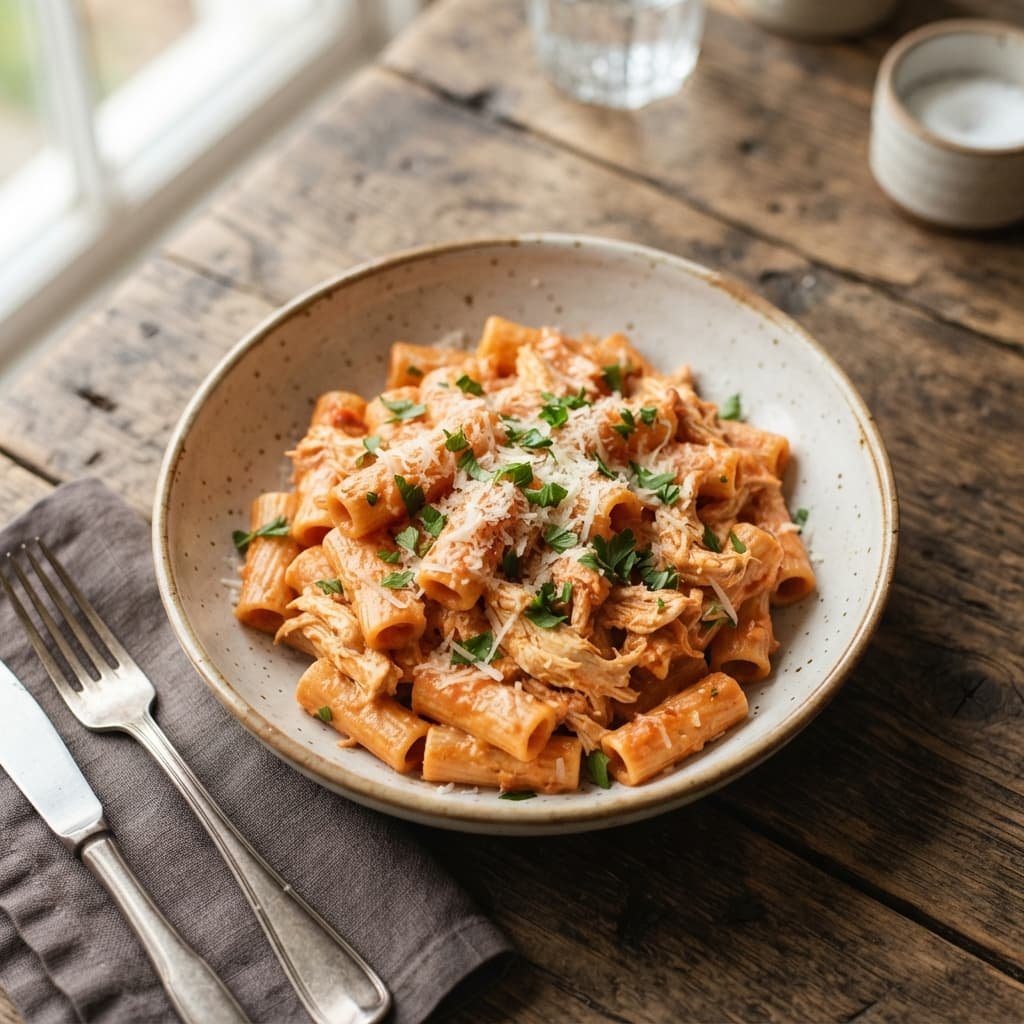
Romesco is, at heart, an oil and nut paste: ground almonds and roasted peppers suspended in olive oil. Oil and water do not mix on their own, which is why a romesco stirred into hot, plain liquid can leave a slick of orange oil floating on top of a gritty sauce. Creamy Romesco Rotisserie Chicken Pasta fixes that with two natural emulsifiers: the starch dissolved in pasta water, and the milk proteins in cream. Together they hold the oil in tiny droplets, so the sauce turns smooth and clings to each noodle instead of pooling in the bowl.
The building blocks are well documented. Creamy romesco pasta is a published recipe, romesco is routinely paired with rotisserie chicken and pasta in weeknight dinners, and rotisserie chicken is a standard base for quick creamy pasta. This version makes the romesco from scratch in a blender, which takes minutes, and uses the shredded chicken to turn the sauce into a full dinner.
| Prep Time | 15 minutes |
| Cook Time | 20 minutes |
| Total Time | 35 minutes |
| Servings | 4 |
| Difficulty | Easy, with one sauce-texture step |
Key Techniques for a Creamy Romesco Sauce
The dish takes about 35 minutes. Blend the romesco in 3 minutes, boil the pasta for 10 to 12 minutes, and finish the sauce in 5 minutes over medium-low heat. The key move is loosening the sauce with starchy pasta water a few tablespoons at a time until it turns glossy and coats the back of a spoon.
Pasta water works because the starch released by the noodles thickens the water slightly and coats the oil droplets, keeping them evenly dispersed. Plain water has none of that effect, which is why reserving the cooking water before draining matters more than it seems. Cream adds fat and protein that further stabilize the mixture, and it softens the sharp edge of the vinegar and smoked paprika.
Heat is the other variable. Romesco contains almonds and garlic, both of which turn bitter if scorched, and a hard boil can break the emulsion. Keep the sauce at a gentle simmer, with small bubbles at the edges, and add the chicken last so it only warms through. Rotisserie chicken is already cooked, so reheating it briefly, to 74°C (165°F), is enough, and longer simmering only dries it out.
Ingredients
This serves 4.
For the Romesco
- 1 jar (12 oz / 340g) roasted red peppers, drained and patted dry
- 1/2 cup (70g) blanched or toasted almonds
- 2 garlic cloves
- 1 slice (about 30g) day-old bread, torn
- 2 tablespoons (30ml) sherry vinegar or red wine vinegar
- 1 teaspoon smoked paprika
- 1/3 cup (80ml) olive oil
- 1/2 teaspoon salt
For the Pasta
- 12 oz (340g) rigatoni, penne, or fusilli
- 3 cups (about 400g) shredded rotisserie chicken, skin removed
- 3/4 cup (180ml) heavy cream
- 1/2 cup (50g) grated Parmesan, plus more for serving
- Salt and black pepper, to taste
- 2 tablespoons (8g) fresh parsley, chopped, for serving
How to Make Creamy Romesco Pasta with Rotisserie Chicken
- Bring a large pot of salted water to a boil. Cook the pasta until just al dente, typically 1 minute less than the package says. Reserve 1 cup (240ml) of the cooking water, then drain.
- While the pasta cooks, add the roasted peppers, almonds, garlic, bread, vinegar, paprika, olive oil, and salt to a blender. Blend for about 1 minute, until thick and mostly smooth with a little texture from the almonds.
- Scrape the romesco into a large skillet over medium-low heat. Warm it for 2 minutes, stirring, until it smells toasty and the surface looks glossy.
- Pour in the cream and stir. Bring to a gentle simmer for 2 to 3 minutes, until the sauce turns a deeper coral and coats the back of a spoon.
- Add the shredded chicken and stir for 2 minutes, until warmed through and coated.
- Add the drained pasta and toss. Pour in 1/4 cup (60ml) of the reserved water and stir vigorously for 30 seconds. Add more water by the tablespoon until the sauce looks smooth, glossy, and clings to the pasta without pooling.
- Remove from the heat. Stir in the Parmesan, taste, and add salt and pepper as needed.
- Serve immediately, topped with parsley and extra Parmesan.
Good vs. Excellent: The Details That Matter
- Dry the peppers before blending. Jar liquid dilutes the sauce and makes it taste watery.
- Pull the pasta a minute early. It finishes cooking in the sauce and absorbs flavor.
- Add pasta water gradually. It is easy to thin the sauce too much, but difficult to thicken it again.
- Add the cheese off the heat. Parmesan can turn stringy or grainy when it melts at high temperature.
- Taste for acid at the end. A small splash of vinegar brightens a rich sauce right before serving.
Troubleshooting Common Problems
Problem: The sauce looked oily and separated. Cause: it boiled, or too little liquid was added to emulsify the oil. Solution: take it off the heat, add a few tablespoons of hot pasta water, and stir hard until it comes back together.
Problem: The sauce was gritty. Cause: the almonds were not ground finely enough. Solution: blend for another 30 to 60 seconds, or use blanched almonds, which break down more smoothly.
Problem: The chicken was dry. Cause: it simmered too long in the sauce. Solution: stir it in near the end and only warm it through.
Problem: The sauce tasted bitter. Cause: the garlic or almonds scorched, or the paprika burned over high heat. Solution: keep the heat at medium-low and stop warming the sauce when it smells toasty, before it smells sharp.
Mastering the Technique
The principle that carries over is finishing a pasta sauce in the pan with starchy water instead of thinning it separately. Cacio e pepe, carbonara, and pesto pastas all rely on the same emulsion of starch, fat, and protein. When a sauce looks tight or greasy, the answer is almost always a splash of hot pasta water and vigorous stirring, not more cream or cheese.
A visual test helps: drag a spoon through the sauce in the pan. If the trail stays open for a second before closing, the consistency is right. If it closes instantly it is too thin, and if it holds like paste it needs more water.
Variations and Substitutions
Hazelnuts can replace almonds for a more traditional Catalan flavor. For a nut-free version, use toasted sunflower seeds. Half-and-half works in place of cream, though the sauce will be a little thinner. A spoonful of tomato paste, blended in with the peppers, deepens the color. Leftover roast turkey or pork can replace the chicken, and spinach stirred in at the end adds a green note.
Serving and Pairing
Serve with a bitter green salad, such as arugula with lemon, to cut the richness. Garlic bread or crusty bread works for the last of the sauce. A pinch of red pepper flakes at the table adds heat.
Storage and Reheating
Refrigerate in an airtight container for up to 3 days. The pasta will absorb sauce as it sits, so reheat in a skillet over medium-low heat with a splash of water or milk, stirring until creamy. Microwaving works in 30-second bursts, stirring between each. The romesco alone keeps in the refrigerator for up to 5 days and freezes well for up to 3 months, but the finished pasta does not freeze well.
Nutritional Information
Values below are estimates per serving and will vary depending on exact brands and quantities used.
| Calories | 740 kcal |
| Protein | 42 g |
| Carbohydrates | 67 g |
| Fat | 34 g |
| Fiber | 6 g |
Frequently Asked Questions
Can I use store-bought romesco? Yes. Use about 1 1/3 cups (320ml) and follow the same method. Taste before adding salt, since jarred versions vary.
Can I make the romesco ahead? Yes. It keeps for up to 5 days in the refrigerator and the flavor often improves after a day.
Why add cream to romesco? Cream mellows the vinegar and paprika and helps emulsify the oil, giving a smooth, silky sauce rather than a coarse paste.
Creamy Romesco Rotisserie Chicken Pasta shows how a few small controls, starchy water, gentle heat, and a late addition of cheese, turn jarred peppers and a blender of almonds into a sauce that tastes slow-cooked. The rotisserie chicken does the rest, and dinner is on the table in half an hour.
Creamy Romesco Rotisserie Chicken Pasta
Ingredients
Method
- Bring a large pot of salted water to a boil. Cook the pasta until just al dente, typically 1 minute less than the package says. Reserve 1 cup (240ml) of the cooking water, then drain.
- While the pasta cooks, add the roasted peppers, almonds, garlic, bread, vinegar, paprika, olive oil, and salt to a blender. Blend for about 1 minute, until thick and mostly smooth with a little texture from the almonds.
- Scrape the romesco into a large skillet over medium-low heat. Warm it for 2 minutes, stirring, until it smells toasty and the surface looks glossy.
- Pour in the cream and stir. Bring to a gentle simmer for 2 to 3 minutes, until the sauce turns a deeper coral and coats the back of a spoon.
- Add the shredded chicken and stir for 2 minutes, until warmed through and coated.
- Add the drained pasta and toss. Pour in 1/4 cup (60ml) of the reserved water and stir vigorously for 30 seconds. Add more water by the tablespoon until the sauce looks smooth, glossy, and clings to the pasta without pooling.
- Remove from the heat. Stir in the Parmesan, taste, and add salt and pepper as needed.
- Serve immediately, topped with parsley and extra Parmesan.