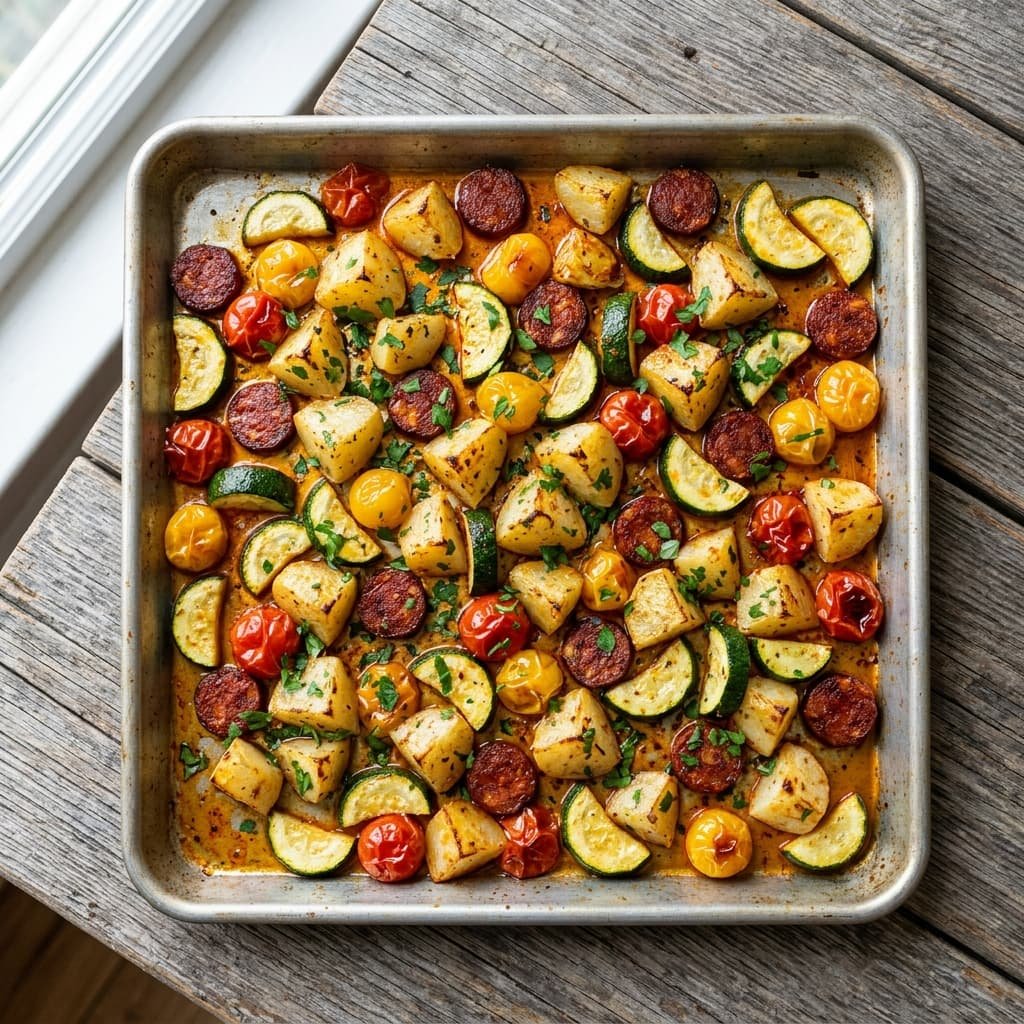
If you have ever picked up a kohlrabi at the market, turned it over, and put it back because you had no idea what to do with it, this summer chorizo and kohlrabi bake is for you. Kohlrabi looks like a pale green alien, but it is just a mild, slightly sweet vegetable that roasts well and picks up the flavors around it. Here it roasts next to cured chorizo, whose paprika-red oil seasons the whole pan.
A note on what is documented and what is a variation. Roasted kohlrabi and sheet pan chorizo with vegetables at 220°C (425°F) are both well established. The pairing of the two, with summer tomatoes and zucchini, is my own working version. The timings are drawn from published recipes and I haven’t tested them in every oven, so treat the color of the vegetables as the real signal.
| Prep Time | 20 minutes |
| Cook Time | 35 minutes |
| Total Time | 55 minutes |
| Servings | 4 |
| Difficulty | Easy |
How Long Does Summer Chorizo and Kohlrabi Bake Take?
Summer chorizo and kohlrabi bake takes about 55 minutes. Roast peeled kohlrabi pieces at 220°C (425°F) for 15 minutes, add the chorizo, tomatoes, zucchini, and onion, and roast 15 to 20 minutes more, until the vegetables are browned and the chorizo edges are crisp.
Kohlrabi Basics, and the Tips That Matter Most
Peel it. The outer skin is tough. Cut the bulb in half, then take the skin off with a vegetable peeler, as published roasting recipes do.
Keep the pieces about 1/2 inch (1.3 cm). Published recipes roast pieces this size for about 25 minutes on their own. Smaller pieces brown faster and bigger ones take longer, so cut evenly.
Give it a head start. Kohlrabi needs longer than tomatoes, zucchini, and onion, which soften quickly. That is why the pan goes in with just the kohlrabi first.
Choose cured chorizo. Spanish chorizo is cured and smoked and safe to eat without further cooking, and its seasoning is built around smoked paprika. That makes it the easy option here, since you only need to brown it. Mexican chorizo is fresh ground pork and must be cooked through, so see the variations below.
Leave space. Crowded vegetables steam instead of browning. Use two pans if one looks packed.
Ingredients
For the pan
| Kohlrabi peeled, cut into 1/2-inch (1.3 cm) pieces | 1 3/4 lb (800 g), about 4 medium bulbs |
| Spanish cured chorizo sliced into 1/4-inch (6 mm) coins | 8 oz (225 g) |
| Cherry tomatoes left whole | 10 oz (280 g) |
| Zucchini cut into half-moons | 1 medium (about 200 g) |
| Red onion cut into wedges | 1 medium (about 150 g) |
| Garlic cloves smashed | 4 |
| Olive oil | 2 tbsp (30 ml) |
| Salt chorizo is already salty | 1/4 tsp (1.5 g) |
| Black pepper | 1/4 tsp (0.5 g) |
To finish
| Fresh parsley chopped | 3 tbsp (12 g) |
| Lemon juiced, plus wedges | 1 |
How to Make Summer Chorizo and Kohlrabi Bake
- Heat the oven. Put a rack in the middle and heat the oven to 220°C (425°F). Use a large rimmed sheet pan, or two.
- Prep the kohlrabi (about 12 minutes). Cut off the stems and roots, peel the bulbs, and cut them into 1/2-inch (1.3 cm) pieces. Toss them with 1 tbsp (15 ml) of the oil, the salt, and the pepper, and spread them in a single layer.
- Start roasting (15 minutes). Roast the kohlrabi alone, stirring once halfway. The edges should begin to turn pale gold.
- Prep the rest. While the kohlrabi roasts, toss the chorizo, tomatoes, zucchini, onion, and garlic with the remaining 1 tbsp (15 ml) of oil.
- Add everything and roast (15 to 20 minutes). Scatter the second batch over the kohlrabi, mix gently, and return the pan to the oven. Roast until the chorizo coins are browned and crisp at the edges, the tomatoes have burst, and the kohlrabi is tender in the center and golden at the edges. Stir once halfway. The pan will smell smoky and sweet, and the oil in the bottom will be paprika red.
- Finish. Squeeze the lemon over the pan, scatter the parsley, and taste. Add a pinch of salt only if you need it.
- Serve. Spoon the vegetables and chorizo onto plates and drizzle the red pan oil over the top. Lemon wedges go on the side.
Where This Bake Goes Sideways
Pale, soft kohlrabi. The pan was too crowded or the oven wasn’t hot enough. Spread the pieces out and let the oven come fully to temperature. If the kohlrabi still isn’t golden after the full time, roast it a few more minutes and watch it closely.
Burnt chorizo. Thin coins can scorch toward the end. Cut them about 1/4 inch (6 mm) thick, and pull the pan if the edges turn dark brown before the vegetables are done.
Mushy zucchini. It releases a lot of water. Add it with the second batch, not at the start, and cut it into thick pieces.
Too salty. Cured chorizo carries plenty of salt. That is why the recipe uses almost no added salt. Taste before you season.
Too greasy. Chorizo renders a lot of fat. A spoonful of the red oil is flavor, but you don’t need to pour all of it over the plates
.
Variations, Substitutions, and Serving
Mexican chorizo. One published sheet pan recipe uses fresh Mexican chorizo dropped on top in roughly tablespoon-sized pieces. Since it’s raw pork, cook it all the way through, to 71°C (160°F), the federal figure for ground pork. Remove it from the casing first. I haven’t tested the exact timing in this recipe.
Other vegetables. Potatoes, bell peppers, or sweet potatoes also roast well with chorizo. Cut potatoes to about 1 inch (2.5 cm) so they cook through.
Alcohol-free. Nothing here contains alcohol.
Serving. Crusty bread soaks up the pan oil, and a spoonful of plain yogurt cools the paprika. Rice or couscous makes it a bigger meal.
Storage and Reheating
This reheats better than many roasted dishes, but the edges soften. Refrigerate leftovers within 2 hours and eat them within 3 days, which is my own conservative window. Reheat on a sheet pan in a 200°C (400°F) oven for about 10 minutes, or in a hot skillet, until hot throughout at 74°C (165°F), the federal figure for leftovers. Tomatoes will be softer the second day. I haven’t tested freezing.
Nutritional Information
These values are estimates per serving (one quarter of the pan). They vary with the brand of chorizo and how much rendered fat you spoon over, so use a nutrition calculator if you need exact numbers.
| Calories | 400 kcal |
| Protein | 18 g |
| Carbohydrates | 22 g |
| Fat | 28 g |
| Fiber | 8 g |
Frequently Asked Questions
Do I have to peel kohlrabi?
Yes. The outer skin is tough, so peel it before cutting.
What does kohlrabi taste like?
It’s mild and slightly sweet, and roasting gives it a golden, nutty edge. If you’ve tried broccoli stems or turnips, it will feel familiar.
Can I use the kohlrabi leaves?
I haven’t tested them in this recipe, so I’d rather not guess. Use the bulbs as written.
The Short Version
Peel the kohlrabi, give it a 15-minute head start, then add the chorizo, tomatoes, zucchini, and onion, and roast until everything is browned. One pan, one oven, and a vegetable you no longer have to wonder about.
Summer Chorizo and Kohlrabi Bake
Ingredients
Method
- Heat the oven. Put a rack in the middle and heat the oven to 220°C (425°F). Use a large rimmed sheet pan, or two.
- Prep the kohlrabi (about 12 minutes). Cut off the stems and roots, peel the bulbs, and cut them into 1/2-inch (1.3 cm) pieces. Toss them with 1 tbsp (15 ml) of the oil, the salt, and the pepper, and spread them in a single layer.
- Start roasting (15 minutes). Roast the kohlrabi alone, stirring once halfway. The edges should begin to turn pale gold.
- Prep the rest. While the kohlrabi roasts, toss the chorizo, tomatoes, zucchini, onion, and garlic with the remaining 1 tbsp (15 ml) of oil.
- Add everything and roast (15 to 20 minutes). Scatter the second batch over the kohlrabi, mix gently, and return the pan to the oven. Roast until the chorizo coins are browned and crisp at the edges, the tomatoes have burst, and the kohlrabi is tender in the center and golden at the edges. Stir once halfway. The pan will smell smoky and sweet, and the oil in the bottom will be paprika red.
- Finish. Squeeze the lemon over the pan, scatter the parsley, and taste. Add a pinch of salt only if you need it.
- Serve. Spoon the vegetables and chorizo onto plates and drizzle the red pan oil over the top. Lemon wedges go on the side.