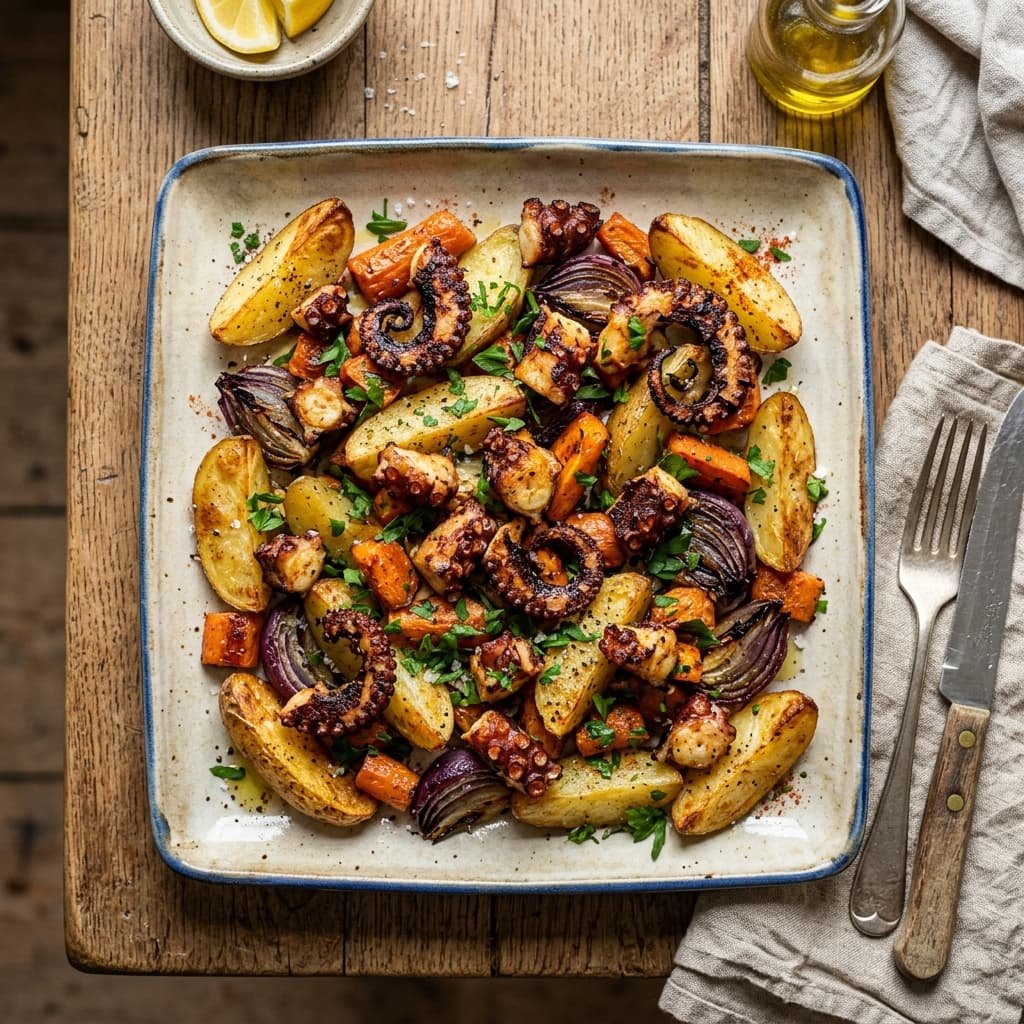
The first taste is salt, the clean, mineral kind that makes you think of the sea rather than the shaker. Then comes lemon and oregano, and then, under your teeth, a thin brittle edge giving way to something dense and tender. That sequence, salt, brightness, crunch, softness, is the reason to make this winter crispy octopus bake on a cold afternoon when the oven is already doing the work of warming the house.
A note on what is documented and what is a variation. Octopus baked until tender in the oven is an established method, one published recipe wraps raw octopus tightly in foil and bakes it at 160°C (320°F) for about 1 hour 30 minutes. Another recipe boils it, then crisps pieces in a very hot pan for about 2 minutes per side and serves them with baked potatoes. This recipe combines those ideas with roasted winter vegetables. The combination, and the timings for the vegetables, are my own, and I haven’t tested them in every oven.
| Prep Time | 20 minutes |
| Cook Time | 155 minutes (about 2 hours 35 minutes) |
| Total Time | 175 minutes |
| Servings | 4 |
| Difficulty | Moderate, mostly waiting |
How Long Does Winter Crispy Octopus Bake Take?
A winter crispy octopus bake takes about 3 hours, but most of it is unattended. Bake the wrapped octopus at 160°C (320°F) for about 90 minutes until a fork slides in, roast the vegetables for 35 to 40 minutes while it rests, then crisp the cut pieces in a hot pan for 2 minutes per side.
Ingredients
For the octopus
| Octopus cleaned, fresh or fully thawed | 2 1/2 to 3 lb (1.1 to 1.4 kg) |
| Olive oil for the wrap | 2 tbsp (30 ml) |
| Bay leaves | 2 |
| Dried oregano | 1 tsp (1 g) |
| Garlic cloves smashed, skin on | 3 |
| Lemon half sliced for the wrap, half for juice | 1 |
For the winter vegetables
| Potatoes cut into 1-inch (2.5 cm) wedges | 1 1/2 lb (680 g) |
| Carrots cut into thick sticks | 2 medium (about 200 g) |
| Yellow onion cut into wedges | 1 large (about 200 g) |
| Olive oil | 3 tbsp (45 ml) |
| Salt the octopus is already salty | 1/2 tsp (3 g) |
| Smoked paprika | 1 tsp (2 g) |
To crisp and serve
| Olive oil for searing | 1 tbsp (15 ml) |
| Fresh parsley chopped | 2 tbsp (8 g) |
| Extra-virgin olive oil to finish | 1 tbsp (15 ml) |
How to Make Winter Crispy Octopus Bake
- Heat the oven. Heat the oven to 160°C (320°F). Tear off a large sheet of foil and a sheet of parchment of the same size.
- Wrap the octopus (about 10 minutes). Lay the parchment on the foil. Put the octopus in the center with the olive oil, bay leaves, oregano, garlic, and the lemon slices. Fold the parchment and foil into a tight packet with no gaps, so the steam stays inside.
- Bake until tender (about 90 minutes). Set the packet on a sheet pan and bake. Open it carefully (the steam is hot) and test the thickest part of a tentacle with a fork. It is ready when the fork slides in with almost no resistance. If it still feels tough, rewrap and bake 30 minutes more, as the published recipe suggests.
- Rest (15 minutes). Leave the octopus in its packet to cool a little. Letting it cool in its own liquid is a step another published recipe stresses, since removing the octopus straight from the heat can leave it gummy.
- Roast the vegetables (35 to 40 minutes). Raise the oven to 200°C (400°F). On a large sheet pan, toss the potatoes, carrots, and onion with the oil, salt, and paprika, and spread them in one layer. Roast, turning once, until the potatoes have deep golden edges and the carrots are tender. The kitchen should smell sweet and toasted.
- Cut and dry the octopus. Remove the head, if still attached, and cut the tentacles into 2-inch (5 cm) pieces. Discard the garlic and bay leaves. Pat the pieces very dry with paper towels. This matters, since moisture is the enemy of crispness.
- Crisp (about 4 to 6 minutes). Heat the tablespoon of oil in a large skillet over high heat until it shimmers. Add 3 or 4 pieces at a time so the pan stays hot. Sear about 2 minutes per side until deep golden and crisp at the edges. Repeat with the rest.
- Serve. Pile the octopus over the vegetables, squeeze over the juice of the remaining lemon half, drizzle with extra-virgin olive oil, and scatter the parsley.
Where the Crisp Comes From, and Why the Bake Comes First
The tenderness and the crispness come from two different jobs. The slow, tightly wrapped bake handles the tough connective tissue in octopus, and the wrap traps steam so the meat cooks gently instead of drying out. Crispness only appears afterward, when the surface is dry and meets a very hot pan.
That order matters. A pan sear on raw octopus gives you a crust over a tough interior. A tender, dried octopus seared for two minutes gives you a thin crust over a soft interior, which is what the name promises. Keep the pan uncrowded, since a cooler pan steams the pieces, and they won’t brown.
Where Octopus Bakes Go Wrong
Skipping the dry step. Wet octopus goes into the pan and steams. Pat it dry thoroughly, then dry it again.
Under-baking the octopus. A fork should slide in easily. If it doesn’t, give it another 30 minutes before you cut it.
Loose foil. Gaps let the steam escape and the octopus dries out. Crimp the edges tightly.
Over-salting. Octopus is already salty, so taste before adding more. The recipe uses only a little salt on the vegetables.
Over-crowding the vegetables. Packed potatoes steam instead of crisping. Use two pans if one is full.
Variations, Substitutions, and Serving
Precooked octopus. If you buy cooked tentacles, skip the first four steps and go straight to the vegetables and the sear. I haven’t tested that shortcut with this exact recipe.
Different roots. Parsnips or celery root work in place of the carrots, though I haven’t tested them here.
Alcohol-free. Some baked octopus recipes use wine. This one uses lemon instead, so nothing needs replacing.
Serving. A sharp green salad with lemon cuts through the richness of the potatoes and oil.
Storage and Reheating
The crisp edge fades within an hour, so this is best at once. Refrigerate leftovers within 2 hours and eat them within 2 days, which is my own conservative window. Reheat the octopus briefly in a hot skillet for a minute or two, and warm the vegetables in a 200°C (400°F) oven. Heat leftovers to 74°C (165°F), the federal figure. Long reheating makes octopus tough. Cold, sliced and dressed with lemon and oil, leftovers make a good salad. I haven’t tested freezing.
Nutritional Information
These values are estimates per serving (one quarter of the octopus and vegetables). They vary with the size of the octopus, how much it shrinks, and how much oil you use, so use a nutrition calculator if you need exact numbers.
| Calories | 520 kcal |
| Protein | 40 g |
| Carbohydrates | 39 g |
| Fat | 22 g |
| Fiber | 5 g |
Frequently Asked Questions
Do I need to boil the octopus first?
Not for this recipe. Published recipes show both approaches, boiling for about 45 to 50 minutes or baking raw in foil. I use the foil method because it needs no pot of water.
Can I crisp it under the broiler instead of in a pan?
I haven’t tested that. A pan gives you better control, and a published recipe sears it for about 2 minutes per side.
How do I know the octopus is done?
The fork test. It should slide into the thickest part of a tentacle with almost no resistance.
Time as an Ingredient
Winter cooking is often about letting the oven do what a hurry can’t. Ninety quiet minutes turn a stubborn ingredient into a soft one, and two loud minutes in a hot pan give it a crust. It is a dish that teaches you to sit through the middle, and the result is worth the wait.
Winter Crispy Octopus Bake
Ingredients
Method
- Heat the oven. Heat the oven to 160°C (320°F). Tear off a large sheet of foil and a sheet of parchment of the same size.
- Wrap the octopus (about 10 minutes). Lay the parchment on the foil. Put the octopus in the center with the olive oil, bay leaves, oregano, garlic, and the lemon slices. Fold the parchment and foil into a tight packet with no gaps, so the steam stays inside.
- Bake until tender (about 90 minutes). Set the packet on a sheet pan and bake. Open it carefully (the steam is hot) and test the thickest part of a tentacle with a fork. It is ready when the fork slides in with almost no resistance. If it still feels tough, rewrap and bake 30 minutes more, as the published recipe suggests.
- Rest (15 minutes). Leave the octopus in its packet to cool a little. Letting it cool in its own liquid is a step another published recipe stresses, since removing the octopus straight from the heat can leave it gummy.
- Roast the vegetables (35 to 40 minutes). Raise the oven to 200°C (400°F). On a large sheet pan, toss the potatoes, carrots, and onion with the oil, salt, and paprika, and spread them in one layer. Roast, turning once, until the potatoes have deep golden edges and the carrots are tender. The kitchen should smell sweet and toasted.
- Cut and dry the octopus. Remove the head, if still attached, and cut the tentacles into 2-inch (5 cm) pieces. Discard the garlic and bay leaves. Pat the pieces very dry with paper towels. This matters, since moisture is the enemy of crispness.
- Crisp (about 4 to 6 minutes). Heat the tablespoon of oil in a large skillet over high heat until it shimmers. Add 3 or 4 pieces at a time so the pan stays hot. Sear about 2 minutes per side until deep golden and crisp at the edges. Repeat with the rest.
- Serve. Pile the octopus over the vegetables, squeeze over the juice of the remaining lemon half, drizzle with extra-virgin olive oil, and scatter the parsley.