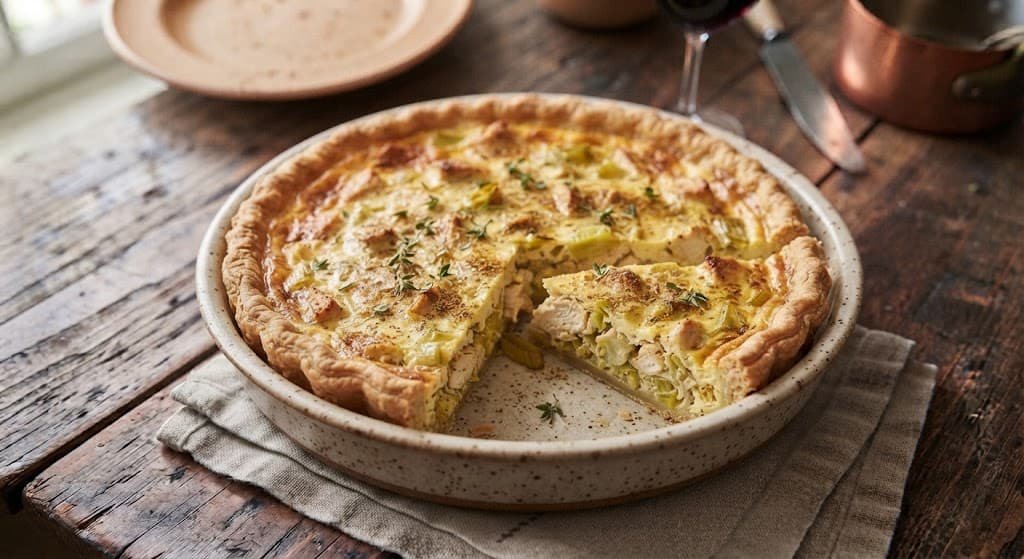
Egg proteins start out as loosely coiled strands floating in liquid, and heat is what unravels them and lets them bond to each other, trapping the cream and milk around them until the whole mixture turns from liquid custard into something you can slice. That single transformation is the entire structural backbone of a quiche, and it’s also the part most recipes rush past on the way to talking about crust. Get the custard set correctly and everything else, including a Moroccan spice blend folded into a very French format, falls into place around it.
Getting Chicken and Leeks Quiche with Ras el Hanout to Set Right
Chicken and leeks quiche with ras el hanout takes about 1 hour 15 minutes total, including a blind-baked crust and a 30-minute bake for the custard. It needs at least 15 minutes to rest afterward, since the egg proteins keep firming up as the quiche cools, not just while it bakes.
The custard itself depends on a ratio, not a feeling: roughly one large egg for every half cup of dairy gives a filling that sets firm enough to slice cleanly but still trembles slightly in the center when it’s fully cooked. Too many eggs relative to the cream and the texture turns rubbery and dense; too few and the center never fully sets, staying loose even after a long bake. Overbaking causes a different problem entirely, called syneresis: push the proteins too far past the point where they’ve bonded, and they start squeezing out the liquid they were holding, leaving watery pools on top of an otherwise cooked quiche. The visual cue that avoids both problems is a center that jiggles slightly like set gelatin, not liquid, when the pan is nudged.
Leeks add their own complication, since they release a surprising amount of water as they cook. Adding them to the custard raw, or even lightly cooked, dilutes the egg mixture enough to throw off that same ratio and leave the filling underset. Cooking them down fully before they ever meet the eggs is what keeps the ratio intact.
Ingredients
For the Crust
- 1 1/4 cups all-purpose flour
- 1/2 tsp salt
- 8 tbsp cold unsalted butter, cubed
- 3 to 4 tbsp ice water
For the Filling
- 1 tbsp olive oil or butter
- 2 leeks, white and light green parts only, halved lengthwise and thinly sliced
- 2 cups cooked, shredded chicken
- 1 1/2 tsp ras el hanout
- 4 large eggs
- 1 cup heavy cream
- 1/2 cup whole milk
- 1/2 cup shredded Gruyère cheese
- Salt and black pepper, to taste
Method
- Pulse the flour and salt together, then add the cold butter and pulse until the mixture looks like coarse crumbs with some pea-sized pieces remaining. Add the ice water a tablespoon at a time, pulsing briefly, until the dough just holds together when pressed. Shape into a disk, wrap, and chill for at least 30 minutes.
- Roll the dough out and fit it into a 9-inch tart pan, trimming the edges. Chill again for 15 minutes; this keeps the butter firm so the crust holds its shape in the oven instead of slumping.
- Preheat the oven to 375°F. Line the chilled crust with parchment paper and fill with pie weights or dried beans. Bake for 15 minutes, then remove the weights and parchment and bake for another 8 to 10 minutes, until the crust looks dry and just barely golden. This blind bake is what keeps the finished quiche from having a soggy bottom.
- While the crust bakes, heat the oil in a skillet over medium heat. Add the leeks and cook for 8 to 10 minutes, stirring occasionally, until fully softened and most of their released liquid has evaporated from the pan.
- Stir in the ras el hanout and cook for about a minute, just until fragrant. Remove from heat and stir in the shredded chicken.
- In a separate bowl, whisk together the eggs, cream, milk, salt, and pepper until fully combined.
- Reduce the oven to 350°F. Spread the chicken and leek mixture evenly in the baked crust, sprinkle with the Gruyère, and pour the egg mixture over the top.
- Bake for 30 to 35 minutes, until the edges are fully set and the center has only a slight jiggle when the pan is gently shaken. Tent the edges with foil partway through if the crust starts browning too fast.
- Let the quiche rest for at least 15 minutes before slicing. The center will finish setting during this time.
The Difference Between a Good Slice and a Great One
A good quiche holds together and tastes seasoned. A great one has a crust that’s genuinely crisp all the way through the bottom layer, not just at the edges, and a custard that’s silky rather than bouncy, with the ras el hanout coming through as warmth and depth rather than announcing itself as a single dominant spice note. That balance depends on toasting the spice briefly with the leeks rather than whisking it raw into the custard, since a quick bloom in warm fat wakes up the aromatic oils in a way that raw spice stirred into cold cream never quite matches.
Where Ras el Hanout Chicken and Leek Quiche Usually Goes Wrong
Why is the bottom of my crust soggy even though the top looks done?
Cause: the crust wasn’t blind-baked long enough before the filling went in, or the filling went in while the crust was still warm from the oven. Fix: bake the empty crust until it’s visibly dry and just golden, and let it cool for a few minutes before adding the leek and chicken mixture.
Why did my custard come out watery or grainy instead of smooth?
Cause: the quiche was overbaked past the point where the egg proteins had just set, pushing them into syneresis. Fix: pull the quiche from the oven as soon as the center jiggles slightly rather than waiting for it to look completely still, since it continues cooking from residual heat after it comes out.
Why does my filling taste watered down despite using the full amount of ras el hanout?
Cause: the leeks weren’t cooked long enough to release and evaporate their moisture before joining the custard. Fix: keep cooking them past the point where they look soft, until the pan is genuinely dry, even if that takes a few extra minutes.
Variations and Substitutes
Turkey works as a direct substitute for the chicken if that’s what you have on hand, and leftover roast turkey is especially good here. Gruyère can be swapped for a milder cheese like fontina if you want the ras el hanout to carry more of the flavor, or for a sharper one like aged cheddar if you’d rather the cheese hold its own. If leeks aren’t available, thinly sliced yellow onion works, though it needs a shorter cooking time and brings a sweeter, less delicate flavor than leeks provide. A store-bought pie crust is a reasonable shortcut on a busy day, though it won’t blind-bake to quite the same crispness as one made from scratch.
Serving and Pairing
A simple arugula salad with lemon and olive oil is the classic pairing here, since its sharpness cuts through the richness of the custard and cheese. This also works well at room temperature, which makes it a solid choice for brunch spreads where food sits out for a while, and it pairs easily with a fruit salad or roasted vegetables if you’re building out a fuller table.
Storage and Reheating
Store leftover quiche, covered, in the fridge for up to 4 days. Reheat individual slices in a 325°F oven for about 10 minutes, which keeps the crust from going soggy the way a microwave tends to. The quiche also freezes well, wrapped tightly, for up to 2 months; thaw it overnight in the fridge before reheating in the oven for best texture.
Nutrition (Per Serving, Serves 8)
These are estimated values per serving. Actual numbers will vary depending on the exact chicken, cream, and cheese used.
| Calories | 345 kcal |
| Protein | 15 g |
| Carbohydrates | 17 g |
| Fat | 24 g |
| Fiber | 1 g |
This recipe was tested and refined in bebup.org’s kitchen before publishing, with particular attention to the custard ratio and bake time that make chicken and leeks quiche with ras el hanout hold together cleanly, described above.
A Classic Worth the Extra Spice
Quiche has room in its structure for almost any flavor you fold into it, and this chicken and leeks quiche with ras el hanout proves that a French technique and a North African spice blend aren’t nearly as far apart as their origins might suggest. The custard doesn’t care where the seasoning came from, only that it’s balanced, and once you’ve got that part figured out, the rest is just filling.
Mastering the Custard Set
Egg proteins begin denaturing, or unfolding from their coiled shape, at temperatures well below boiling, and they continue bonding to each other as the mixture climbs through roughly 155°F to 180°F, forming the network that traps the cream and milk in place. This is a gradual process rather than a single switch flipping, which is why quiche bakes low and slow at 350°F instead of a hotter oven that would set the outer edges long before the center ever caught up. Cream and milk both slow this process down slightly compared to eggs alone, giving a wider window to catch that ideal set point before the proteins overtighten. That’s also why a water bath isn’t strictly necessary for a crusted quiche the way it is for a delicate custard baked in a dish alone: the pastry shell insulates the sides just enough to keep the whole thing cooking at a more even pace.
Chicken and Leeks Quiche with Ras el Hanout
Ingredients
Method
- Pulse flour and salt, cut in cold butter until crumbly, add ice water until dough holds together. Chill 30 minutes.
- Roll out and fit into a 9-inch tart pan. Chill 15 minutes.
- Blind bake at 375°F: 15 minutes with pie weights, then 8 to 10 minutes without, until dry and lightly golden.
- Cook leeks in oil for 8 to 10 minutes until softened and dry. Stir in ras el hanout for 1 minute, then remove from heat and stir in chicken.
- Whisk eggs, cream, milk, salt, and pepper together.
- Reduce oven to 350°F. Spread chicken and leek mixture in the crust, top with Gruyère, and pour in the egg mixture.
- Bake 30 to 35 minutes until edges are set and center jiggles slightly.
- Rest at least 15 minutes before slicing.