Your thumbs manage about 38 words a minute, while your voice runs at roughly 150. That gap makes dictation the obvious choice, yet the faster method isn’t always the quicker finish. Choosing dictation or typing for drafting a long message is a sums problem more than a matter of taste. For a message of 400 words, dictation wins as long as the phone mishears fewer than about one word in nine, and typing wins beyond that. The factor that settles it is the cost of correction, not the speed of entry. The test case throughout is a 400-word message. The numbers are rounded guesses and no brand names appear, so redo each calculation with your own thumbs.
What Decides Dictation or Typing for Drafting Long Messages
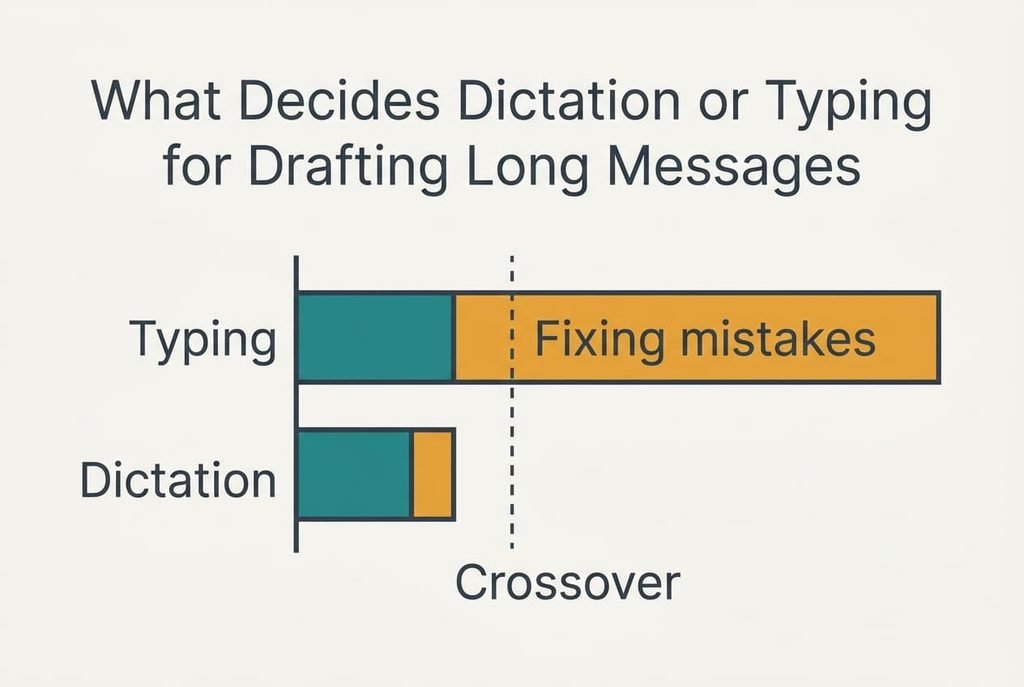
Count the whole job instead of the entry alone. Typing 400 words at 38 a minute takes 632 seconds. Add 60 seconds to read the message through, and the total is 692 seconds, close to 11.5 minutes. Dictating the same words at 150 a minute takes 160 seconds. The same 60-second read-through brings it to 220 seconds before a single mistake is fixed.
Mistakes are where the lead melts. Suppose each mishearing costs 10 seconds, since you have to spot it and then tap into the text to repair it. At 10 mistakes the dictated total is 320 seconds. At 47 mistakes it reaches 690 seconds, level with typing. That crossover sits at 47 of 400 words, or 11.8%, which is roughly one word in nine. What settles the matter is how often your phone gets a word wrong in the room you’re in, and every other consideration follows from it. Both methods need a read-through, though dictation needs the more careful one, as the table below shows.
Quiet rooms and ordinary vocabulary keep the error rate low. A busy street or a list of surnames pushes it up fast.
Test the error rate before you trust either method.
Typing or Dictation for Drafting, Row by Row
The table compares behaviour where the two methods really differ. It leaves out speed and cost, which the sums above already covered. Test each row on your own phone by dictating one paragraph and typing the next. Look at the rows you care about and ignore the rest.
| Question | Dictation | Typing |
|---|---|---|
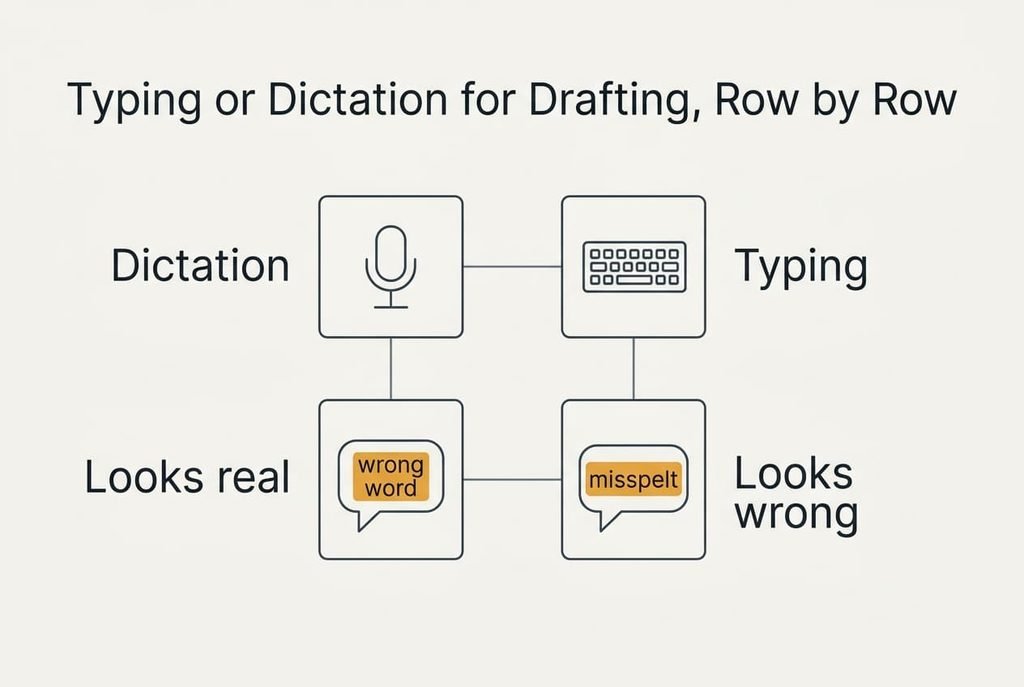
| Typical mistake | a wrong word that looks real | a wrong key or a missing letter |
| Who can overhear | everyone in the room | nobody |
| Hands needed | one, to hold the phone | both thumbs |
| Names and rare terms | often misheard | spelled as you mean |
| Rewording mid-sentence | awkward, say it again | quick, move the cursor |
| Noisy room | error rate climbs sharply | no effect |
| Punctuation | spoken aloud or guessed | typed directly |
The first row holds the surprise. A dictated mistake is usually a real word in the wrong place, so a quick skim passes over it, whereas a mistyped word looks wrong at once. Dictation therefore needs a slower read-through than the 60 seconds assumed above, and that extra time pulls its crossover lower. Treat dictation or typing for drafting as a question about proofreading as much as entry. Measure the read-through separately, with a stopwatch, because it’s the number most people guess too low.
Where Dictation Wins
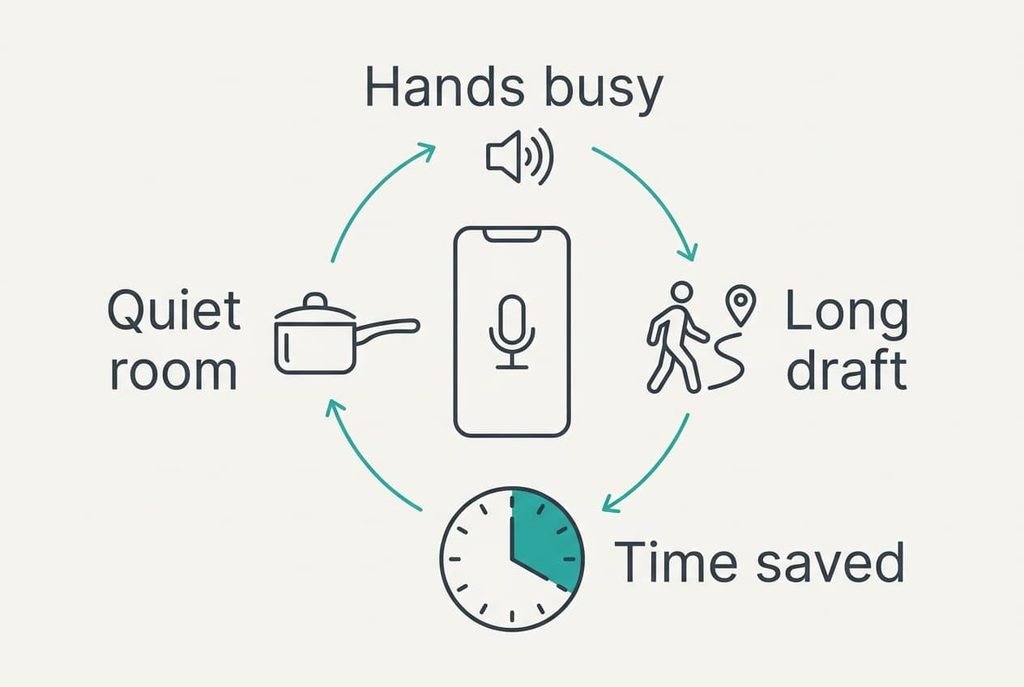
Dictation wins on a long first draft in a quiet place. At one mistake in 30 words, a 400-word message holds about 13 errors. The total is 160 + 60 + 130 = 350 seconds, close to 6 minutes, against 11.5 for typing. That saves five and a half minutes per message, and five messages a week save about 28 minutes.
It also wins whenever your hands are busy. Walking or stirring a pan leaves you able to talk but not to type. A draft spoken at the hob turns idle minutes into a finished paragraph. And it wins on tone: speech tends to produce sentences you’d actually say, which suits an email to a friend or a long reply to a family group.
The cost is the read-through. Skim a dictated message as you would a typed one and a wrong-but-real word survives into the sent copy. Read it aloud at half speed, or at least run your finger beneath each line, and the swaps appear.
Where Typing Wins
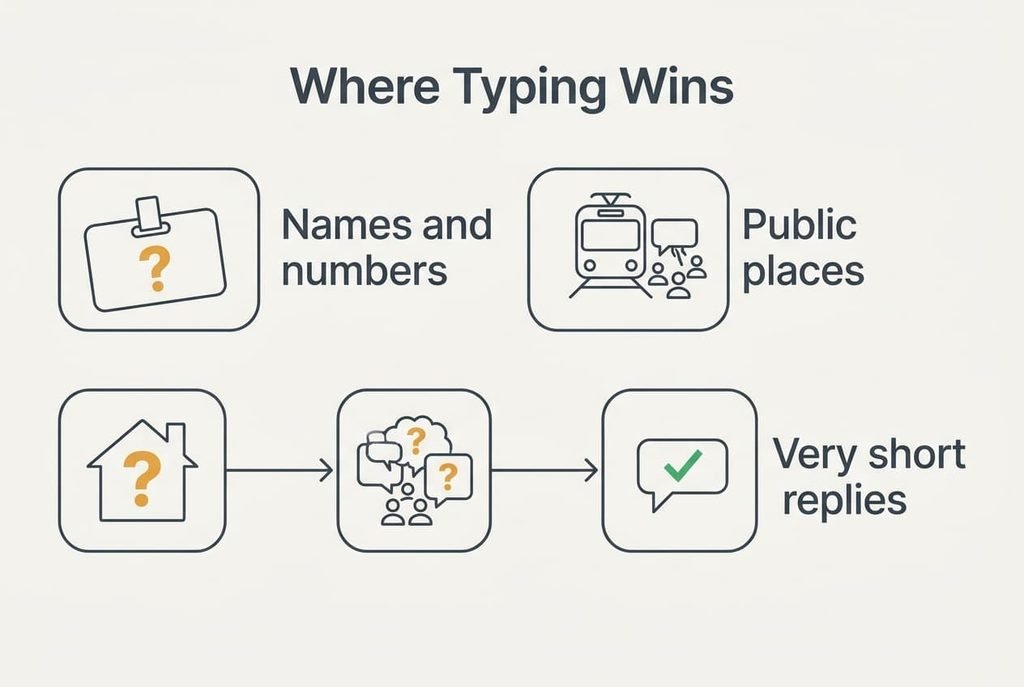
Typing wins whenever precision outweighs volume. Names and unusual spellings are where the phone’s guess fails most often. A message made mostly of those has an error rate far above one word in nine, and the table’s crossover arrives within the first paragraph.
It wins in public, because speaking a message on a train shares your business with the carriage. It wins in noise too: a kitchen with an extractor fan or a street at rush hour can double the error rate. And it wins on very short messages. A reply of 12 words takes about 19 seconds to type. Dictation adds roughly 18 seconds, spent on starting it and checking the result, so typing is level or ahead.
Typing also gives control over rewording. Because you can place the cursor inside a sentence, a changed idea costs a few taps, whereas dictation means saying the sentence again.
Anyone who edits as they write will feel that difference by the second paragraph.
When Neither Method Suits the Draft
Some drafts don’t belong on a phone at all. A message over about 800 words, or one with a table or figures, is better written on a keyboard or sent as a spoken voice note, since both methods lose their edge there. At that length the read-through alone takes several minutes. Tables and numbers also break dictation. The choice between dictation or typing for drafting stops mattering at that length.
A voice note skips the problem of correction. The listener hears your words as spoken, and nothing needs fixing. The price is that nobody can skim a recording, so it suits a friend and not a client. A short call settles things sooner when the topic has more than three open questions.
If the matter is formal, leave a draft written either way overnight and reread it in the morning. Fresh eyes catch the wrong-but-real words that dictation leaves behind.
Which One to Pick
When the surroundings are quiet and the message is mostly your own ideas in ordinary words, dictate it. Speak in whole sentences and say the punctuation aloud. Plan a slow read-through. Hold the phone about chest-high with the microphone towards you, and keep each sentence under 20 words so the guess has context. Expect to finish in about half the typing time.
If the message leans on names and numbers, or you’re somewhere noisy, type it. The mishearing rate rises past the crossover, and nobody else gets to listen in. Check each figure once against its source, and read any name back letter by letter.
Many drafts suit a mix: dictate the body and type the names. Whichever you choose, measure it once with a 100-word paragraph. Dictation or typing for drafting is settled by your error count, so a single test replaces any rule of thumb. Run that test now and note which method finished first. Repeat it in a noisy room once, since that is the case that changes the answer.
Questions Readers Keep Asking
How long does dictation take to get used to?
About a week of regular use. You learn to speak in whole sentences and to say the punctuation aloud. The first messages feel slow because you’re also learning to proofread differently. By the fifth long message most people settle at a mistake rate they can live with.
Why does dictation get my words wrong?
The phone guesses each word from sound and context. Noise and rare names weaken the guess, as do some accents. It then picks the likeliest real word, which is why errors look plausible. A quieter room and a steady pace reduce them noticeably.
Which is better for a quick reply?
Typing, for anything under about a dozen words. Dictation adds time to start and to check, so a short reply gains nothing, and at around twelve words typing is level or ahead. Save dictation for messages where you have more to say than your thumbs can comfortably carry.