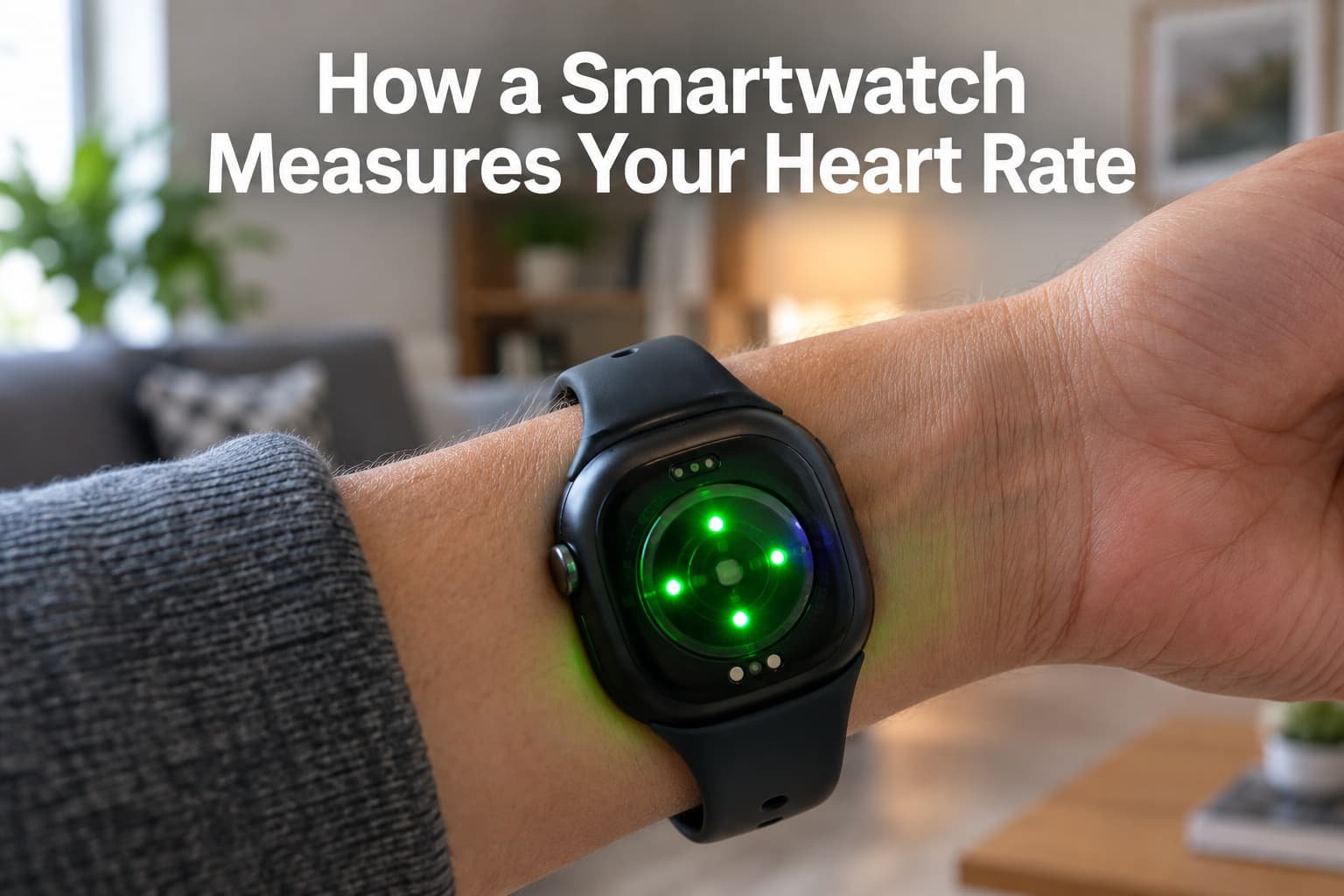
The back of a smartwatch has a small cluster of green lights and a sensor that looks like a window. It does not touch your heart, and it does not feel your pulse the way a fingertip does. It watches the colour of your skin change, a fraction of a second at a time, and works out your heart rate from that. Once you know how, you also know why the number is usually good at rest and sometimes unreliable in the middle of a hard workout.
The short answer, and what it leaves out
The watch shines light into your wrist and measures how much comes back. Each heartbeat pushes a little more blood through the tiny vessels under the skin, and blood absorbs light, so the returning light dips and rises in time with your pulse. The watch counts those dips.
What that leaves out is everything that can disturb the signal. The sensor reads light from a small patch of skin, and anything that changes that light other than your pulse, such as movement, a loose strap or cold skin, becomes noise the software has to separate from the real signal.
How it actually works, step by step
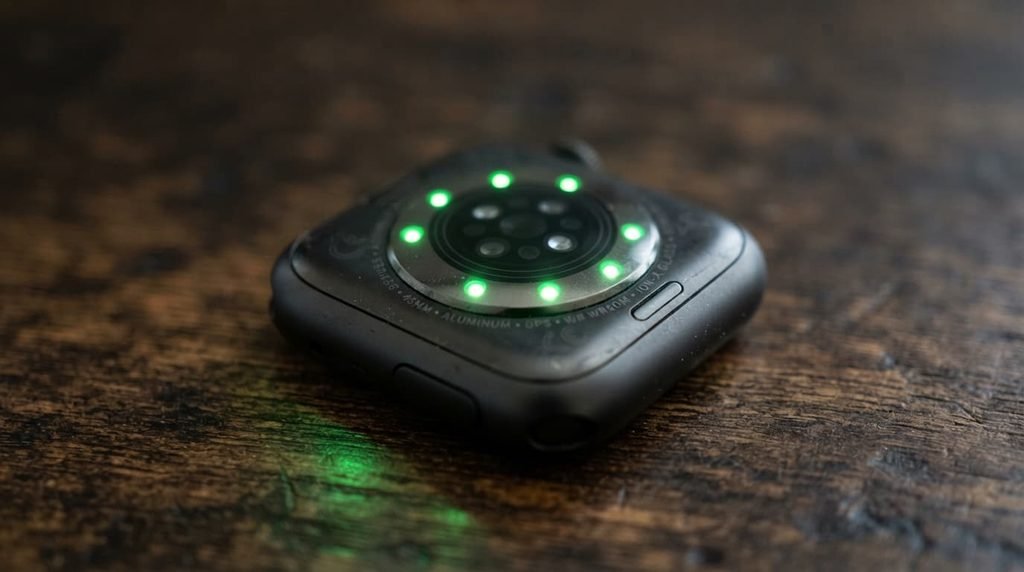
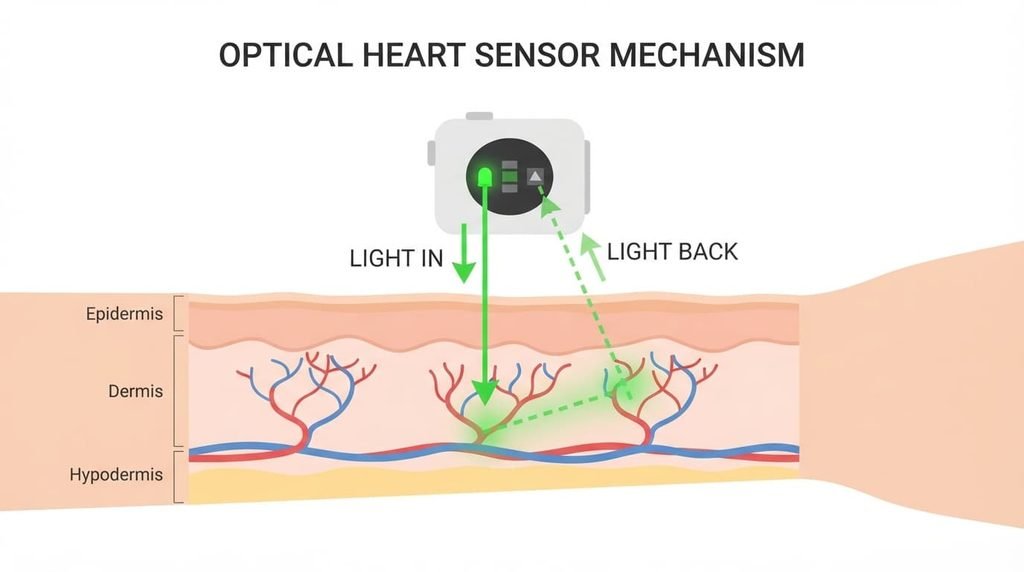
The watch switches on light-emitting diodes on its underside, usually green, and shines them into the skin of your wrist. Green light is absorbed strongly by blood, which is why it is the common choice for heart rate.
A light sensor beside the diodes measures the light that is reflected back from the skin and the tissue just beneath it. When blood volume in the small vessels rises with each heartbeat, more light is absorbed and less returns. Between beats, blood volume falls and more light returns. The result is a wavy line that rises and falls with your pulse.
The watch’s software then reads that wave. It counts the peaks, converts the count into beats per minute and smooths the result. Because your arm moves, it also uses a motion sensor to recognise swinging and bouncing and remove those patterns from the light signal.
To save battery, many watches measure at intervals when you are resting and switch to continuous measurement during a workout. That is one reason heart-rate tracking costs more power during exercise.
The analogy, and where it breaks
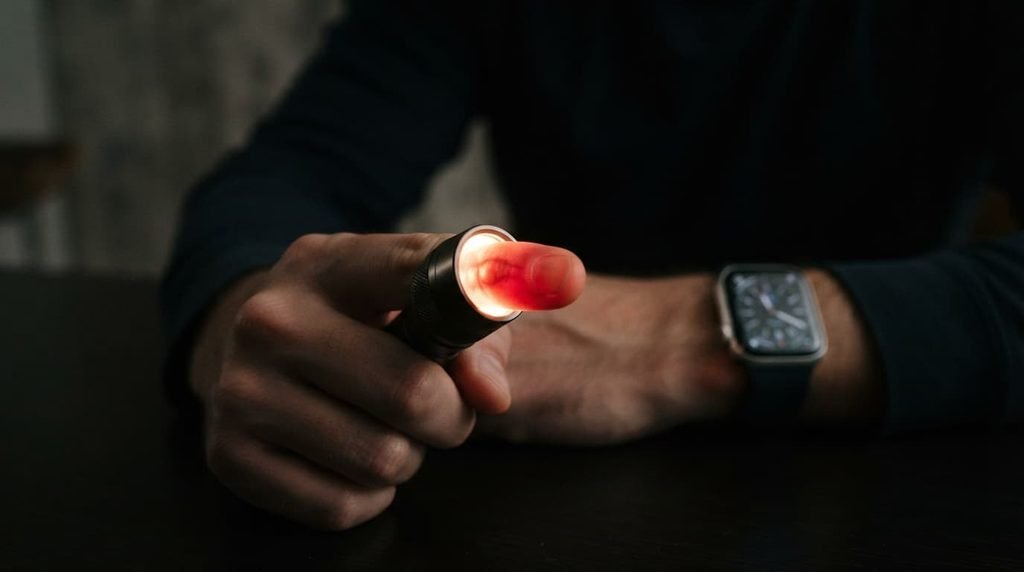
You can see the same effect by pressing a torch against the tip of a finger in a dark room. The glow that passes through the finger brightens and dims faintly with your pulse. A smartwatch does the same thing, but from the surface of the skin rather than through the finger.
The analogy holds for the idea that blood changes how much light gets through. It breaks because a torch through a fingertip passes light through a thin, well-supplied piece of tissue, while a watch has to read reflected light from a wrist, where the signal is weaker and easier to disturb. The watch cannot see your heart. It only sees small vessels near the surface of the skin, and it infers the rest.

What this does not explain
It does not explain why readings sometimes differ from a chest strap. A chest strap measures the electrical signal that makes the heart beat, which is a direct signal and does not depend on light, so it stays accurate during fast movement. A watch infers the rate from blood flow in the wrist, so rapid arm movements and changing grip can confuse it.
It also does not cover the other sensors. Some watches add red and infrared lights to estimate blood oxygen, and some have electrodes that record a short electrical trace when you touch the case, used to check the rhythm of the heart. These are different measurements with their own limits, and the heart-rate light is only the first of them.
What affects the reading
The fit of the strap matters first. A watch worn loose slides, lets in outside light and loses contact with the skin, while one worn snug on the wrist bone, a finger’s width above the wrist crease, usually gives a steadier signal.
Movement matters next. Steady activities such as walking and running with a regular rhythm are easier for the software than interval training, weightlifting or cycling with a tight grip on the handlebars.
Cold, tattoos, hairy wrists and darker skin can all weaken or confuse the light signal, because they change how much light is absorbed or reflected. Makers work to reduce these effects, but they remain a reason to treat a single reading with caution.
What people get wrong about it
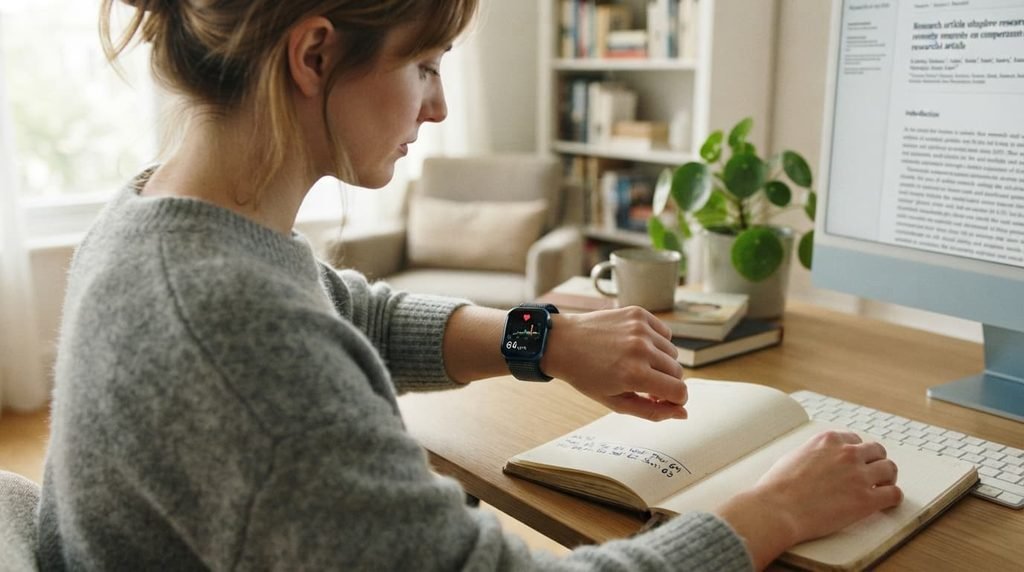
The first misunderstanding is that the watch measures your pulse in the same way a doctor does. It estimates the rate from light, and the estimate is only as good as the signal behind it.
The second is trusting one reading during hard exercise. A trend over a week tells you more than one number during a sprint, so compare like with like: the same time of day, the same activity and the same fit. Resting heart rate, measured while you are still or asleep, is the best use of the sensor, because there is little movement to disturb it and the trend over weeks says something about how you are doing.
The third is treating the number as a medical result. A smartwatch is a consumer device, not a diagnostic tool, so use it for patterns and not for deciding whether you are healthy or ill.
Where the popular explanation oversimplifies
The usual explanation says the watch “detects your pulse”. That makes it sound like a direct measurement. In practice it is a processed estimate: raw light data cleaned by software that tries to subtract movement and interference. Understanding that explains why the number can lag after a sudden effort, why it can jump when you swing your arms, and why two watches on the same person can disagree.
When the number is not the point
If you feel chest pain, dizziness, severe breathlessness or faint, seek medical help immediately, whatever the watch says. A normal reading does not rule out a problem, and a strange one is not proof of one. If a watch repeatedly shows a reading that worries you, tell a doctor and bring the pattern, not a single value.
Questions readers keep asking
Is a smartwatch accurate enough for training?
For resting heart rate and steady exercise, usually. For intervals or very high-intensity work, a chest strap tends to be more reliable, because it measures the heart’s electrical signal instead of light.
Why does my watch show a lower heart rate than the gym machine?
They measure in different ways and sometimes at different moments. Machines that read through the hands are sensitive to grip, and a watch is sensitive to fit and movement, so neither is a perfect reference.
Does a tighter strap help?
A snug, stable fit helps, but too tight a strap restricts blood flow and is uncomfortable. The goal is steady contact with no sliding, not pressure.
Can the watch tell me if my heart rhythm is irregular?
Some watches can flag irregular patterns and a few can record a short electrical trace. They can prompt a conversation with a doctor, but they cannot diagnose a condition.
Does the watch measure my heart rate all day?
Usually not continuously. Many watches take a reading every few minutes at rest to save battery and switch to continuous measurement during workouts. A brief spike between two readings can therefore pass unnoticed.