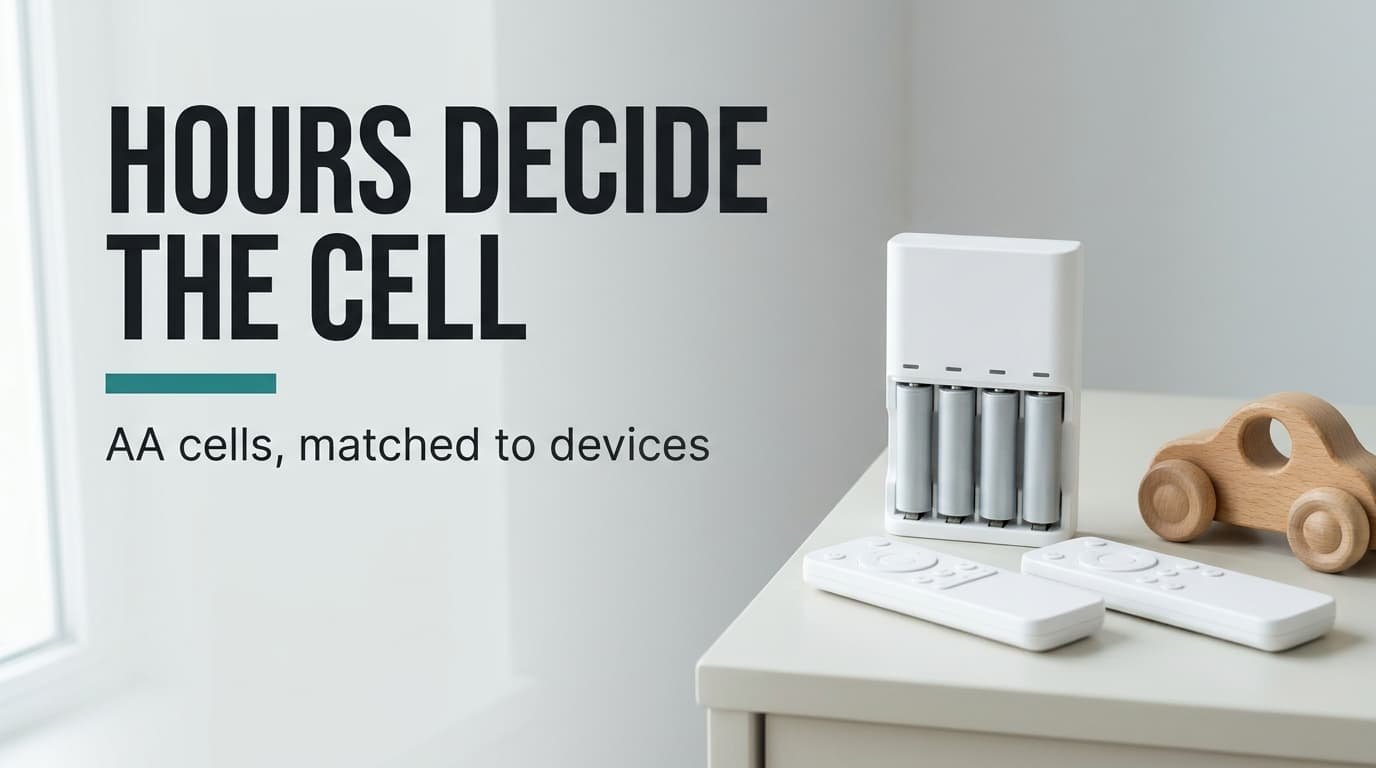
Rechargeable or disposable AA batteries turn on one figure, the hours a set of cells lasts inside the device. Our example is Maya’s house in Bristol, where a toy car sees an hour of play a week and a TV remote and a wall clock sit quietly beside it. The verdict splits, and each device gets its own answer. Rechargeables suit the toy, while disposables suit the remote and the clock. Maya changes about 59 cells a year, and 56 of them go into the car. Prices stay out of this piece, and every number is approximate, so time your own devices first.
What Decides Rechargeable or Disposable AA Batteries for Home Gadgets
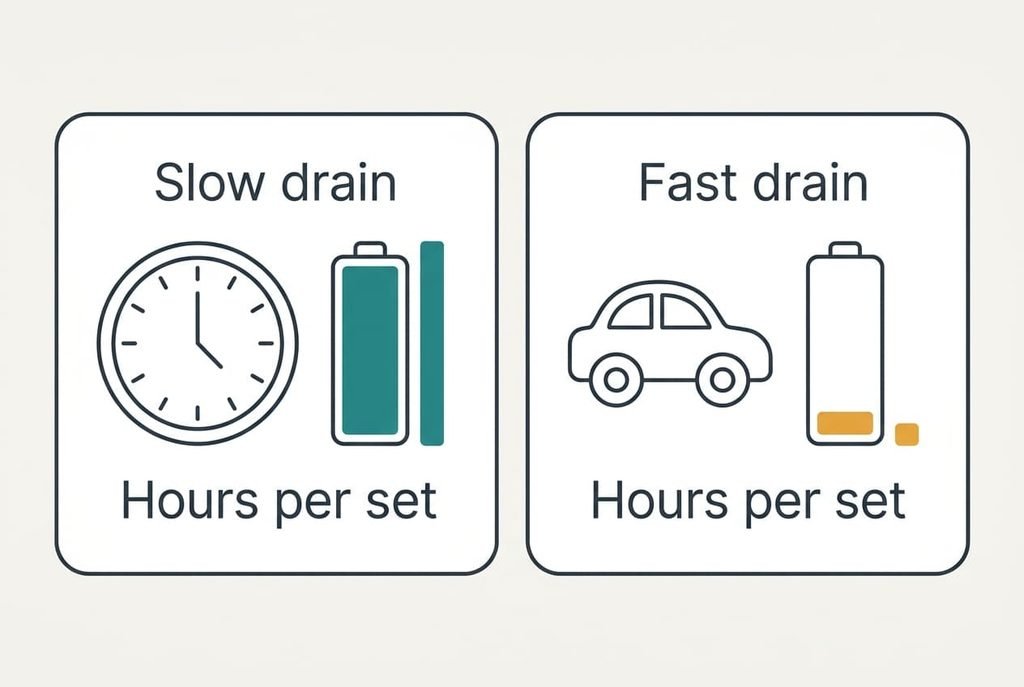
Begin by counting hours. A cell stores a set quantity of charge, so the hours it lasts depend on how fast the device drinks it. Maya’s toy car draws about 400 mA. A rechargeable cell of 2,000 mAh runs it for 5 hours, and a disposable cell gives up a quarter of its capacity at that rate, which leaves about 3.75 hours. Her wall clock draws 0.2 mA, so one disposable cell of 2,500 mAh keeps it going for 12,500 hours, or about 17 months. The remote sits between them, since two cells last about a year.
Find out how many hours a set lasts in the device ahead of any other comparison, because that one figure sorts every gadget in the house. Write the date you fit the cells and the date they give out. Two entries in a notebook are enough to answer it.
A set that empties in under 20 hours of use points one way, and a set that lasts a year points the other. The two ends of that range need different cells, which is why one answer for the whole house rarely works.
Hours settle it, whatever the box says.
Rechargeable and Disposable Cells, Row by Row
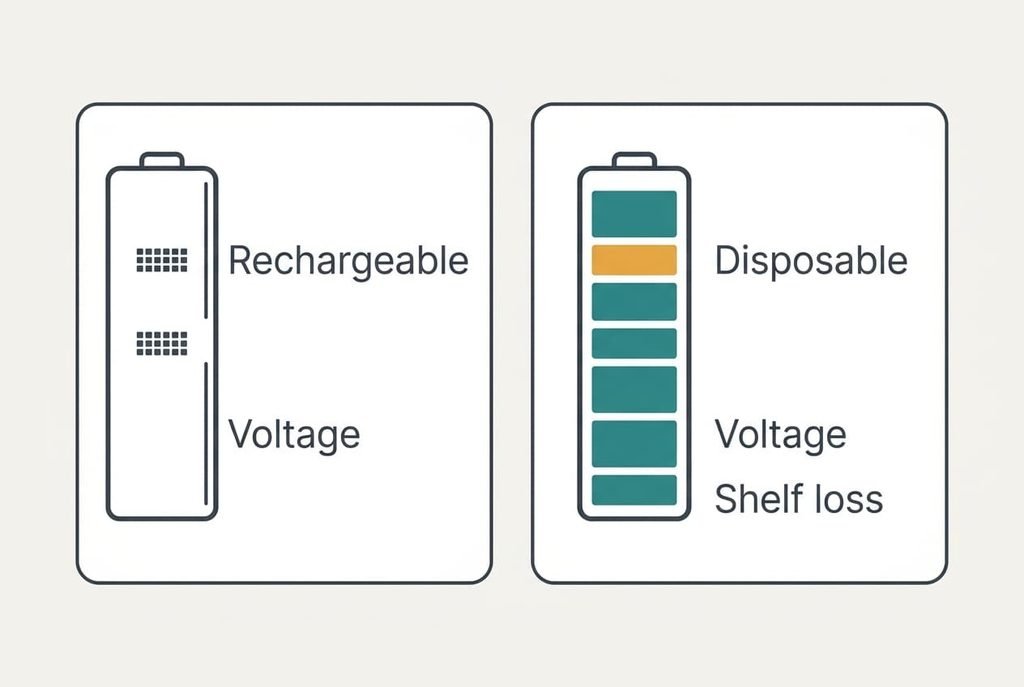
The table sets behaviour side by side. Price and charging speed stay out, because the hours above already settle both. Each row describes the cell and not any one maker, so it holds on any shelf. Rechargeable or disposable AA batteries differ most where a cell sits unused, so read each row against a device you own.
| Question | Rechargeable cells | Disposable cells |
|---|---|---|
| Voltage when full | 1.2 V | 1.5 V |
| Charge kept on a shelf | a fifth lost a month in a standard type, most kept for a year in a low-loss type | most kept for years |
| Ready when the device dies | only if a charged spare waits | yes, a spare sits in the drawer |
| Uses per cell | hundreds of charges | one |
| Cells used by the toy in a year | 4 | about 56 |
| Devices that accept them | nearly all, though a few flash a low-charge warning | every AA device |
The surprise is the voltage row. A fresh rechargeable reads 1.2 V where a fresh disposable reads 1.5 V, so a device that checks its cells can flash a low-battery sign on cells that are full. Maya’s remote does exactly that, and it’s a reason to keep disposables in it.
Where Rechargeable Cells Win
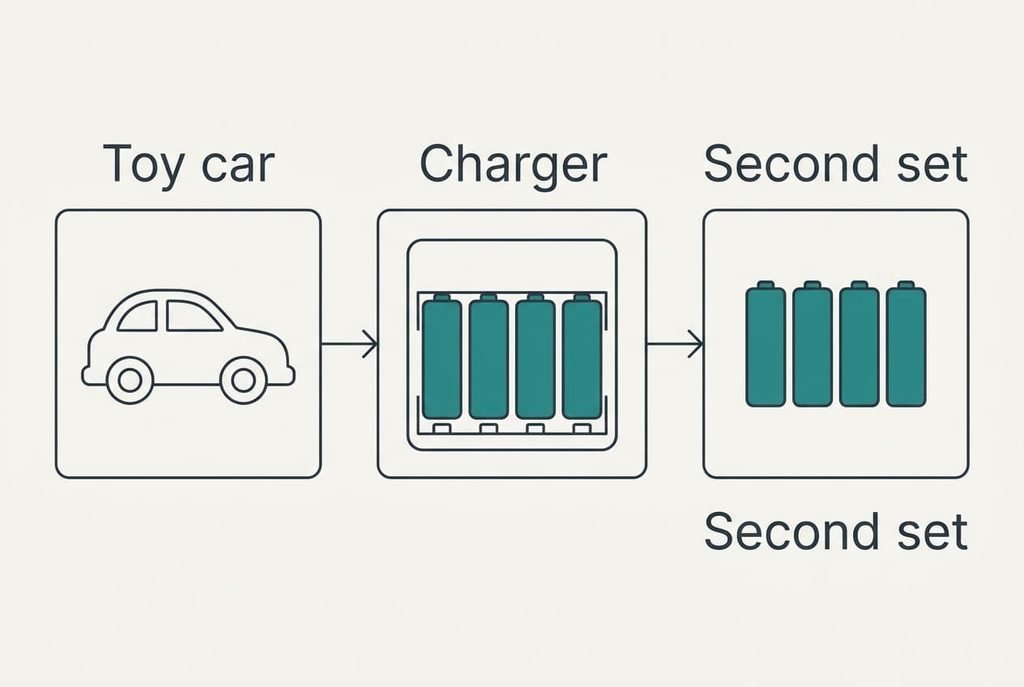
The toy car is the clear case. Maya’s 56 disposable cells a year come to 14 sets of four, each lasting 3.75 hours. A single set of rechargeables gives 5 hours a charge, so the same 52 hours of play need about 10 charges. Four cells replace 56, and the charger sits on a shelf for the other 355 days.
A second set removes the wait. Charging 2,000 mAh at 250 mA takes about 8 hours, so one set charges overnight while the other is in the car. The toy is never flat on a Saturday morning.
Frequent use hides the weak point of these cells. The charge they lose on a shelf doesn’t matter when the cells are used within days. A game controller used nightly or a torch used most evenings suits the same arrangement. For rechargeable or disposable AA batteries, hours of use per week is the figure that favours the rechargeable.
Check the charger as well. It should hold the cells until they’re full and then stop, and it should take four at once.
Where Disposable Cells Win
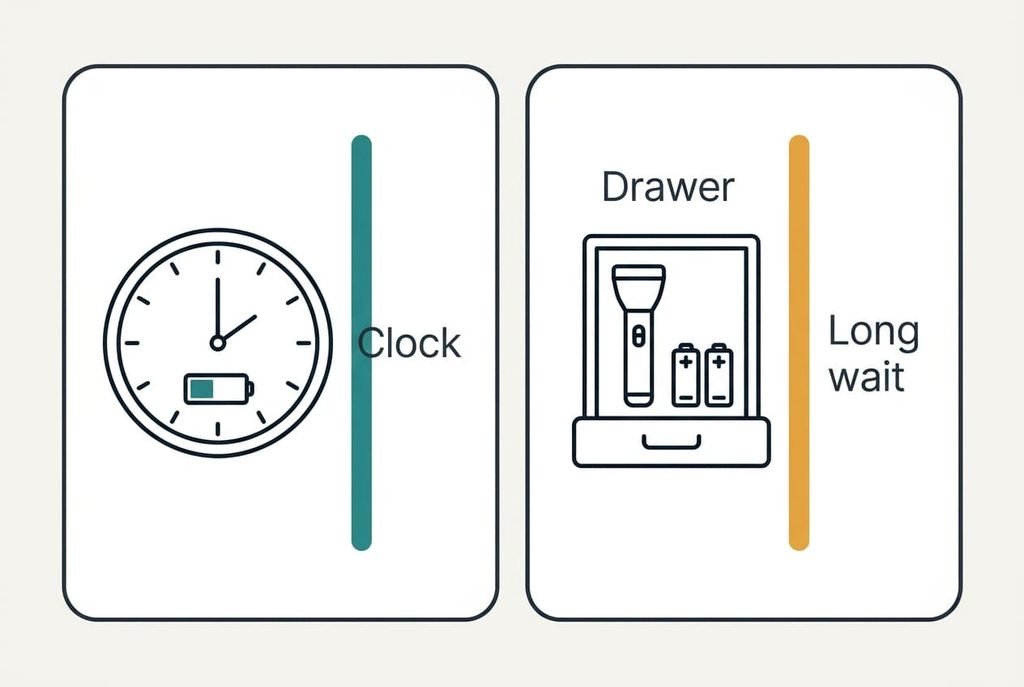
The clock is the mirror image. One disposable cell runs it for 17 months with no attention, and the cell never sits waiting for a charge. A rechargeable in the same clock has to be topped up every few months, and the day you forget the clock stops.
Shelf loss decides the rest. Take a standard rechargeable that loses a fifth of its charge each month. After three months in a drawer it keeps about half, since 0.8 × 0.8 × 0.8 is roughly 0.51. A torch kept for a power cut would then give half the light it should. A disposable cell in the same drawer holds most of its charge for years.
The remote shows the voltage point. Its two cells last about a year, so a rechargeable pair would need charging four or five times to match one pair of disposables, and the low-battery sign could appear on full cells. That’s effort for no gain.
Disposables win wherever the device is used rarely or draws very little.
When Neither Suits the Device
Some devices fit neither cell. A gadget with a sealed battery, or one that takes a different cell size, leaves AA batteries out of the question altogether. Look at the back panel of the device before you shop, since a coin cell can’t be replaced by either kind. If the device takes a smaller size such as AAA, the same hours rule still applies. Count the hours first, then pick the type.
A mains adapter sometimes beats both. A wall clock that hangs near a socket needs no cell at all, and the adapter removes the 17-month chore. Where a lead would cross a doorway, a cell is still the better route.
Forwarding the choice to the device’s own manual saves a mistake. It names the cell type it expects and often the lowest voltage it accepts. A manual that lists only disposable cells has probably been tested only with 1.5 V, so a rechargeable pair may misbehave.
Which to Buy: Disposable or Rechargeable Batteries?
If the device empties a set in under 20 hours of use, buy rechargeable cells and a four-slot charger. Keep a second set so one is always ready. Charge them overnight and mark the date you first used them. Retire any set that no longer lasts half as long as it did.
If the device sits unused for long spells or runs for months on one set, use disposable cells. Keep a spare pair in the drawer next to the remote, and write the fitting date inside the battery cover. Replace both cells at once, so a fresh cell never works beside a tired one.
Settle rechargeable or disposable AA batteries one gadget at a time, not for the whole house. Time each device for a month and sort it by hours. Then give each group the cell it suits. The toy will repay the change quickly, and the clock won’t notice. Recheck in a year, because a new gadget changes the count. Stick the results on the inner face of the cupboard door.
Questions Readers Keep Asking
How much effort do rechargeable cells take?
About two minutes a week for a toy that gets daily use: slide the cells into the charger at bedtime and swap them in the morning. A remote or a clock would need a reminder every few months. Effort rises as use falls, which is why those devices suit disposables better.
What if a rechargeable cell stops holding its charge?
Test it by timing the device. If a set lasts half as long as it used to, retire the cells. Use disposables as cover until a new set arrives. Cells in a set age together, so replace all four at once rather than mixing one new cell with three old ones.
Which suits a remote control and a wall clock?
Disposables suit both. The remote draws so little that rechargeable cells would need charging four or five times a year, and the clock could stop if a charge ran out. A pair of disposables in each lasts a year or more and asks nothing from you beyond a note of the date.