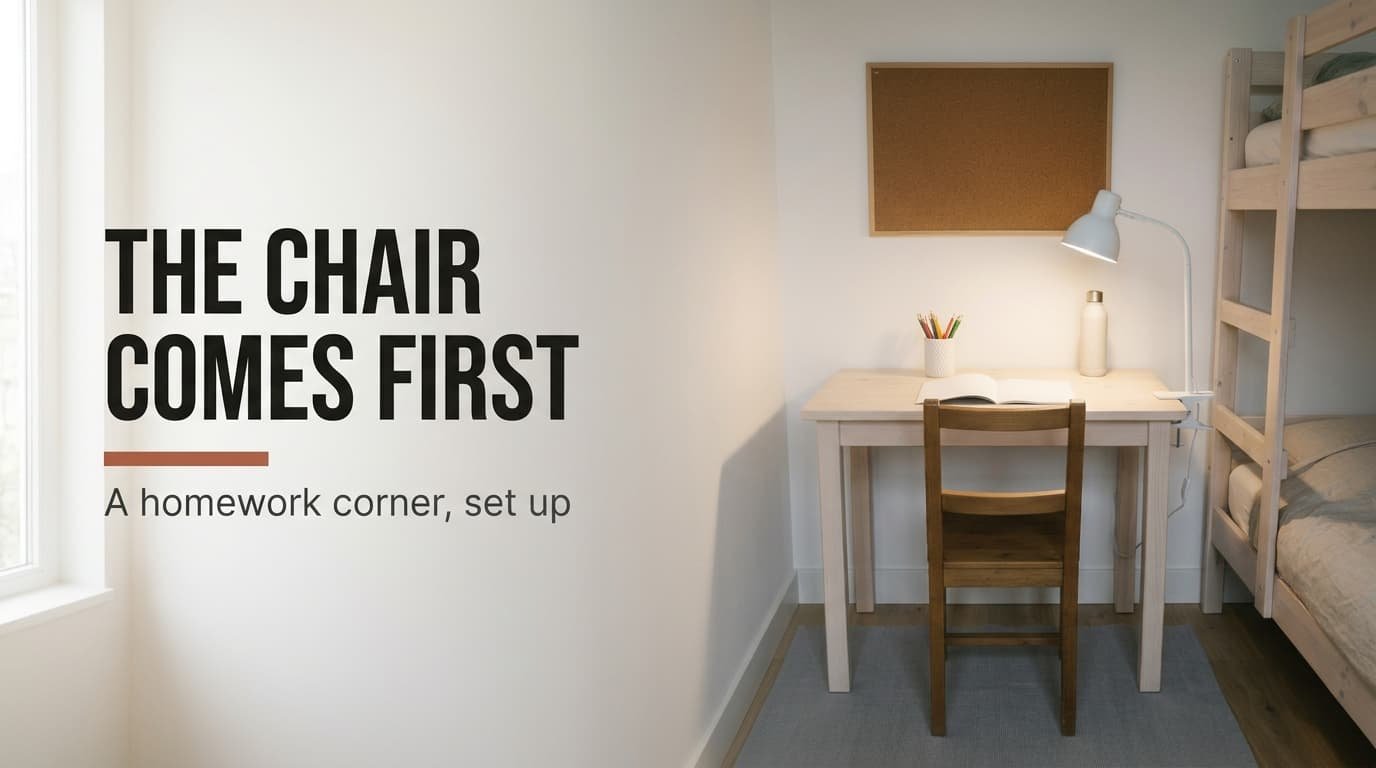
A homework desk in a shared bedroom needs five purchases, and their sequence weighs more than any one pick. Our example is an eight-year-old who lives with a younger sister in a room of 3.2 m by 3.6 m, in a rented Utrecht flat where the walls stay free of drill holes. The child stands 130 cm tall and works for about 40 minutes each evening. Buy the items singly, and pause on the evening the work gets done without a fight. Read each figure as an estimate, and measure your own child before you spend anything.
The rule that sets the order of every purchase
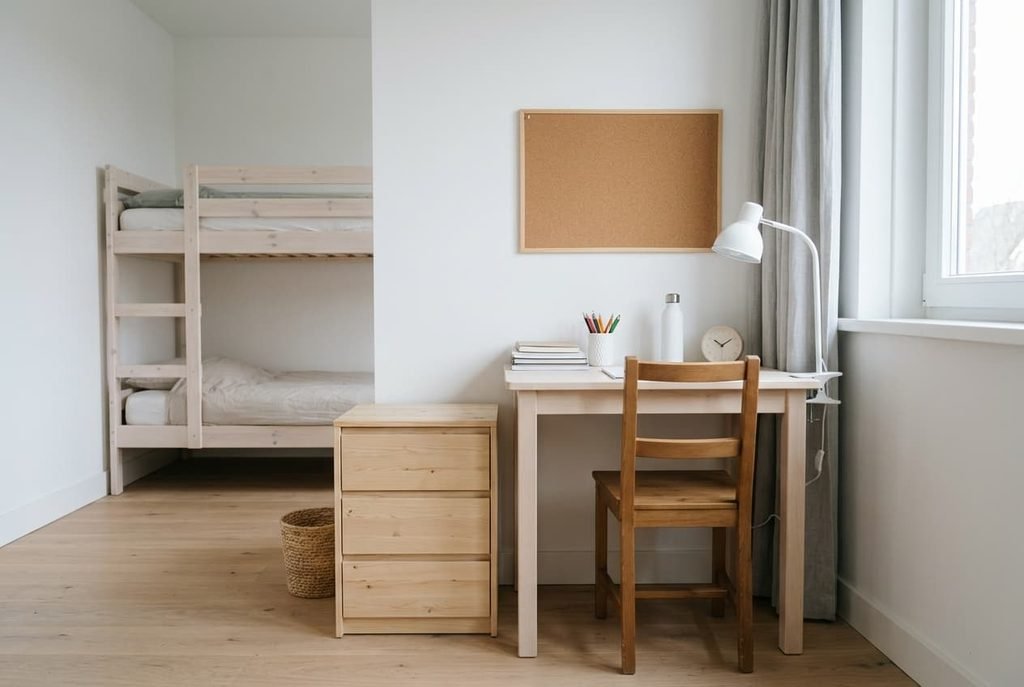
Start from the child, since furniture only works when it matches one body. A seated child needs both feet flat on the floor and thighs level, with the elbows at desk height. At 130 cm tall, our child has a lower leg of about 34 cm, so the seat has to sit at 34 cm. The desk top then goes 26 cm above the seat, which puts it at 60 cm.
Match the chair to the child before you choose anything else, because a desk is only as useful as the seat beneath the child. A chair that’s 6 cm too tall leaves the feet dangling, and the child shuffles forward onto the front edge. A desk or a lamp can be corrected later with a cushion or a shim, whereas a wrong chair can’t be. The numbers shift every year. A child gains about 5 cm in height and roughly 1.3 cm of lower leg, so a seat that adjusts is worth its extra cost from the start.
The shared room adds a second limit. Ours holds two beds and a wardrobe, leaving a gap of 110 cm under the window, so the desk may be 100 cm wide at most. A wider top blocks the chair from sliding back.
Space decides everything after the chair.
Five purchases for a homework desk in a shared bedroom, in order
1. A chair with a seat that adjusts from 30 to 42 cm comes first because every other measure follows from seat height. Tier: BUY ONCE. Construction matters here. A steel gas lift or a threaded column holds its height for years. A plastic ratchet slips after a few hundred adjustments and lowers the child by 3 cm mid-sentence. Sit on it and lean your weight to one side. A chair that creaks or sinks under a firm push should go back.
2. A desk 100 cm wide and 55 cm deep, with a top at 60 cm, comes second. The work needs room for two open exercise books side by side. Tier: MID. A top made of 18 mm board stays flat across 100 cm, but a 12 mm board sags about 3 mm under 8 kg of books. Press the middle with both hands, then lean on one corner. Any bounce means the sag will come later. Legs with two height holes let the desk grow with the child.
3. A lamp on a clamp, with an arm reaching 45 cm, takes third place. The shadow of the writing hand falls across the page when the light comes from the wrong side. Tier: MID. Metal joints with a friction washer hold the head where you set it, while a plastic joint droops within weeks. Extend the arm to full length and tap the head. It should stay put. Clamp it opposite the writing hand, about 30 cm from the page.
4. A unit of three small drawers, 30 by 35 by 40 cm, ranks fourth. It holds pencils plus spare exercise books. Tier: BUY CHEAP. Plain plastic runners in a moulded shell are enough, since a drawer of stationery carries no great weight. Slide each drawer in and out five times in the shop. A drawer that catches on its runner will jam by the end of a school term.
5. A cork pinboard of 60 cm by 40 cm closes the list. It carries the timetable plus the week’s spelling words. Tier: BUY CHEAP. A board with a stiff backing stays flat on the wall, whereas a thin one curls at the corners. Flex it gently and treat any bend that stays as a fault. Hang it on adhesive strips, since the lease rules out holes.
Why the drawer unit is the item to scale down
Of the five, the drawer unit is the purchase a parent can skip with the least regret. A lidded box of 3 litres holds a term of pencils and rulers, and it asks for much less money and floor than a unit. Our child’s stationery fills about 2 litres, while the unit holds 36 litres, so it invites clutter in proportion to its size.
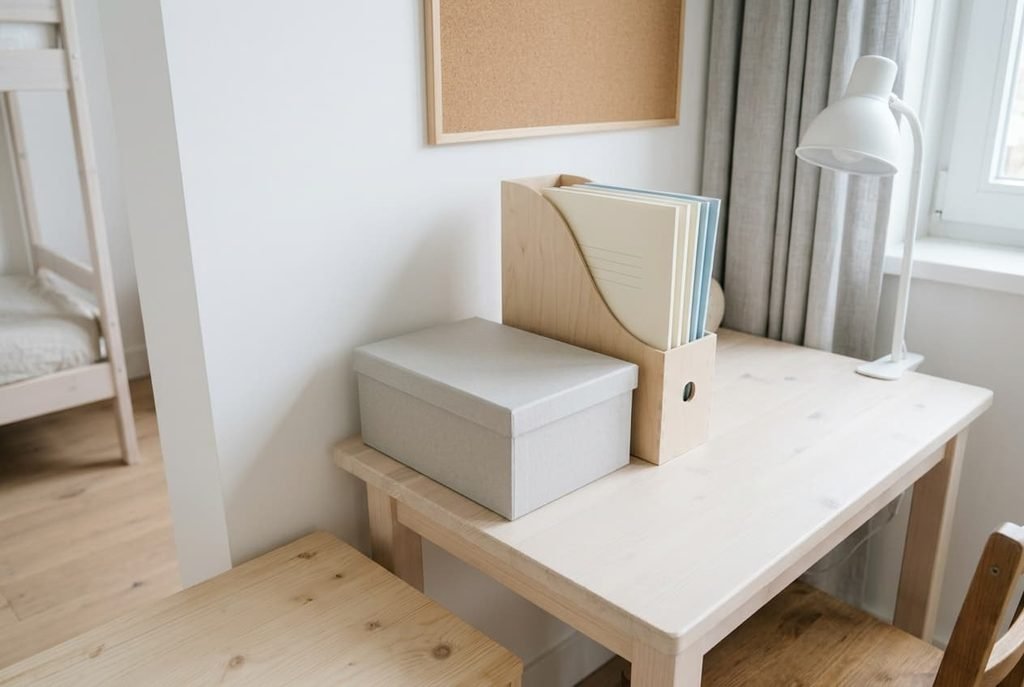
Floor space matters more. The unit covers 30 by 35 cm, nearly a third of the 110 cm gap under the window. A box sits on the corner of the desk, and a magazine file holds the exercise books upright beside it. The floor stays clear for the chair to slide back, and the corner looks tidy even on a bad evening.
Wait a month before buying the unit. If the box overflows twice a week, the unit has earned its place, and you’ll know which drawer you want most. If it doesn’t, the savings go towards a better lamp. A homework desk in a shared bedroom works with fewer containers than most parents expect.
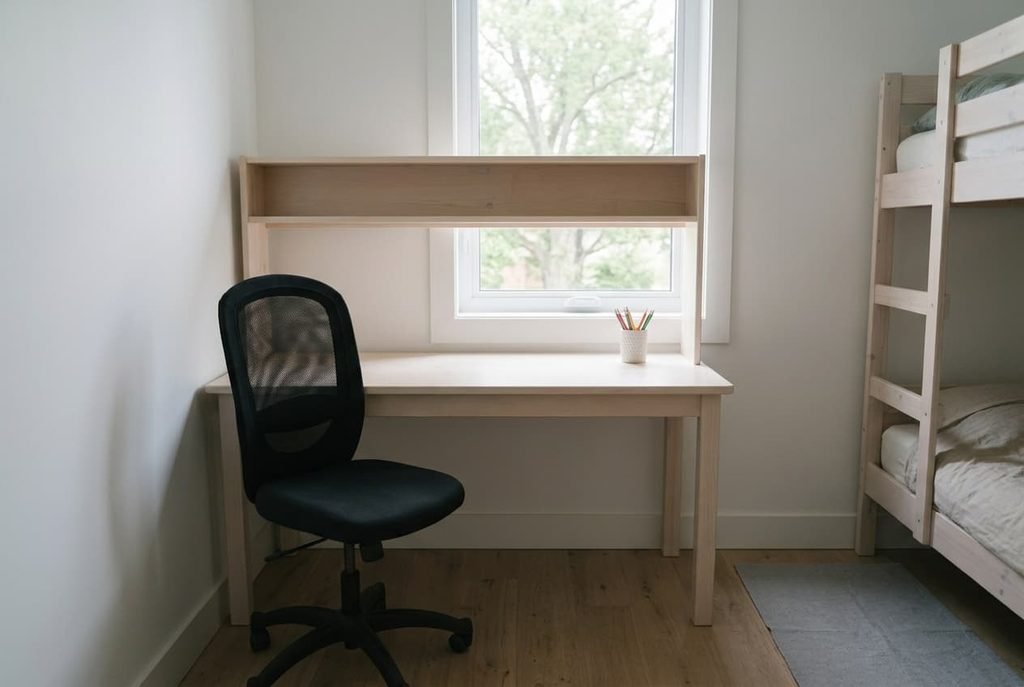
What a shared bedroom changes about a child’s homework desk
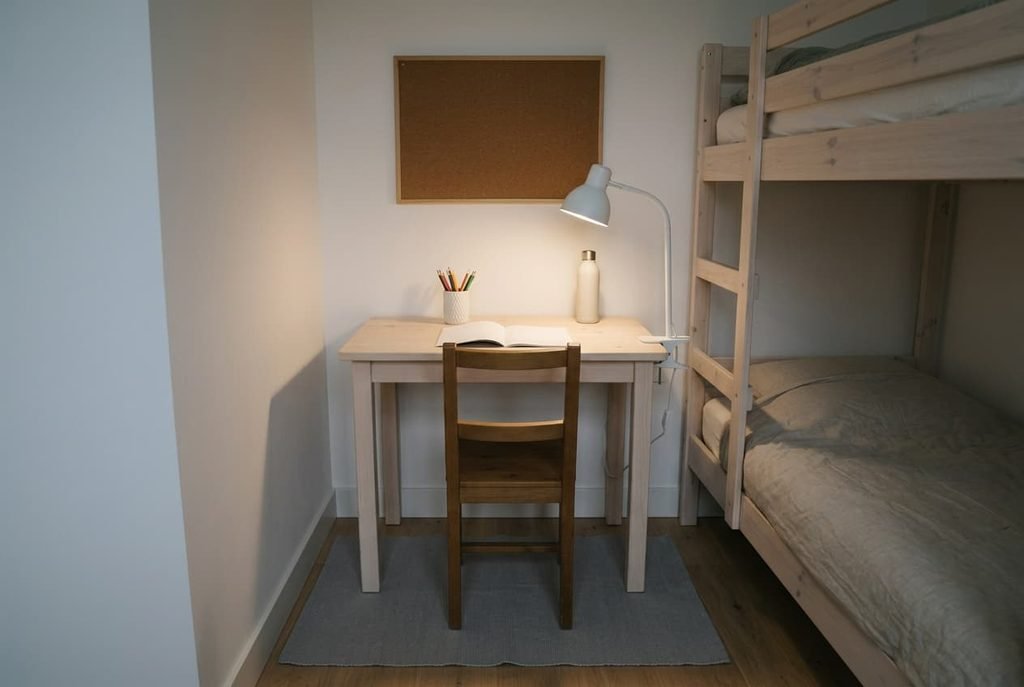
A sister who goes to bed at 19:30 sets the finishing time. The lamp has to light the page and keep the bunk side of the room dim. That’s why a clamp lamp with a narrow beam beats the ceiling light. Turn the desk to face the wall, so the child’s back is to the bunk and the other bed stays out of view.
Agree a slot of 17:30 to 18:10 for the work, when the younger child is at the table with her own drawing. Noise is the usual complaint, so a rug measuring 1.2 by 0.8 m under the chair takes the scrape out of the floor.
Clear the desk each evening before bed. The pinboard keeps the timetable in sight and the box holds the pencils, so packing away takes two minutes. A homework desk in a shared bedroom stays calm only if both children can see where their own things go.
Give each child a shelf of their own, and share only the room.
What to skip entirely
Skip the desk with a built-in hutch, because the shelves above it sit across the lower 40 cm of the glass and cast a shadow on the page. You pay for storage that blocks the daylight the child needs. Skip the full-size office chair too, since its seat usually can’t drop below 42 cm and the child’s feet would dangle.
Leave out the desk organiser set of twelve pieces as well. A child uses four of them, and the rest gather dust on a surface that’s only 55 cm deep. Also pass on a second lamp, because one lamp with a good arm does the job. A footstool is another extra, since an adjustable seat already puts both feet on the floor.
The test of a homework desk in a shared bedroom is how little fuss the finished corner asks for. Stop adding items when these five cover the 40 minutes you expect, and spend any savings on a chair that grows with the child. Choose a date each September and adjust the seat and the lamp together. A growing child outpaces any fixed setup within a year or so. Revisit the corner after a month and move whatever annoyed you.
Questions readers keep asking
How many items do I need before I start?
Two: the chair and the desk. Together they cover sitting and writing, and that covers most of a child’s evening. The rest answers a narrower need, so add the lamp when the days darken. Start there, then watch what slows the work before you buy anything more.
In what order should I buy them?
By the cost of a wrong choice later. A chair that’s too tall wears on the child every evening, so it leads. The desk follows once the seat height is known, then the lamp. The drawer unit and the pinboard wait until the first three have proved their worth.
How do I judge a desk lamp in a shop?
Clamp it to a counter and extend the arm to its full 45 cm. A good lamp stays where you leave it. Tap the head and tilt the arm up and down, and listen for any creak. Check the cable length too, since a short one tugs the head out of position.