You touch up a scuff on the living-room wall and leave it to dry. Then the neat little square shines back at you from across the room, and it’s all you can see. Fresh paint shows as a patch for reasons the tin never mentions, and each reason has a separate remedy. The model wall here belongs to a Dutch rented flat. It measures 260 × 350 cm, and the scuff was 12 × 12 cm. The numbers are made up to show the method. Measure your own wall with the same steps, because real walls differ.
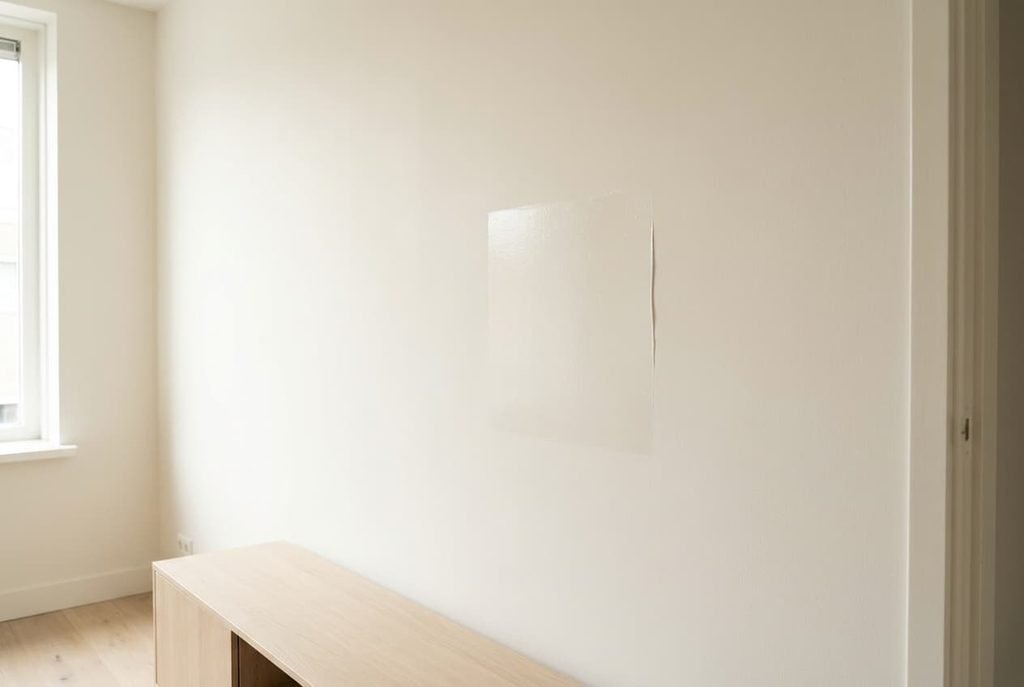
Why fresh paint shows as a patch even in the right colour
Three separate things make a patch visible, and the light decides which one you notice. The first is sheen: a thicker new film that dries with a different gloss from the coat around it. The second is texture. A roller leaves a fine stipple and a brush leaves smooth strokes. A patch made with the wrong tool reflects light differently from its surroundings. The third is colour, because a wall that has seen five winters of daylight and cooking has drifted a little away from the colour in the tin.
Light exaggerates the first two. A ridge casts a shadow 5.7 times its own height when light skims in at 10°. When light drops from above at 60°, the shadow is only 0.58 times the height. The same ridge is therefore about ten times easier to see under skimming light. In the model room the window faces you from the left end, so daylight runs along the 350 cm side through most of the day. The patch covers 144 cm² of a 91,000 cm² wall, which is 0.16% of the surface, and your eye still finds it.
A 12 cm square has 48 cm of boundary for the light to catch.

Confirm which kind of patch your fresh paint shows
Three quick tests sort the cases, and none takes longer than a minute. Gather a torch and a bank card first. First, hold a torch flat to the wall a few centimetres off, so the beam skims across the patch at a low angle. Texture or sheen is the culprit when the patch appears only under that beam, because both react to the direction of the light. Second, draw the edge of a bank card across the patch. A catch you can feel marks a lip of dried paint or a shallow dent, and a lip needs sanding more than it needs paint. Third, stand 3 m away at midday with the torch off. A patch that still shows then is a colour mismatch, and no amount of rolling will cure it.
Most scuffs give two answers at once, such as a faint lip together with a slight tint shift. Note which tests found something. The fixes below are arranged so that each one matches a result, so you can quit once the patch vanishes at 3 m in daylight.
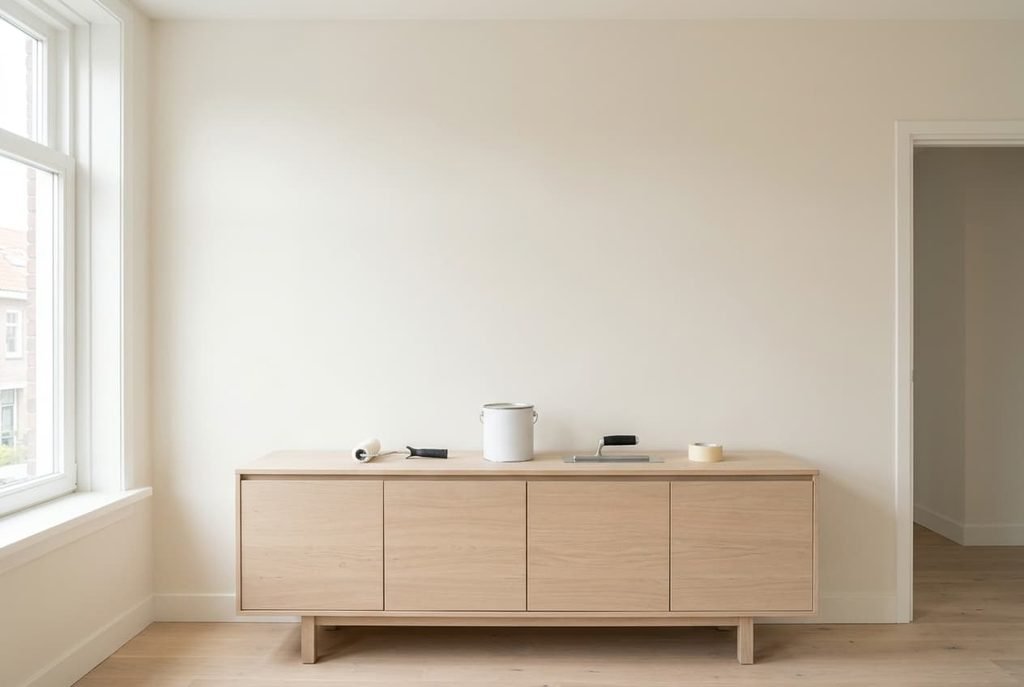
Four fixes, from free to professional
Each fix answers a different test result, so your notes point to the one you need when fresh paint shows as a patch on your wall. The first costs nothing and the last needs a tradesperson.
Re-roll the patch with the same roller and leftover paint, then feather outward, which corrects texture and sheen. Load the roller lightly and work over a 40 × 40 cm square centred on the patch, which is 1,600 cm² or about eleven times the damaged area. Keep the pressure light and finish with long, even strokes while the edge is still wet. It costs ten minutes, provided the leftover tin was stored sealed. A roller changes only the character of the surface, so any colour shift stays where it is.
Have the paint matched to the wall as it is today, which targets colour. A shop can read a sample taken somewhere hidden, such as the back of a wardrobe or the wall behind a door. It then mixes a tin to suit the aged wall instead of the original recipe. Expect to spend a little and visit the shop. The weakness is the sample itself, because a spot that never saw daylight can read a shade too dark.
Repaint the whole wall from corner to corner, so the edge itself disappears. With no boundary inside the wall, the light has nothing to catch except the corners, where a shadow line already hides the join. The model wall is 91,000 cm², so the job is 632 times the area of the scuff. It needs a tin sized by the coverage on its label and an afternoon’s work. Mask the ceiling line first. Tenants may need the landlord’s consent first, and one wall in a new coat can make its neighbours look tired.
Hire a plasterer to skim the damaged area flat, which changes the surface itself. When the scuff left a dent deeper than about 2 mm, no paint can fill it. A flat skim followed by a fresh coat gives one continuous surface. It’s the dearest option, with a booking to make and several days of drying. A skim is a patch until it’s painted, so you’ll return to the earlier fixes afterwards.
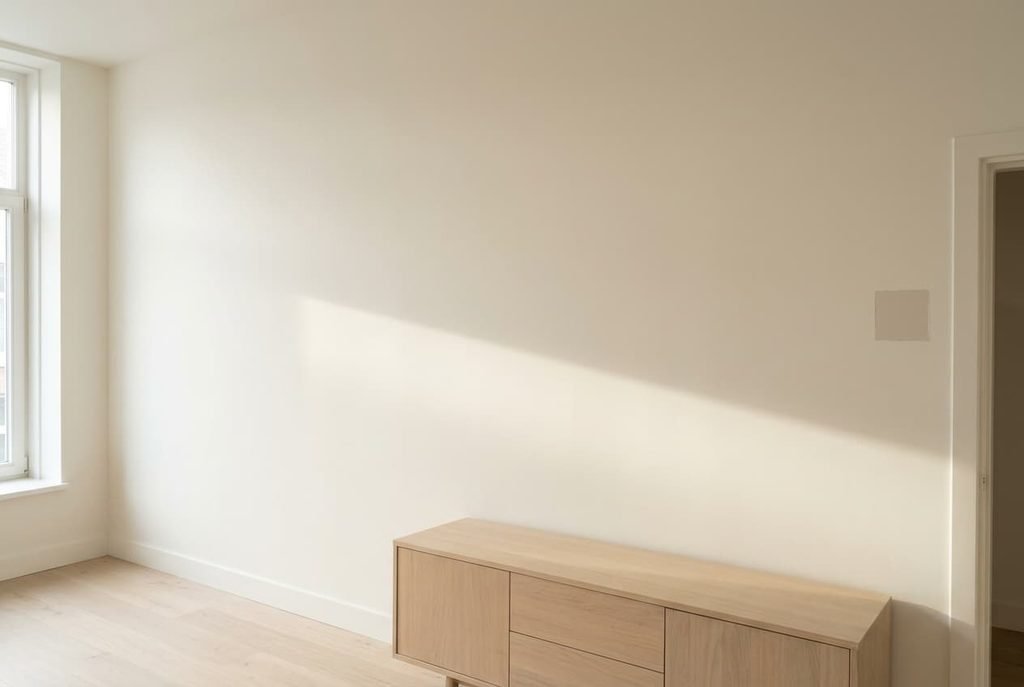
What this room’s own wall and window mean for you
Two features of the model room can’t change. The window at the left end sends skimming light along the whole 350 cm side. A ridge in the paint will show at some hour, whatever you do. The scuff also sits 110 cm above the floor beside a doorway, where a passing bag will brush it again.
Those two facts set your expectations. The window makes texture and sheen the priority, because skimming light finds them first. Beside the doorway, the scuff will probably return, so a quiet patch today is worth less than a wall that tolerates the next knock. Paint and tool are yours to change, but the window is fixed, so judge every result in its own light. If fresh paint shows as a patch only in the evening sun, texture is to blame. A colour fix won’t help.
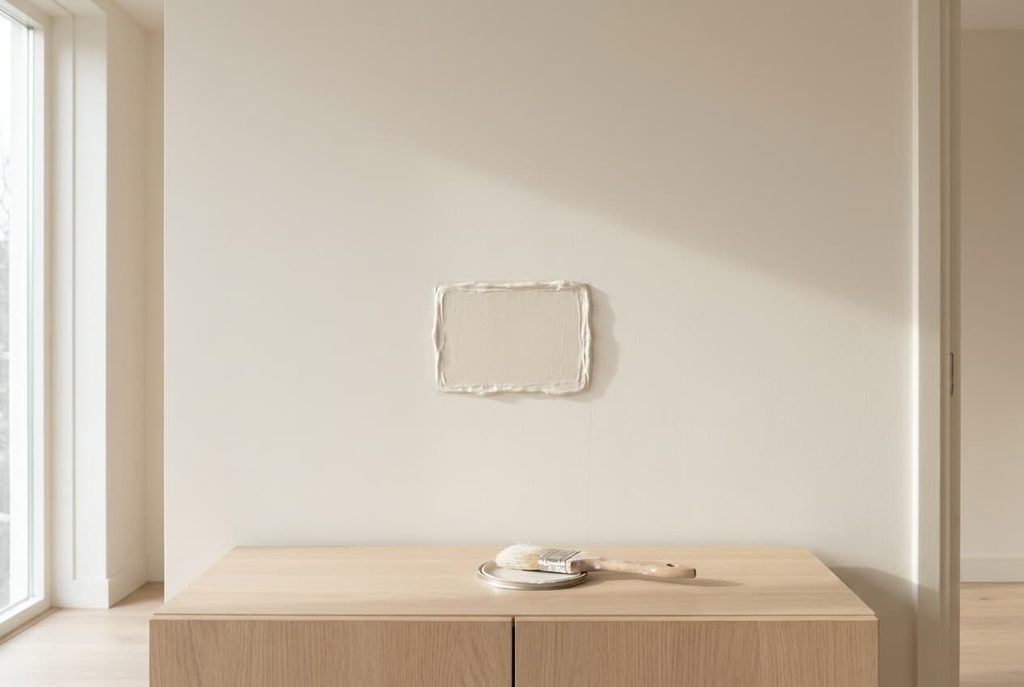
The fix that doesn’t work
Adding coat after coat to the patch until it blends in is the common mistake. Each coat thickens the film and builds the ridge, so the edge casts a longer shadow and the extra gloss grows with it. After four coats the patch can be easier to see than the scuff was. Painters call the effect flashing when a coat dries unevenly, and more coats on the same spot only repeat it.
Another dead end is a brush-on touch-up from a small pot of nearly matching paint. Brush strokes sit smooth beside a stippled roller finish and catch the light differently. A third is scrubbing the area first with a strong cleaner. That can polish the old coat and widen the gap in sheen, so the repair starts further behind than the scuff did.
None of these changes why the patch stands out.
Run the tests before you open a tin, because the results tell you why fresh paint shows as a patch on your wall. Then pick the cheapest fix that answers them, and judge the outcome at 3 m in midday light with the torch off. A patch that stays hidden through a week of mornings and evenings counts as fixed. One that reappears at dusk sends you on to the next remedy.
Questions readers keep asking
Can a patch that has dried for months still be blended?
Yes, in most cases. Paint that has cured for months still takes a light sanding. A leftover roller coat feathered across a 40 × 40 cm square can hide a mismatch in texture or sheen. A colour mismatch needs the shop-matched tin instead, so run the tests before you pick a fix.
Is repainting the whole wall the expensive answer?
It’s the biggest job of the four, though not the dearest. A plasterer costs more than a tin and an afternoon. Start with the free re-roll, and move to the whole wall only if the patch survives it, because the cheap fixes cost nothing to try.
Why does the patch show only when the sun is low?
Low sun skims along the wall and turns every ridge into a long shadow, about ten times longer than light from above at the same height. At midday the effect fades. That points to texture or sheen, so re-roll with leftover paint before you buy anything.