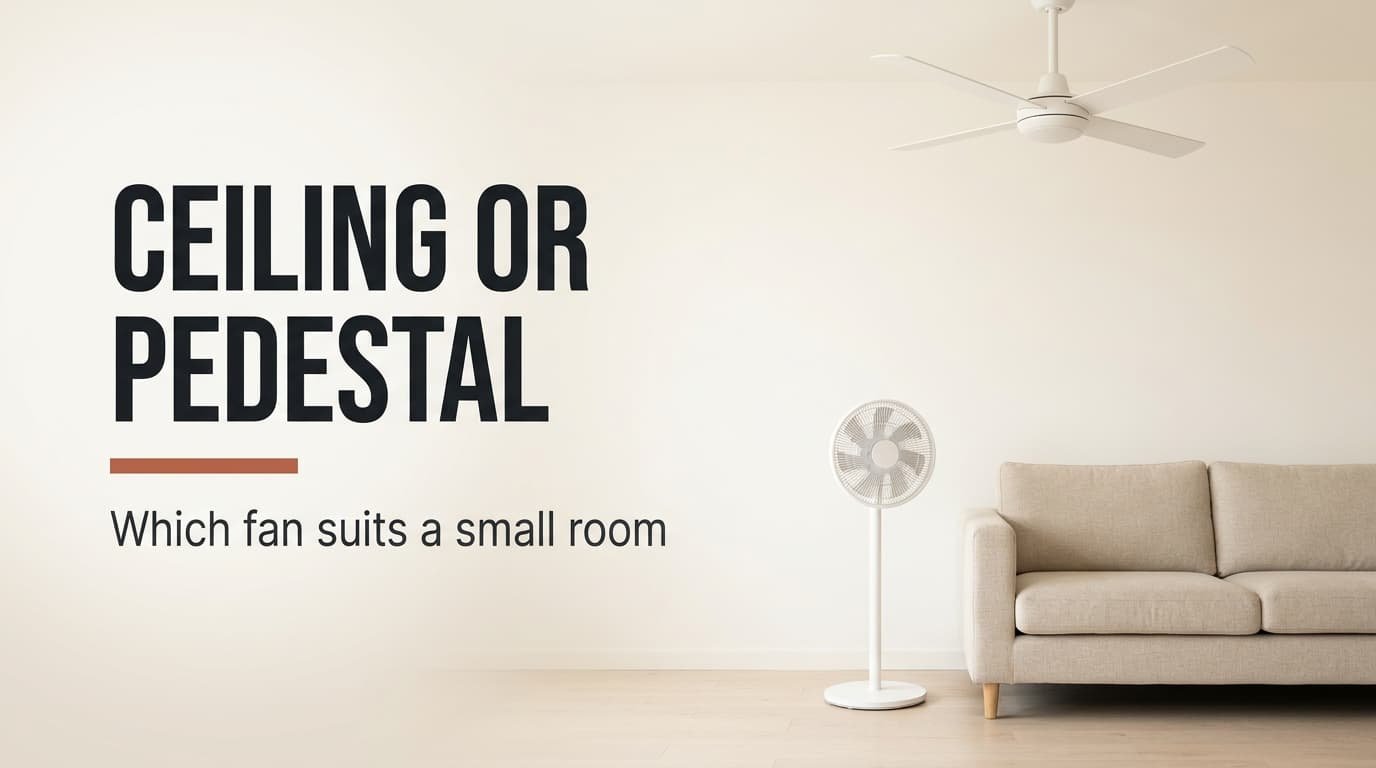
Choosing a ceiling fan or pedestal fan sounds like a question about airflow, yet in a small Dutch living room a tape measure answers it first. The room here measures 320 × 420 cm and has a 2.5 m ceiling and a 200 cm sofa along one short wall. Both fans can move air through that much space. What truly differs is where each one stands, what it demands from the building and how easily it leaves with you. We’ll compare them on those points, follow each through ordinary use and then look at a route with no fan at all. A pair of simple rules ends the page.
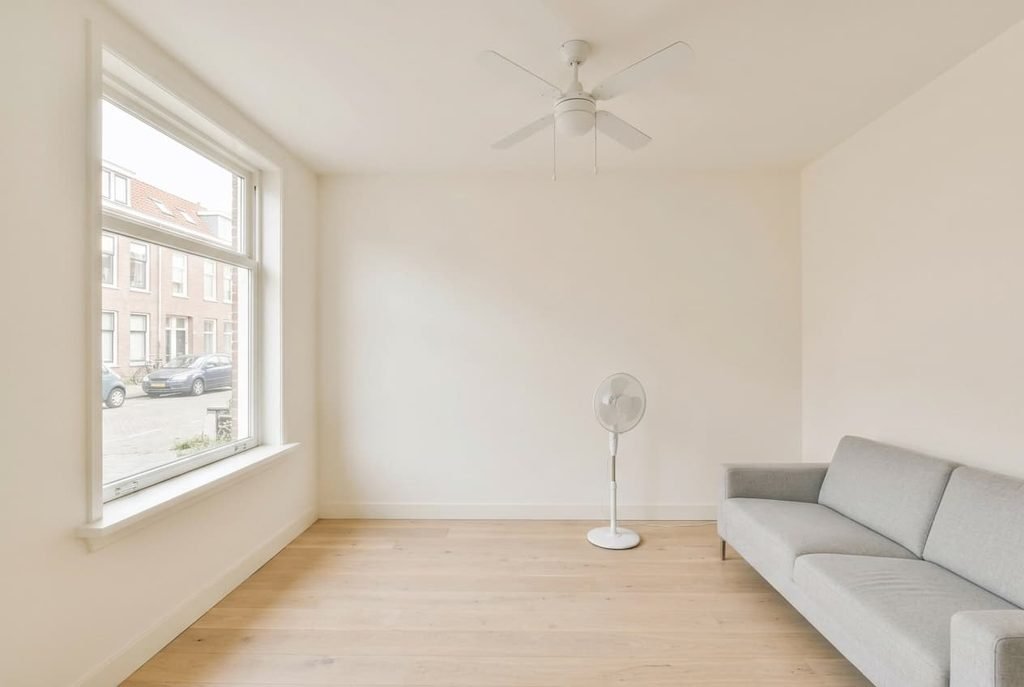
How a ceiling fan or pedestal fan compares in a small living room
A fan cools nobody directly. It moves air past you, which makes the useful question where that air goes. Put simply, the two differ in that one pushes a column down from overhead and the other throws a stream you can aim. Overhead here means 160 cm from each long wall and 210 cm from each short one. A fan 107 cm across hanging there has blade tips roughly 65 cm from the sofa’s seat edge. Nobody sits under the blades. The breeze reaching the sofa is the column spreading sideways once it meets the floor, which weakens it a little on the way.
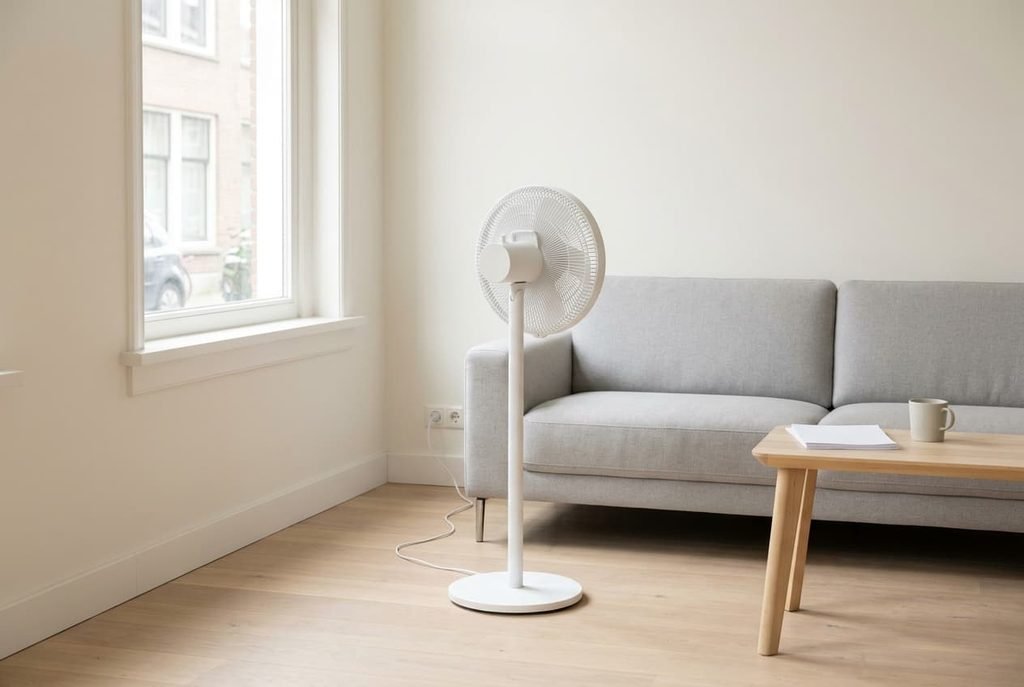
A pedestal fan goes wherever its cord allows. Parked 150 cm from the sofa with its head level with the seat, it sends the stream at the people who want it, and a turn of the head redirects it to the armchair.
That sketch skips the fitting, and for this room the fitting matters more than the breeze. Noise levels and speed settings count as well, though they follow from the choice rather than steer it.
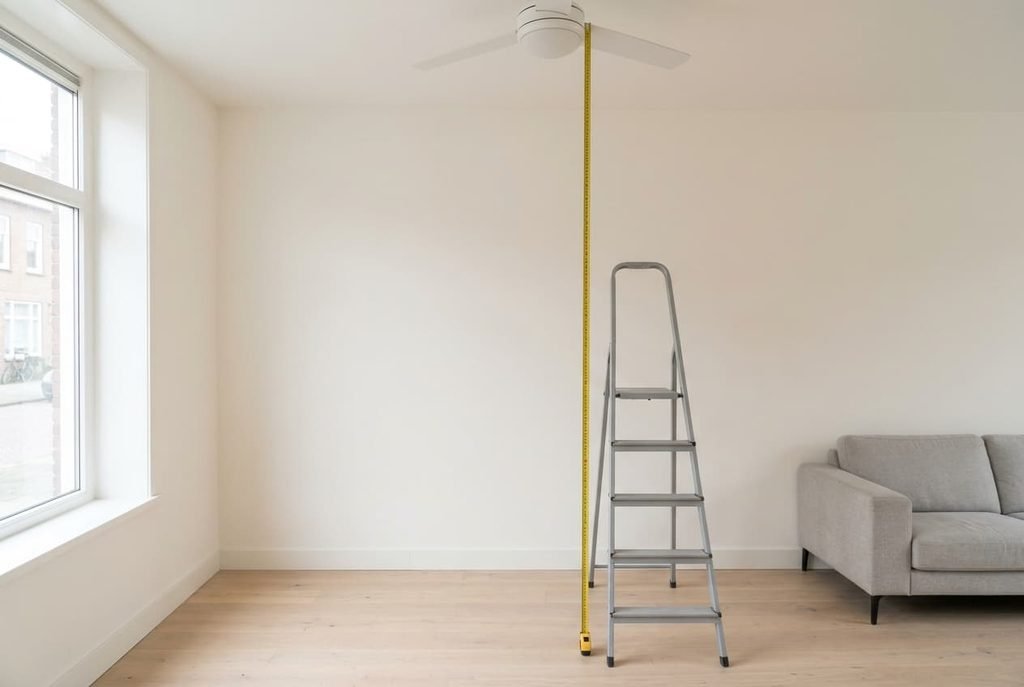
The ceiling is only 250 cm high, and that single number can decide the matter before airflow gets a vote.
The two fans side by side
Six properties separate this pair. Each one is a matter of geometry and wiring, so it holds for any model you could buy. A table lays the split out faster than a paragraph about one model could, and the rows below are worth reading downwards.
| Property | Ceiling fan | Pedestal fan |
|---|---|---|
| Floor taken | none | a base 40 cm across, 0.13 m² |
| Air path | down from overhead, then sideways | one stream, swinging about 90° |
| Height needed | 230 cm to the blades, plus the motor above them | a column about 120 cm tall |
| What the building must give | a ceiling box and an electrician | a socket within cord reach |
| Aim | none, so it serves every seat alike | turns to whichever seat is in use |
| Leaving | removal and a capped ceiling box | fold the stand and store it |
A ceiling fan takes no floor and treats every seat alike. Our pedestal fan takes 0.13 m² and answers to whoever holds the plug, which is the better trade for a tenant. Rooms near 250 cm are decided by the height row, so the next section starts there. Anyone with a taller ceiling can weigh the other rows more heavily instead.
How a ceiling fan behaves day to day
Most makers ask for the blades to hang at least 230 cm above the floor. Take 230 from our ceiling of 250 and only 20 cm remain to hold the entire machine, mounting bracket included. A flush-mount model dropping 25 cm would leave the blades at 225 cm, so they fall 5 cm short. Only a low-profile design with a total drop of 20 cm at most passes here, and every extra centimetre of ceiling widens the field.
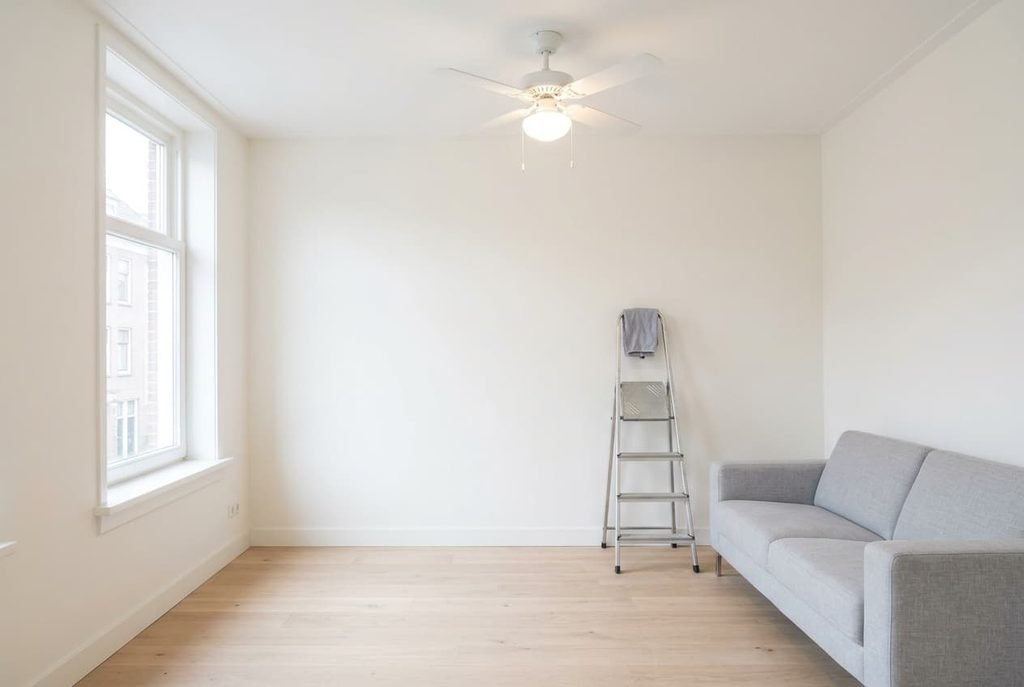
The fitting needs a ceiling box built to carry a fan, wired by a qualified electrician with the landlord’s agreement. That work stays when you move out. Weighing a ceiling fan or pedestal fan for a rental, you’ll find this point alone leans towards the pedestal.
After that, upkeep is light. Dust settles on the top face of each blade, out of sight. A stepladder and a damp rag deal with it twice a year. There’s no cord on the floor and no aiming, since the fan serves every seat. Its limit is that everyone gets the same column whether they want it or not.
How a pedestal fan behaves day to day
A pedestal fan costs no ceiling height, because its column stands about 120 cm tall. It spends floor instead. The base, 40 cm across, covers 0.13 m², or 0.9% of our 13.44 m² room. Set in a passage 90 cm wide, it leaves 50 cm to walk through.
The cord decides the range. A lead 2 m long reaches no further than the socket permits, so the final position is often what the wall allows, not what the sofa suggests. An extension lead stretches the reach but adds one more cable to cross the floor.
Control is the upside. The head turns towards the sofa one evening and towards the desk the next afternoon, and it can sweep about 90° to share its stream. Loose sheets of paper near that stream slide off a table, so keep the fan near the seat and away from the work surface. The stand unscrews when the weather turns, and the parts fit into a cupboard. Cleaning means lifting off the front grille and wiping the blades, five minutes in all.
The third option: let the window do the work
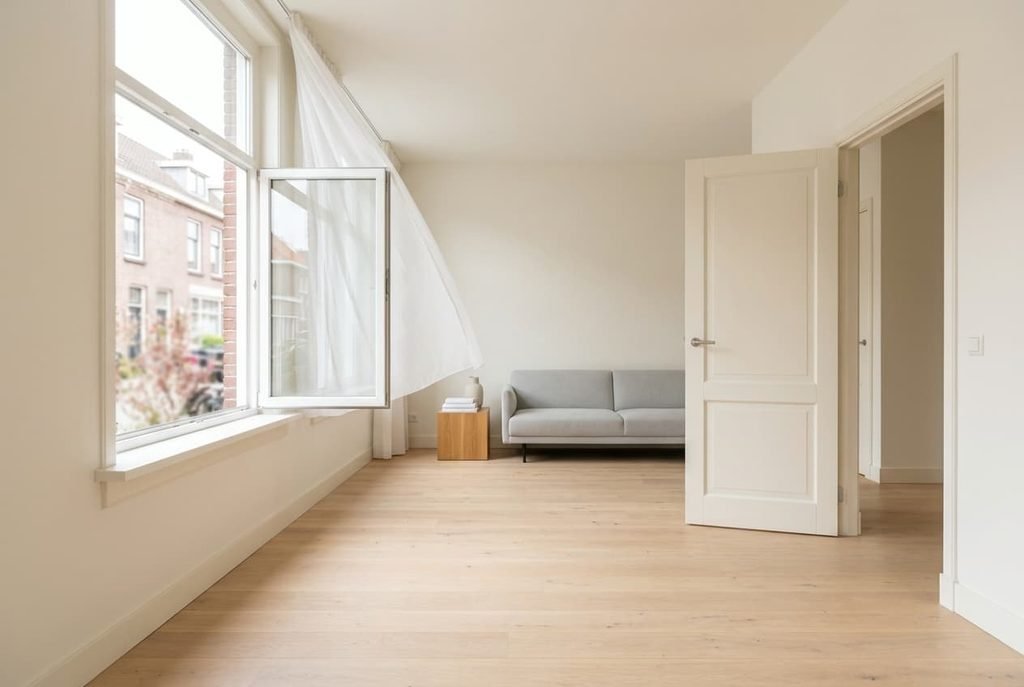
Some rooms need neither machine, because you can open the window in a long wall, then the door in the opposite one, so the air crosses 320 cm of floor. A path that long refreshes the whole room for nothing, and it keeps working even if the money meant for a ceiling fan or pedestal fan goes elsewhere.
The route has limits. It needs outside air that’s cooler than the room, so it works best early and late in the day. On a still day it does almost nothing. A window facing a busy street also lets the noise in, which some households would rather avoid.
Treat the open window as a trial run first.
Should the room feel comfortable with it on most warm days, a fan is only needed for a handful of evenings, and a stand fan kept in a cupboard covers that cheaply. A failed trial costs nothing, and it tells you which fan to look for.
Which suits a small living room: pedestal fan or ceiling fan?
When you rent, or the ceiling stands below 255 cm, choose the pedestal fan. You pay with a patch of floor, 0.13 m², and a cord to manage. You gain aim and an untouched ceiling, and the fan moves house with you. Place it 150 cm from the sofa and check the stream at seat height.
Once you own the flat and the ceiling reaches at least 255 cm, pick the ceiling fan. You pay with an electrician and a fixed position. You gain a clear floor and moving air in every corner. Confirm that the blades will hang at 230 cm or higher before ordering.
With a ceiling fan or pedestal fan on the shortlist, subtract the model’s drop from the room height and compare what remains with 230 cm. A shortfall ends the debate in favour of the pedestal fan. A pass leaves a matter of taste, so sit where you sit most and ask whether you’d prefer air from overhead or from the side. Either answer is fine once the number has passed.
Questions readers keep asking
Which wears out first?
Both run for years with ordinary care. The part that tires first is usually the motor bearing, and a sturdy metal housing tends to outlast thin plastic. A ceiling fan stays put, whereas a pedestal fan gets carried about. Its stand and plug take more knocks over time.
How often should the blades be cleaned?
Wipe both faces of a ceiling fan’s blades twice a year, since dust builds slowly up there. A pedestal fan lives at head height and collects dust faster. Wipe its grille and blades monthly, and unplug it first. Damp cloth does the job, since a dry one only pushes the dust around.
Which fan suits a flat with a sloping ceiling?
The pedestal fan, nearly every time. A ceiling fan hangs on a straight rod and needs a level ceiling at a sensible height, so a sloped roof rarely offers a spot. The pedestal fan stands on the floor wherever the roof is high enough and ignores the shape above it.