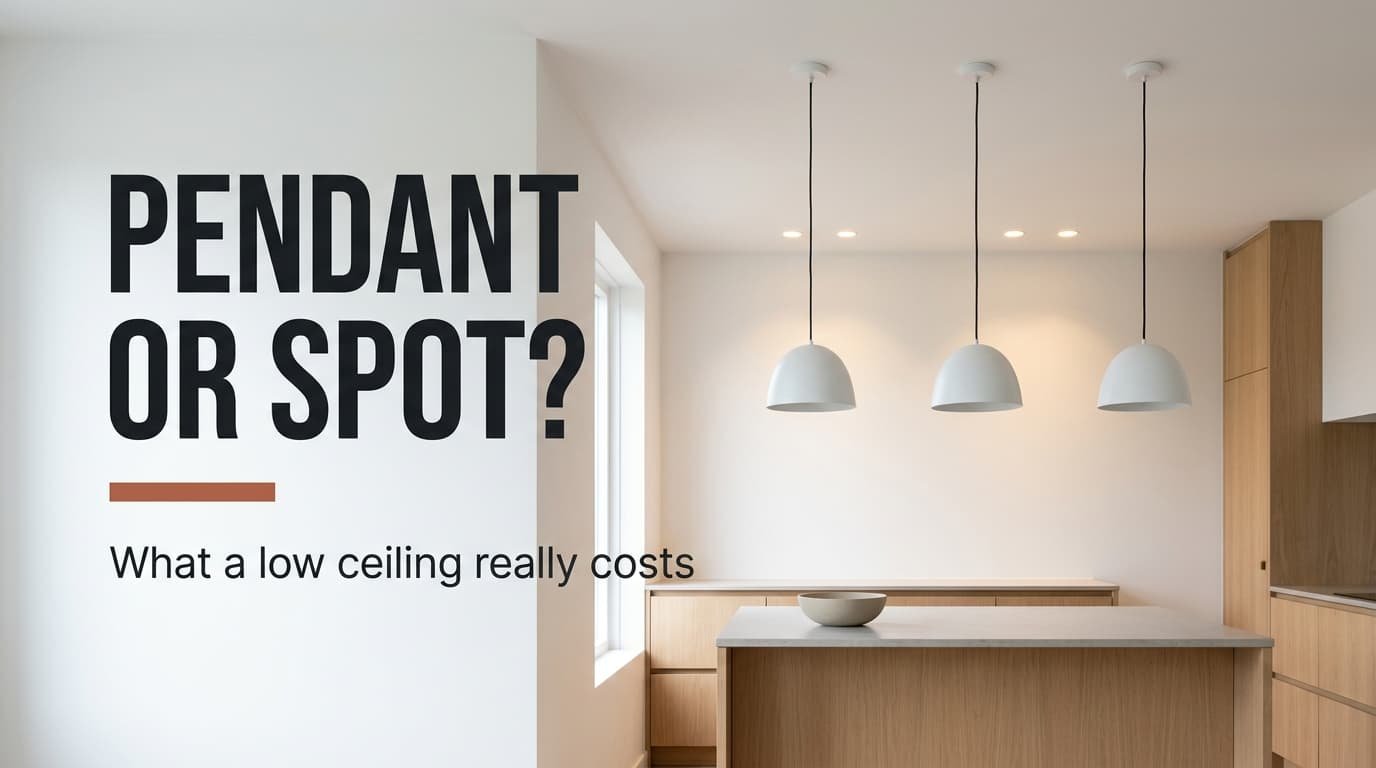
A low ceiling matters less to this choice than what sits above it. Pendant lights or recessed spotlights both promise to keep a kitchen feeling tall, yet they spend height in opposite ways. A pendant takes a large bite from one small patch of ceiling. A recessed spot takes a thin slice from every square metre, unless a void already hides it. The example here is a Dutch kitchen 400 cm long and 330 cm wide, with a 235 cm ceiling and a concrete slab above it. Replace these measurements with your own as you read. Ten minutes of measuring will tell you which of the two costs you less.
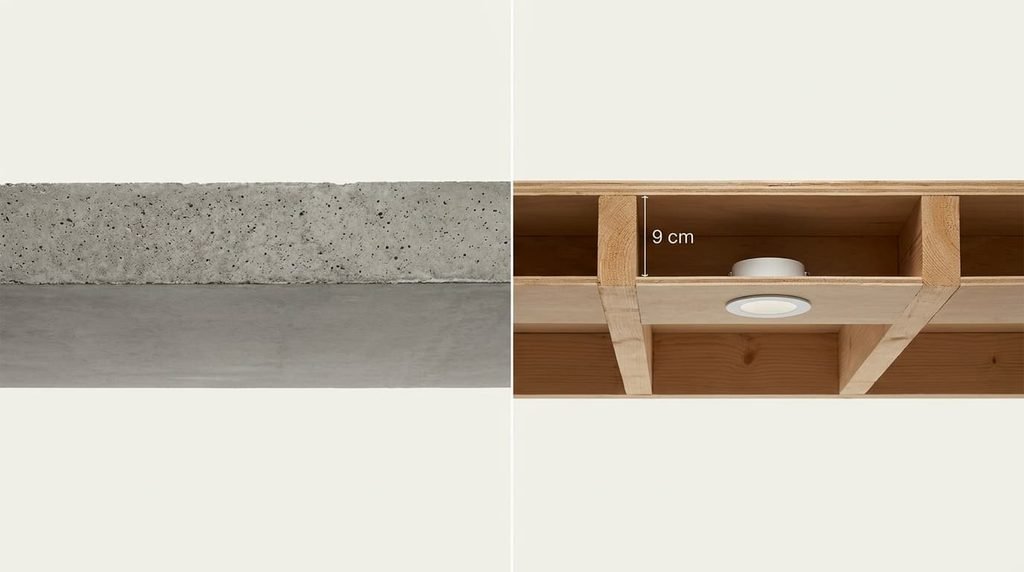
The one property that decides pendant lights or recessed spotlights
A recessed spotlight sits inside the ceiling, so it needs a void above it. The fitting and its driver together need about 9 cm of depth. A concrete slab has no void, so the only way to fit spots is to build a false ceiling below it. A frame of 3 cm plus the 9 cm of depth lowers the ceiling by 12 cm everywhere. In the example that takes 235 down to 223, which is 5% of the height across all 13.2 m² of floor.
A pendant takes the opposite route. It hangs from a single point. A shade whose bottom edge sits at 190 cm drops 45 cm below the slab. Over an island of 180 by 90 cm that touches 1.62 m², or 12% of the floor. The rest of the ceiling stays at 235 cm.
So the choice is a trade between a deep drop in one place and a shallow drop across the whole room. If a void of 9 cm or more already sits above you, the spots cost no height whatsoever. The pendant’s 45 cm then looks expensive by comparison. If the slab is solid, the pendant’s concentrated drop is usually the cheaper loss.
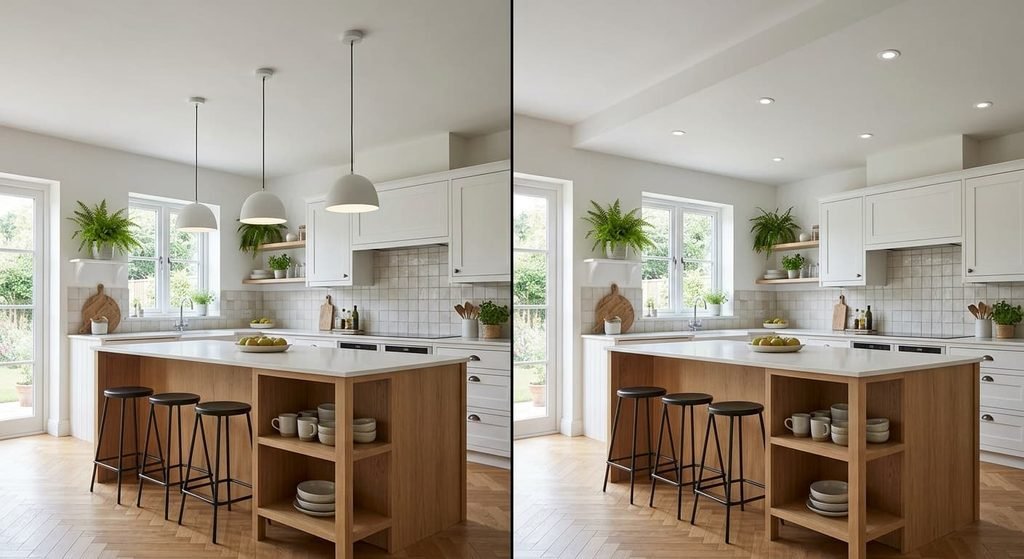
Head to head: recessed spotlights or pendant lights in a low ceiling kitchen
The table uses the example kitchen, with a 60° beam on the spots and the island pendants hung at 190 cm. Every figure follows from those two settings and the 235 cm ceiling, so changing either moves every row.
| Question | Pendant lights | Recessed spotlights |
|---|---|---|
| Height taken from the 235 cm ceiling | 45 cm, over the island only | 12 cm over the whole room on a slab, 0 cm with a void |
| Share of the floor affected | 12% | 100% when a false ceiling is needed, 0% with a void |
| Lamp height above the floor | About 202 cm | 223 cm lowered, 235 cm with a void |
| Distance from lamp to worktop at 90 cm | 112 cm | 133 cm lowered, 145 cm with a void |
| Work needed | One ceiling point and a hook | A frame and six holes, with cable runs above |
| Can it move later | Yes, to any ceiling point | No, each hole is fixed |
| What stays at move-out | Nothing | Holes and a frame |
Rows one and two decide how the room feels, while the last three rows decide the paperwork. Work down the rows in that sequence. A ceiling that can’t take a void rules the spots out before looks come into it.
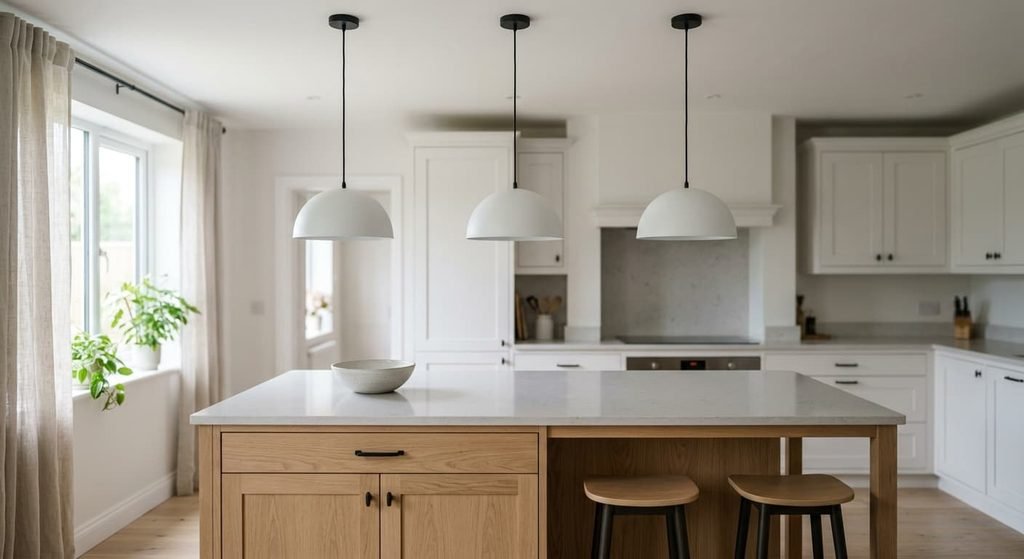
Where pendant lights win
Between pendant lights or recessed spotlights, pendants win on a slab you can’t alter. Three shades hang at 60 cm spacing from one canopy over the island, which leaves 30 cm at both ends of the 180 cm length. Their bottoms sit at 190 cm, above the 165 cm eye line of a standing adult. The shades read as a feature, and the room beneath them stays open. Nothing is cut, and the other 235 cm of ceiling stays whole.
They also adjust after you hang them. Shorten each cable by 10 cm and the drop falls from 45 to 35 cm, which gives height back where you need it. The cost is that the island becomes a landmark. Shades hung in rising kitchen air collect grease and dust, so you’ll want a smooth, wipe-clean finish. Shades about 30 cm across suit that spacing. Three of them then hang at 60 cm centres with a 30 cm gap between neighbours, and they read as one group.
When you leave, the hook goes with you and the ceiling returns to the state you found it in.
Where recessed spotlights win
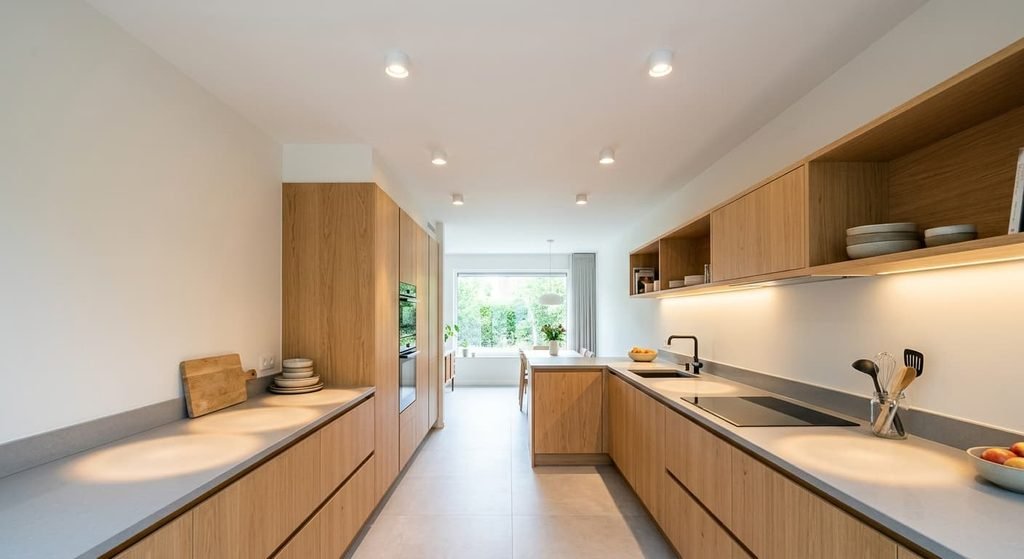
Spots win wherever a void already exists, such as a timber floor above or a ceiling that was dropped to hide pipes. With 9 cm of depth available, the ceiling keeps its full 235 cm and nothing hangs into the room. Two rows of three fittings, 120 cm apart within each row, cover the 400 cm length and leave 80 cm at each end. At 235 cm the light travels 145 cm to the worktop, so a 60° beam makes a pool 167 cm across. That is wider than the 120 cm gap, and neighbouring pools overlap into an even wash.
Every fitting is a hole, and the positions stay fixed for good.
A kitchen on a slab needs the false ceiling and its 12 cm before it can have any of this. The lowered version still works, since the beam makes a 154 cm pool from 133 cm above the worktop. That overlaps the 120 cm gap as well, but the whole ceiling now sits at 223 cm.
When neither is right
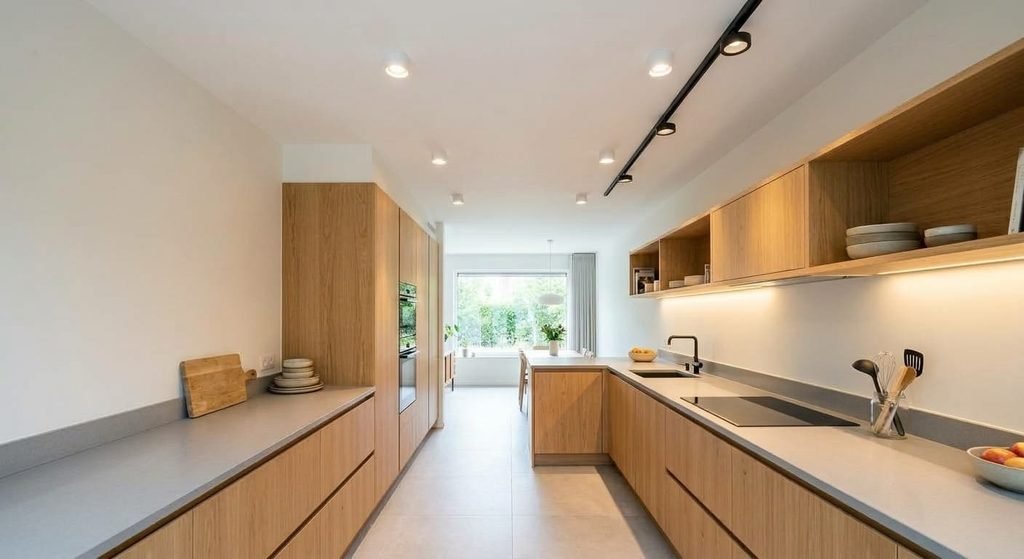
Slim surface-mounted discs on a rail can beat both. Choose them when pendant lights or recessed spotlights both fail your ceiling. A disc 3 cm deep takes 3 cm from the 235 cm ceiling, only 1.3%, and needs no void. That is a quarter of the 12 cm a false ceiling takes. One rail of 200 cm with three heads runs from a single ceiling point, so it suits a rented slab.
Aim the heads down the worktop and the pools overlap just as the spots would. Expect a visible fitting instead of a flush one, which suits a kitchen with exposed pipework better than a smooth white ceiling. Keep the rail clear of the extractor, and slide the heads along it if you later move the table.
Under-cabinet strips are the second answer. Wall cabinets that end at 135 cm leave 45 cm above the 90 cm worktop. A strip fixed beneath them lights the surface from close range and takes 0 cm from the ceiling. They’ll do the work alone in a kitchen with no island and no void.
How to decide in thirty seconds
To settle pendant lights or recessed spotlights, find out what sits above your ceiling. Ask the landlord or look at the building plans. Check whether you have a slab or a void of 9 cm or more. If a void exists and you may cut into it, take the recessed spotlights, because they keep all 235 cm of height. If it is a slab, or the flat is rented, take the pendants for an island and the rail for a kitchen without one.
Before you order, tape three marks to the ceiling at 60 cm spacing and stand beneath them. If the line looks too heavy at 45 cm of drop, plan for shorter cables.
The honest answer to pendant lights or recessed spotlights is whichever one fits what’s above your ceiling. In the example that meant 45 cm over 12% of the floor against 12 cm over all of it. Your own slab and your own lease change both figures. Neither is visible to me, so confirm both before you buy. If you’re still torn, the void question is the only one worth a phone call.
Questions readers keep asking
How long will each one keep working?
Either should serve for many years if the fixing is sound. A pendant relies on a hook and a cable that you can see and replace yourself. A spot relies on a driver hidden above the ceiling, which you reach only by opening the ceiling up. Choose the one you can inspect without a builder.
How do you clean each one?
A pendant needs a wipe every month or two, because it hangs in rising air that carries grease. A recessed spot needs a wipe of its front ring and nothing more. Smooth opaque shades clean faster than ribbed globes, so favour the smooth kind.
Which suits a small galley kitchen better?
Spots, if a void exists, because they leave all 235 cm clear and nothing hangs into the narrow aisle. Without a void, the surface-mounted rail suits a small galley better than a pendant. A galley has no island to hang one over.