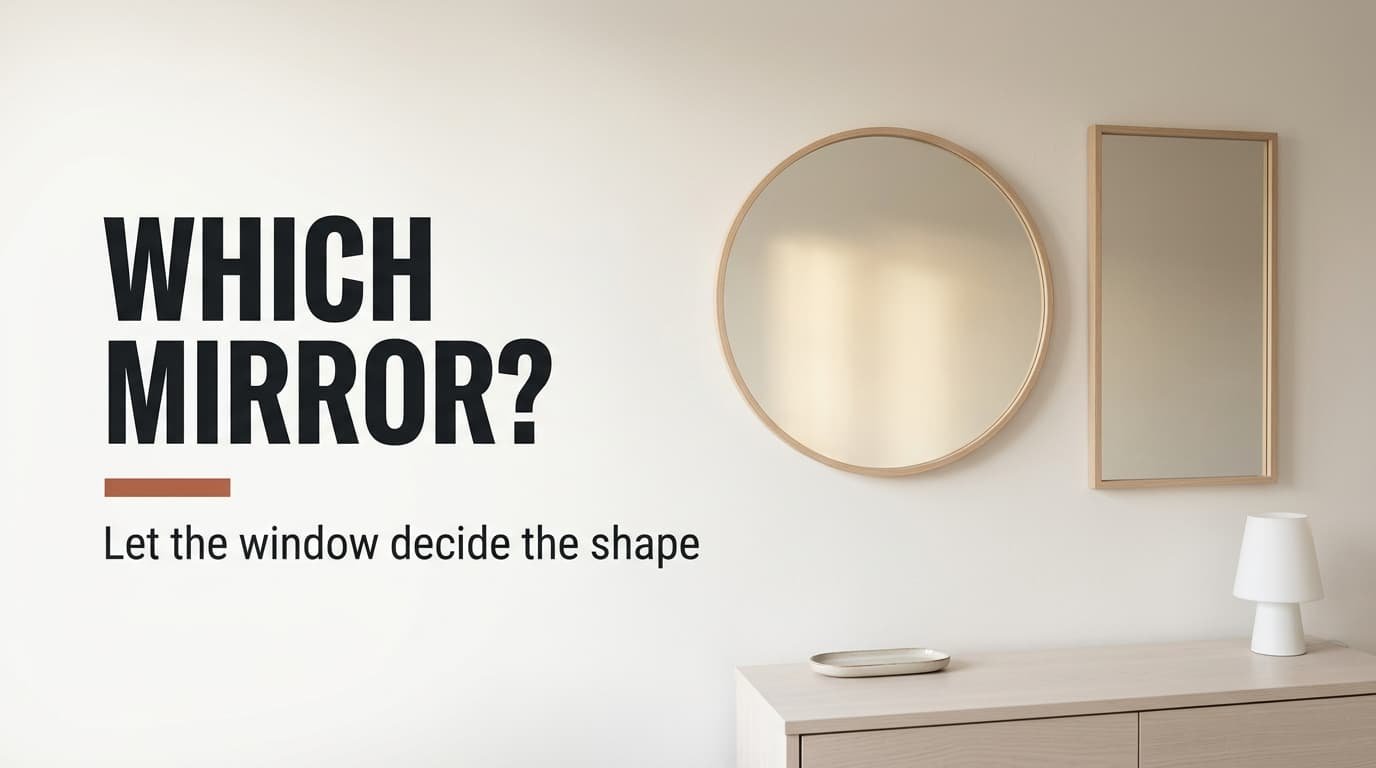
A mirror shows each part of you at the height halfway between your eye and that part, whatever your distance. Two people 25 cm apart in height need a window of 53.5 cm. A round mirror gives it only at about 61 cm across, while a rectangle of 30 by 54 cm gives the same. So pick a rectangular mirror above a hallway console when the wall is narrow, and a round one when the console is 80 cm wide or more. I’d push back on choosing by shape alone.
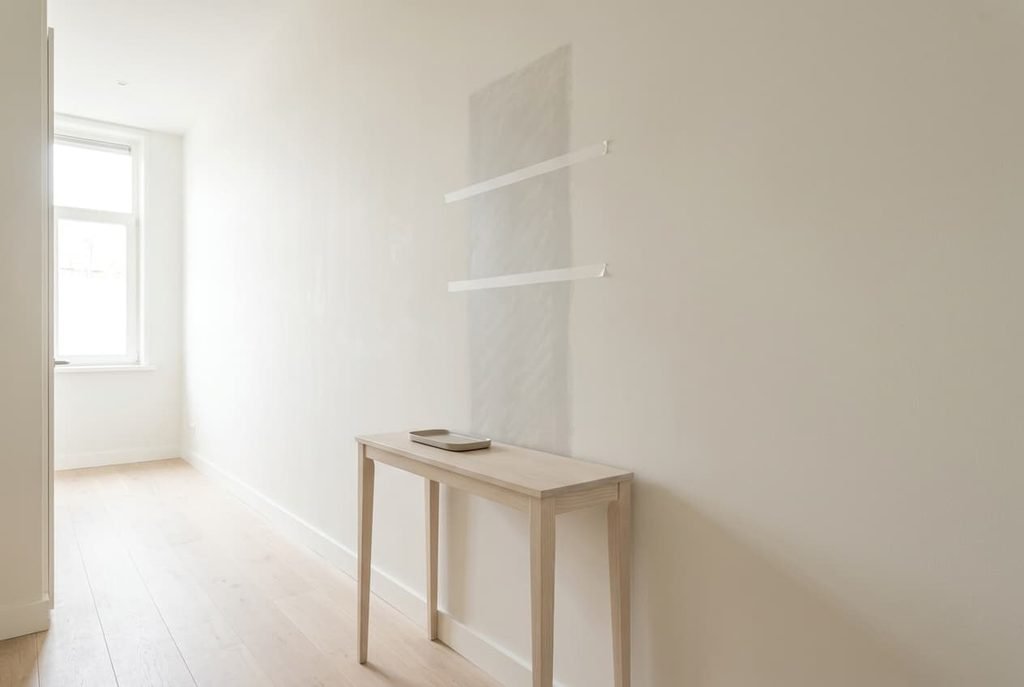
Our hallway is a rented Dutch one, 100 cm wide, with an 80 cm console. Each figure is only an example, so take your own heights first.
What decides a round mirror or a rectangular mirror above a hallway console
Start with the half-height rule. A flat mirror shows each point on you, from hair to chest, at the height midway between that point and your eye. Distance never changes it. For a last look before the door you want the top of your head, 12 cm above your eye, down to your chest. That’s 45 cm below it. The mirror must reach from 22.5 cm below eye level to 6 cm above it. That makes a window of 28.5 cm.
Two people share the mirror, and they stand at different heights. Take 160 cm and 185 cm. Eyes sit about 12 cm under the top of the head. They’re therefore at 148 cm and 173 cm, a spread of 25 cm. Add the spread in eye heights to 28.5 cm and you get 53.5 cm, running from 125.5 to 179 cm above the floor.
Width is easier. The mirror needs half your body’s width, so shoulders of 45 cm ask for 22.5 cm, and 30 cm leaves a margin. A rectangle gives that width along its whole height.
A circle gives its full width only at the middle. It narrows towards the top and bottom edges, so it has to grow until it keeps 30 cm of width across the whole window.
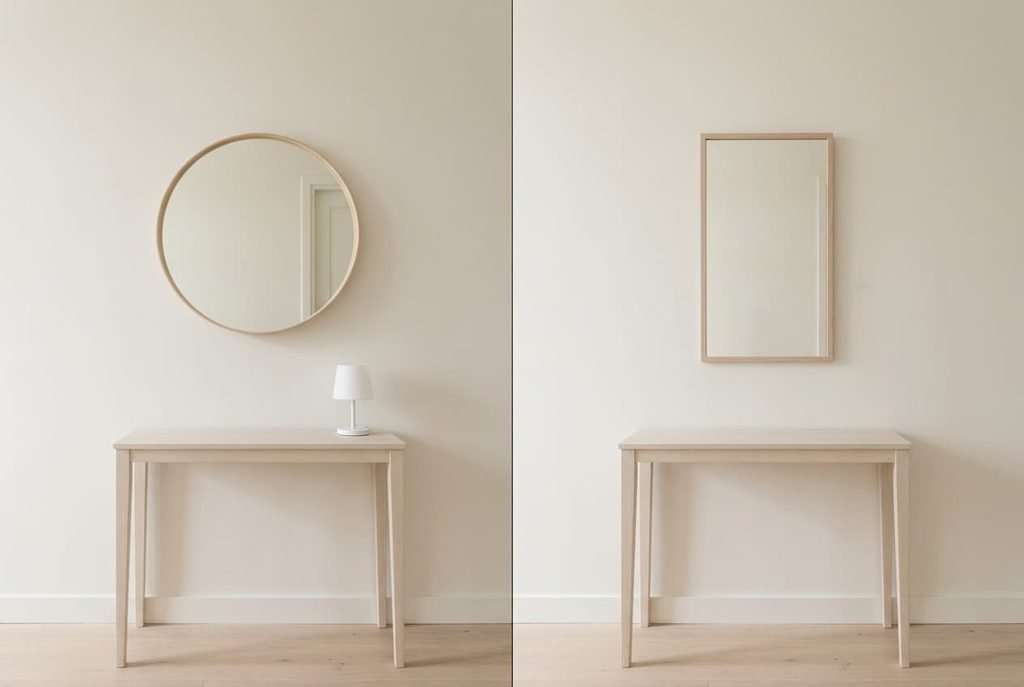
A round mirror or a rectangular one above a hallway console, side by side
Both mirrors are sized to the 53.5 cm window with 30 cm of width kept at the window’s upper and lower limits, and the table holds no prices, because geometry outlasts shop lists. Each hangs with its window centred at 152 cm above the floor, and the console top sits at 80 cm. That leaves 41 cm under the round mirror’s lowest point and 45 cm under the rectangle. That’s enough for a lamp 35 cm tall beneath either one. Measure your console’s own height before you copy these gaps.
| Question | Round mirror | Rectangular mirror |
|---|---|---|
| Smallest size that meets the need | 61 cm across | 30 by 54 cm |
| Wall area it covers | 0.30 m² | 0.16 m² |
| Share of an 80 cm console’s width | 76% | 38% |
| Width at the window’s top and bottom edges | 30 cm, wider in the middle | 30 cm all the way |
| Clear height above the console, 25 cm off-centre | 54 cm | 45 cm |
| Corners to line up with a door frame | none | four |
The fifth row surprises most people: a round mirror leaves 54 cm free at the side, so a tall lamp tucks in there, while a rectangle’s straight edge stays at 45 cm all along. The first two rows carry the decision, since a circle spends 85% more area on the same window. That surcharge pays for the curve.
Where a round mirror wins
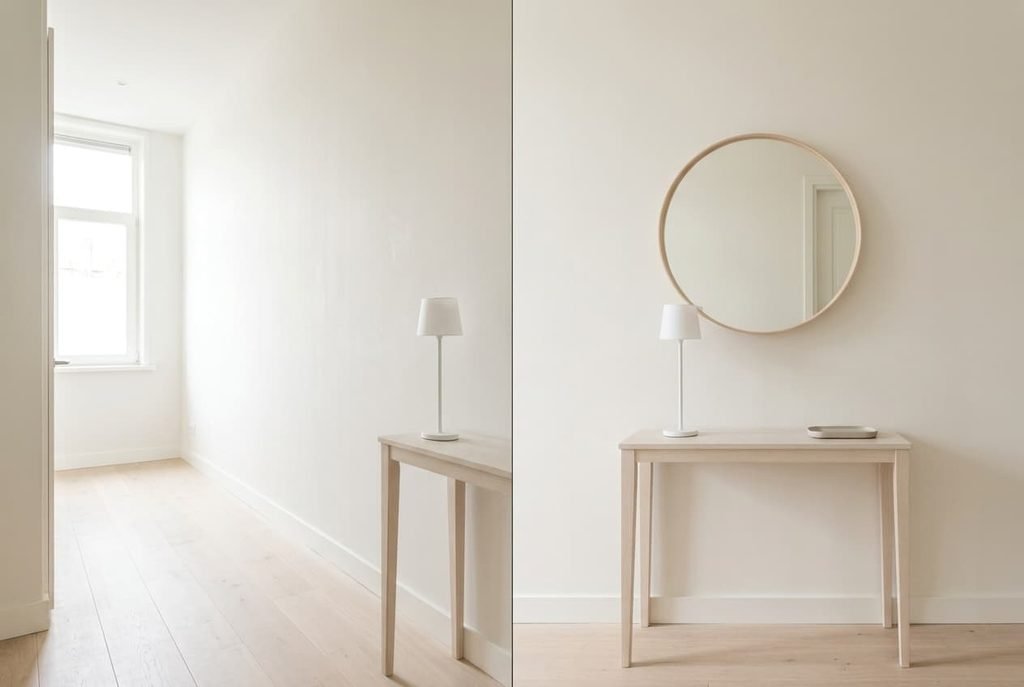
Against a rectangular mirror above a hallway console, a round one wins on a wide wall. Over an 80 cm console, 61 cm across fills 76% of the width, which sits inside the common range of two thirds to three quarters. That proportion reads as chosen for the furniture, and below half a mirror looks stranded. The mirror then doesn’t drift on the plaster.
It wins beside tall objects. The curve rises away from the centre. A lamp 50 cm high placed 25 cm off the middle tucks under the edge, where a rectangle’s flat base would meet it.
It wins in a hallway of right angles. Door frames and skirting all run square, and so do the console’s corners. A circle is the only shape in view without a corner.
It wins for one user. A single person needs a window of just 28.5 cm, so a circle about 41 cm across does the job and fits a narrow wall. That’s 0.13 m² of glass, and it sits beside a coat hook without crowding it.
Where a rectangular mirror wins
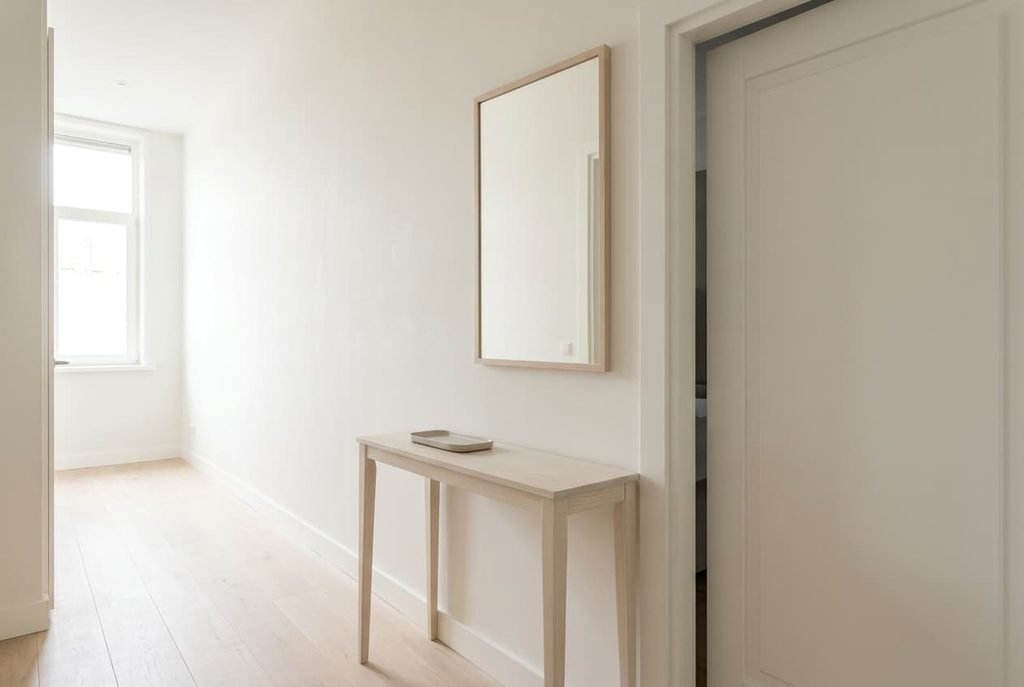
A rectangular mirror above a hallway console wins on a narrow wall. Over a console 60 cm wide, a round mirror of 61 cm overhangs the furniture. The rectangle of 30 by 54 cm leaves 15 cm free at each side.
It wins when heights differ a lot. The window is the spread plus 28.5 cm, so a spread of 45 cm asks for 73.5 cm. A circle then needs 79 cm across, which is wider than the console. The rectangle still needs only 30 cm of width.
It wins beside a door frame. Its vertical edge can follow the frame at a steady distance, and the two read as a single line.
A circle can’t do that, since its nearest point to the frame is a single touch.
It wins on wall area. For the same window it covers 0.16 m², against the circle’s 0.30, so more plaster stays free. A key shelf of 25 by 10 cm fits beside the mirror with room to spare.
When neither is right
A full-length mirror leaning beside the console gives the whole body a view and needs no drilling. Seeing from the feet up to the hair asks for a window from 74 to 179 cm for our two people. That’s 105 cm, so a mirror 180 cm tall and 40 cm wide covers it. It shows 105 cm of you at once, nearly double the 53.5 cm of the wall mirror.
It costs wall and floor. The mirror takes 0.72 m² of wall, and its base needs about 15 cm of floor in a hallway only 100 cm wide. Our two people leave 85 cm of walkway, which is enough to pass. It also shows the hallway behind you, which stretches the space, though it doubles every coat hook within its view.
This suits a rental best, since nothing goes into the wall.
The console then keeps its lamp and tray. You glance at your full outfit before leaving, and the hook space stays free.
How to decide in thirty seconds
Stand against the wall and mark your eye height with a strip of tape, then do the same for everyone who uses the hallway. Subtract the lowest mark from the highest. Add 28.5 cm and you have the window.
If the spread is under 15 cm and the console is 80 cm wide or more, choose round. At a spread of 15 cm the window is 43.5 cm and the diameter 2 × √(21.75² + 15²), which is 53 cm.
If the spread reaches 25 cm, or the console is under 70 cm, choose a rectangle 30 to 40 cm in width and as tall as the window. A rectangle of 35 by 55 cm suits our two people.
For a rectangular mirror above a hallway console the answer comes from one figure, your household’s spread in eye heights. Our two people gave 25 cm and a window of 53.5 cm, which suits a rectangle on a narrow wall and a 61 cm circle on a wide one. Measure first, then buy. Count the spread, add 28.5 cm, and check the wall width against 61 cm and 30 cm.
Questions readers keep asking
Do edges chip more on a rectangular mirror?
Corners take the knocks, because a bump near a door frame lands on a point and not along an edge. A circle has no corners. A frame protects either shape, and a bevelled edge chips less than a flat-cut one. Hang a rectangle clear of the door’s swing.
How often should a hallway mirror be cleaned?
A hallway mirror collects fingermarks near the frame and dust along the top edge, so a wipe every two weeks keeps it clear. Follow a damp cloth with a soft dry one. Skip sprays that run behind the frame, since moisture can creep under the silvering.
Which shape suits a tall and a short person sharing a hallway?
A rectangle usually does. The window grows with the gap between eye heights, and a circle has to grow in both directions to keep its width at the top and bottom. With a spread of 25 cm the circle needs 61 cm across, and the rectangle only 30 cm of width.