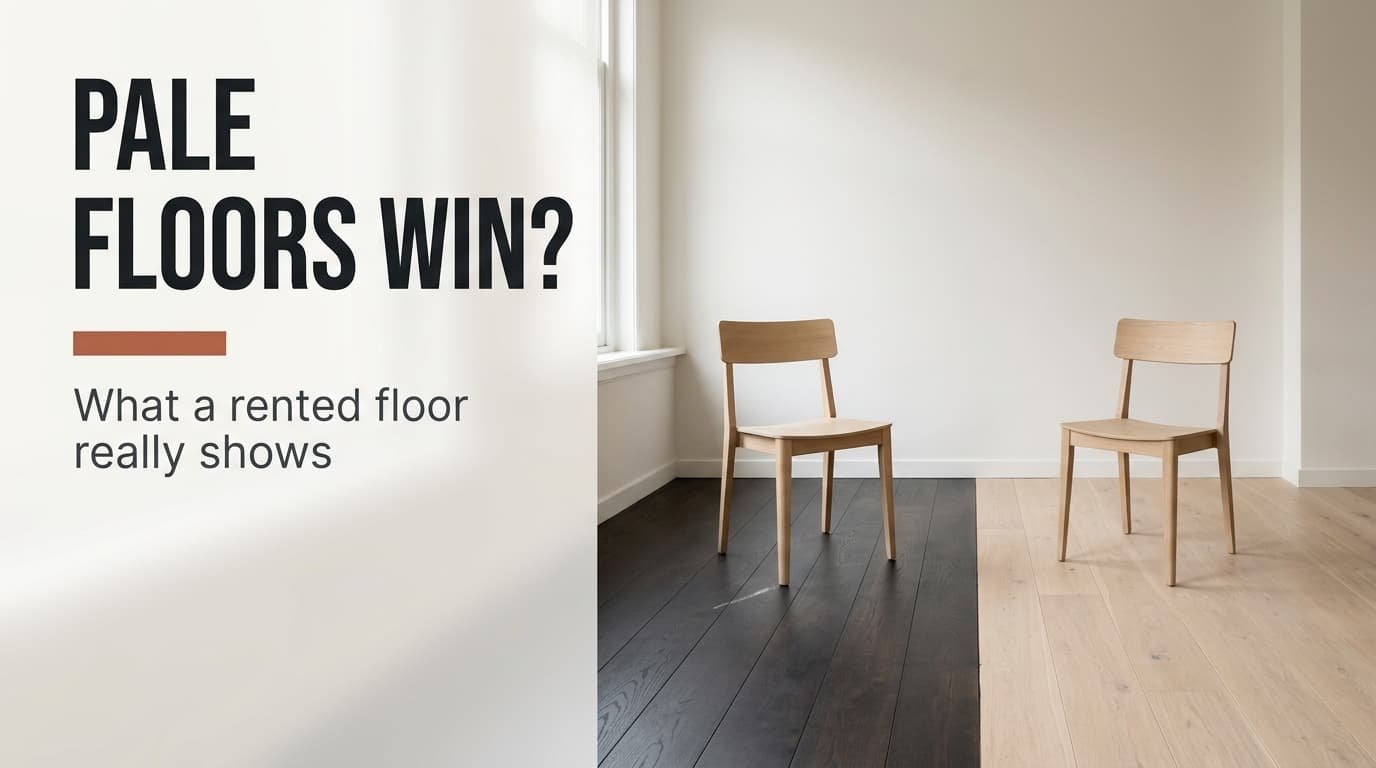
Picture a chair leg dragged across a dark stained floor: it leaves a pale line visible from the doorway. Drag it across pale oak and the line nearly disappears. That small contrast explains why pale wood floors are replacing dark ones in rented flats: a floor now has to survive a tenancy, and the marks a tenancy leaves have changed their weight. The effect is measurable, and it comes down to contrast. Our example is a Dutch flat with 14 cm oak boards. Check your own floor before relying on any figure. Two minutes with an offcut and a pinch of flour will show it.
Where the dark floors came from
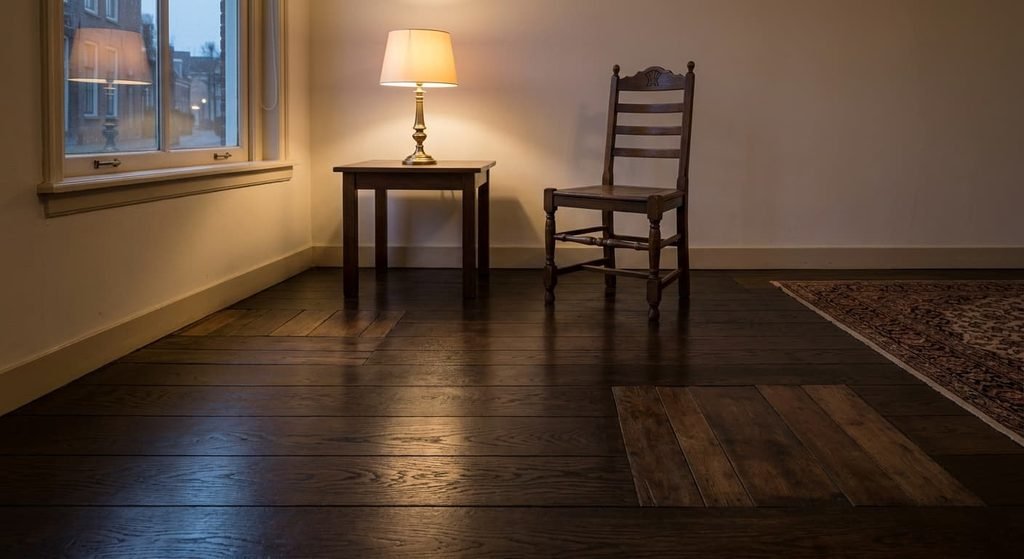
Dark stain was the old answer to a floor that had seen use. It hid patches and filled repairs. It covered the grey of boards worn by shoes. A tenant inherited that logic with the flat: the darker the floor, the less it showed. Polish added a deep gloss, and the gloss suited rooms where most of the light came from lamps after dark. Floors were refinished rarely, so a colour that hid wear was worth its darkness.
Then flats changed jobs. The living room became a workspace and a dining room at once. Chairs now scrape across the same boards a dozen times a day, and a landlord inspects the floor at hand-back. A scratch that exposes bare wood is a charge a tenant can expect on a dark floor.
Pale finishes arrived as the quieter option. A matt oil or a white-washed wax keeps the grain and drops the shine. Boards come in the same widths as before. The shift happened gradually, moving from mid-brown to honey and on to pale oak.
What actually changed as pale wood floors are replacing dark ones
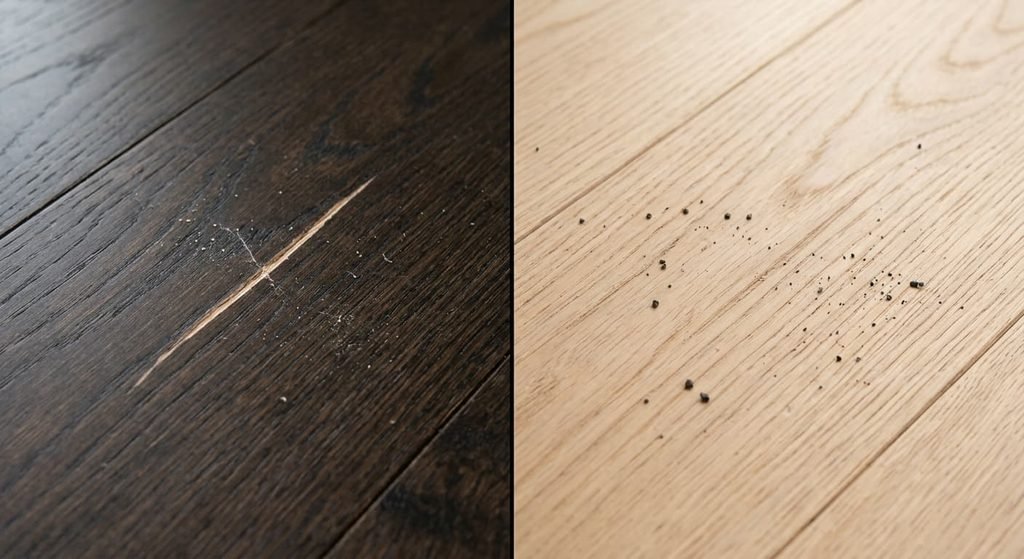
A mark shows because it differs from the floor around it. Measure that as contrast: the mark’s reflectance minus the floor’s, divided by the floor’s. Take a dark stained oak at 12% reflectance and a pale oiled oak at 55%. Three marks cover most of a tenancy. A scratch exposes bare wood at 50%, light dust sits at 35% and dark grit or hair sits at 10%.
On the dark floor a scratch has contrast (50 − 12) ÷ 12 = 3.2. Dust has (35 − 12) ÷ 12 = 1.9. Grit has (10 − 12) ÷ 12 = −0.17, which is close to invisible. On the pale floor the same marks read (50 − 55) ÷ 55 = −0.09 for the scratch, −0.36 for the dust and −0.82 for the grit. Assume that a mark under about 0.1 stops registering from 2 m away. That line is a working assumption, so treat any crossing as a guide. If your stain is lighter or darker than these two, rerun the sums with your own estimate.
In the example, the scratch’s contrast falls from 3.2 to 0.09, which makes it about 35 times quieter. Dust gets about 5 times quieter. Grit goes the other way and becomes about 5 times louder.
So pale floors didn’t win by being cleaner. Scratches and dust are what a tenancy makes most often, while grit is what a broom removes in a minute. The trade favours a flat where inspection matters more than daily sweeping.
Pale floors swap the marks you see and remove none of them.
Who it suits, and who it doesn’t
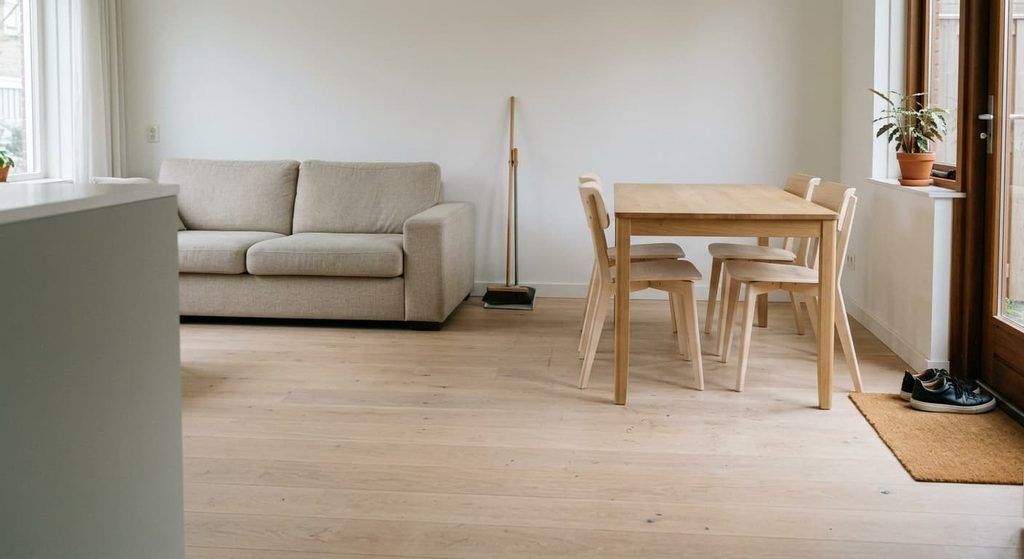
Where pale wood floors are replacing dark ones, the change suits a flat with plain furniture and chairs that move. The marks there are scratches and the pale dust that textiles shed, and on pale oak the scratch drops under 0.1 while the dust falls to 0.36. A weekly vacuum then keeps the floor looking untouched, and the hand-back inspection finds less to record.
It fits a household that sweeps often, because the louder marks are the loose ones. Grit and hair lift off in a single pass. Count the chairs, too: four dining chairs pushed back twice a day make eight drags a day. That’s 56 a week, and each can leave a line on a dark floor.
It suits a dark-haired pet or black-soled shoes badly. A black rubber scuff at 8% reads (8 − 55) ÷ 55 = −0.85 on pale oak, against (8 − 12) ÷ 12 = −0.33 on the dark floor. That’s about 2.6 times louder, and a scuff doesn’t sweep away. Coffee grounds and dark pet hair do the same.
Room light matters less than people expect. The contrast sums don’t depend on how bright the window is. Mark and floor receive the same light.
Choose by what you actually drag across the floor.
Replacing dark ones: are pale wood floors worth the change
Change the floor only when it needs replacing anyway or the lease allows a removable layer, and regard the other routes as optional. A sound dark floor has years left. For a living room of 18 m², a loose-laid pale overlay is a weekend of work and needs the landlord’s written consent.
Reversal costs differently. A dark floor under a pale layer is still there when you leave. A new fixed floor is permanent, and the next tenant inherits your choice.
Both routes leave the landlord’s floor as you found it. The moderate move is a rug. A 200 × 300 cm rug covers 6 m², a third of the 18 m², and the marks under it stop mattering. Lift one corner and view the dark and pale surfaces together before you commit to more.
The version that will date fastest
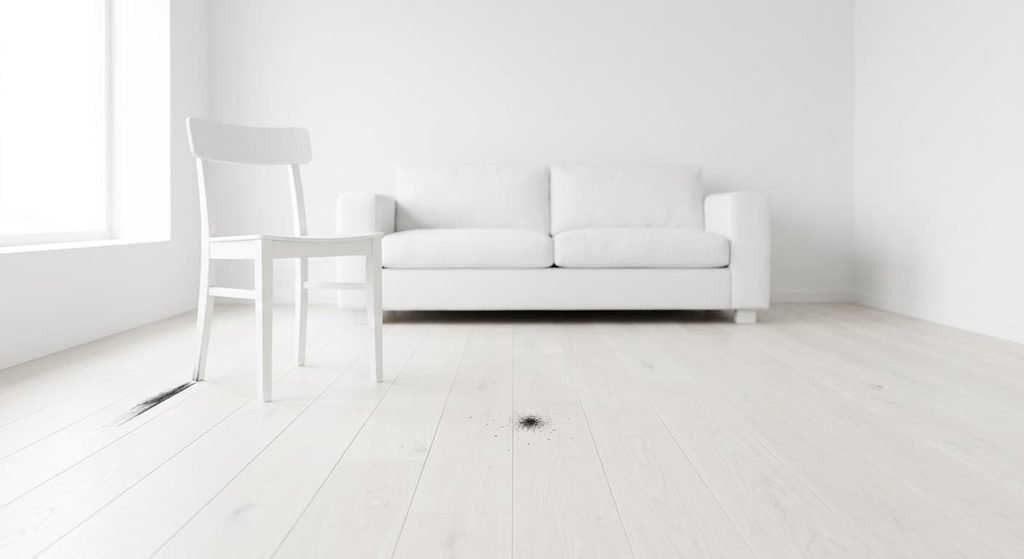
Where pale wood floors are replacing dark ones, the furthest step is an all-white floor with white walls and white furniture, bleached until the boards read at 75%. Nothing gives the eye a line to follow, so the whole room blurs into a single tone.
Three things age it. The sums turn against it: at 75% the scratch reads (50 − 75) ÷ 75 = −0.33, nearly 4 times louder than on pale oak, and grit reaches −0.87. Every mark now clears the 0.1 line. It also commits the room to one scheme, and any later scheme starts with a repaint and a new floor. Edges disappear too, since a white chair leg on a white floor has no outline.
It isn’t a recommended version. The moderate one keeps the boards pale and the furniture varied, with one dark piece such as a chair or a rug to give the eye an edge.
How to try it without committing
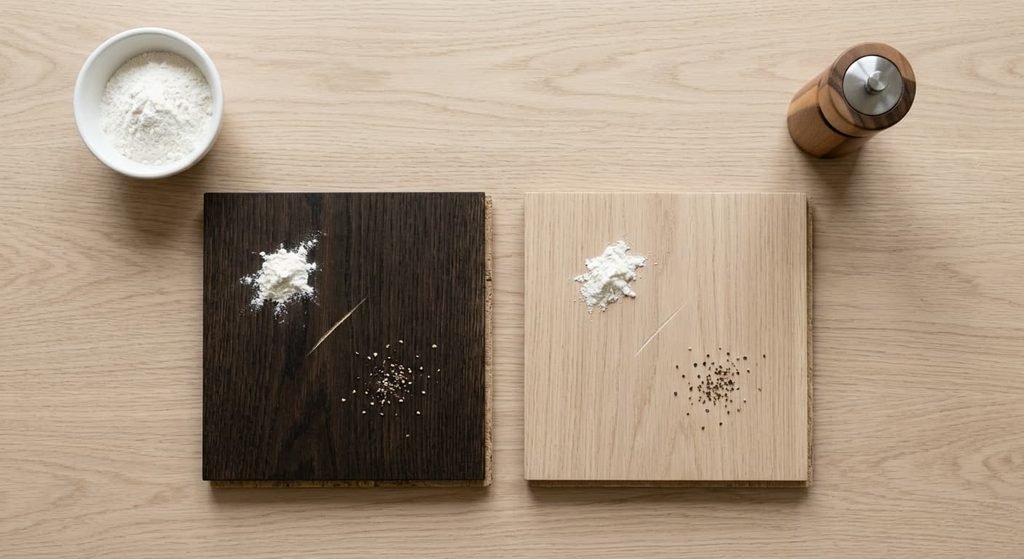
Sprinkle three marks on a dark offcut or sample and on a pale board, then look from 2 m. Use a pinch of flour for light dust, a chair leg dragged once across an offcut for a scratch and a few grains of ground pepper for dark grit. Take each photo from one fixed spot. Note which marks you can still see, then look again the next morning. In the example, the dark sample shows the flour and the scratch, and the pale board shows the pepper and, more faintly, the flour. If your own result matches, the floor suits how you live.
Pale wood floors are replacing dark ones because a rented floor has to survive scratches and dust, and the sums reward pale boards for exactly those two marks. Buy the change when a floor needs replacing anyway, or start with a rug. Keep the furniture varied, and test your own marks first. Date the three results, so they can be set against the floor you’re considering.
Questions readers keep asking
Should I swap my dark floor for a pale one?
Only if the floor needs replacing anyway or the lease allows a removable layer. The gain is that scratches fall to a contrast of about 0.09 in the example. Try a rug or a sample board for seven days before deciding.
Does a pale wood floor suit a rented flat?
Often, yes, when the usual marks are scratches and light dust. Dark scuffs and pet hair show more on pale boards, so check your own shoes and pets first. A weekly vacuum keeps the loose marks in check, and the scratches stay quiet.
Will pale wood floors go out of style?
That can’t be forecast. The contrast sums don’t date, though: a mark is visible when it differs from its floor. The all-white version ages quickest, because every mark clears the visibility line. Keep the boards pale and the room varied.