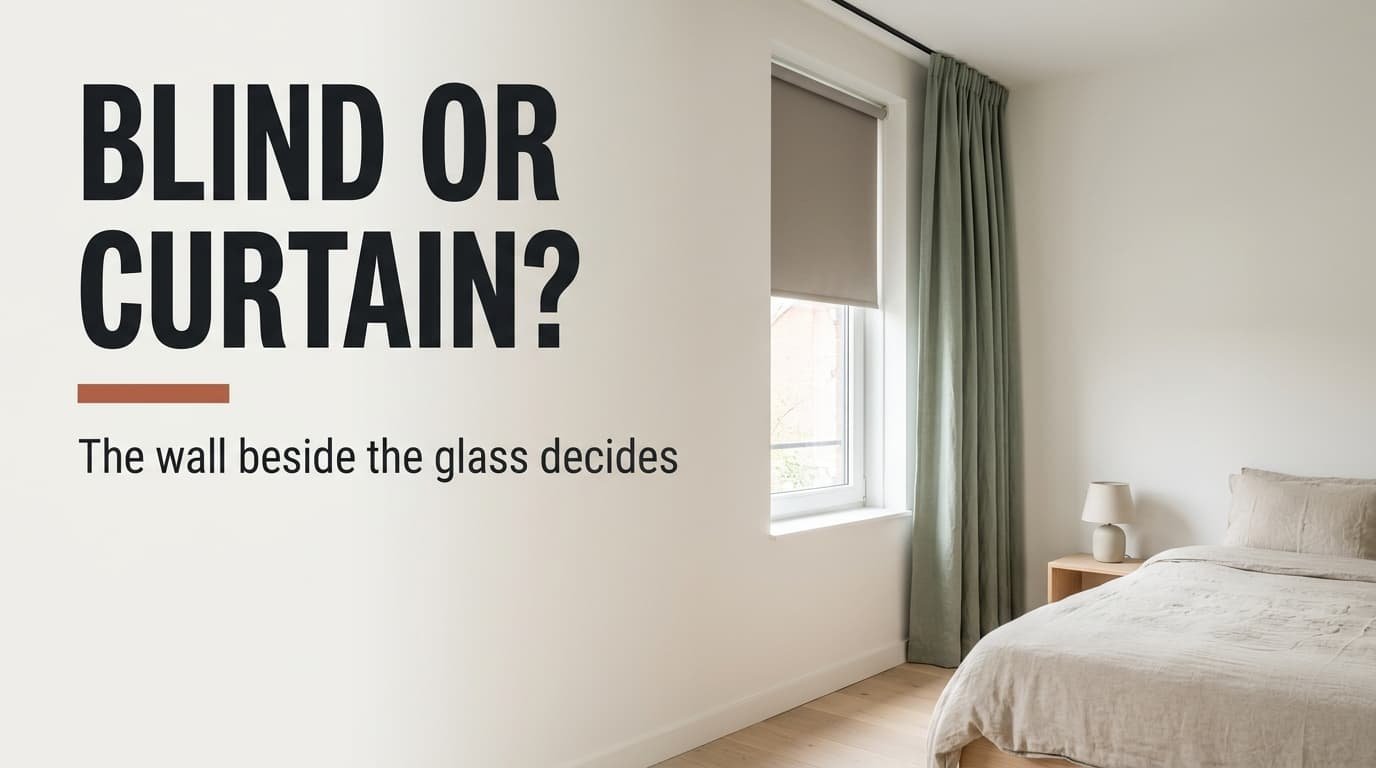
“Whichever I hang, the window ends up looking smaller.” That complaint starts most of these decisions, and it blames the wrong thing. Picking roller blinds or curtains for a narrow bedroom window comes down to wall, because a curtain needs wall beside the glass to park on when it’s open. Our test case is a Dutch bedroom 250 cm wide, with a window 80 cm wide and 110 cm high. It has 10 cm of wall on its left and 40 cm on its right. Use your own numbers as you go. Five minutes of measuring will show which one costs you less glass.
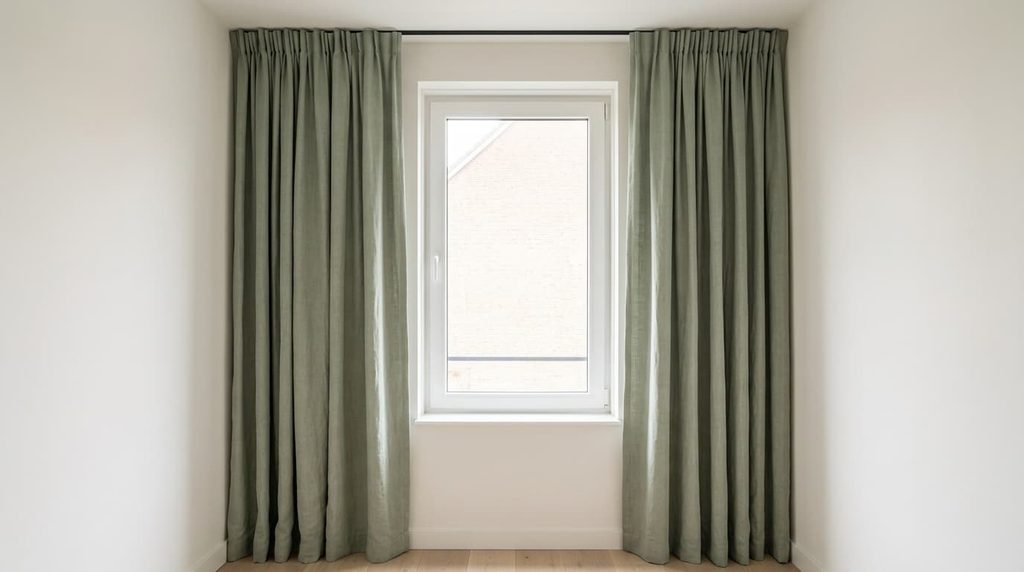
What decides roller blinds or curtains for a narrow bedroom window
A curtain has to go somewhere when you open it. The gathered cloth needs wall beside the glass, and a narrow window rarely has any to spare. Gathered fabric packs to about one fifth of its flat width, and a curtain at the usual fullness of 2 holds twice its track length in cloth. So the open stack measures 0.4 times the track, shared between two panels.
Hang a pair of equal panels on a track that ends 10 cm past the glass on each side. The track is 100 cm long and the stack is 40 cm, so each panel packs to 20 cm. Each panel has only 10 cm of wall to park on. That leaves 10 cm of cloth over the glass at each end. That’s 20 × 110 = 2,200 cm², or 25% of the 8,800 cm² window, hidden even when the curtains are open.
A roller blind has no stack at all. Its tube hides the top 6 cm, which is 6 × 80 = 480 cm², or 5.5%.
Run the same sum for any window and a rule falls out. A pair of curtains needs wall of one third the glass width on each side, which for this window is 27 cm.
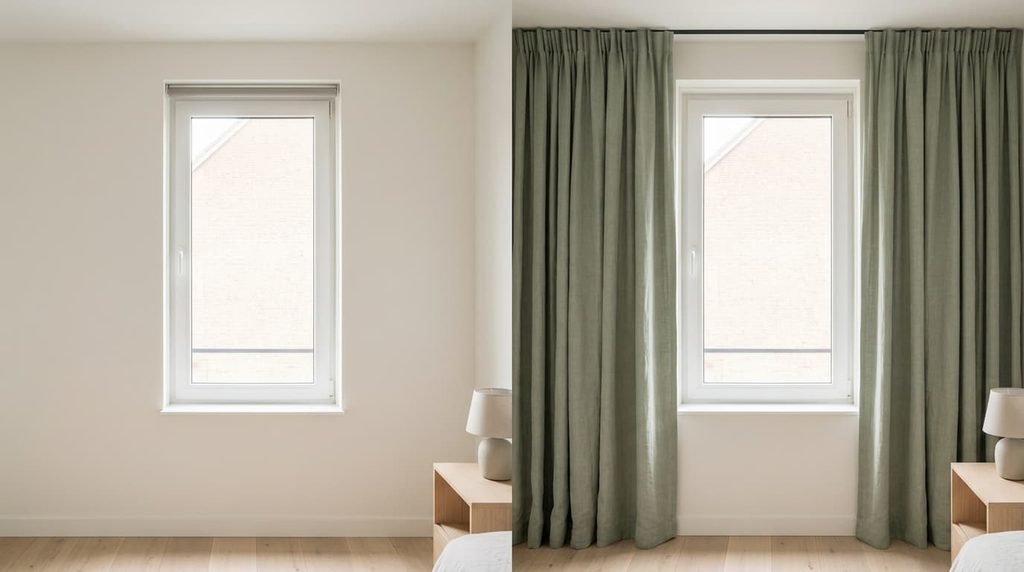
Roller blinds or curtains side by side for a bedroom with a narrow window
This table reuses the window and the pair of panels from above. Every figure comes from the same sum, so a different window moves them together. Daylight figures use the glass area of 8,800 cm².
| Question | Roller blind | Curtains |
|---|---|---|
| Wall needed beside the glass | 0 cm | 27 cm on each side |
| Glass hidden when open | 480 cm² (5.5%) | 25% at 10 cm of wall each side, 0% at 27 cm |
| Depth into the room | About 0 cm, set in the recess | About 11 cm (3 cm of track, 8 cm of gathered cloth) |
| Width the window appears to have | 80 cm | 134 cm on a track that clears the stack |
| How finely you set the opening | Any height, to the centimetre | Open or closed, with a few folds between |
| Fixing in a rented flat | 4 screws or 2 clamps in the recess | 4 to 6 drill holes in the wall or ceiling |
| Washing | Wipe the fabric | Machine-wash at 30 °C |
The first three rows settle how much daylight you keep, and the rest settle the look and the paperwork. Take them in that sequence, since a curtain that hides a quarter of your window can’t win on style.
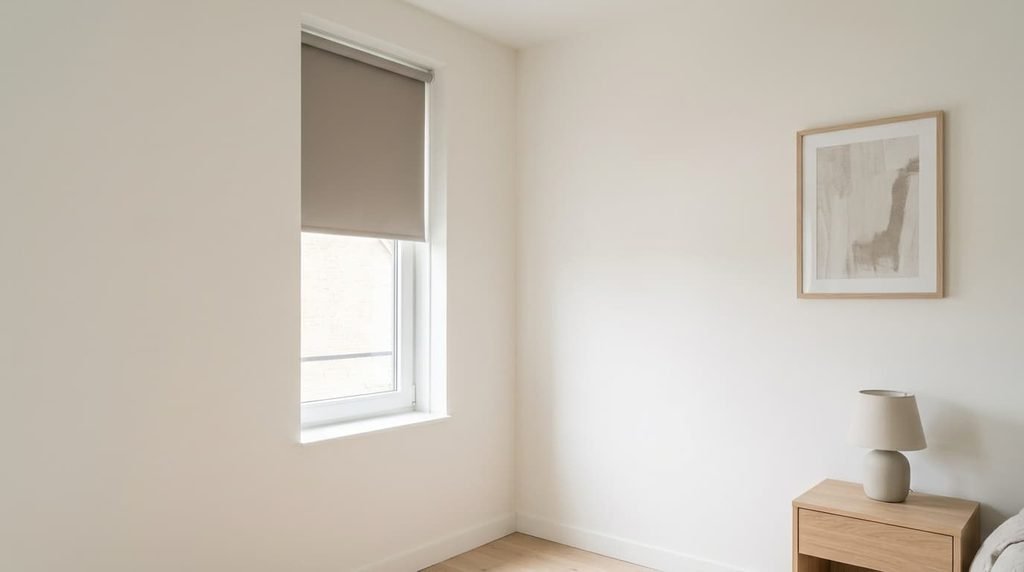
Where a roller blind wins
Between roller blinds or curtains for a narrow bedroom window, the blind wins whenever either side has under 27 cm of wall. In the example the curtains hide 25% of the glass when open, and the blind hides 5.5%. Shifting the track towards the wardrobe helps only a little. The best layout for two equal panels still leaves 12.5 cm of cloth over the glass, which is 16%.
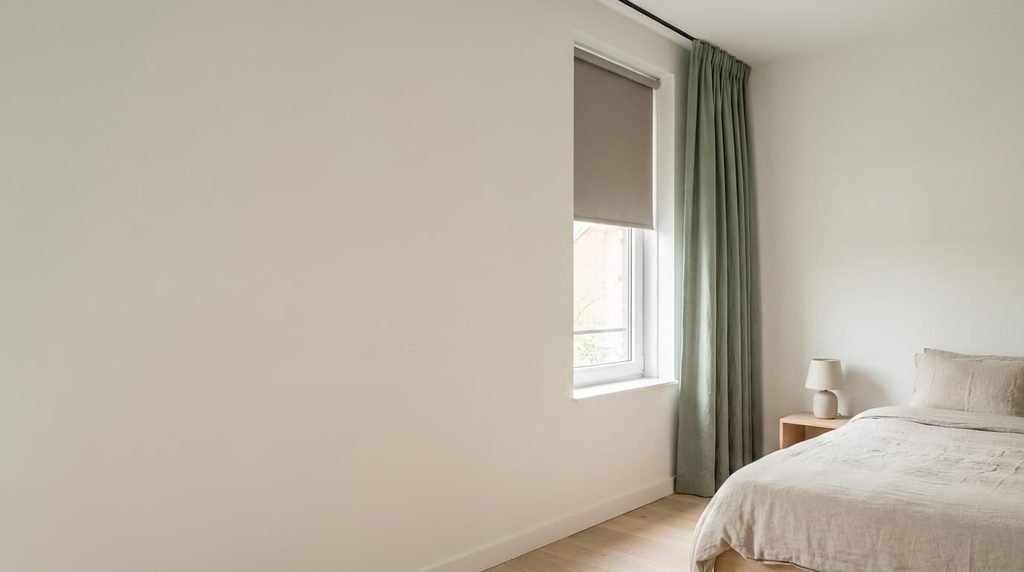
Fit the blind inside the recess with the fabric 1 cm narrower than the opening, so 79 cm. Choose a matt cloth within one shade of the wall, and the closed blind reads as a flat panel. Raised, it leaves only a 6 cm cassette at the top. A roller blind also keeps the sill clear. That matters when a bedside lamp stands beneath a window set 90 cm up. A picture frame 30 cm wide then fits on the right-hand wall. Hang it with its centre at 145 cm.
That strip of wall stays free for other things.
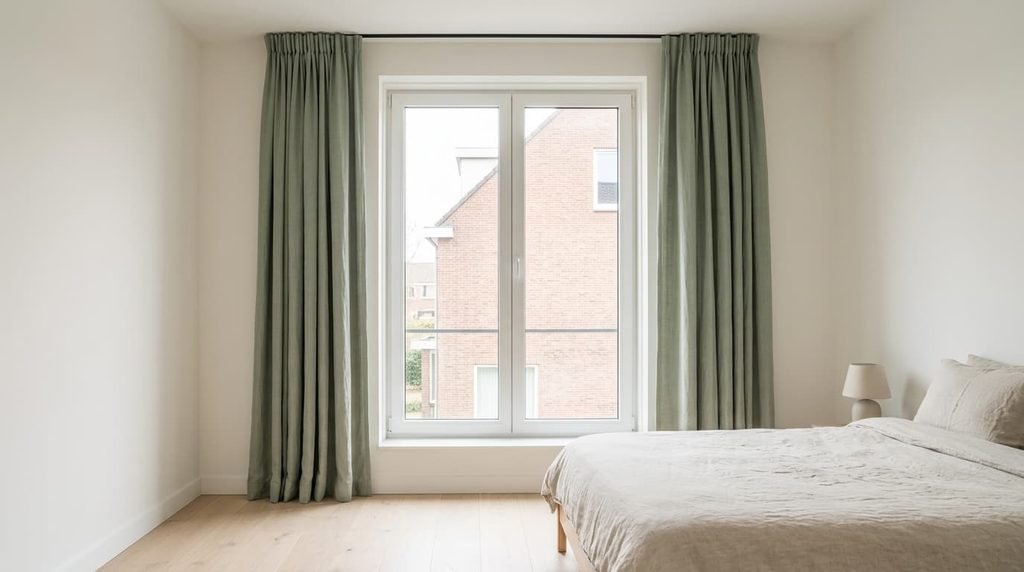
Where curtains win
Give the same window 30 cm of wall on each side and the sum flips. The track is now 140 cm long and the stack is 56 cm, so each panel packs to 28 cm. That fits inside 30 cm, and the open curtains hide 0% of the glass against the blind’s 5.5%.
They also change how wide the window looks. The glass fills 32% of the 250 cm wall, while a 140 cm track makes the whole group read as 56%. A narrow window gains presence from cloth. A blind can’t give that. Hang the track at 225 cm, 25 cm above the 200 cm top of the glass, and the group reads taller too.
Take the cloth to 1 cm above the floor, a drop of 224 cm. Two panels of 140 cm flat width fill the 280 cm that fullness 2 asks for.
Expect four to six holes in the wall, plus a 30 °C wash now and then.
When neither is quite right
One curtain panel parked on the wide side is the middle answer. Pick it when roller blinds or curtains for a narrow bedroom window each leave you short. Run the track from the left edge of the glass to 40 cm past the right edge, which makes it 120 cm long. The single panel’s stack is 0.4 × 120 = 48 cm, and the right wall holds 40. Eight centimetres of cloth stay over the glass, which is 8 × 110 = 880 cm², or 10%. That cuts the pair’s 25% loss by more than half, and it still sits above the blind’s 5.5%.
The panel always opens to the same side, so the left 10 cm of wall never gets cloth. Pair it with a roller blind in the recess and you get a soft edge from the cloth and full closing from the blind. A panel that stops at the sill drops 90 cm instead of 224 and keeps a bedside shelf free beneath it.
How to decide in thirty seconds
Measure the wall from each edge of the glass to the nearest corner or wardrobe. Divide the glass width by 3, which gives 27 cm for an 80 cm window. To settle roller blinds or curtains for a narrow bedroom window, compare the two numbers. If both sides reach it, take the curtains, because they hide none of the glass and widen the window. If either side falls short, take the roller blind, because the stack would sit over the glass. When one side is short and you still want cloth, hang the single panel from the last section. Both measurements take under a minute, so write them down before you shop.
In the example the blind hid 5.5% of the glass and the curtains hid 25%. Your walls will give other figures, so measure before you order. If the numbers sit close, hang the blind first. It costs you no wall, and you can add a panel later. Retake the measurements after any wardrobe moves, since 10 cm either way changes the answer more than any fabric choice does.
Questions readers keep asking
How much wall does a curtain stack need?
One third of the glass width on each side, for a pair of panels at fullness 2. For an 80 cm window that’s 27 cm. When both sides are short, each centimetre you lack puts roughly 0.6 cm more cloth over the glass on that side.
Can a roller blind cope with a wider window?
Yes, because the tube still hides only its own height, 6 cm, across any glass width. At 120 cm wide it hides 6 × 120 = 720 cm². That’s still 5.5% of a window 110 cm high, the same share as before, so width barely changes the sum.
Which is easier to take down when you move out?
Usually the blind. Clamps or screws in the recess leave two to four small holes. The whole unit comes off in a minute. A curtain track leaves four to six larger holes in the wall or ceiling, and filling them takes longer than the removal itself.