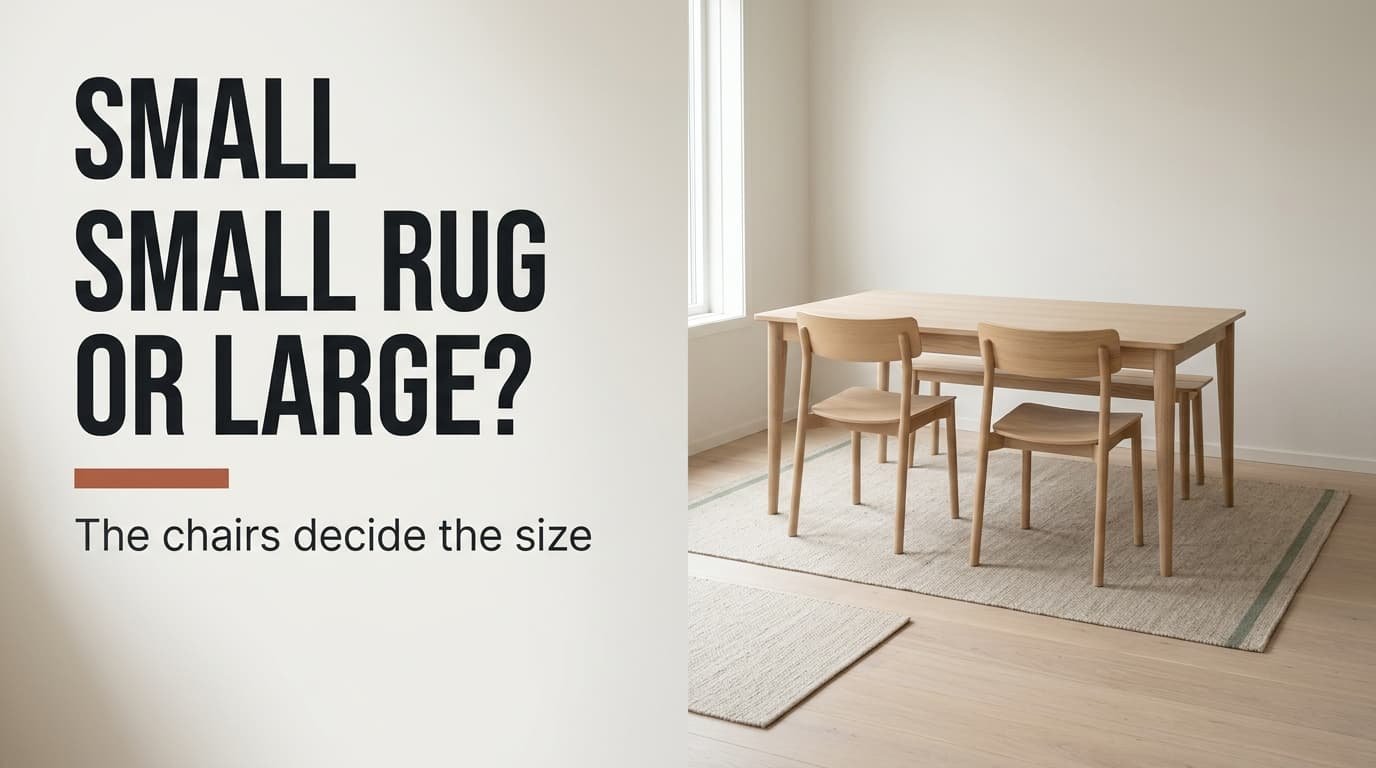
A small rug follows the table’s footprint, while a large rug follows the chairs. So small rug or large rug for a dining table comes down to where people sit. Take the large one if chairs sit on both long sides and clear floor for 210 × 300 cm. Take the small one if they don’t. I’d go further than most buying advice, which says to buy the biggest rug that fits. Size it to the seated sides, because that’s where a rug fails.
Our test room is a Dutch rented flat with an 80 × 120 cm table and four chairs. Tape your own room first; every figure here is an illustration.
What decides small rug or large rug for a dining table
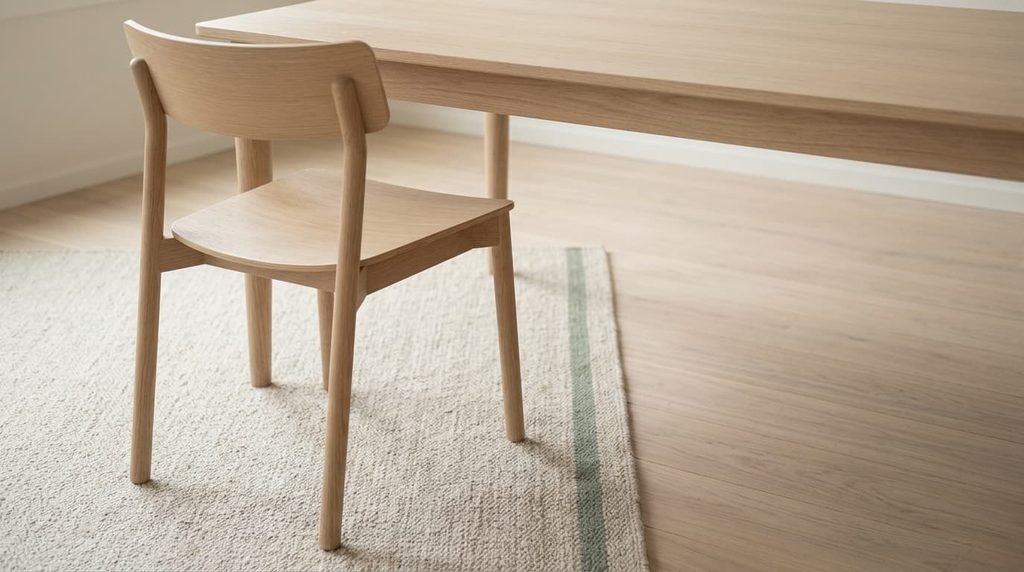
Sit down and watch where the chair goes. The rug has to reach past the back legs of a pulled-out chair. A chair that straddles the rug’s edge tilts by the thickness of the pile and rocks each time you shift. Say you pull a chair out until its back legs stand 55 cm out from the table edge. Add 5 cm so the legs don’t land on the fringe. Each seated side then needs a margin of 60 cm.
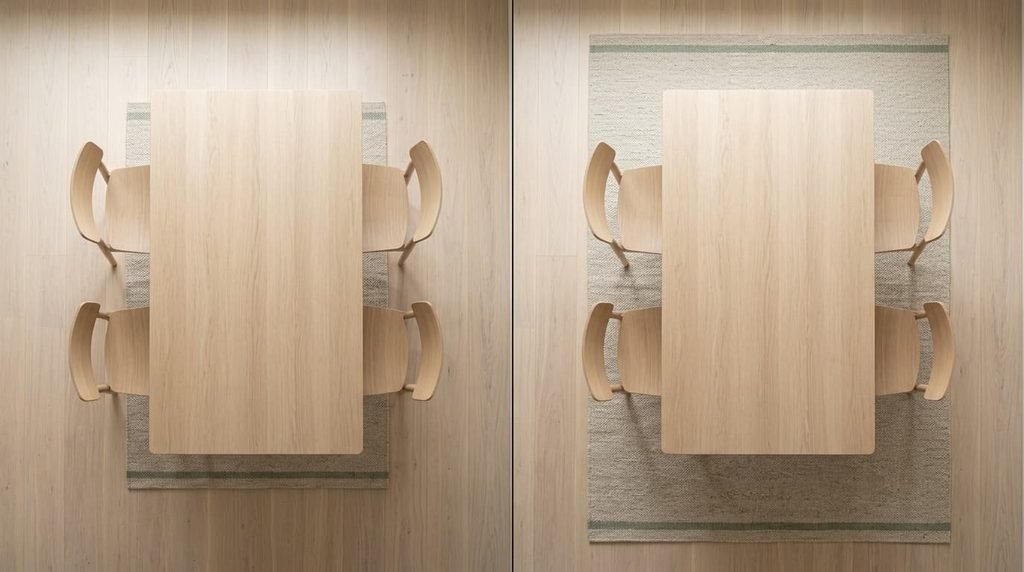
An 80 × 120 cm table with seats on both long sides needs a rug 80 + 60 + 60 = 200 cm wide. Nobody sits at the short ends. Those need only 15 cm each, which makes 120 + 15 + 15 = 150 cm long. The rug you need is 200 × 150 cm, and the shops sell 160 × 230 and 200 × 290. The wide one meets the sitting rule, but its length overshoots by 290 − 150 = 140 cm. That strip measures 1.4 × 2.0 = 2.8 m² of rug under nobody, or 48% of its area.
The large rug passes the chair test and wastes half of itself.
Small rug or a large rug for a dining table, side by side
The table fixes the inputs. It measures 80 × 120 cm, it has seats on both long sides, and a pulled-out chair reaches 55 cm. Each rug sits centred under it, and both are low flat weaves, so pile thickness is equal. Every figure is an example. Put in your own three inputs and the rows move together. Prices stay out of the table because they date. What a rug does doesn’t date.
| Question | Smaller rug, 160 × 230 cm | Larger rug, 200 × 290 cm |
|---|---|---|
| Margin beyond each long side of the table | 40 cm | 60 cm |
| Back legs of a pulled-out chair | 15 cm off the rug | 5 cm inside the edge |
| Floor covered | 3.7 m² | 5.8 m² |
| Clear floor needed, with 5 cm slack all round | 170 × 240 cm | 210 × 300 cm |
| Weight to carry up a stair, by area | 1 | 1.6 |
| Patch of unfaded floor at hand-back | 3.7 m² | 5.8 m² |
The last row catches people out. The rug that settles the chair test also leaves the larger patch for the landlord to see, because a floor ages in daylight and the covered part keeps its old tone.
Where the small rug wins
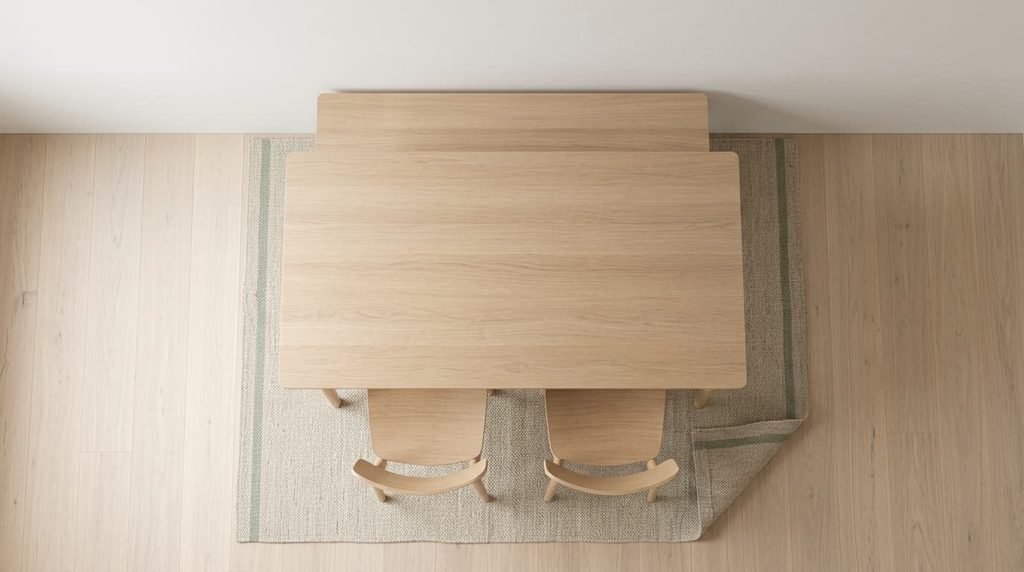
Small rug or large rug for a dining table is settled in favour of the small one when only one long side is used. Push the table’s long edge toward a wall or a bench. The seated side needs 60 cm and the other side needs only 20. That makes 80 + 60 + 20 = 160 cm, exactly the width of the smaller rug. Slide the rug so the table sits 20 cm from the edge on the wall side. The chairs then land on pile whenever they’re pulled out.
The unglamorous reasons favour it too. By area it’s 1.6 times lighter to carry and roll. You can lift it alone to vacuum the floor beneath. It needs only 170 × 240 cm of clear floor, so it suits a dining corner where the larger rug would climb a skirting board. At hand-back it leaves 2.1 m² less floor to explain.
It also copes with a short room, since a dining corner 250 cm wide holds it with a 40 cm border of floor on either side.
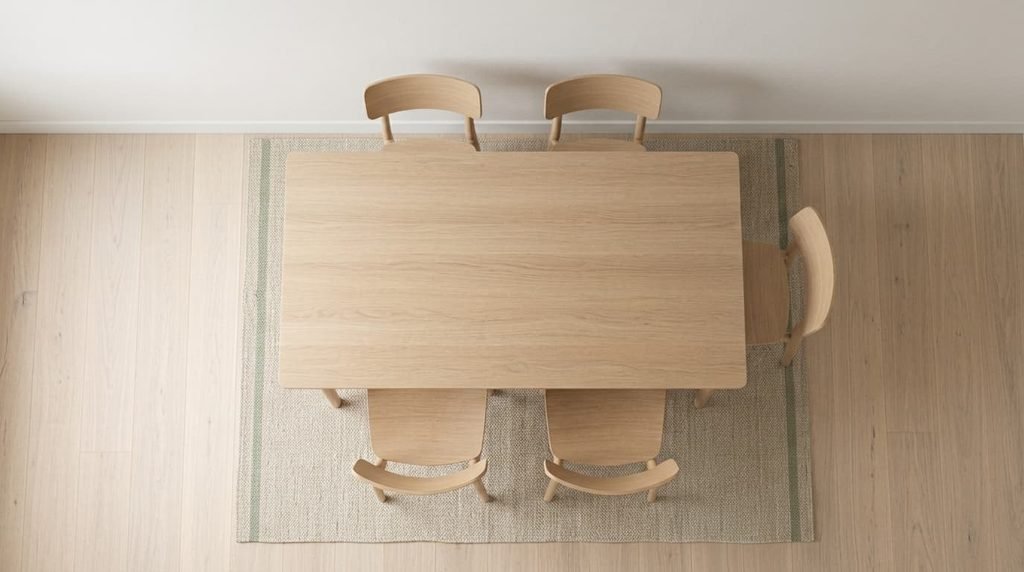
Where the large rug wins
With seats on both long sides, the large rug is the only standard size that holds every chair leg at the moment of sitting. The 60 cm margin beats the 55 cm reach by 5 cm. A chair slides out and back with your weight on it and crosses no edge. Small rug or large rug for a dining table is an easy call when the household eats together every evening.
It wins on sound too, and the reason is plain mechanics. Every drag of a chair ends at the same place, 55 cm out. On the smaller rug that place is 15 cm beyond the pile. The scrape lands on bare boards and carries to the flat below. On the larger rug it lands on wool. In a rented flat with neighbours underneath, that matters more than the look.
The table can also move 20 cm in any direction with every leg still on pile. The price is floor: 210 × 300 cm between the skirtings, which a tape measure will confirm in a minute.
When neither is right
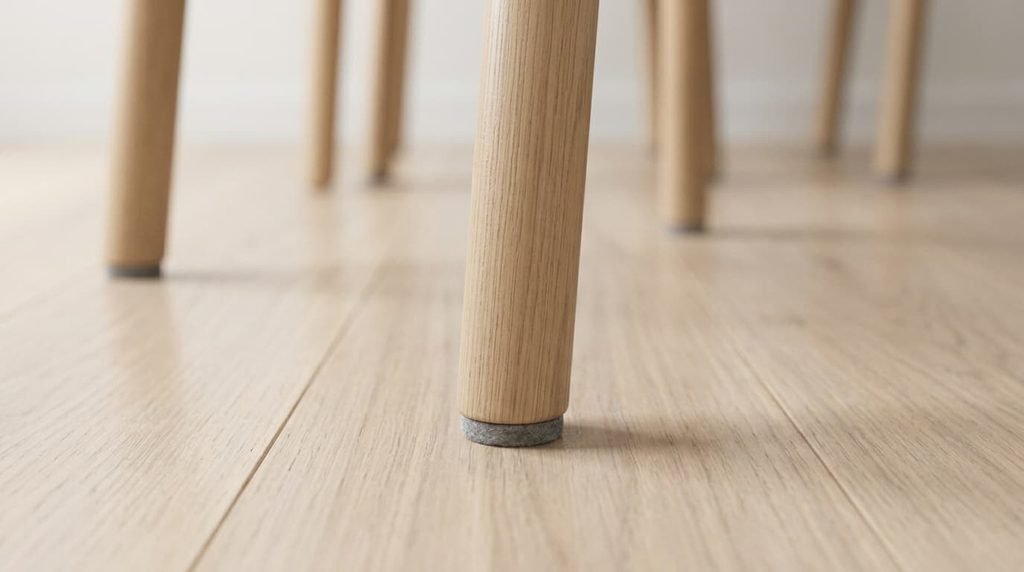
Leave the floor bare and fit felt glides to all 20 legs, four on the table and sixteen on the chairs. That’s the right answer when the dining corner has less than 170 × 240 cm clear, because neither size lies flat. It’s right too when the lease asks for no rugs. Glides cut the scrape noise at its source, since the leg stops hitting the board directly.
The cost is what the bare floor shows: crumbs and the tracks the chairs leave. A damp cloth clears them in a minute, and a hard floor finish forgives the rest. Bare boards also carry sound across the room. A dining corner beside a bedroom wall hears more of the evening.
If the table sees few meals, this is the lightest way to keep it. Check the glides every few months, because dust packs into the felt and turns it into sandpaper.
[IMAGE 6 HERE – replace this box with the generated image]
How to decide in thirty seconds
Slide a chair out as you’d sit down and measure from the table edge to its back legs. Add 5 cm. That’s your margin, 60 cm in the example.
If chairs sit on both long sides and you have 210 × 300 cm of clear floor, take the large rug, 200 × 290 cm. If chairs sit on one long side only, take the small rug, 160 × 230 cm, shifted so the table sits 20 cm from the free edge.
Lay four strips of newspaper in the rug’s outline and pull the chairs out. Then look at where the back legs land. If both sides are used and the floor is short, go back to the bare floor above.
Size the rug to the seated sides of the table. Small rug or large rug for a dining table then comes down to one measured number, the reach of your own chair. The example gave 55 cm and a 60 cm margin, which only the large rug meets. Yours may differ by 10 cm either way. That’s enough to change the answer, so tape the floor before ordering.
Questions readers keep asking
Does a dining rug wear out faster under the chairs?
Yes, wear gathers along the lines where chair legs drag, so those strips go flat first. A larger rug spreads the same traffic over more pile. Turning any rug through 180° every six months or so evens out the tracks. Flat weaves hide the flattening better than thick pile does.
How do I keep a rug under a dining table clean?
Vacuum along the direction of the weave. Go over the strip beside the table edge often, because crumbs collect where the chairs pull in. Flat weaves release crumbs faster than cut pile. Shake a small rug outdoors each month. Roll the larger one back so you can vacuum the floor beneath it too.
Does a round table need the same margin?
Yes, the margin counts from the table edge on every seated side. A round table of 100 cm with seats all round needs 100 + 60 + 60 = 220 cm. Use a round rug of 220 cm or a square one of that width. A lighter chair reaches less than the 55 cm in the example, so measure yours.