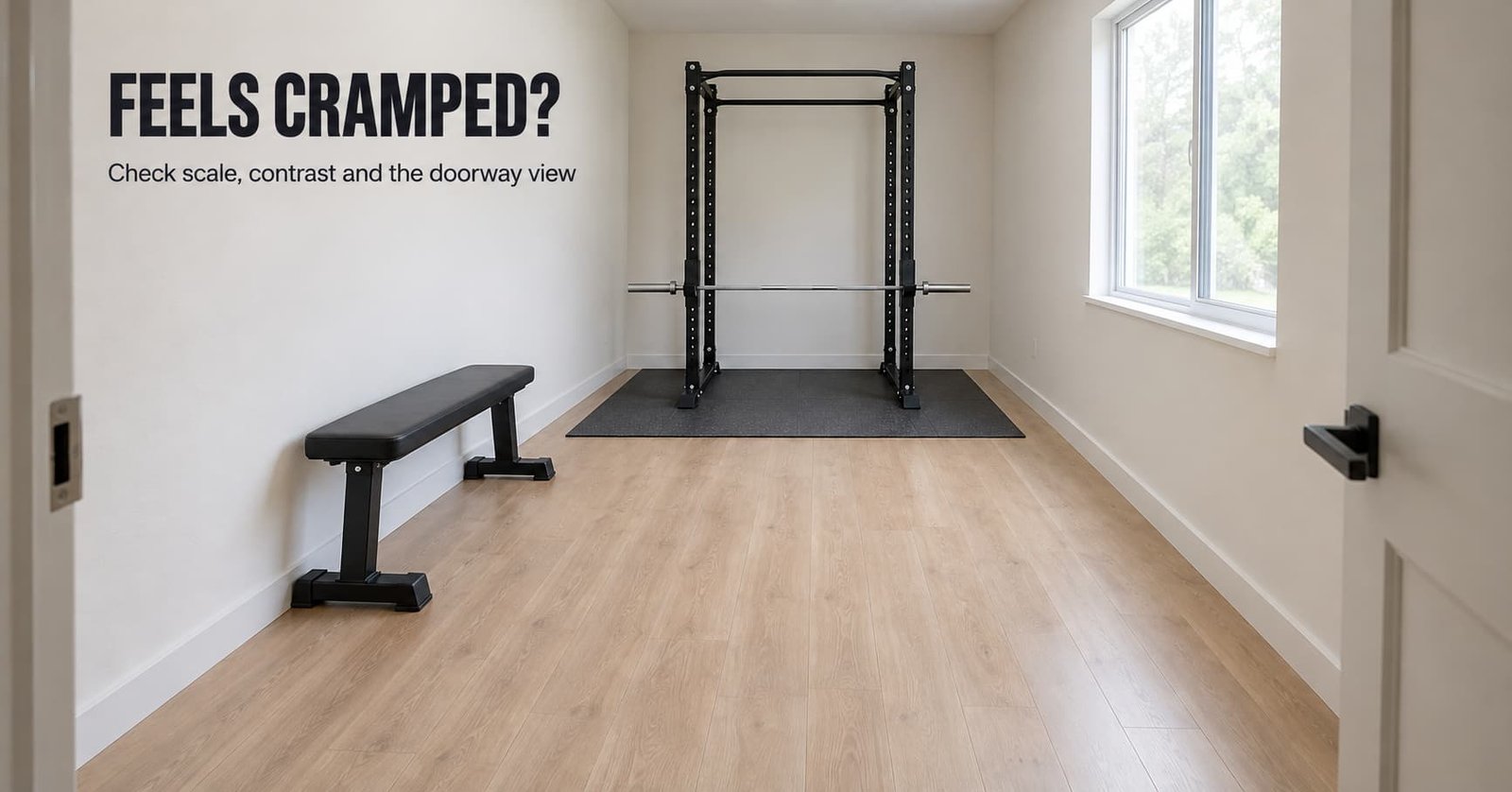
Open floor counts only when the eye can travel across it. What makes a home gym feel cramped is equipment that interrupts that path early, and a 15 m² spare room with a rack in it can read smaller than a bare 9 m² one. You see it the moment the door opens.
Three properties of the room produce that reading: the scale of the tallest piece, the tone gap between kit and floor, and the first object your eye meets from the door. They belong to proportion and contrast, and each can be checked in a minute without a tape measure.
What makes a home gym feel cramped on a large floor
The usual diagnosis is the room is too small for a gym, and floor area is the wrong number to test it with. A room reads as large when the eye meets a long unbroken line of floor and as small when objects cut that line within the first metre or two.
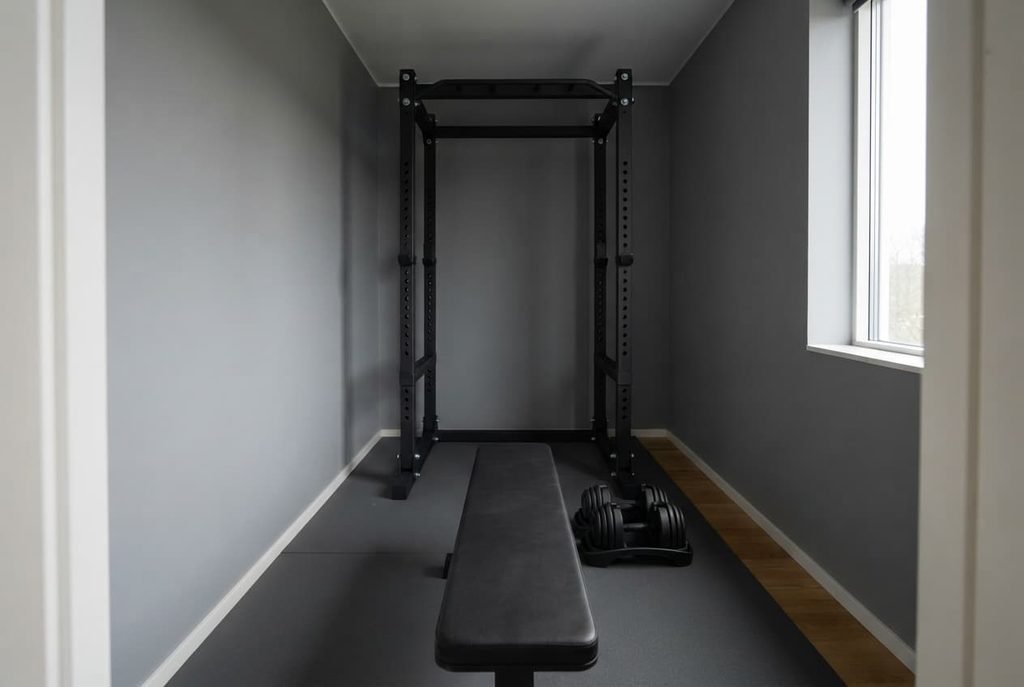
Scale comes first. A rack or multi-station stands about 210 cm tall, which fills nearly the whole height of a wall under a 240 cm ceiling, so it reads as part of the building. Contrast comes second. Light reflectance value (LRV) is a 0 to 100 scale for how much light a surface bounces back, and charcoal rubber sits near the bottom of it. Black kit on a charcoal mat against a mid-grey wall falls inside one narrow band, so the eye can’t separate object from floor.
Placement comes third. Whatever the eye meets first from the doorway sets the room’s apparent depth. A bench end 100 cm inside the door shortens a 420 cm room before anyone looks further. Run those checks on a plan and you can predict what will make a home gym feel cramped before a single piece is bought.
How to tell which fault you have
Stand in the doorway with the lights on and run three looks in this order. None of them needs a tape measure.
Look at height first. Find the tallest piece and compare its top edge with the ceiling line. A gap under about 30 cm means the piece reads as part of the structure, and the scale fault is yours.
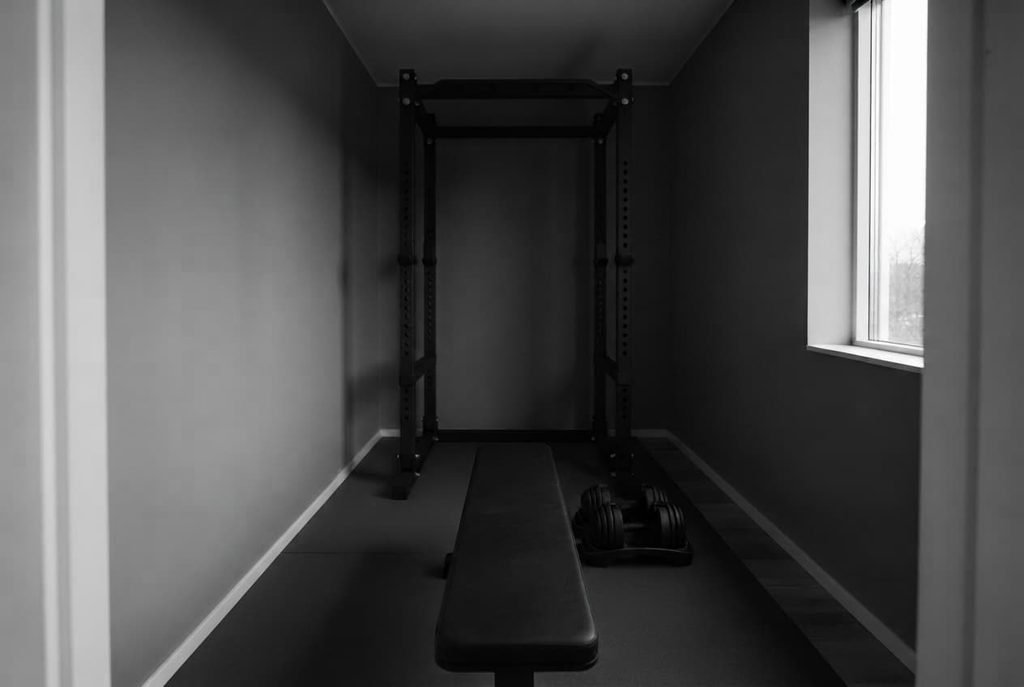
Then squint until detail blurs. A photo switched to black and white does the same job. If the mat and the kit merge with the lower wall into one dark shape, the contrast fault is yours. Where each piece keeps a paler edge around it, the room passes this look.
Last, note the first object that stops your eye and pace the distance from the door to it. Under half the room’s length means the placement fault is yours. Dark objects hold the eye longer than pale ones do, so a black bench at that spot counts for more than a white one would.
Two failed looks mean two faults, and each fix below works on its own.
Why does a home gym look cramped: three faults, diagnosed
Each entry pairs a symptom with its cause and a fix. Free changes come before purchases, because most causes that make a home gym feel cramped respond to a move.
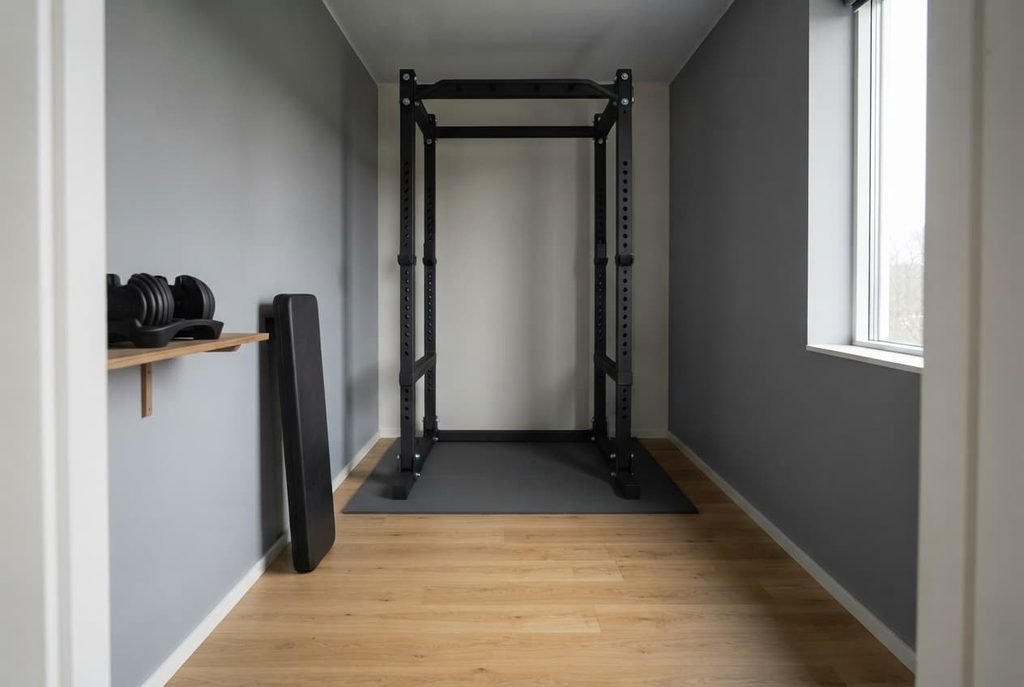
The tallest piece dominates and the wall seems to vanish behind it. The cause is scale. A 210 cm frame under a 240 cm ceiling leaves a 30 cm gap, and apparent size falls as distance grows, so the same frame reads far smaller from 4 m away than from 1.5 m. The free fix is to move it to the wall farthest from the door. A rearrangement helps further: keep everything beside it below hip height so the frame stands alone against the wall. A purchase is the last resort, a squat stand of about 150 cm that leaves 90 cm of wall visible above it.
The kit and the floor look like one dark block. The cause is contrast. Black steel and charcoal rubber both sit under about 10 on the LRV scale, so no object has an edge the eye can follow, and a mat that has faded to grey with dust still sits near the dark end. The free fix is to cut the mat back to the lifting zone and let the bare floor show around it as a lighter border. Next, move the darkest piece away from the dark wall, because a pale gap behind it restores the edge. The purchase is a tin of pale paint behind the kit, which gives the equipment a lighter backdrop for the price of a weekend.
The room looks short the moment the door opens. The cause is placement. A bench or a tray inside the first metre becomes the focal point and the eye stops there. The free fix is to keep a strip about 90 cm wide from door to far wall clear of everything. Moving the bench to a side wall is a rearrangement that finishes the job, since a side-on bench reads as part of the wall. A wall shelf at 90 cm takes the dumbbell tray off the floor, on fixings rated for double the weight it holds.
What to check before you add anything else
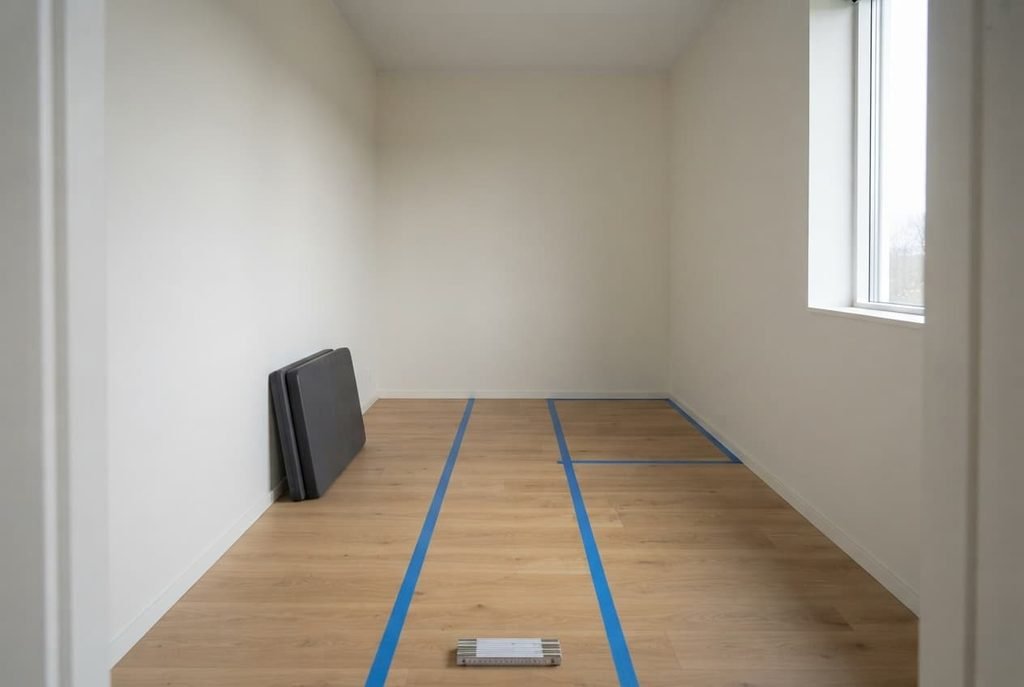
Before the next piece arrives, test it against the causes that make a home gym feel cramped. Hold its height against the ceiling line, and keep it below about four-fifths of the wall unless it goes at the far end. That ratio is my rule of thumb rather than a standard. Compare its tone with the floor and the wall behind it, and favour a lighter finish when both are dark. Tape its footprint on the floor and look from the doorway, because a piece that crosses the clear strip has failed before it’s bought.
How hard each check bites depends on the room’s own light and height. A north-facing room gets flatter light, which sharpens the contrast fault, and a ceiling under 230 cm brings the scale fault in sooner.
The fix that isn’t worth doing
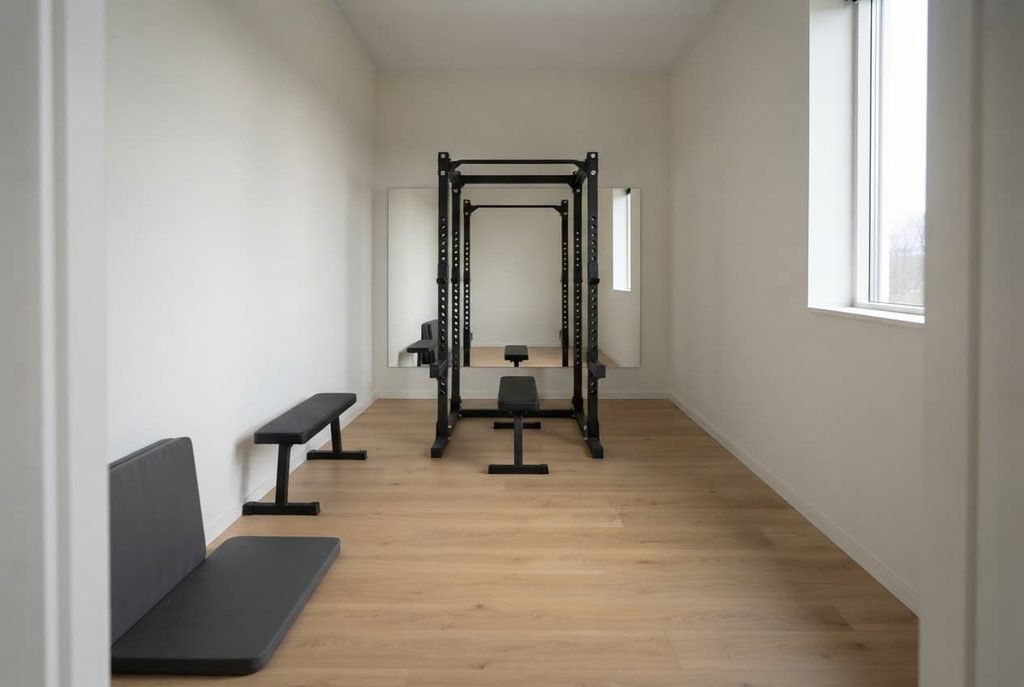
A wall of mirror to make the room look bigger is the standard remedy, and it leaves the cause intact. A mirror shows a second copy of the kit at twice the distance, so the ratio of equipment to floor stays what it was, and a mirror opposite the door puts a reflected rack at the end of the sightline. I’d defend a harder rule than most gym guides: a mirror is a form-checking tool and has never been a room-enlarging one. One mirror about 60 cm wide beside the lifting spot does the form job without touching the sightline. Pale rugs and wall art fail for the same reason, because none of them changes the height of the tallest piece or the tone of the kit.
A mirror copies a crowded room faithfully.
A room reads as cramped when something cuts the eye’s path across the floor, and the three faults above cut it in three different ways. Fix them in the order that costs least: distance for scale, a lighter backdrop for contrast and a clear strip for placement. The squint look from the doorway catches the most common fault fastest, because dark kit on a dark floor merges into one shape within a second. If it merges, start there before moving anything heavy, and recheck from the same spot after each change so you can see which one did the work.
Questions readers keep asking
Why does my home gym feel cramped when the room is big?
Cramped is read from sightlines, so floor area alone decides little. Three causes show up most: a tall piece that fills the wall, dark kit on a dark floor that merges into one shape, and an object inside the first metre from the door that stops the eye early.
How do I make a home gym feel less cramped quickly?
Clear a strip about 90 cm wide from the door to the far wall, then move the tallest piece to the end farthest from the door. Both changes cost nothing and take under ten minutes. Recheck from the doorway afterwards and squint to see whether the kit still merges.
Can a cramped home gym be fixed without renovation?
Yes, in most rooms. Scale and placement faults respond to moving pieces, and the contrast fault responds to a smaller mat or a pale backdrop. A ceiling under 230 cm limits the scale fix and a windowless room limits the contrast fix, so those two can only be reduced.