Which surface gives way first when a three-year-old and a six-year-old share your sofa? Fabric or faux leather seems to be about taste, yet the real gap lies in how each one treats a tipped cup and a hard corner. We model a three-seater 200 cm wide, with seats 55 cm deep, in a Utrecht flat, occupied roughly five hours daily by two adults and two children. Next come the behaviour of each surface and a comparison table, then a third route for households that already own a sofa. Two closing rules decide the matter. Swap each figure for your own.
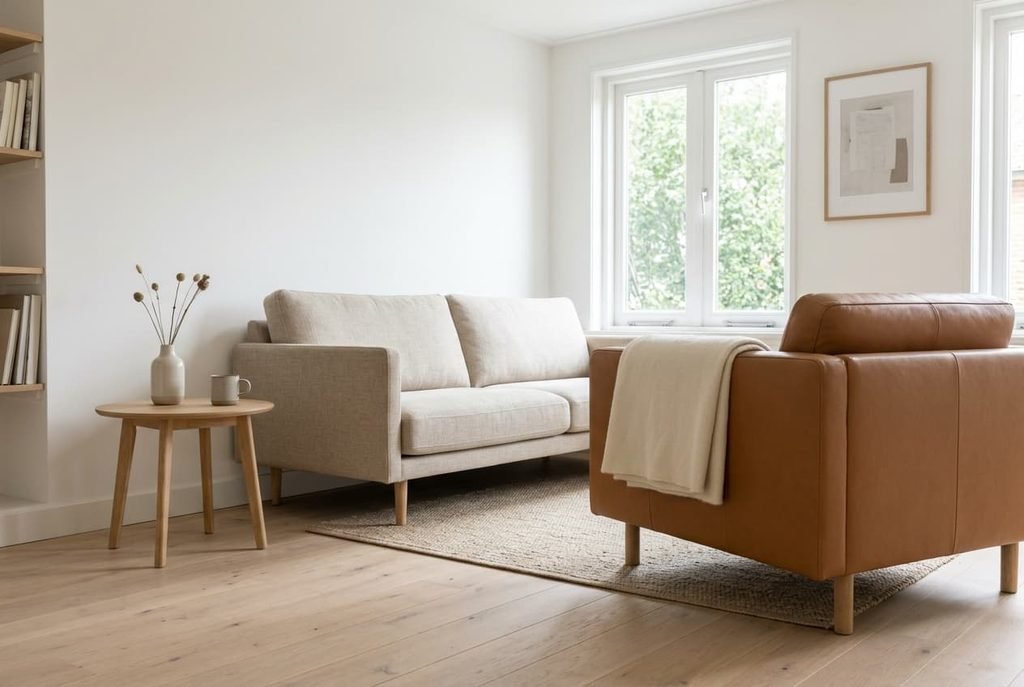
Fabric or Faux Leather: What a Family Sofa Has to Survive
A family sofa absorbs four kinds of abuse. Liquid lands on it, sticky fingers rub against it, a toy corner pokes into it and the same few seats get used for years. Each material meets these in its own way.
Five hours daily adds up to 5 × 365 = 1,825 hours annually, concentrated on a seat zone of 200 × 55 cm, which is 1.1 m². Few surfaces in a living room carry that load.
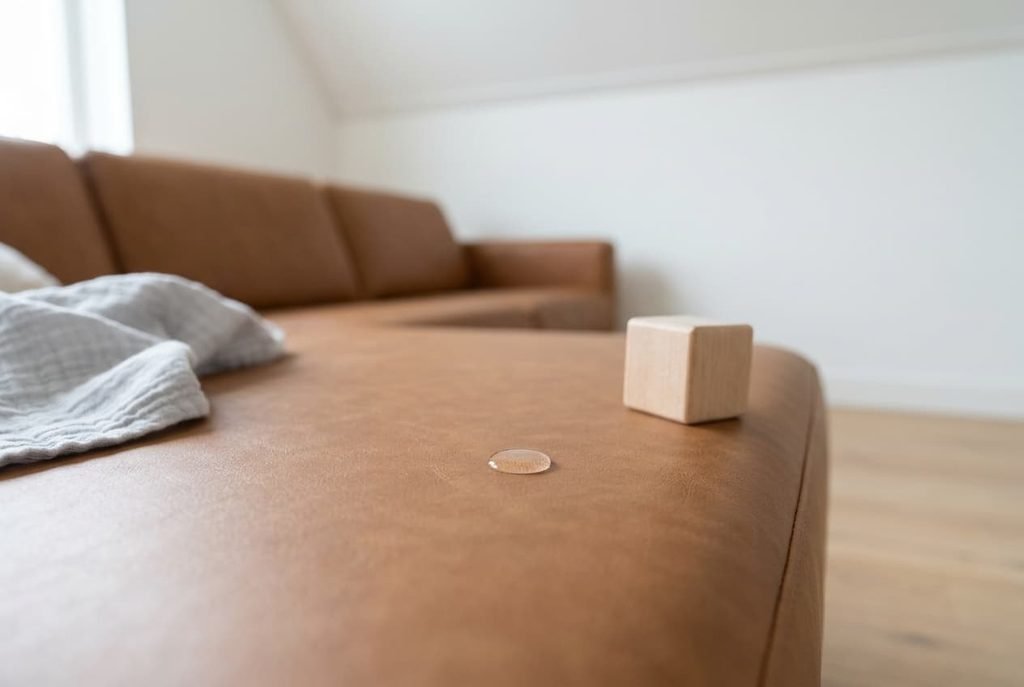
Faux leather is a woven base with a thin plastic film on top. Liquid sits in beads on the film until a cloth removes it. Fabric works the other way round: the fibres pull liquid inward, so the damage starts as soon as the cup tips.
Assume one spill every week, or 52 per year. A cloth clears faux leather in about 20 seconds, so a year costs 52 × 20 = 1,040 seconds, just over 17 minutes. Fabric needs roughly 3 minutes of blotting and spot treatment per spill, which comes to 52 × 3 = 156 minutes. Four complete cover washes at 45 minutes apiece contribute 180 more, so fabric totals 336 minutes, close to 5.6 hours. Judged purely by time spent cleaning, the coated surface wins by about nineteen to one, although the film settles that debt in other ways.
Cleaning time is only one measure of a good sofa.
The Two Surfaces Side by Side
Seven traits separate the pair. Each applies to any weave or any coating, and none relies on a manufacturer, so you can carry the rows from one showroom to the next. Compare them with the mess your own household makes.
| Property | Fabric | Faux leather |
|---|---|---|
| Spilled juice | soaks in within a minute | beads and wipes off |
| Sharp corner or claw | snags or pulls a thread | can pierce the film |
| Bare skin in warm weather | feels dry | can feel sticky |
| Bare skin in cold weather | feels warm at once | feels cool at first |
| How wear shows | pilling and shiny patches | cracking or peeling of the film |
| Cleaning method | blot, then wash covers | wipe with a wrung-out cloth |
| Repair at home | patch or re-cover a cushion | hard to hide a split |
Faux leather leads on cleaning, while fabric leads on comfort against skin and on graceful ageing. In the contest of fabric or faux leather, the wear row settles most long arguments, because a split film can’t be mended invisibly.
Two rows deserve a second glance. The temperature rows differ since the film carries heat away from skin faster than cloth pile does. The wear row looks ahead: pilling is cosmetic, whereas a break in the film is permanent and tends to spread outward from the first split.
How a Faux Leather Sofa Behaves Day to Day
Anyone weighing fabric or faux leather should inspect the seat edge first. The coating is smooth and doesn’t absorb, so spills stay put until someone wipes them. Juice and wax crayon leave with a wrung-out cloth and one dry pass. Felt-tip ink needs a second go. That suits a toddler who snacks in front of a screen, and nobody has to hover over a cup.
The film is also the weak point. A toy corner or a cat’s claw can break through, and a break can’t be disguised. A split exposes the woven base. The edges then begin to lift. Flexing concentrates along the lip of each cushion, so cracking appears there before anywhere else. Pen caps and keys do equal harm, and a scratch from a zip leaves a line that no wipe will remove. A weekly pass with a cloth keeps grease from settling into the seams.
Temperature is the final trade. With no pile to trap warm air, the first minute on a cold evening feels chilly. In summer bare legs stick to the film, and restless children wriggle more.
How a Fabric Sofa Behaves Day to Day
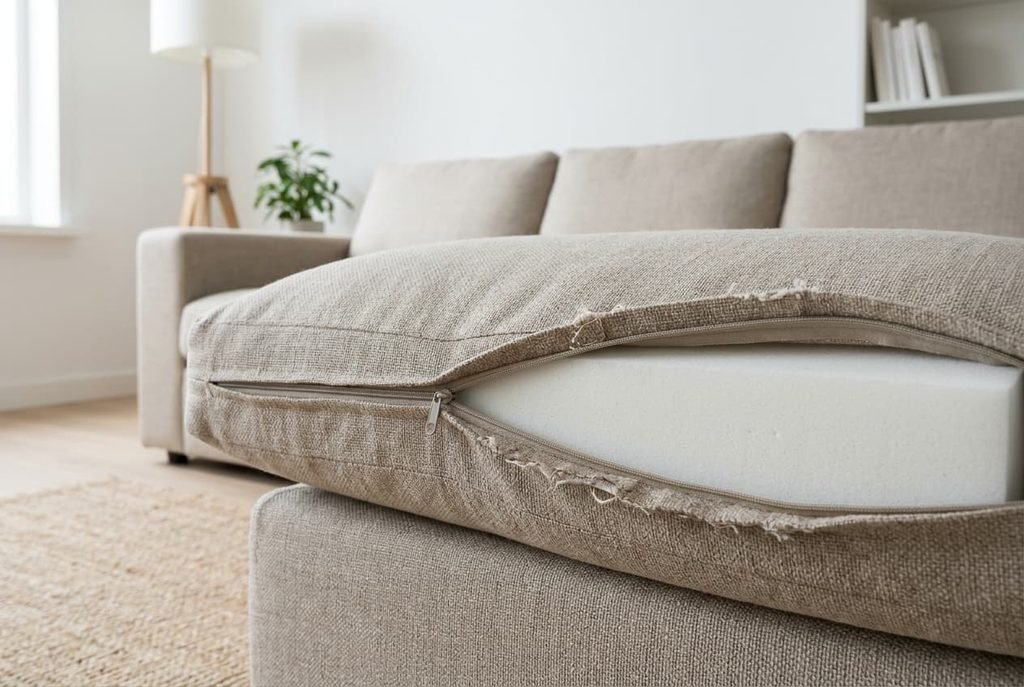
Fibres cling to whatever lands on them. A drink caught quickly mostly lifts out, whereas a sauce left overnight stays. A dense weave in a speckled mid tone conceals marks well, while a plain pale one displays every fingerprint. Open weaves collect crumbs and toy corners, so the cloth’s texture counts as much as its colour. Cloth doesn’t split at a sharp corner the way a film does, since the threads give before they break.
Washing is the fabric sofa’s real advantage.
A removable cover goes into the machine at a low temperature and is dry by the next evening. A fixed cover can be treated in place with a little mild soap, and the foam underneath stays dry if you move briskly. Ageing is gentler as well. After some years the cushion lip shines and tiny fibre balls form where elbows rest, yet nothing tears open. A worn cushion takes a new cover from a metre of cloth, so the frame carries on.
Faux Leather Against Fabric: Keeping the Sofa You Own
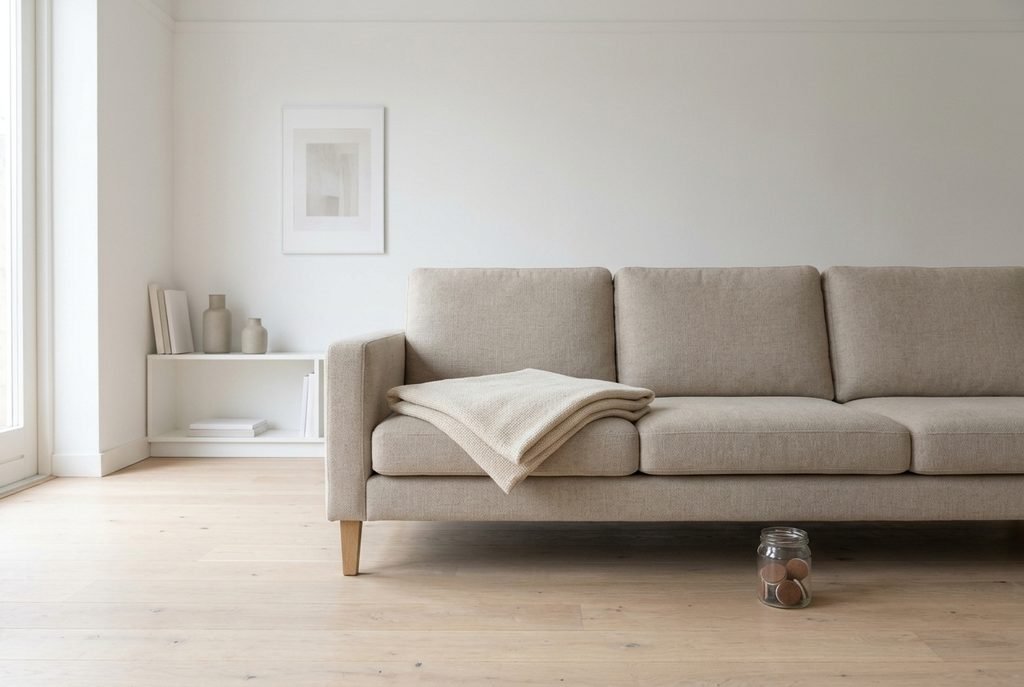
When a sofa is already in your living room, switching surfaces needs a solid reason. A firm frame and cushions that rebound typically buy you another year, and a washable throw across the seat zone with glides under the legs answers most family grumbles about stains and scraping.
Run three checks first. Press each cushion to see whether it recovers. Run a hand along each cushion lip for early cracks or shine. Rock the whole sofa to learn whether the joints have worked loose.
The plan collapses when the film has already split or the frame has cracked, since a throw covers damage without halting it. Where the sofa is sound, one afternoon does the job. You skip the delivery and the clear-out, and the room keeps its present layout. The price is a throw to launder every week or two. Choose a tight weave for it, because a loose one snags on small toes. Glides cost little and quieten a sofa that children push across tile.
Which Suits Your Household: Two Short Rules
If the children eat or draw on the sofa daily and you want the fastest tidy-up, pick faux leather. You live with a cool first sit and a surface that can’t be patched. In exchange, each wipe takes 20 seconds. Keep scissors and claws well away from it.
If the sofa is mainly for sitting and you can launder a cover each season, pick fabric with a removable cover. You live with a longer tidy-up after each big spill. In exchange, the seat feels warm at once and ages by fading, not splitting. Wash the cover twice a year and its colour holds up.
Fabric or faux leather will each cope with a busy family when the pick fits the mess. At the showroom, press a wet fingertip on a sample and time how long the mark lingers. Ten seconds of testing says more than the swing tag does. The same test shows when neither option is needed, and keeping your present sofa is the sensible move.
Questions Readers Keep Asking
Which lasts longer with children in the house?
Fabric usually outlasts the coating, because its wear appears as fading and pilling that never opens up. Faux leather performs well until something pierces the film or the flexing zone cracks, after which it looks worn immediately. Decide which damage you could tolerate and which one you could mend yourself.
How do I clean each one?
Wipe faux leather with a wrung-out cloth, then dry the surface at once, because standing water can lift the film’s edge. Blot fabric without scrubbing, then work in mild soap. A removable cover tolerates a cool machine cycle. Hot water shrinks cloth, so avoid it.
Which suits a small Dutch flat?
In a small flat the sofa often sits near a window and the heating, so a surface that feels warm and wipes clean weighs heavier than a label. Fabric with a removable cover usually fits best. If the room is bright and summers feel sticky, faux leather becomes less pleasant.