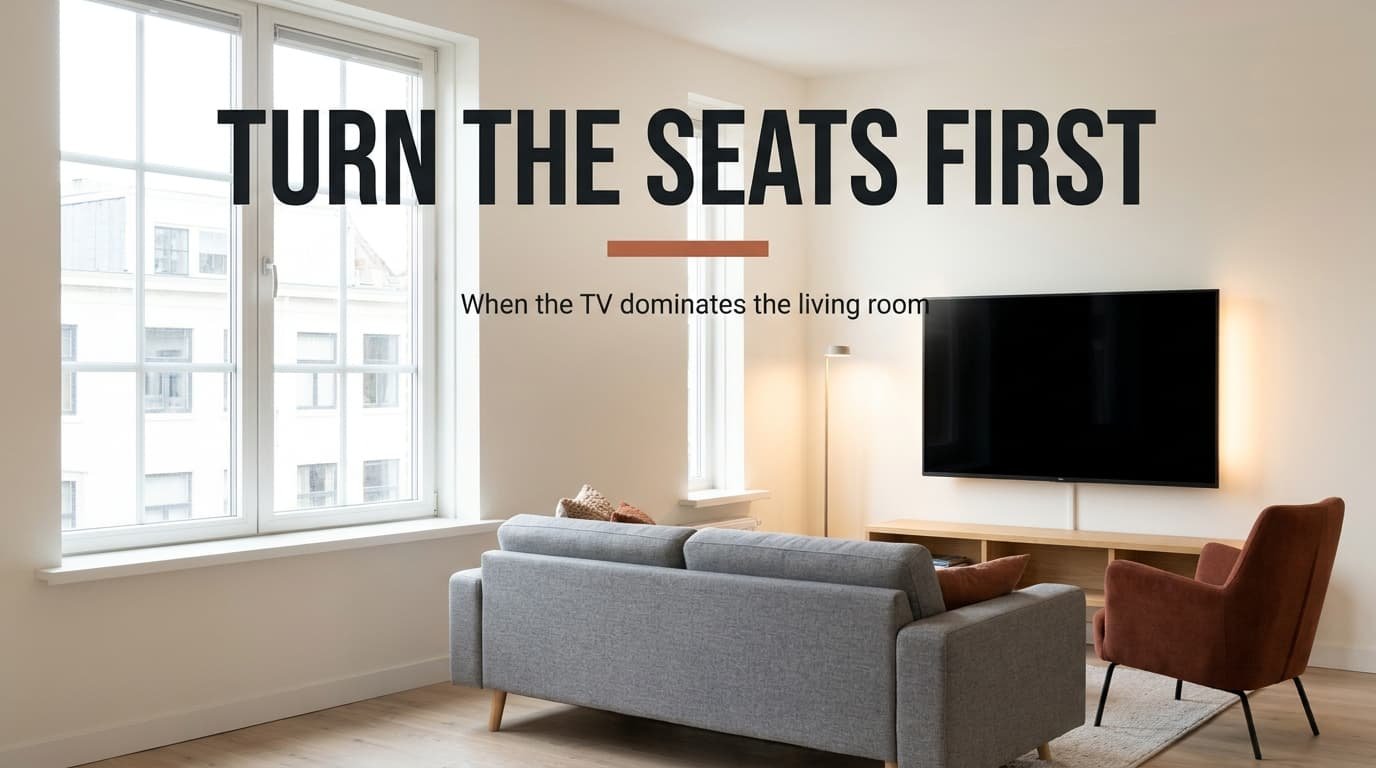
A television beats a sofa and a bookcase for your attention, which is how you end up with the living room where the TV dominates every evening. Turn the seats first, so that none of them points straight at the screen.
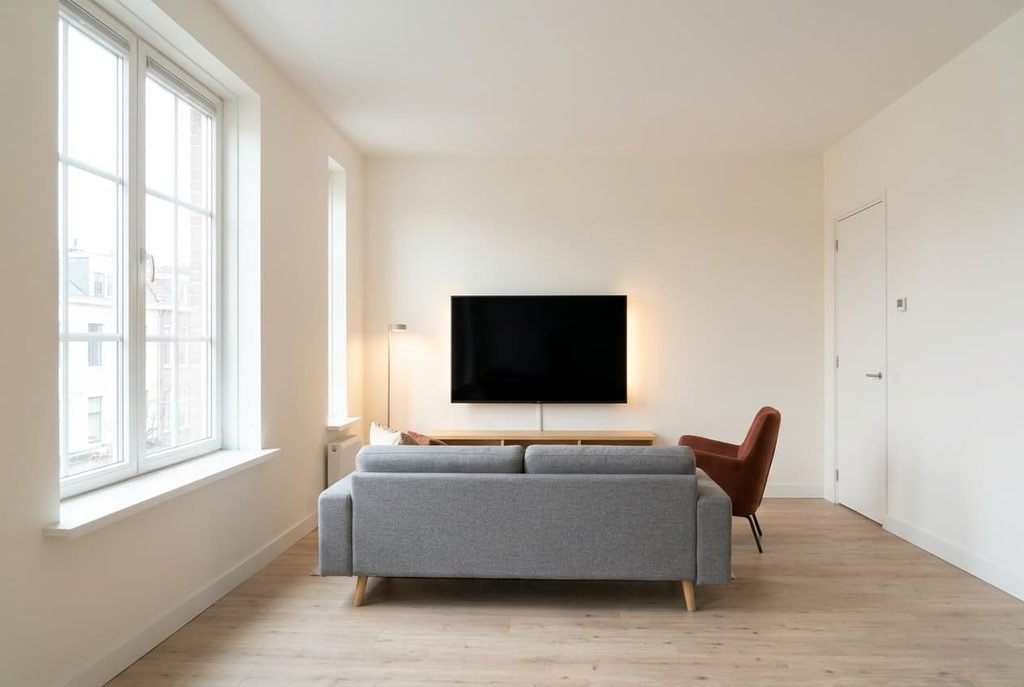
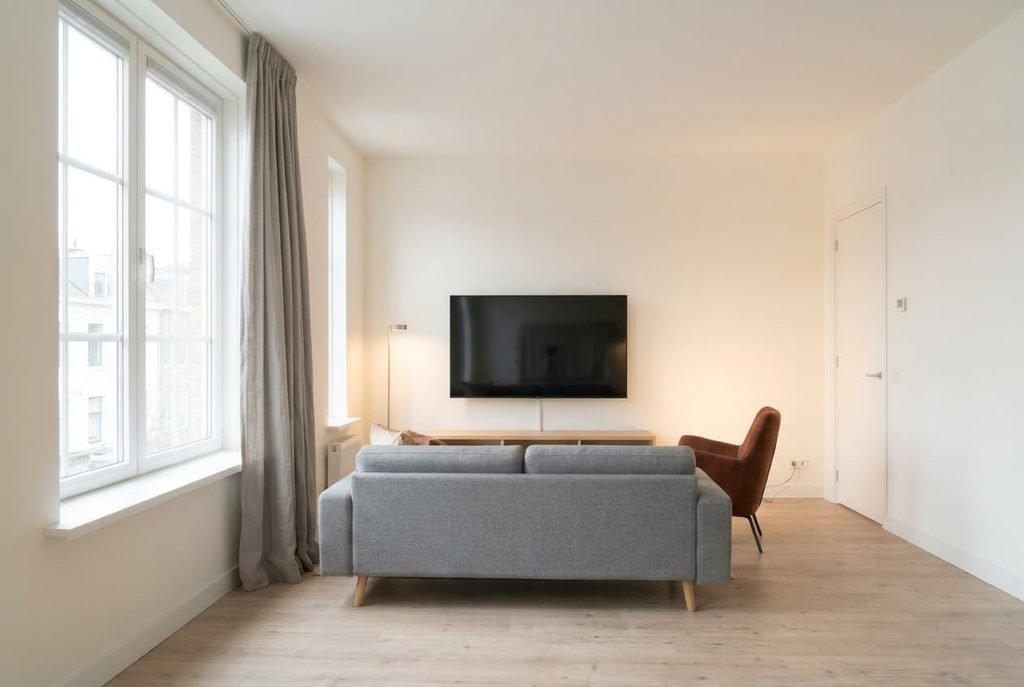
Our model room is Dutch and measures 380 cm by 460 cm. Ceiling height is 250 cm and the walls are warm white. A 55-inch screen hangs on the short wall, facing a sofa 3.0 m away. Read the numbers as a ranking aid, because they come from a rough model and won’t match your wall exactly.
What is going on in the living room where the TV dominates
A dark rectangle on a pale wall forms the sharpest edge available, and your gaze reaches for that edge before anything else. Our screen measures 122 by 69 cm, which is 0.83 m² on a 9.5 m² wall. That’s 9% of the area, yet a switched-off glass face returns only about 4% of the light that meets it, while the warm-white wall returns 72%. The contrast across that edge is 18 to 1.
Two more mechanisms stack on top. When every seat points at the screen, the room has a single line of sight, and nothing else gets looked at. At 3.0 m the screen fills 23° of your view, wider than anything else here, and a sofa for three plus an armchair puts four of four heads on the same line. After dark the screen gives 120 candelas per square metre against a wall lit to 4.6, a ratio of 26 to 1, so the picture is the only bright thing in view.
Each mechanism has its own remedy. Use that to predict the same condition in any room: a larger screen widens the angle, and a paler wall steepens the edge.
Confirm why the TV dominates your living room
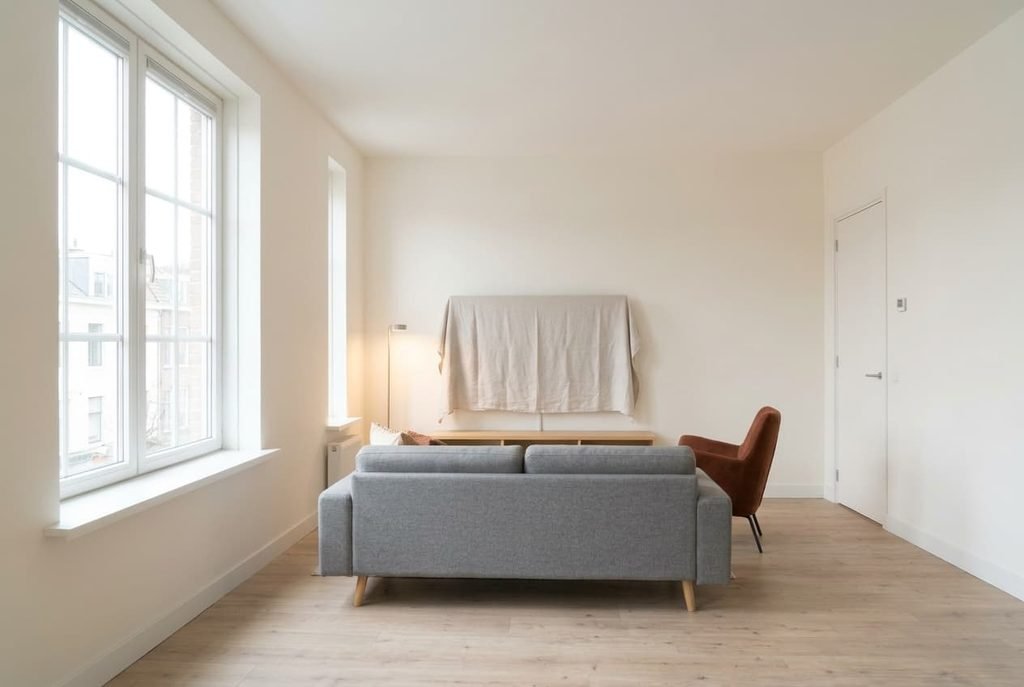
Run three quick tests before moving a piece of furniture. First, drape a plain sheet over the screen in daylight and stand at the door. If the room suddenly feels settled, the cause is the black rectangle itself. The paint and joinery fixes below will then matter most. If nothing changes, the sheet has ruled that cause out, and you can skip those two.
Next, sit in each seat. Point your arm along the line of your knees. If every arm lands within about 10° of the screen, the seating axis is the cause. Turning the seats will do more for you than anything you buy.
Lastly, switch the screen on after dark with every lamp off. If the room looks fine by day and lopsided at night, you’re dealing with the evening contrast, and a lamp is the cheapest answer. Write down which of the three applies before you start. Two causes usually overlap, and the mix decides where you begin.
Treat the strongest one first.
The fixes, in order
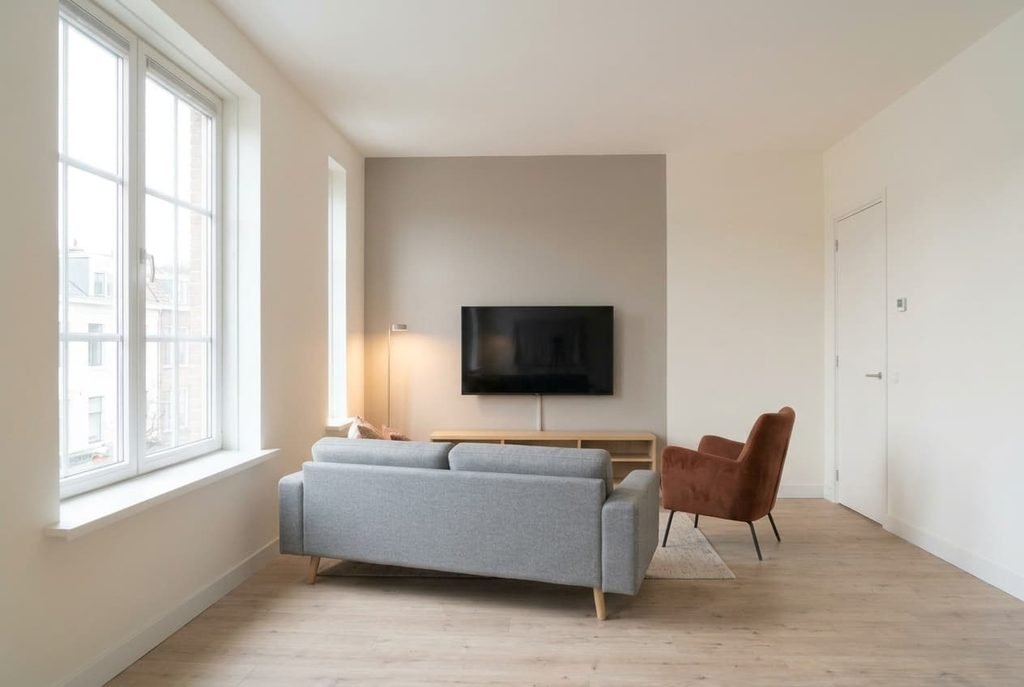
Turn the sofa and chair until the screen sits about 30° off each seat’s line, which addresses the single line of sight. No money is needed, and the screen stays watchable at that angle. Angle the sofa towards the chair, and a conversation corner forms that gives your eye somewhere else to land. At 3.0 m, 30° off means the screen sits 1.7 m to the side of a seat’s line. The limit is the black rectangle, which keeps its 18 to 1 edge, so from the doorway it still says TV room. Expect the change to show from the sofa and not from the doorway.
Light the wall around the screen with a warm lamp, which addresses the evening contrast. It’s the cheapest relief in the living room where the TV dominates after dark. Raising the wall from 20 to 60 lux lifts it from 4.6 to 13.8 candelas per square metre, and that cuts the ratio from 26 to 1 to about 9 to 1. It costs one lamp and a bulb, and it needs a socket within reach of the wall. A warm bulb of about 2,700 K keeps the wall from looking blue beside the screen. Aim the light at the wall beside the screen and keep the bulb out of your sight. The limit is daytime, when the lamp does nothing for the dark glass.
Paint the screen wall a mid tone near 18% reflectance, which addresses the edge, the 18 to 1 step between the glass and the wall. At 18% the step falls to 4.5 to 1. It costs one tin and an evening with the furniture pulled forward. Choose a matt finish, since a sheen would add a reflection of its own. The limit is the wall itself, which now absorbs light. The screen still glows after dark.
Have a carpenter build a shelving frame 220 cm across and 200 cm tall around the screen, which addresses the area. The screen drops from the whole of its zone to 19% of the 4.4 m² frame, and books break up its outline. Fill the shelves about two thirds full so the edge dissolves into texture. It costs professional work, and a rental needs your landlord’s consent. The limit is the seating, which stays pointed at the glass, so do the first fix as well. Joinery that sits flush with the wall also hides the cables, a small bonus.
What this room’s fixed features allow
Three features of the living room where the TV dominates are built in, and no styling alters them. The aerial socket sits on the short wall, so the screen can’t move far from it without a longer lead. The radiator under the window rules out a sofa in front of it. And the window on the long wall faces the screen’s likely spot, so daylight reflects in the glass, which is the one problem here that paint can’t touch.
That reflection is what to plan for. A mid-tone wall does nothing about it. Lined curtains at the window cut the glare. If your room has no window facing the screen, drop that concern. Spend on the lamp instead. A high ceiling would give you room for taller shelving, but a 250 cm ceiling caps the carpenter’s frame at about 200 cm once you allow for a plinth.
The fix that doesn’t work
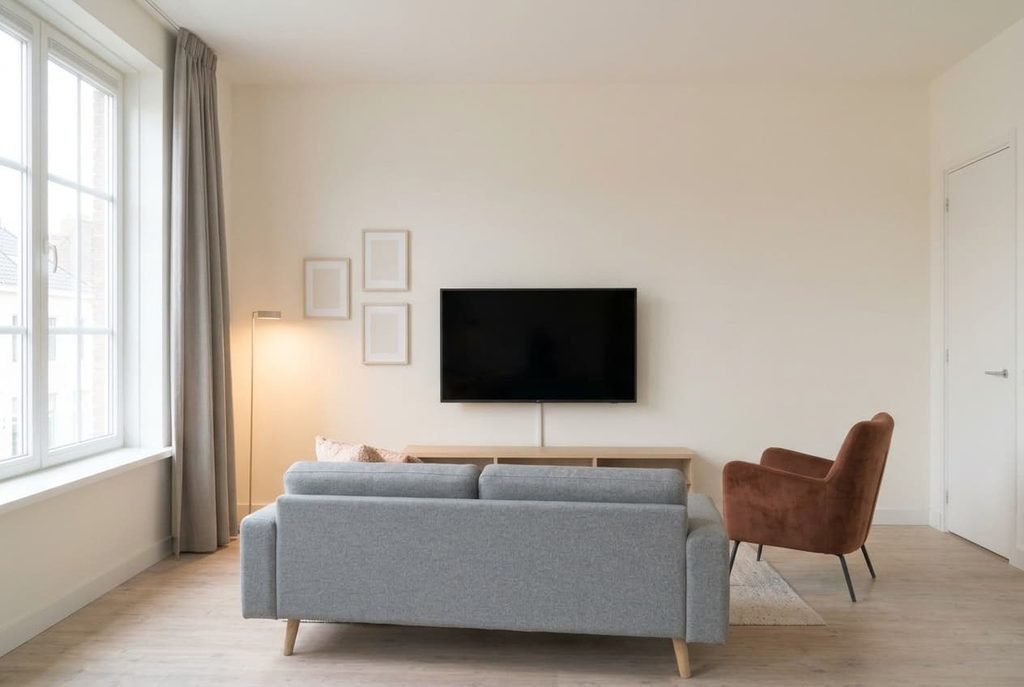
Hanging pictures on either side to balance the screen is the advice you’ll hear most. Three frames of 40 by 50 cm total 0.6 m², close to the screen’s 0.83. The eye measures contrast and not area. Pale paper in a pale frame on a 72% wall gives about 1 to 1. The screen’s 18 to 1 edge is untouched. Even a dark painting of 60 by 80 cm at 10% reflectance gives only 7 to 1, so you’d end up with two dark rectangles competing, and the larger still wins. A balanced room needs a counterweight of equal darkness, such as a dark bookcase beside the far arm of the sofa.
Pictures decorate a wall and can’t offset glass, so hang them for pleasure only and keep them well away from the screen’s edge.
Soften the step between glass and wall first, since that’s where your gaze lands. In the living room where the TV dominates, turn the seats this evening, add the lamp at the weekend and test the sheet again. If the space still looks like a TV room, paint is next. Joinery is last. Keep the measurements, because a bigger screen later restarts the sums. Ask whether the space still looks like a TV room before spending more.
Questions readers keep asking
Can a big TV ever look balanced in a living room?
Yes. Handle the edge contrast and the seating axis first. A mid-tone wall and seats turned 30° off the screen then let a 55-inch panel sit quietly. A counterweight across the room helps. The screen stays the brightest object after dark, so keep expectations modest.
How much does it cost to make a TV blend in?
Nothing is charged for the opening fix, which only moves furniture. A lamp and some paint are small purchases. Built-in joinery is the expensive step and is worth considering when the earlier three leave the screen in charge. Costs climb with each step.
Why does the TV dominate even when it’s switched off?
A black glass face is the darkest large patch against a pale wall, and your gaze lands on the sharpest edge. The 18 to 1 contrast does the work, with no picture needed. Paint the wall a mid tone, or frame the screen with shelves, to soften that edge.