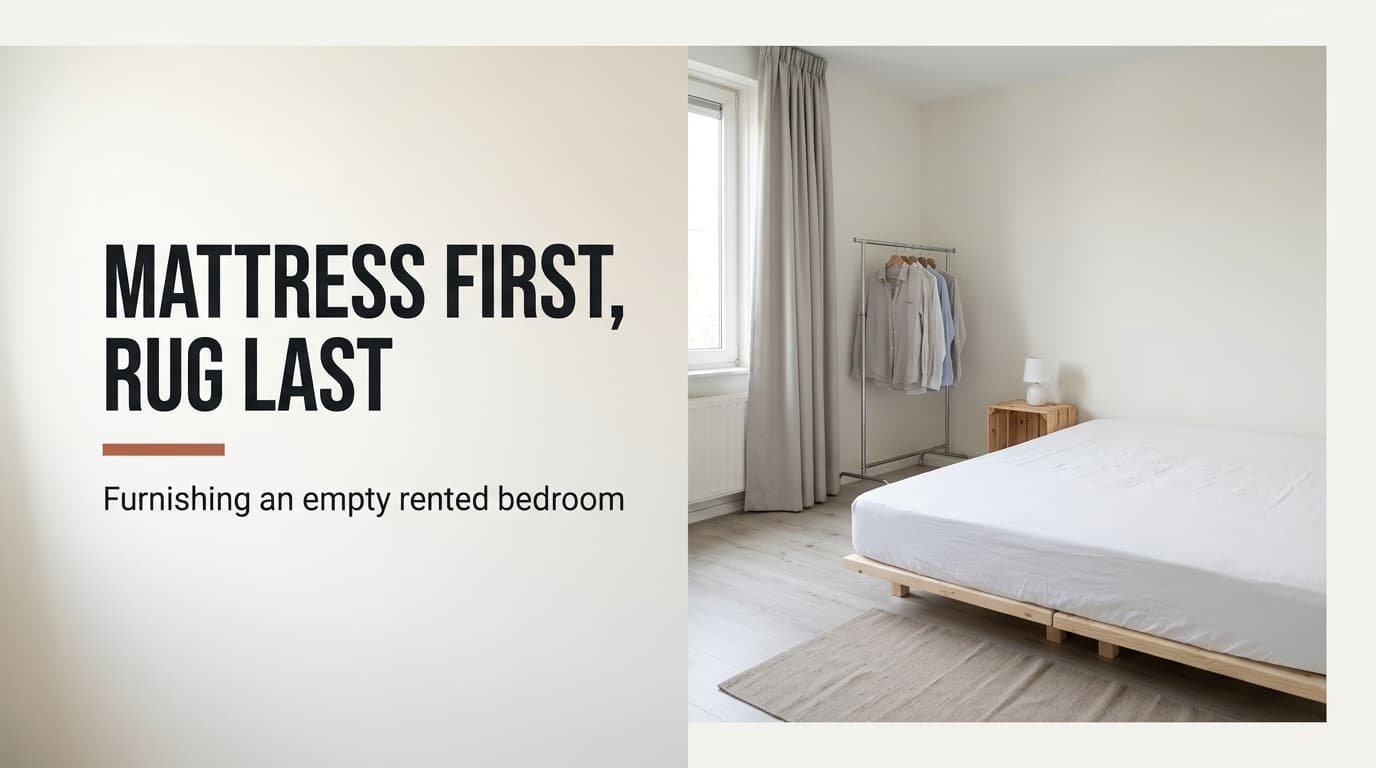
What does the first night in an empty rented bedroom need? A mattress and a light come first, with a cover for the window by the next morning. The clothes rail follows within the week, and the rug can wait a month.
Our invented Dutch room is 300 by 380 cm, with the ceiling at 250 cm. Its window measures 120 by 140 cm and its door 90 cm. Prices change fast, which is why each piece here is weighed by dimensions and construction. Run the arithmetic again with your own tape measure.
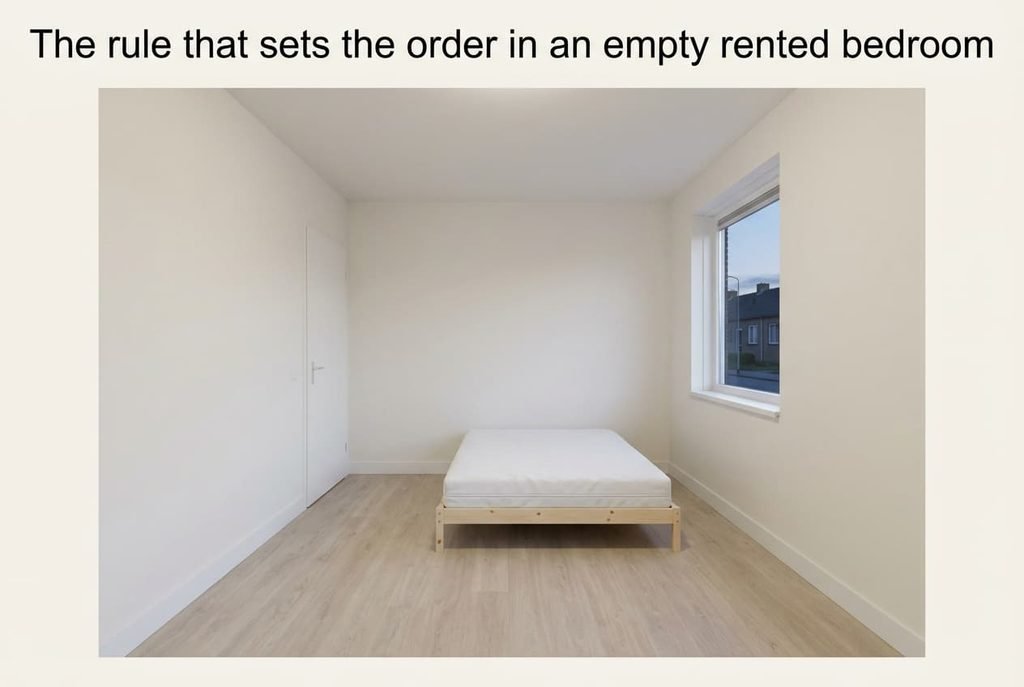
The rule that sets the order in an empty rented bedroom
You’ll move out one day, so every purchase answers two questions. Will the piece fit the next room unchanged? And does extra money buy a construction detail you can check in a shop? Spend only where both answers are yes, and keep everything else cheap.
A 140 by 200 cm mattress passes the first question, because nearly every bedroom can take that size. It passes the second as well, since the foam density appears in the specification. A lamp passes the first and fails the second, because the bulb gives the light while the lamp merely holds it. Curtains cut to this window fail the first, though they pass the second.
Order follows a different logic: the day you’d first miss the piece. The mattress is missed at bedtime on night one. The sun is up by about 05:20 in June, so the window cover is missed at dawn. After a week of living out of bags you’ll miss the rail, and a rug only matters once bare boards at the bedside annoy you. These days are assumed, so move them around to suit your habits.
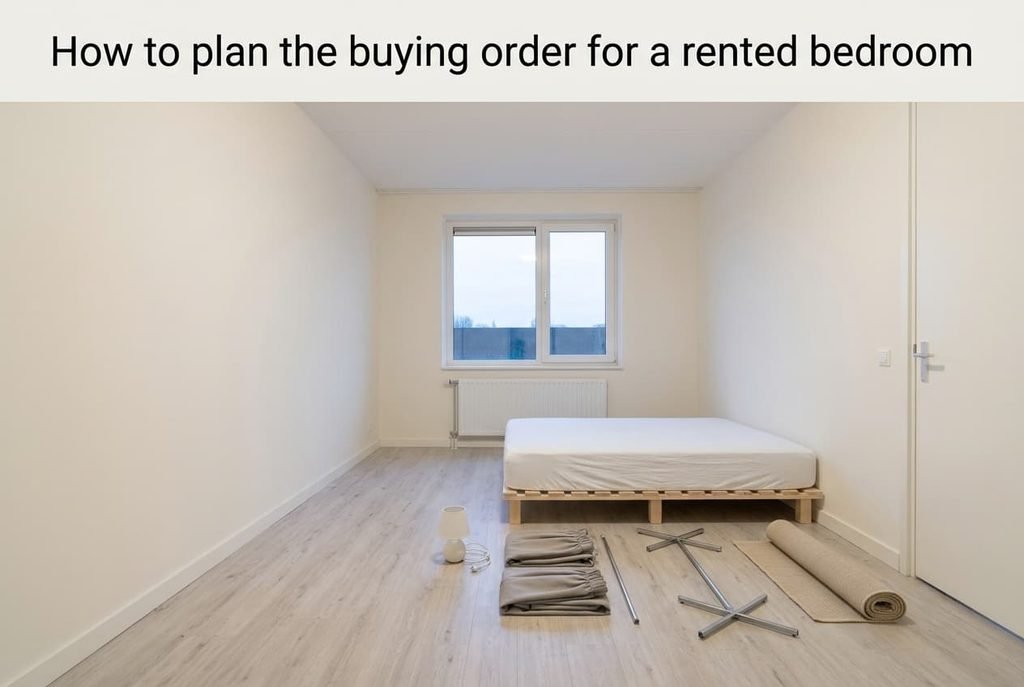
How to plan the buying order for a rented bedroom
1. A 140 by 200 cm mattress on a slatted base with gaps of about 3 cm, bought first because night one needs it and no other piece can stand in. Tier: BUY ONCE for the mattress and BUY CHEAP for the base. Look for a foam core quoted in kilograms per cubic metre, since a core under about 30 tends to sag sooner, and for a cover that unzips for washing. The giveaway of a poor one is a thick soft top glued onto a thin core, which compresses into a hollow where you lie.
2. A bedside lamp with a standard E27 socket and a 180 cm cable. Second place follows from the sunset at about 16:30 in December, with the ceiling switch a long walk from the bed. Tier: BUY CHEAP, since only the switch wears out. The giveaway of a poor one is an LED module sealed into the body, which makes the whole lamp disposable once the module dies.
3. Lined curtains for a 160 cm rod, with a drop of 234 cm. That is a 15 cm gap under the ceiling and a 1 cm gap above the floor. Fullness of 1.8 means 288 cm of fabric, so two panels of 144 cm. They rank third since the rod may need your landlord’s permission. Tier: MID, and pay for the lining. A poor lining is a coating painted onto the cloth’s reverse, and it peels at the folds after a few washes.
4. A freestanding clothes rail 150 cm wide, in steel tube, with a cross brace between its feet. It takes fourth place because clothes can sit in bags for a week. Tier: MID. The brace is the part that matters, since a rail without one racks sideways each time you slide a hanger along it. Pick one whose upper bar adjusts between 160 and 170 cm.
5. A flat-weave rug of 100 by 160 cm, laid beside the bed so your feet land on it. Last place suits it, since it alters only how the floor feels. Tier: BUY CHEAP. A flat weave has no pile to flatten, so little is gained by paying more. The giveaway of a poor one is a missing non-slip layer, so it creeps across the floor.
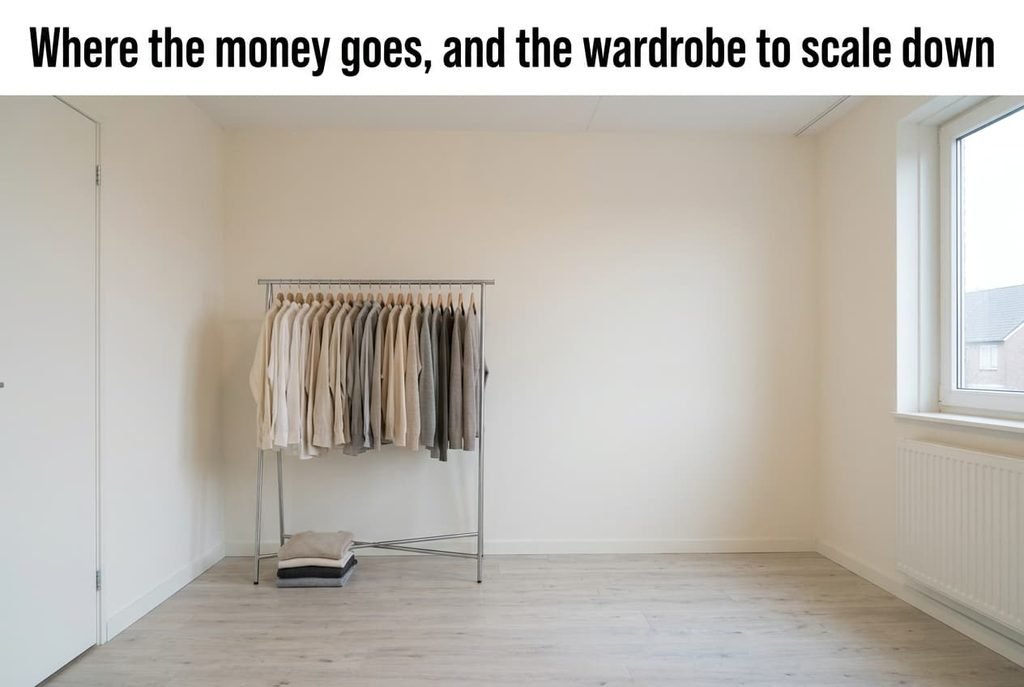
Where the money goes, and the wardrobe to scale down
The mattress core takes the biggest share of the budget. Once it’s delivered you can’t inspect it, whereas a rug can be exchanged within the hour. Density ranks ahead of a quilted top, because the top can be covered later. In an empty rented bedroom the mattress travels to every later flat, so its cost is split across all of them.
Then scale the wardrobe down to a rail, which readers rarely expect from a buying guide. A wardrobe 100 cm wide and 60 deep has a hanging bar of about 96 cm, which holds 24 hangers at 4 cm apiece. The rail holds 37 on 150 cm. Per square metre of floor, that’s 55 hangers against 40, so the rail stores more clothing in a room where space is short.
Nobody inspects a wardrobe’s insides after the delivery van leaves.
A rail also leaves with you in one piece, while a wardrobe has to be unscrewed and rebuilt. Its doors swing 50 cm into the room and the rail has none. The price is visible clothing, so a bedroom that stays tidy suits it better than one that doesn’t.
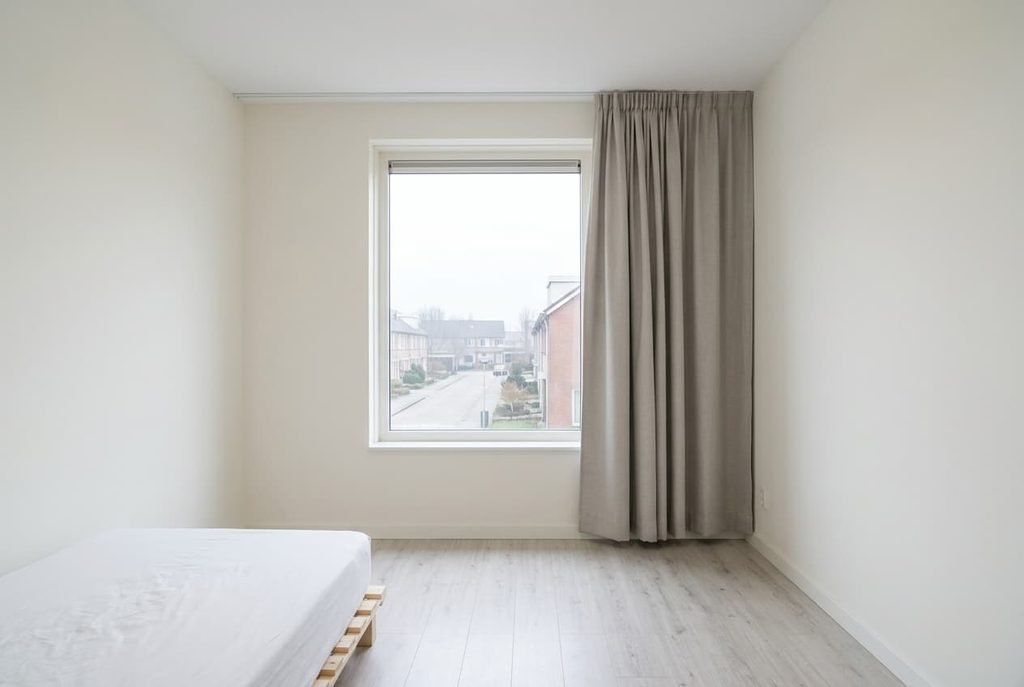
What this order assumes, and when it breaks
The order suits a lease of at least a year, no bed supplied by the landlord, and a socket within 100 cm of where your head will lie. Check each one before ordering. If the landlord supplies a bed, drop item one. The lamp then moves to the front.
Your window decides how far the curtains can slide down. An east-facing room gets low sun by 05:20 in June, so the curtains stay at number three. A north window gets no direct sun, so a plain blind could take that slot and the lined pair can wait for winter. Look at your own window at dawn before you decide.
Ceiling height alters the drop. In a flat with a 270 cm ceiling, the same panel stops 20 cm short of the floor, and that gap shows from the doorway. In an empty rented bedroom, a mismatch like that is the commonest reason curtains get bought twice. Someone staying under three months should borrow a bed and skip items three to five.
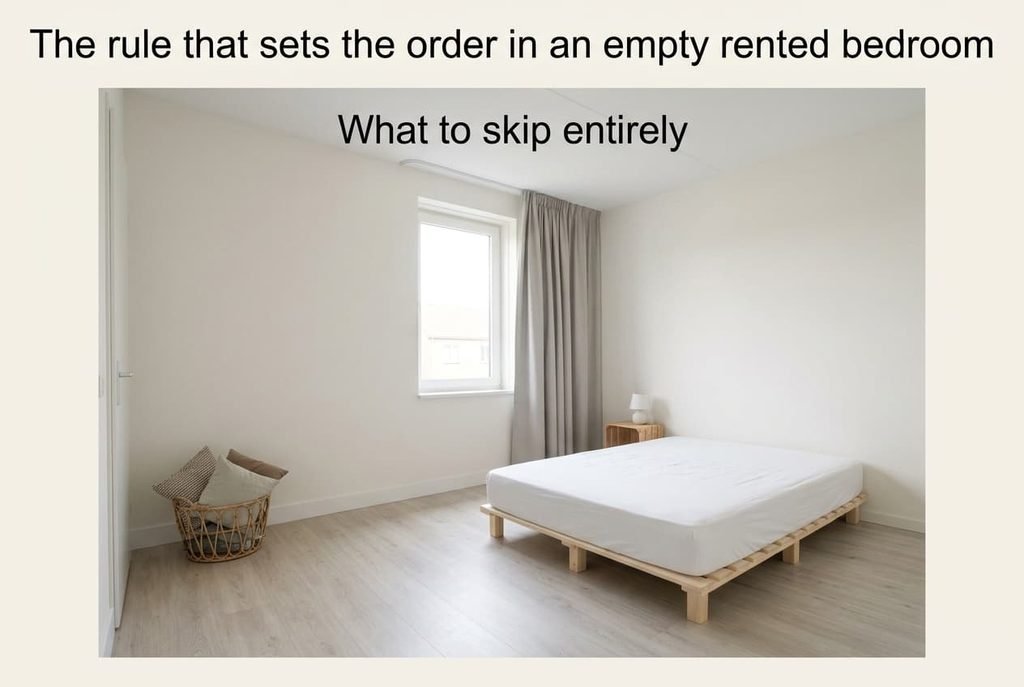
What to skip entirely
The matched bedroom set heads the skip list, because it fixes three sizes before you’ve seen how the room behaves. Two bedside tables of 45 cm flanking the 140 cm bed claim 230 cm of a 300 cm wall and leave 70 cm for everything else. Any headboard calls for drilling and 140 cm of clear wall, and your landlord may refuse the holes. Cushions sold in a bundle add laundry and no comfort, and a second rug can follow only once you’ve lived on the first. Skip all four, and don’t leave a gap in the room for any of them until the first month is over.
Each of these fixes a size before you know the room.
The mattress goes in first because night one needs it, and the lease outlasts every curtain. Buy the lamp that evening and cover the window by morning. Everything else can wait until you’ve lived a week in an empty rented bedroom, with a tape measure in your hand and the 140 by 200 cm bed already in place. That week teaches more than a shop visit. Write the order on a card and tick it off as each piece arrives.
Questions readers keep asking
How many pieces does a new bedroom really need?
Five cover the first month. The mattress with its base comes first, and the lamp follows. Lined curtains take third place. A clothes rail and a small rug close the list. Only the mattress is bought once. A sixth purchase tends to be decoration, so give it a few weeks before you commit.
How long can I wait before buying curtains?
Only until the first dawn. The sun rises about 05:20 in June, and a bare window gives no shade or privacy before that. In winter you can wait a week. A temporary sheet pinned over the frame will do, if the landlord allows pins.
How can I judge a mattress in a shop?
Ask for the core density in kilograms per cubic metre and for the cover to be removable. Press your hand flat on the top and feel how far it sinks before the core pushes back. A thick soft top over a thin core feels plush now and sags within a year.