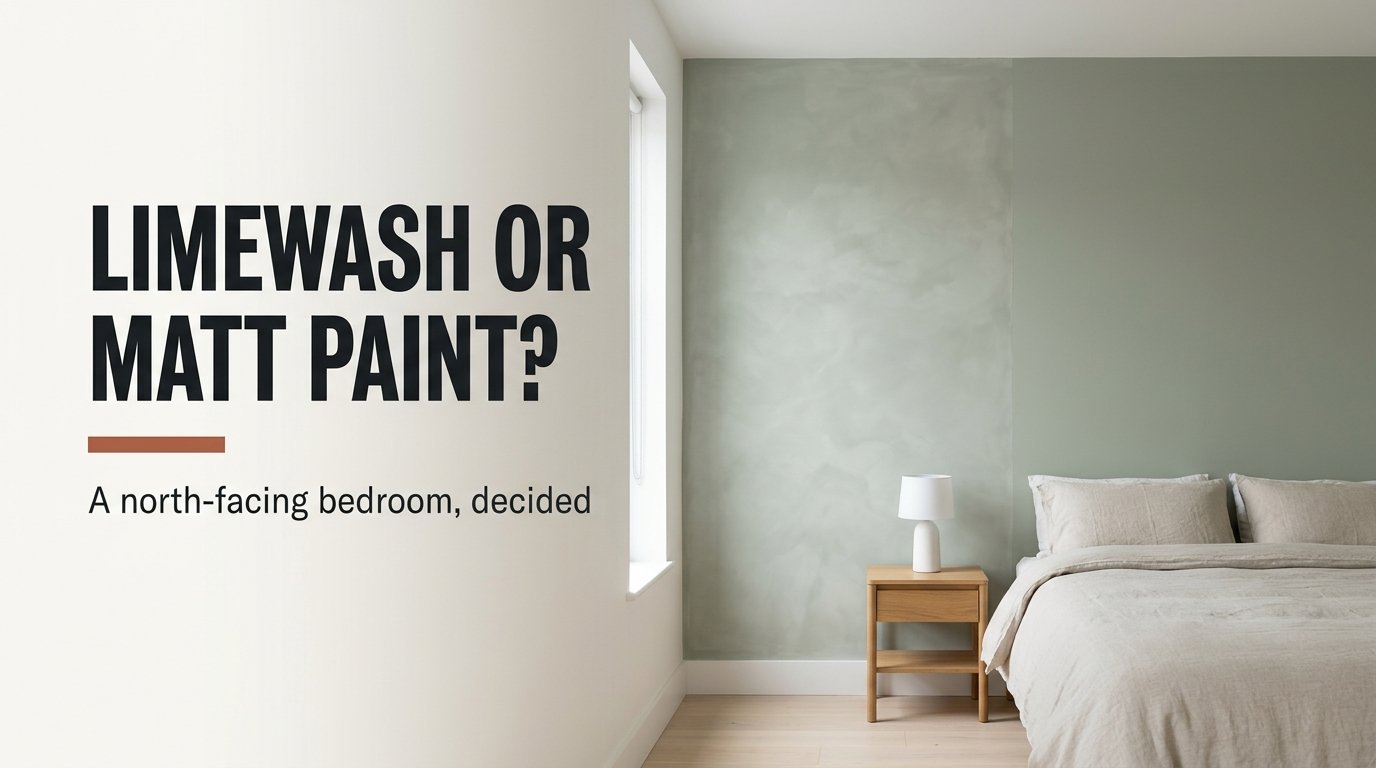
A brushstroke of limewash dries several shades lighter than it looks wet, and in a north-facing room the dry result is the only one the light will ever show you. In the limewash vs matt emulsion decision, take limewash for old, uneven walls that nobody leans on. Take matt emulsion for a wall that gets rubbed or must be repainted later. The deciding property is how each finish handles flat, cool light.
Our worked example is a Dutch rented bedroom of 3.4 by 4.0 m, 2.5 m high, with one window facing north. About 33 m² of wall needs paint, and you should replace our figures with yours as you read.
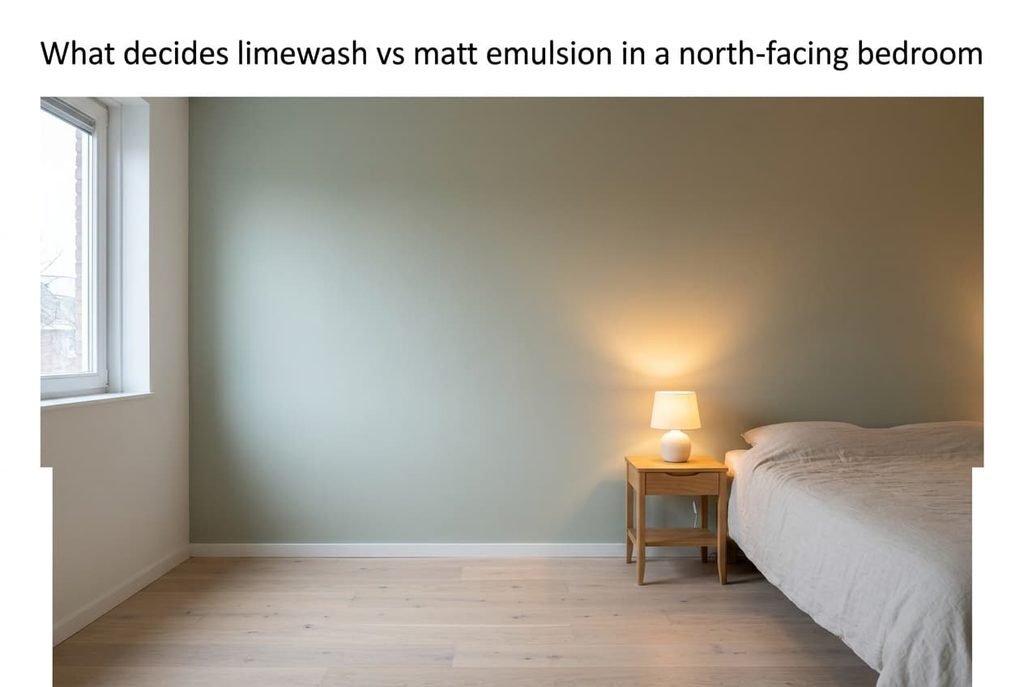
What decides limewash vs matt emulsion in a north-facing bedroom
A north-facing window gets no direct sun. Its light comes from the whole sky. It arrives cooler than any bulb you own, and with no shadows. On a clear day it runs at 6500 K or above. A warm bedroom bulb sits at 2700 K, so your walls live under two lights that differ by at least 3800 K. Evenings are when a bedroom is used most, which means colours must survive both.
Flat light settles the choice because how well the finish copes with flat, cool light is the one thing that separates the two. Matt emulsion is a continuous film of constant opacity. Its colour is predictable, and under diffuse light it reads as one steady tone that’s calm and a little flat. Limewash goes on in thin translucent layers whose thickness changes with every stroke. The mineral crystals scatter light softly, and the small shifts in tone give the wall depth that flat light would otherwise take away.
The price of that depth is visible work. Every stroke and every rubbed mark stays on show, along with each patch of uneven plaster. Some readers will find that tiring in a room meant for rest.
Flat light rewards a wall that isn’t flat.
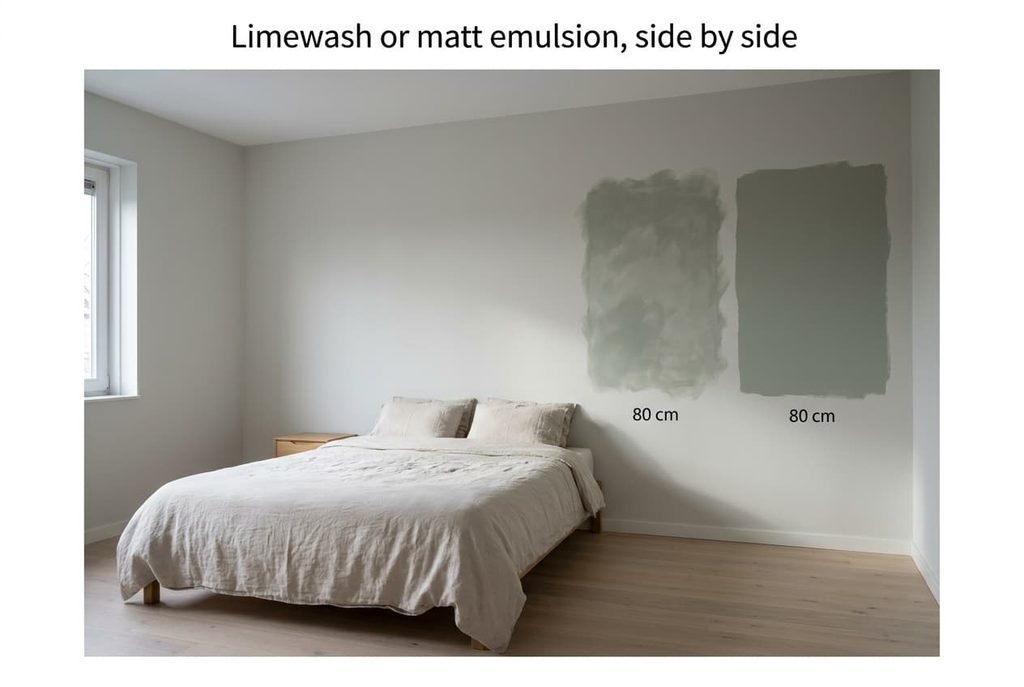
Limewash or matt emulsion, side by side
The table compares how each finish behaves. Wear and repair outlast any shop list, so it carries no prices. Read each row against the 33 m² of our example, and replace the figures with your own walls.
| Question | Limewash | Matt emulsion |
|---|---|---|
| Surface and sheen | Chalky and cloudy, with brush strokes showing | Even flat film, no strokes |
| Look in flat north light | Tone shifts from stroke to stroke, which adds depth | One steady tone that reads calmer and flatter |
| Rubbing and wiping | Powders a little under friction and can’t be scrubbed | Many types wipe clean |
| Repairing a patch | The patch blends into the cloudy texture | The patch flashes as a different sheen in raking light |
| Colour change on drying | Dries several shades lighter | Dries close to the tin sample |
| Surface it needs | Porous or primed plaster | Most sound, clean surfaces |
| Coats for full cover | Three thin coats | Two coats |
The repair row surprises most people, since the finish that looks harder to live with is the easier one to patch. In flat north light a touched-up spot of emulsion shows as a pale rectangle. The same spot of limewash vanishes into the clouds.
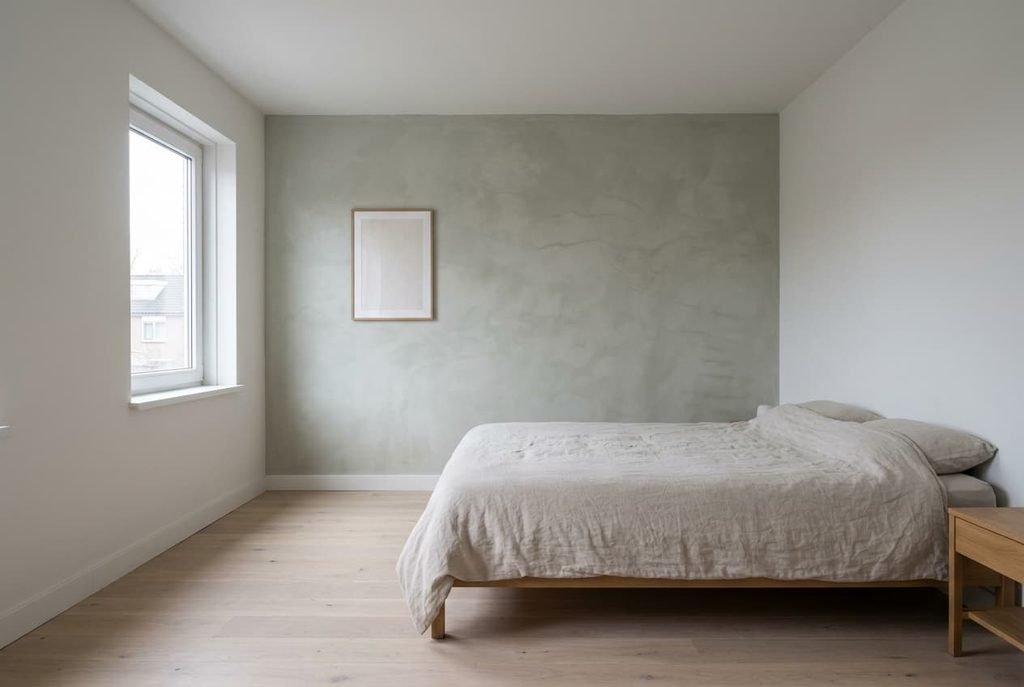
Where limewash wins
On old plaster the limewash vs matt emulsion contest tilts one way. Walls with ripples or hairline cracks look better under a finish that already has movement, because the unevenness joins the pattern instead of fighting it. A flat emulsion draws a line around every ripple under raking light from a window at the side.
Limewash also wins where nobody touches the wall. A bed that stands 40 cm clear of the plaster, or a wall used only for a framed print, never meets the friction that powders a chalky surface.
Its last advantage is an unglamorous one: repairs. A scuff near the door takes a dry brush and ten minutes, and the patch merges with its surroundings. Three thin coats over 33 m² cost two evenings, which most people can fit around work. A test patch needs a full day to dry before you judge it, since limewash lightens as it dries. Put that patch on the wall farthest from the window, where the colour will look darkest.
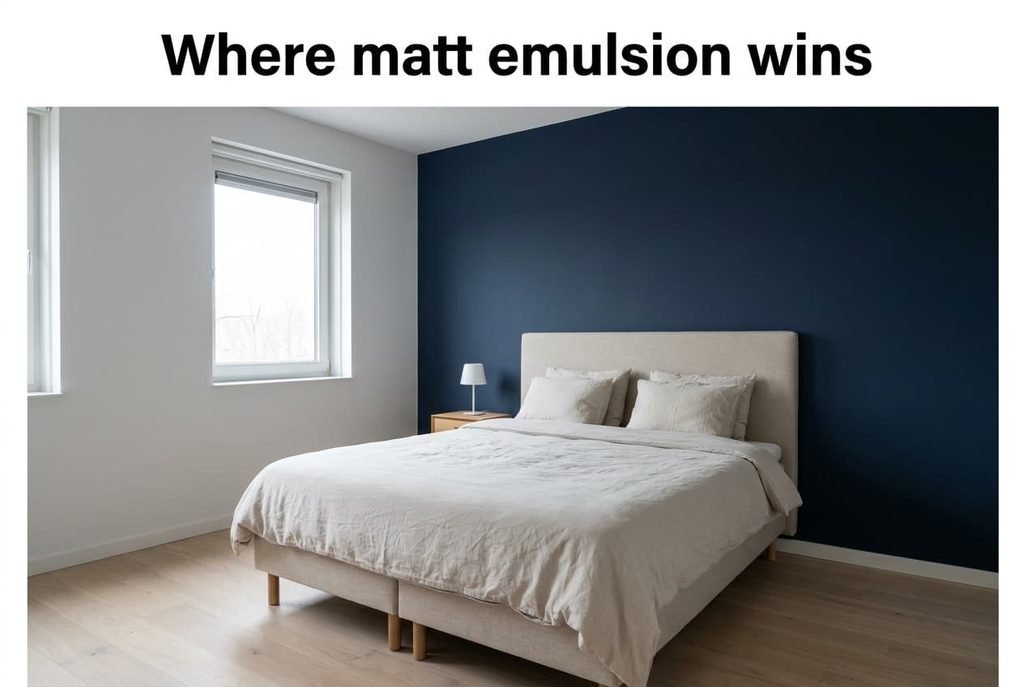
Where matt emulsion wins
Behind the bed, limewash vs matt emulsion is settled quickly. A 160 cm bed with a headboard touching the wall puts a zone 160 cm wide and about 60 cm high in daily contact with pillows and shoulders. That’s 0.96 m², roughly 3% of the wall area, and it takes nearly all of the wear. Many emulsions wipe clean there, and a chalky finish would shed dust onto the bedding.
Matt emulsion wins in a rental. Before leaving you have to return the walls to white, and white emulsion covers emulsion in two coats. Over limewash it needs a sealing coat first, or the surface keeps absorbing paint unevenly. That extra step is the unglamorous cost of choosing the mineral finish in a flat you don’t own.
It wins for deep colours. A navy or an aubergine stays close to the sample on the tin. Limewash moves several shades lighter as it dries, so you’d paint a bolder colour than you want and hope.
It also wins on speed. Two coats are enough, and the second can go on the same afternoon.
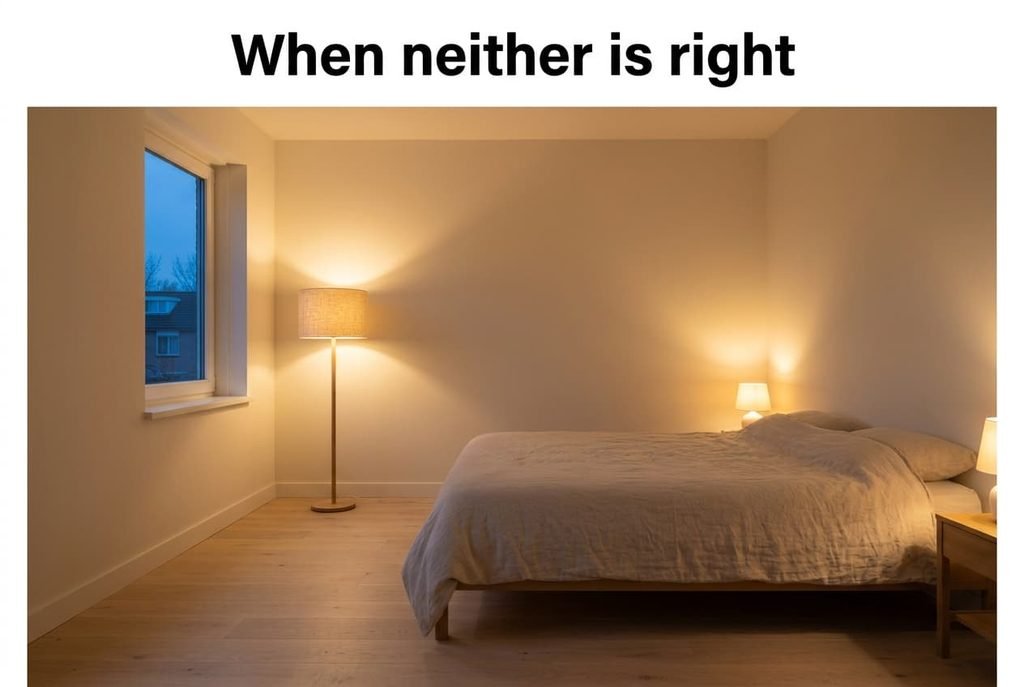
When neither is right
The case for keeping what you have starts with the paint already on the wall. If it’s sound and a quiet neutral, the problem in a north-facing bedroom is usually the bulb. A cool 4000 K bulb pushes a room further from the 2700 K evening glow, and an overhead light alone leaves the far wall dim.
I’d defend a month under 2700 K bulbs and one lamp near the far wall before any paint decision, against the habit of repainting first. Walls that looked cold in daylight often look right once the evening light is warm and a second source lifts the dark corner.
Whether this helps depends on what shades your window. A large tree can cut daylight further than a clear sky would, and in a heavily shaded room the daytime colour will stay cool whatever you do. A lamp costs a fraction of the paint and a weekend of work.
If the walls are sound, a month costs nothing but patience.
How to decide in thirty seconds
Stand at the far wall at midday with the lights off and look back toward the window. Judge the wall you see. Note whether the surface looks flat or rippled, because the branches below use exactly that information.
If your walls are old and uneven and no headboard touches them, take limewash. The finish will turn the flat light into depth, and it’ll forgive the plaster for the next ten years.
If a bed touches the wall or you rent, take matt emulsion. You’ll wipe the pillow zone clean, and you can repaint to white in two coats on the day you leave.
The choice between limewash and matt emulsion comes down to variation against uniformity. Limewash turns flat light into depth and forgives bad plaster, while emulsion gives a steady colour and survives friction and a tenancy. Measure the pillow zone first, since 0.96 m² of wear can outweigh the other 32 m². In the limewash vs matt emulsion question, decide by the wall behind the bed and not by the tin.
Questions readers keep asking
Is limewash less durable than emulsion in a bedroom?
On a wall that nobody touches, limewash lasts well. It ages gracefully because wear blends into its texture. Friction is the weak point, since it powders a little. Behind a headboard, matt emulsion is the more durable choice, and many types can be wiped clean.
How do you clean limewashed walls?
Dust them with a soft dry brush or cloth. Scrubbing lifts the finish and leaves a pale patch, so deal with marks by touching up with the same limewash. Keep a small amount of the leftover mixture, because a patch made with it blends into the clouds.
Which is better for a rented north-facing bedroom?
Matt emulsion suits most rentals, because you can repaint it to white in two coats before you leave. Limewash would need a sealing coat first. Choose limewash only when your landlord allows the change and the plaster is so uneven that a flat paint would highlight every ripple.