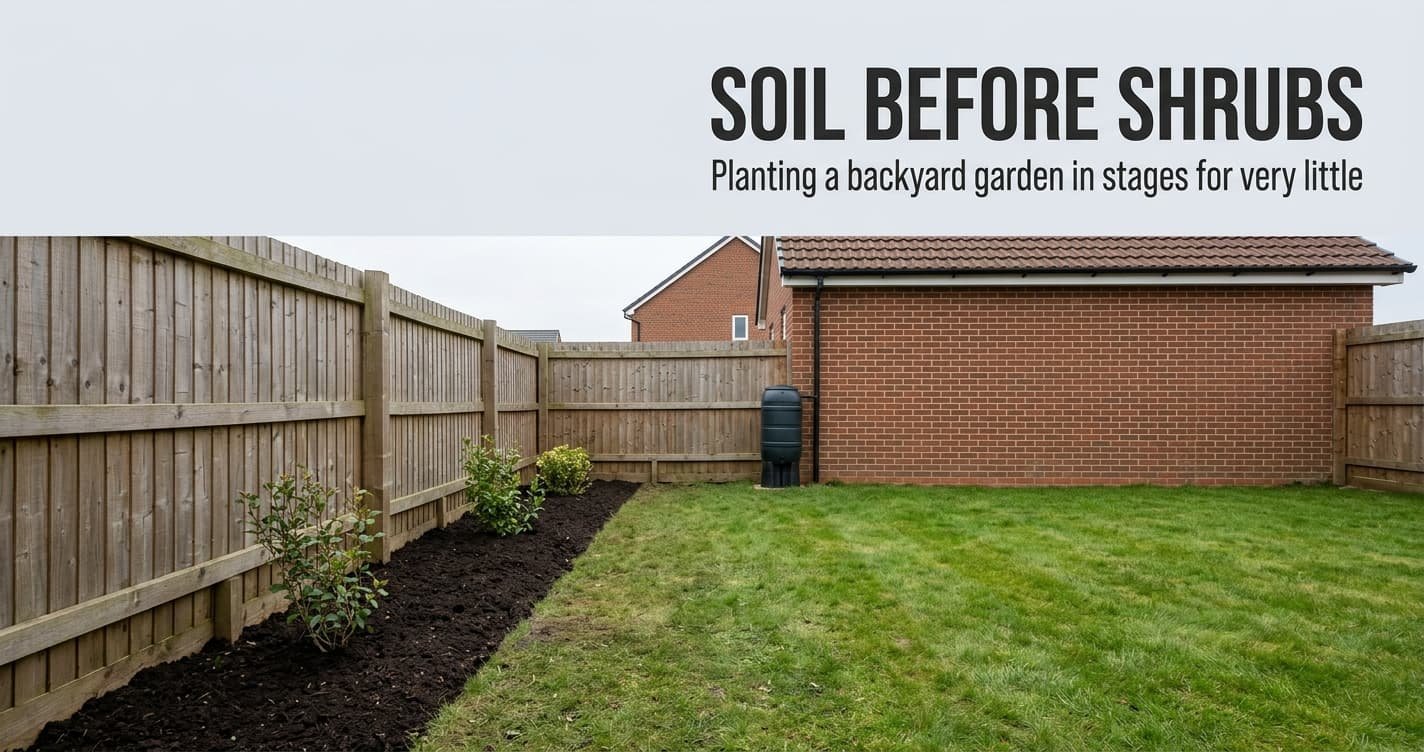
A common complaint about a new garden is that the money runs out before the plants fill the space. The fix is an order that follows what can’t be redone later. Planting a backyard garden in stages applies it: prepare one border first and fit water second. Plant two shrubs in autumn, divide perennials in year two and sow seed into the gaps.
The plot is a bare Dutch rear garden of 5 × 6 m and so 30 m², with a fence on three sides. Costs appear in relative terms only, because prices go stale within a season. Seed is the cheapest square metre and a shrub the dearest.
The rule that decides where the money goes
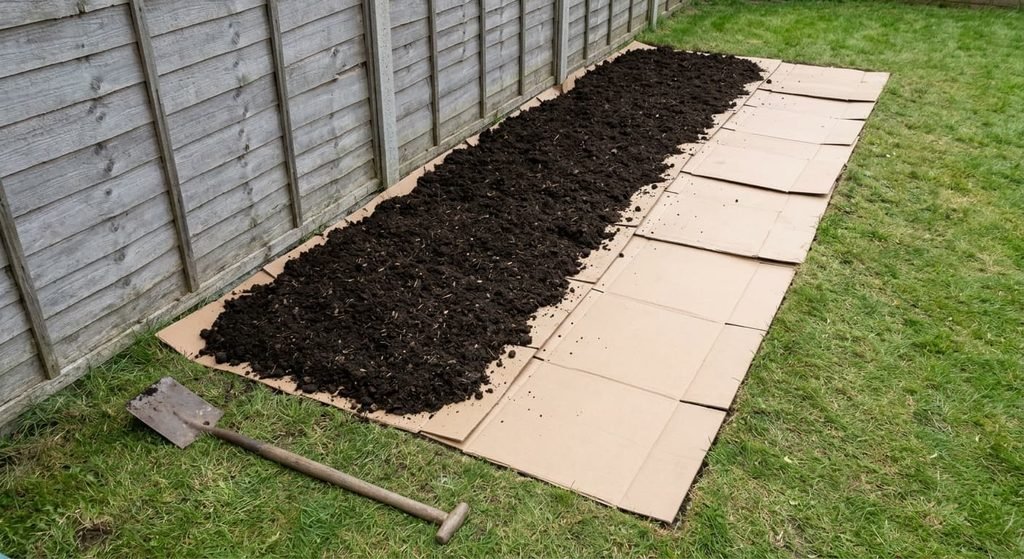
Spend where the work can’t be redone under a plant, and buy cheap whatever multiplies itself. A planted border can’t have its soil improved without lifting everything in it. Soil work and a water supply therefore go in before the first root. The cheapest soil improvement is the one done while the ground is still empty. Compost forked in later reaches roots only as worms draw it down, which takes years. Forking after planting cuts the roots you paid for. A clump-forming perennial multiplies without help. Ten plants, each split in three in year two, give thirty for the price of ten.
Soil is the one thing you can’t buy twice.
Doing a backyard garden in stages also limits the bet. One border of 1.5 × 4 m covers 6 m², which is 20% of the 30 m² plot, so year one commits a fifth of the planting spend and leaves the rest as mown grass. That cuts the cost of any mistake to a fifth of the whole-plot figure. A dry fortnight in year one then asks for 60 L a week, against 300 on the whole plot. A border that works earns its extension in year three.
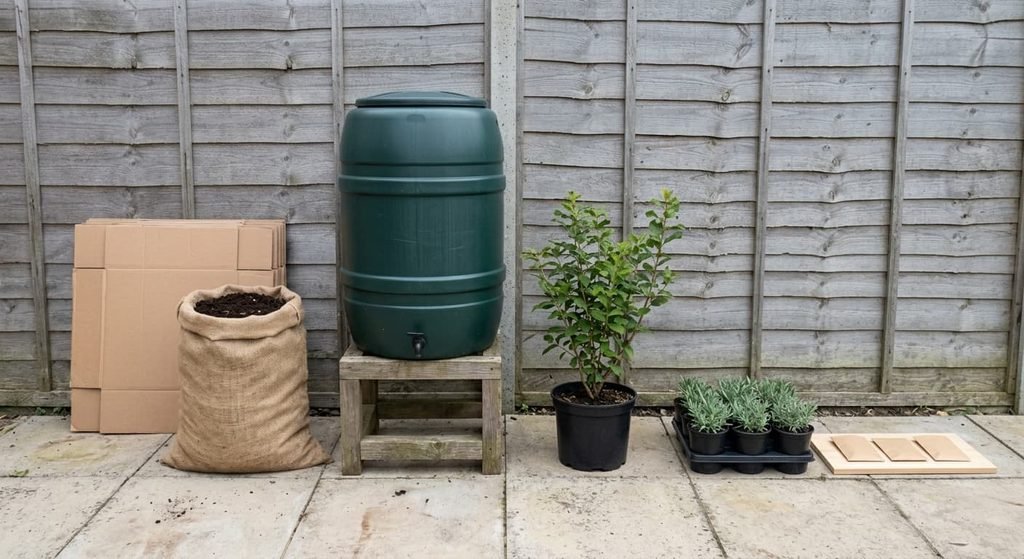
Five purchases for planting a backyard garden in stages, in buying order
1. One smothered and mulched border, 1.5 × 4 m: overlapping cardboard goes over the turf, topped with 5 cm of loose compost. That’s 0.3 m³, or six bags of 50 L. It goes first because it’s the only job that can’t be repeated once plants stand in it. Tier: BUY ONCE, because roots reach improved soil only when it’s laid before planting. The bad version tips compost on bare turf, and the grass regrows through it inside a season.
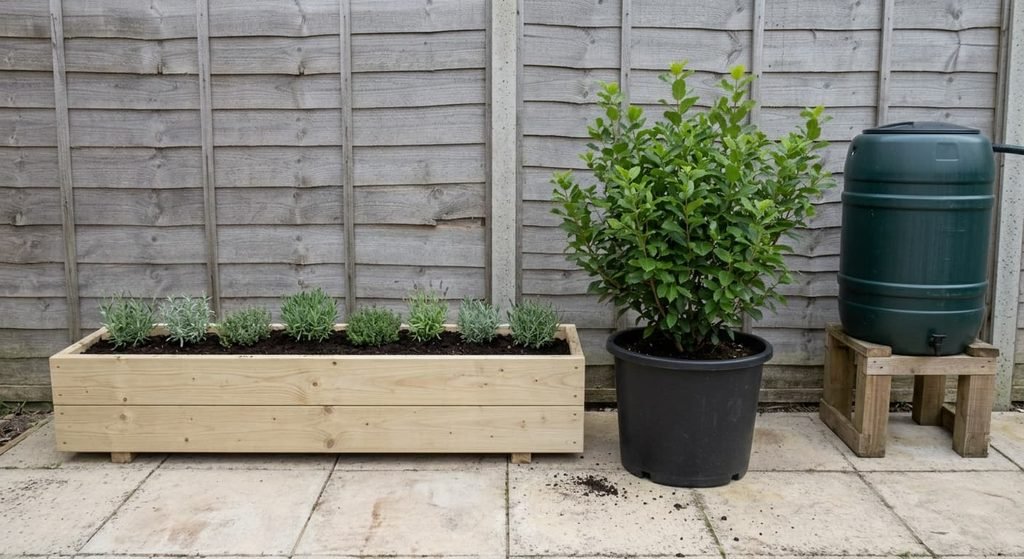
2. A water butt of 200 L under a downpipe, on a stand 40 cm high so a can fits beneath the tap. Each millimetre of rain on 12 m² of roof yields 12 L, so two 10 mm showers fill it. It comes second because a new border wants about 10 L per m² a week in a dry spell, which is 60 L for 6 m². Tier: MID, since the tap decides how long it lasts. The bad version has no overflow, so it spills against the wall.
3. Two shrubs in 3-litre pots, planted 150 cm apart in October or November. They come third because autumn soil is warm and wet, so roots grow while the top sleeps. The shrubs also set the frame that everything else is spaced from. Tier: MID, because a 3-litre plant usually roots out in one season. The bad version is a pot-bound plant whose roots circle the base and keep circling after planting.
4. Ten clump-forming perennials in 1-litre pots on a 60 cm grid. In spring of year two, split each into three. That gives 30 plants, enough to fill 4.8 m² at 40 cm. They come fourth because splitting needs a year of root growth first. Tier: BUY CHEAP, because every purchase becomes three. The bad version is a vigorous runner that crowds the shrubs and can’t be split cleanly.
5. Seed for the gaps: annuals sown where they will flower, then thinned to 15 cm apart. They come last because the gaps only show once the perennials stand. Tier: BUY CHEAP, since one packet holds hundreds of seeds. The bad version is a mix of twenty species sown thick, where the strongest smother the rest.
Where a garden in stages saves, and where it costs
The first three items are the ones to pay for. Compost lies under the plants and the butt feeds them, so a poor choice shows for years. A rushed border repeats its fault every season, since it carries the whole plan. Redoing that work means digging around living roots, which is the most expensive way to do it.
The last two form the cheap tier. Perennials multiply and seed counts in hundreds, so a mistake there costs one spring and one packet. A failed split costs a clump you can replace from the others.
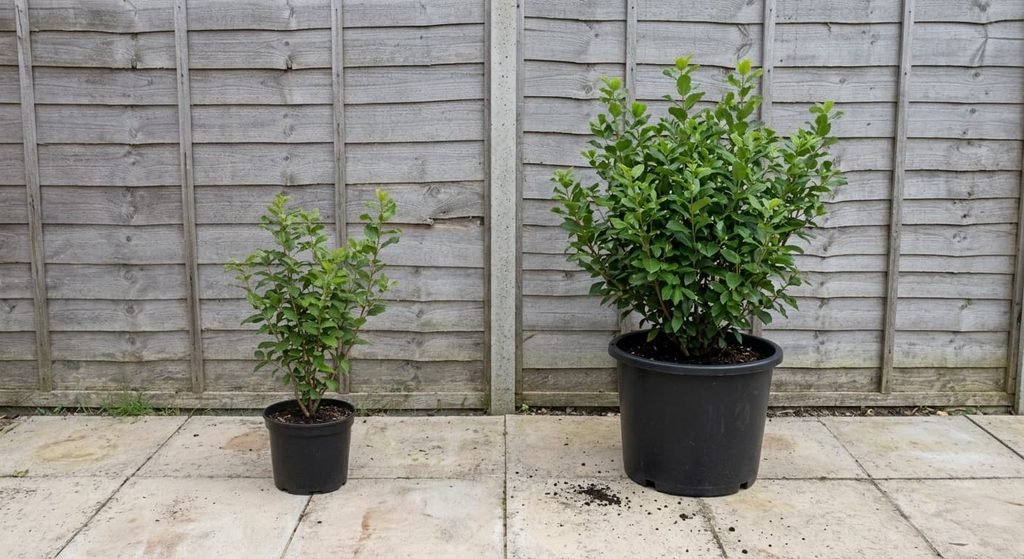
Then comes the call that surprises people: skip shrubs bigger than 3 litres. A larger pot holds an older root ball that’s heavier to move. It enters new soil with a greater shock to repair. It often takes two seasons to establish where a 3-litre plant takes one, and by the third year the two are close in size. The price gap is a multiple, though. I’d spend that difference on soil work and the butt.
Patience is the cheapest plant in the garden.
What this order assumes, and when it breaks
A backyard garden in stages suits a bare plot of 20 to 40 m² with soil a spade can enter, and a household that can wait three years. It fails on a paved or rented yard. There the border becomes a trough or a large pot, and the shrubs go into containers of 40 L. The sequence survives: soil first, water second, structure third.
It breaks again with a deadline. A party in June needs colour within eight weeks, and annual seed sown in April gives that for little money. The perennials then follow in autumn.
Light settles the species, and your light is the one input this page can’t measure. Six hours of direct sun is the usual line between sun plants and shade plants, so note how many hours the border gets in June before buying anything in steps three and four. Heavy shade over most of the plot changes the plant list in steps three to five and leaves steps one and two alone.
What to skip entirely
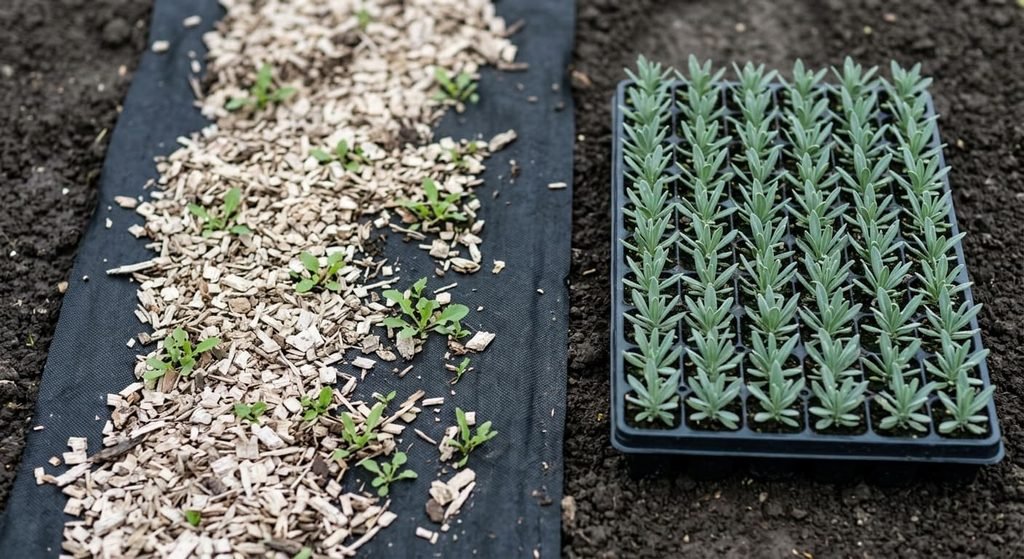
Weed-control fabric under the mulch leads the list. It stops worms pulling organic matter down, so the soil beneath stays thin. Weed seeds land on the mulch and root in it within a season, and splitting a perennial means cutting through it.
Pre-planted border kits come next. They pack plants for the final spacing, about 38 at 40 cm over 6 m², and you pay for the whole count in year one. Wildflower seed over the full 30 m² looks good for a summer. In rich soil it often thins to coarse grass. Each of the three fails the rule, because it spends where the work can be redone, or where plants would have multiplied for free.
Plant a backyard garden in stages by preparing one border first, since soil is the one purchase you can’t repeat under plants. Water follows, then shrubs in autumn, with perennials split in year two and seed in the gaps. Spend where the work is buried and buy cheap whatever multiplies. A border of 6 m² this year tells you what the other 24 m² should be. Buy nothing for them until the border has survived one dry August. That order costs the least and keeps every mistake small.
Questions readers keep asking
What number of plants fills a small border?
A border of 6 m² needs two shrubs and ten perennials in year one, plus a few packets of seed. Splitting the perennials in year two brings the count to 30 plants, which fills the border at 40 cm spacing. Buying all 38 at once costs far more and adds nothing that year two won’t.
When is the best time to start a garden in stages?
Start the border in early autumn, so the cardboard rots down by spring. Plant the shrubs in October or November while the soil is damp. Sow seed in May, once the ground has warmed. Splitting the perennials waits for spring of year two.
What marks out a healthy plant on the nursery bench?
Lift the pot and look at the drainage holes. A few white roots are good, and a dense mat wound round the base means the plant is pot-bound. Choose firm shoots over a plant in full flower. The compost should be damp and free of moss.