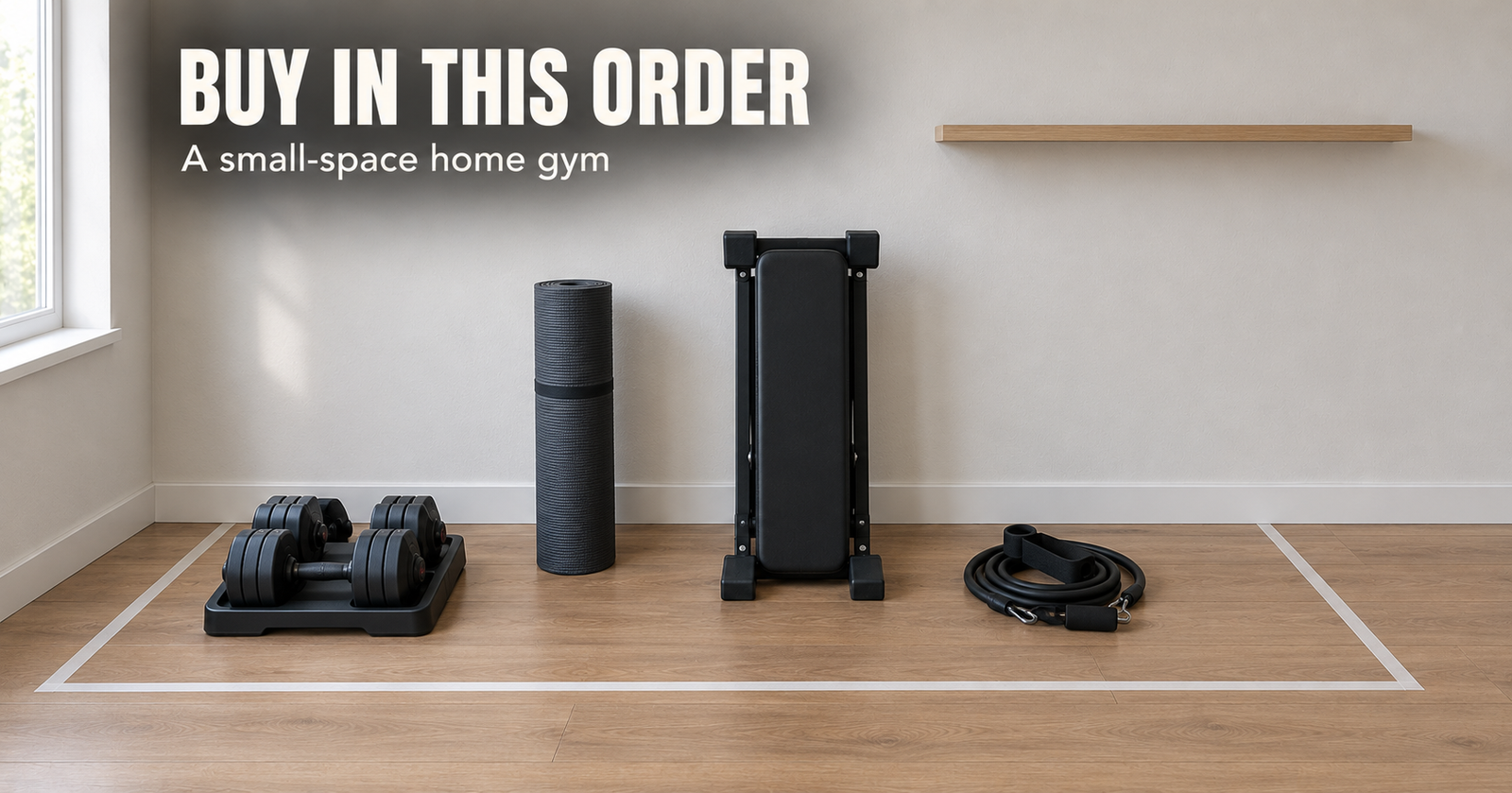
One adjustable dumbbell pair does the work of ten fixed pairs in a 50 × 25 cm tray, which is why it tops any answer to what to buy first for a home gym. A mat follows it, then the bench, then bands, then a wall shelf. The bench waits until the floor test passes.
Everything after the pair can wait a month or more. Some items that guides recommend never earn a place at all. Each purchase below is ranked by what it carries: pieces that bear your load come before pieces that only sit on a shelf.
The rule behind what to buy first for a home gym
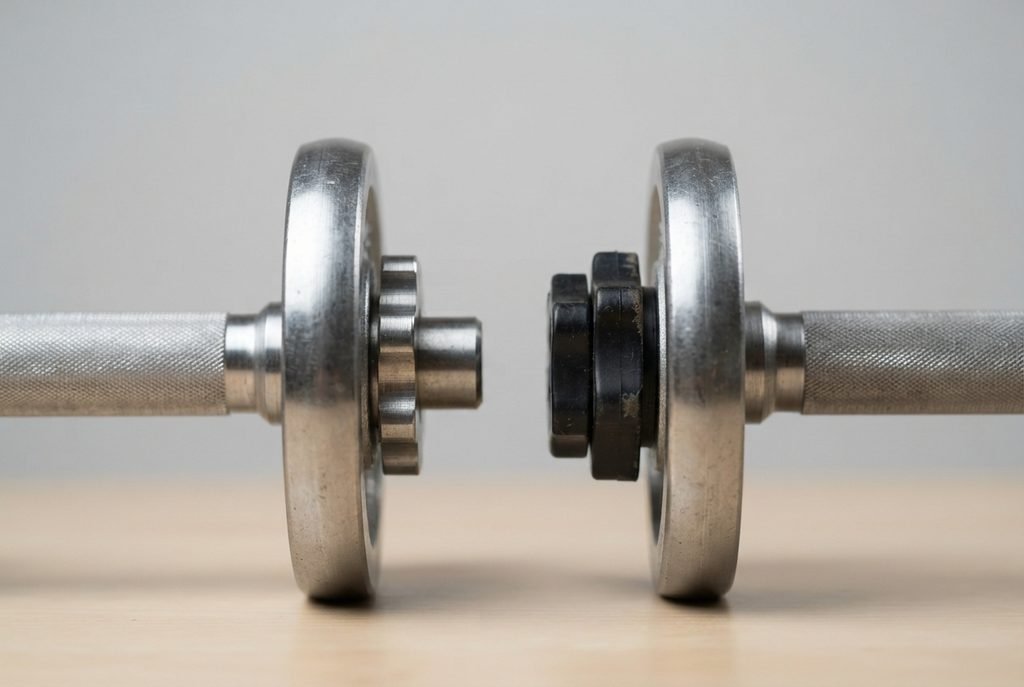
Spend on whatever carries your load or fails under it. Save on whatever only sits. A dumbbell handle used about 150 times a year holds each plate on a locking collar at the moment your arm is overhead, so the answer to what to buy first for a home gym is the item whose failure costs most. A loose collar costs far more than any saving on the pair.
What touches your hands every session earns the outlay, because you feel a poor handle on every rep. Hard-to-change parts rank above easy ones: a welded bench frame can’t be re-padded into a stable one, while a worn pad swaps out in minutes. Bands perish within a year or two of stretching, so they’re replaced by design.
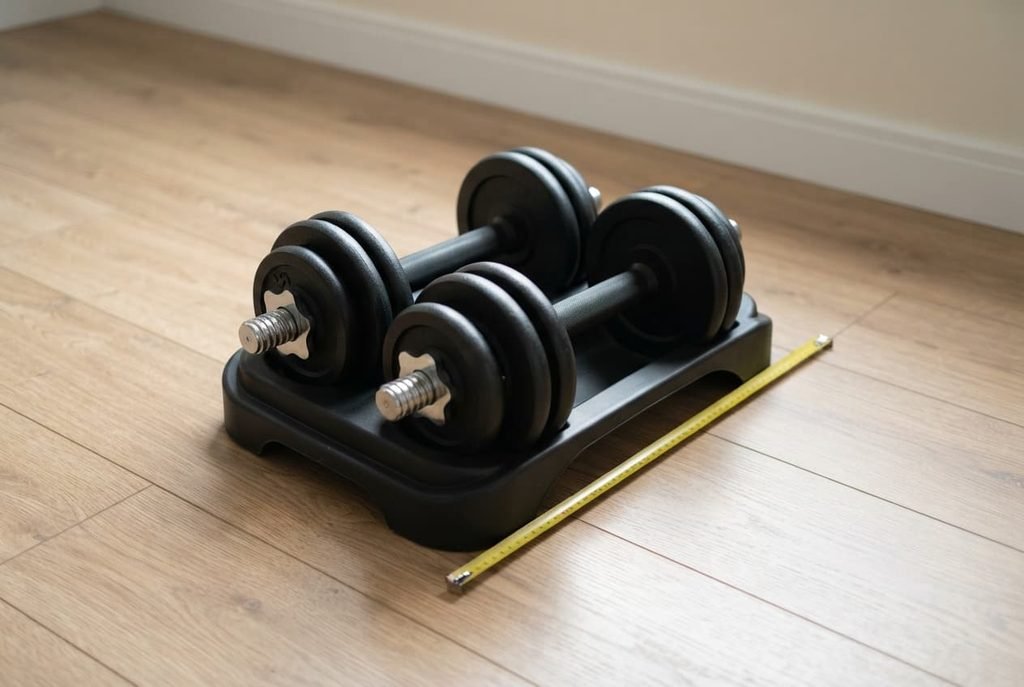
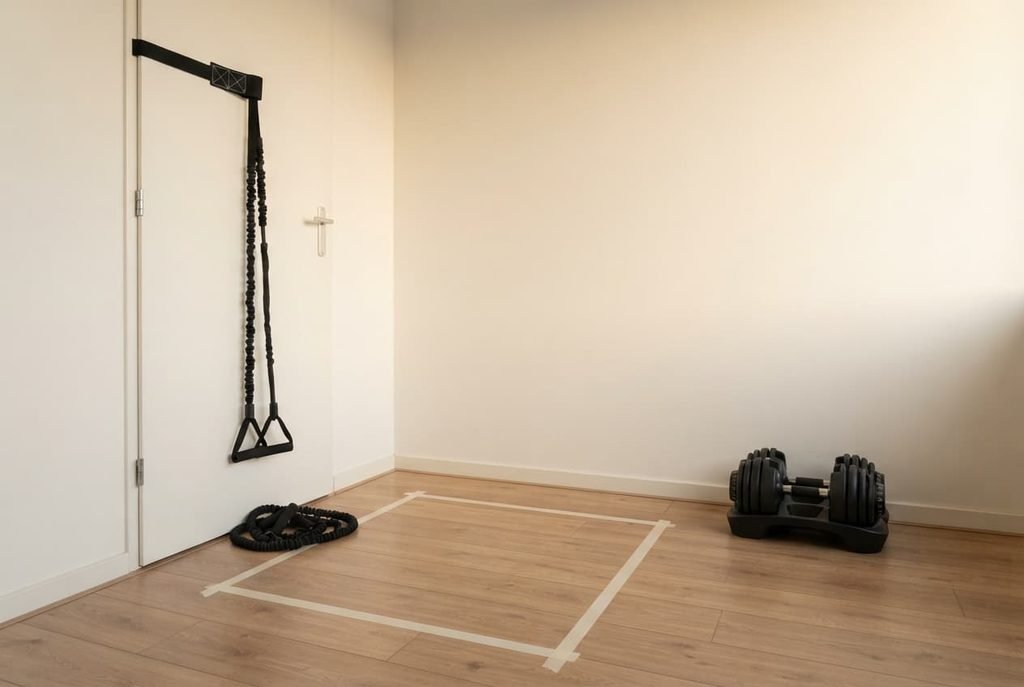
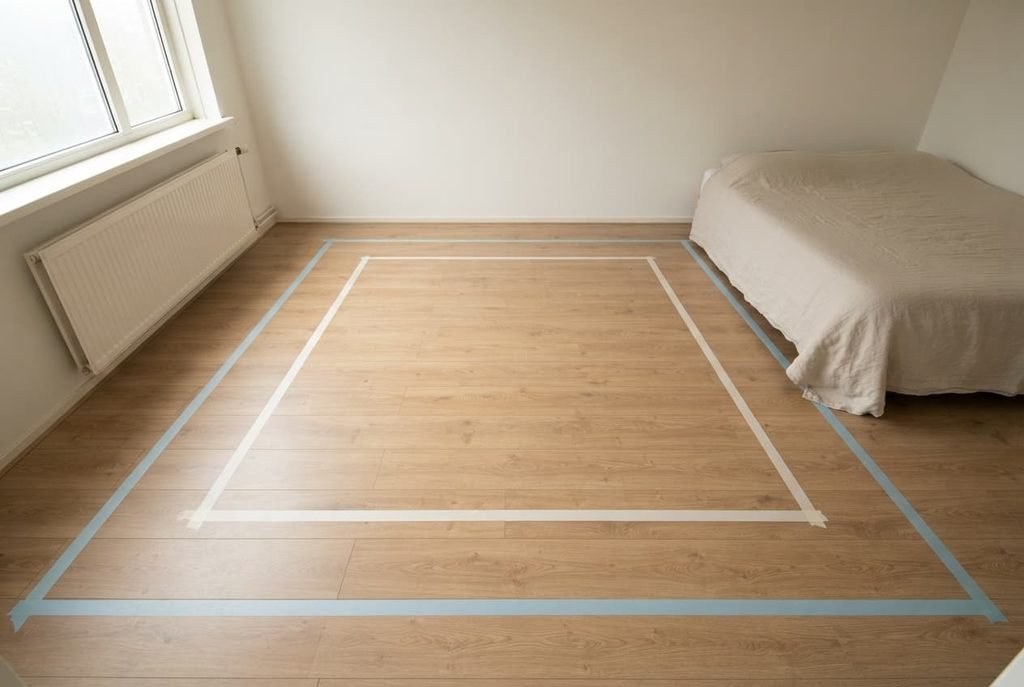
I’d defend buying the pair before any flooring, against the widely repeated advice to protect the floor first. A taped square on your real floor shows what surface you need before you pay for one. A pair stored on a shelf at 90 cm is lifted without bending, whereas a pair on the floor adds an awkward step, and that step is where sessions get skipped.
Frames stay; pads and bands get replaced.
What to buy first in a home gym, in order
1. An adjustable dumbbell pair with steel plates held by a pin or dial that engages a machined slot, a knurled steel handle about 30 mm thick and a tray that stores it in roughly 50 × 25 cm. It comes first because one pair covers upper-body work and leg work inside a 150 × 150 cm corner. Tier: BUY ONCE, because the lock bears the load every rep. A bad version holds plates with a single plastic collar that creeps loose and rattles within weeks. Choose a top weight about a third above your heaviest current row, since your strength is the one variable no article can see.
2. A rubber-backed exercise mat of about 10 mm with a grippy underside and a closed-cell top that doesn’t soak up sweat. It sits second because it keeps your feet planted on laminate and softens kneeling before the bench arrives. Tier: BUY CHEAP, because its only jobs are grip and knee comfort. A bad version is 4 mm of smooth-backed foam that slides under a lunge and flattens under the knee.
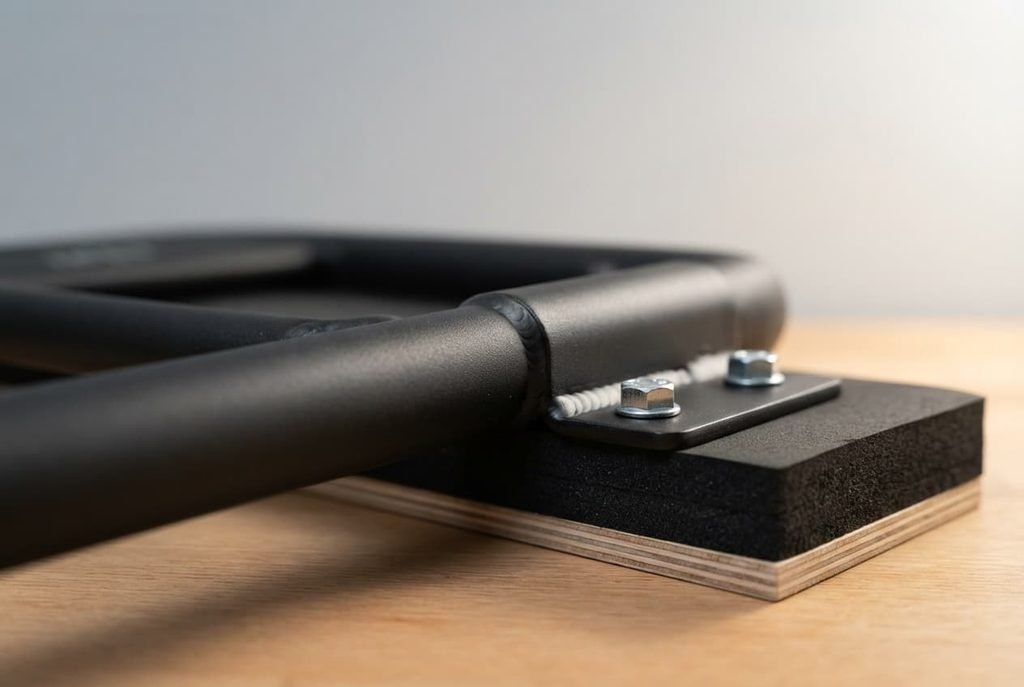
3. A fold-flat bench with a steel-tube frame and continuous welds. It has a foam pad over a plywood base and four rubber-capped feet. It sits third because it needs a 250 × 110 cm footprint when the loading space at each end is counted, so you buy it after the tape test shows the space exists. Tier: BUY ONCE, because the frame carries you plus the weights. A bad version folds on a single-bolt hinge that sways under load.
4. Door-anchor resistance bands: sleeved tubes with a stitched strap and a block that sits on the hinge side of a door. They sit fourth because they add pulling angles the dumbbells can’t supply at almost no floor cost. Tier: BUY CHEAP, because latex perishes on schedule. A bad version has an unsleeved tube that snaps at the clip.
5. A wall shelf or hook rail fixed into masonry or studs with steel brackets. The fixings should be rated at twice the stored load. It sits last because it only pays once you know what you own. Tier: MID, because a failure drops weight on a foot. A bad version is a shelf held by plastic plugs in plasterboard, which may tear out under 20 kg.
Where to spend and where not to
Spend on the two items that carry load. The dumbbell pair’s locking mechanism and handle decide whether plates stay put at the top of a press. The bench’s continuous welds and two-bolt hinge decide whether it still sits steady in year three, and foam that springs back within a second of a thumb press will outlast foam that holds a dent for three seconds. Wall fixings sit in the middle, because the cost of a failure is a dropped shelf rather than a ruined session.
Argue the flooring down. Readers expect a floor to be a big outlay, yet spend almost nothing on flooring while you lower weights instead of dropping them: a mat for your body and a sheet of plywood under the bench zone do the work of covering the whole square. The dumbbell pair is the largest outlay here. The bands are the smallest outlay; the bench and shelf sit between them. Cheap items still need two details. A mat needs a grippy underside, and bands need a sleeve; those features separate a one-month item from a three-year one. Rank every candidate by one question: what happens if this fails in the middle of a set?
What this order assumes, and when it breaks
What to buy first for a home gym assumes a corner of at least 150 × 150 cm, training three times a week with loads under about 25 kg, and a floor that tolerates a controlled set-down. Each of those assumptions breaks for some readers, and each has a substitution.
Under 120 × 120 cm the bench goes. Bands come before the pair, since they need no floor. With a neighbour below, the mat and a rubber tile under the weight zone come second. A slower tempo then holds the sound level down until a test confirms it. A household training twice a week with loads under 15 kg can skip the bench and still train every major movement with the pair plus bands. Renters who can’t drill swap item 5 for a free-standing shelf unit with a wall strap rated for twice the stored weight. For anyone already pressing beyond about 25 kg, an adjustable pair tops out, so the substitution is a pair of fixed dumbbells at the working weight.
What to skip entirely
The skip list for what to buy first for a home gym starts with an all-in-one multi-station. It claims roughly 120 × 180 cm plus 60 cm of clearance on each side, which is a room rather than a corner, and its cables need servicing. Skip the full rack of fixed dumbbells too: ten pairs weigh over 100 kg and need a 150 cm stand.
An exercise ball as a bench shifts under load. A vibration plate adds nothing that ten minutes of lunges can’t. A pull-up bar clamped into a light door frame asks plasterboard and timber to carry a swinging body they were never rated for.
Anything that needs its own wall waits until the corner has proved itself.
Buy the adjustable pair first, because it carries the load, fits a 50 × 25 cm tray and tells you within a month how much of the rest you need. Let the tape square decide the bench first and the floor second. Spend on what bears weight and save on what sits. A month of sessions should justify every later purchase. If the pair feels too light in month three, trade up then; no other purchase is urgent before that.
Questions readers keep asking
How many pieces of equipment does a small home gym need?
Five cover a full routine. The list runs adjustable dumbbell pair, mat, bench, bands, wall shelf. A 150 × 150 cm corner holds the first three. Beyond five pieces, each extra item claims floor space without adding a movement the others can’t already cover.
Should you buy a bench or dumbbells first?
Buy dumbbells first. They work on any floor, store in about 50 × 25 cm and cover most upper-body and leg exercises. A bench with loading space at each end takes roughly 250 × 110 cm, so buy it after the lunge test shows the space exists and a month of sessions shows you’ll use it.
How can you tell if home gym equipment is well made?
Check what bears the load. Plates on dumbbells should lock to a slot with a pin or dial rather than a plastic collar. A bench needs continuous welds and foam that springs back within a second of a thumb press. A shelf needs fixings into masonry or studs, rated at twice the load.