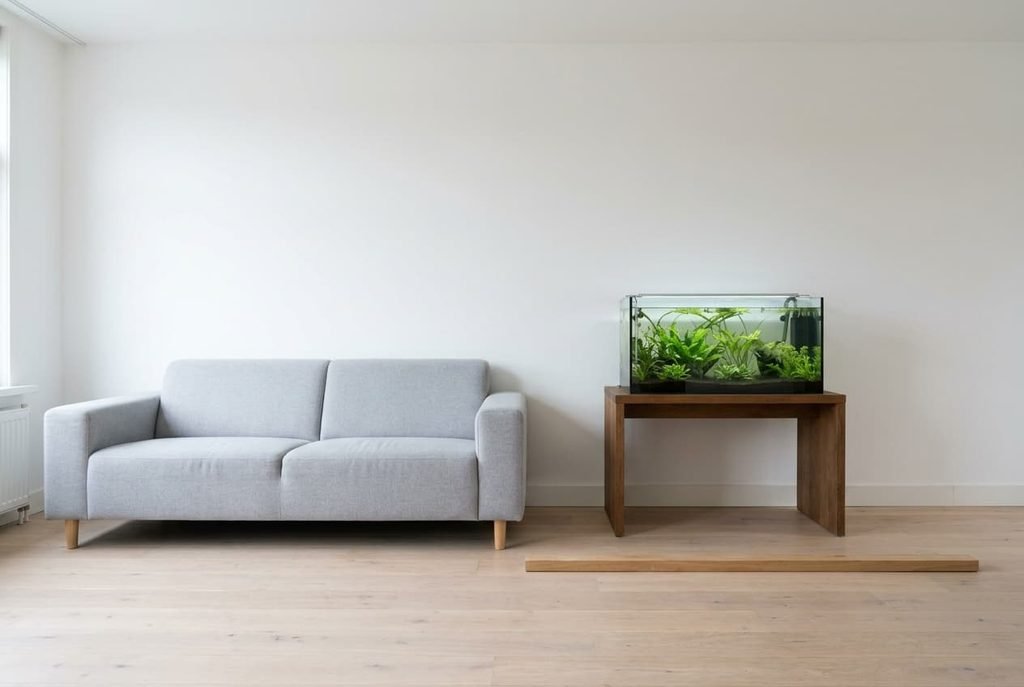
A large aquarium in a living room belongs against the wall the floor can carry, with no sun landing on the glass. A filled 300 litre tank weighs about 385 kg on a footprint of only 0.6 m², far more than any sofa asks of a floor. Our sample is a first-floor flat in Haarlem measuring 380 by 520 cm, with timber joists spanning the short way. Below, we weigh the tank first. Four spots and the costliest mistakes follow. All sizes here are assumed samples. Replace them with yours, and ask the building owner about the floor.
Why a Large Aquarium in a Living Room Needs Three Measurements
Weight comes first, because you can’t adjust it once the tank is full. The water alone is 300 kg. Glass and stand add 30 kg each, and the gravel with its rock adds 25 kg. The filled tank therefore weighs 385 kg. It rests on a stand 120 cm long and 50 cm deep, which is 0.6 m². Each square metre under the stand carries about 640 kg. Ten adults at 80 kg each, spread across the 19.76 m² room, put about 40 kg on every square metre, while the stand presses on the boards roughly sixteen times harder than that crowd.
Weight decides the wall before looks do.
Position matters next, because joists pass their load to the walls they rest on. Here they run across the 380 cm span. A strip inside 50 cm of a long wall sits over their ends, and mid-room, 190 cm from either support, is where the boards flex most. Identical tanks can be a modest load in one spot and a real strain in another.
The last measurement is the working zone. Leave 12 cm behind the stand for hoses and 70 cm in front for kneeling at the glass. Above the tank, 40 cm of clear air is needed for opening the lid and changing the light. Together these give a floor zone measuring 132 × 120 cm, or 1.58 m². For a large aquarium in a living room like ours, that’s about 8% of the area.
Four Places for a Large Aquarium in the Room
Each wall below is judged by where the joists end and where the sun falls. Only then does the view get a vote.
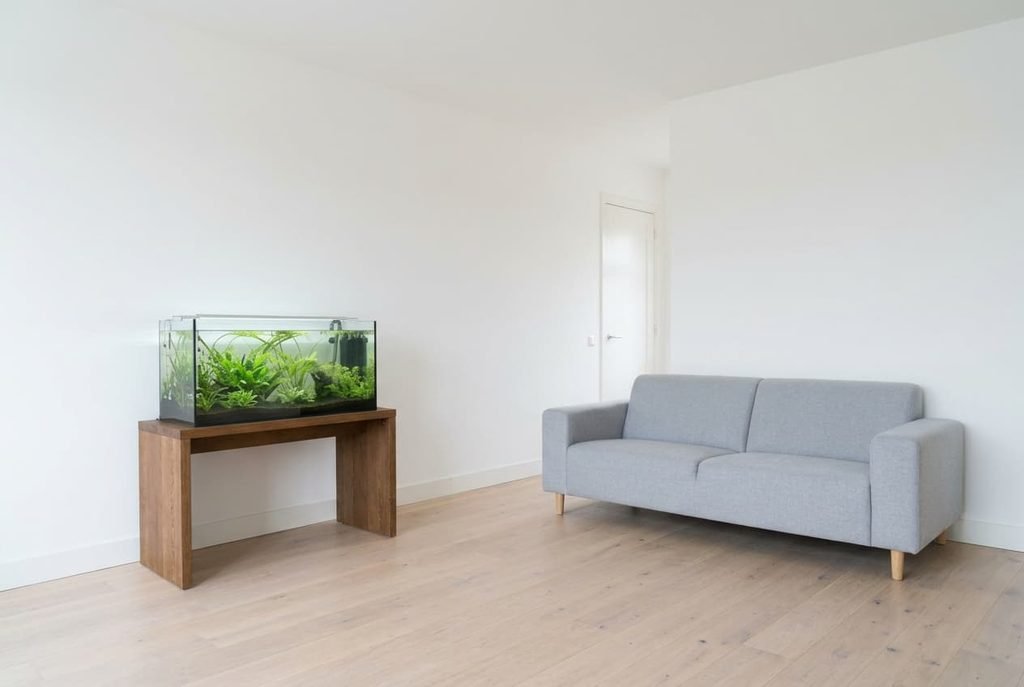
– South wall, 260 to 380 cm from the west corner: the tank sits over the joist ends and beyond the window’s evening sun, which stops about 220 cm along this wall. A double socket already sits at 300 cm, which keeps the cables short. The sofa goes on the north wall and leaves 380 − 132 − 90 = 158 cm to the tank zone, while the door in the east wall keeps a 140 cm approach. We went with this one.
– North wall, beside the radiator: the joist ends and the shade are the same, yet the radiator stands 80 cm from the zone. Its warm air lifts the water temperature on winter evenings, and the tank heater then works against it all day. It’s cheap to try and slow to regret.
– West wall, under the window: the joists run parallel to this wall. The load lands on one or two of them, far from their ends. Evening sun also strikes the glass for hours and feeds a green film on every surface. No stand cures either problem.
– Mid-room as a divider: a tank here would look striking from both sides. It would also stand 190 cm from each support, where the boards flex most, and leave two walking strips of (380 − 132) ÷ 2 = 124 cm.
Four Mistakes That Leave a Tank Hard to Live With
Most trouble with a large aquarium in a living room starts as a small shortcut on installation day. Each one costs more to undo than to avoid.
Placing the glass where evening sun lands. A few hours of direct light a day turns the water green within weeks. Sun in this room reaches 220 cm along the south wall at its longest. The tank must start beyond that mark. A curtain only helps if someone draws it every day.
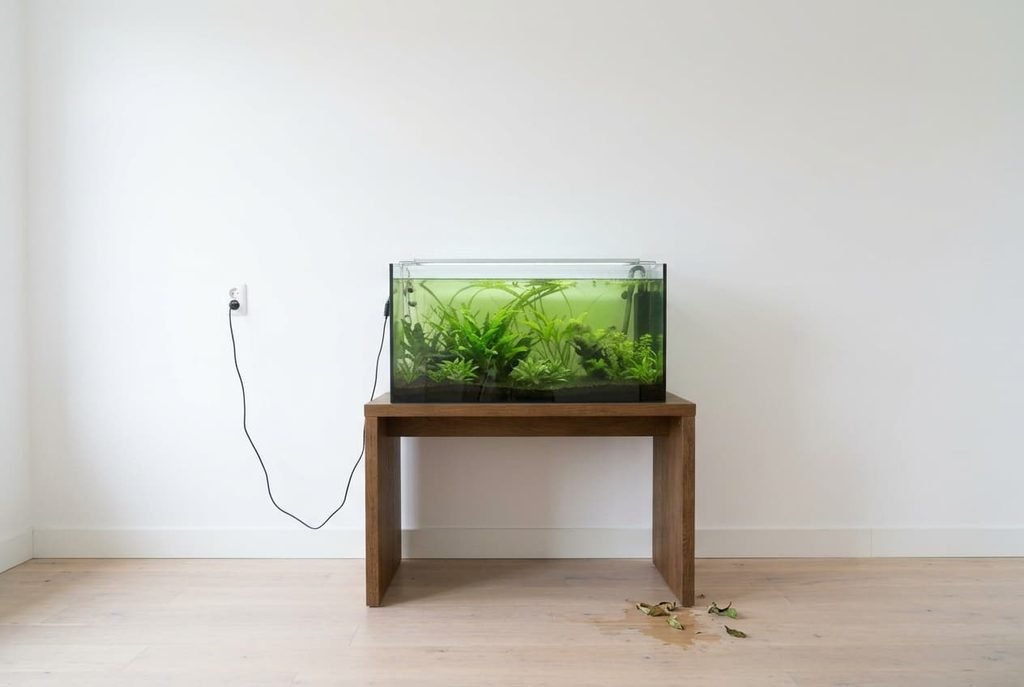
Running cables with no loop below the socket. Water follows a cable downhill. A dip of 20 cm below the plug makes drips fall off before they reach the socket. The sample tank draws about 250 W in total, which is 1.1 A at 230 V. An ordinary socket copes with that, yet the loop still matters.
Setting the stand flush with the wall. Hoses and the filter outlet need about 12 cm behind the stand, and a skirting board adds 2 cm of its own. Measure from the wall face rather than the board. A stand pushed tight turns every maintenance job into a job for two people.
Ignoring the walk to the tap. A 25% water change is 75 L, which is eight trips with a 10 L bucket. Each full bucket weighs 10 kg, and a route through two doorways and round the sofa gets old quickly. Keep the path short and at least 90 cm wide.
Tape the zone before the tank is ordered.
When the Usual Advice About Centring the Tank Fails
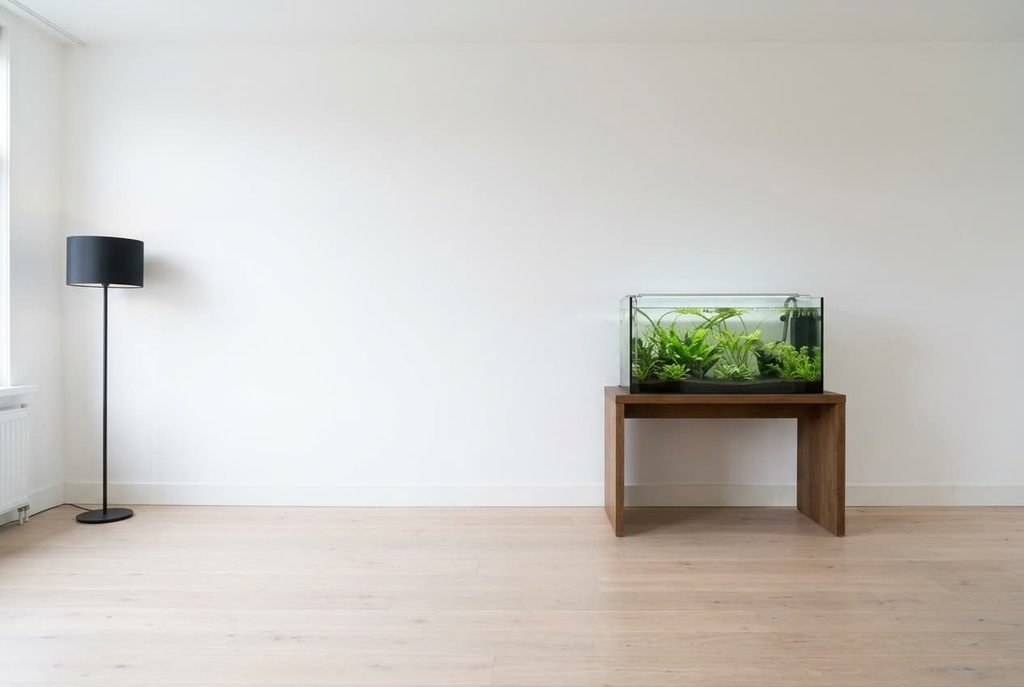
The usual advice puts the largest feature halfway along the longest wall, because it looks planned there. Centred on the 520 cm south wall, the tank would occupy the stretch between 200 and 320 cm. The last 20 cm of the sun patch would touch its left side, and the sofa would face a glass front that glows green by June. I’d defend an off-centre spot near the eastern corner of the same wall, despite looking less formal.
The cost is a lopsided wall, and a floor lamp at the western end evens that out. The tank still sits over the joist ends and still keeps a clear approach from the door. A large aquarium in a living room works as a feature wherever it stands, provided the water stays clear and the floor stays steady. A shelf unit beside the tank can also carry the sight line along the wall, and the position then looks chosen rather than squeezed in.
Rooms vary. With a concrete floor the joist question disappears. The sun and the tap run then decide the wall alone, and you can choose the spot that looks best from the sofa.
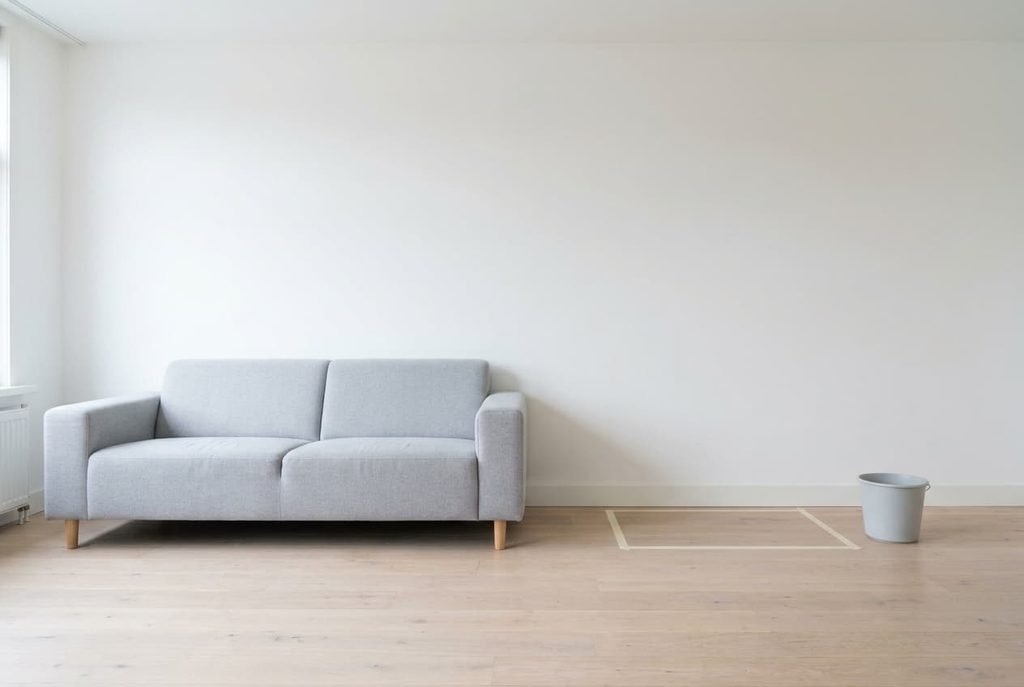
Three Checks to Make Before the Tank Arrives
1. Tape the zone, 132 by 120 cm, along the south wall from the 260 cm mark. Leave it down for a day while everyone walks round it, and move it if anyone complains. Ask the building owner at this stage, too, which way the joists run and what load the floor may carry.
2. Mark the edge of the sun patch with tape in the late afternoon and again two hours later. Confirm that the zone stays at least 40 cm clear of both lines.
3. Fill two 10 L buckets and walk them from the sink over to the taped zone. Time one trip and multiply by eight to see what a water change feels like. If you dread it, that’s a sign to move the zone closer to the tap.
A large aquarium rewards patience at the planning stage. Settle the floor before anything else, and leave the sofa until last. Then walk the route with a full bucket and notice every doorway and corner on the way, which teaches more than a plan can. Once the water is in, no position change is cheap. Give the tape a full week before the tank arrives.
Questions Readers Keep Asking
How much floor does a 300 litre tank need?
The tank and stand cover 120 by 50 cm, but you also need 12 cm behind and about 70 cm in front for kneeling. That makes a zone of 132 by 120 cm, or 1.58 m². In our 19.76 m² room that’s about 8% of the area before any walking space is added.
Which wall suits a heavy tank best?
A long wall that the joists rest on, because the load travels straight into the brickwork. A wall running parallel to the joists, or mid-room, puts the same weight where the boards bend. Ask the building owner which way the joists run before you decide.
Does sunlight really matter for a tank?
Yes. A few hours of direct sun a day warms the water and feeds a green film on the glass. Pick a spot the sun doesn’t reach, then add a lamp on a timer for the plants. In this room the sun stops 220 cm along the south wall, which is where the tank starts.