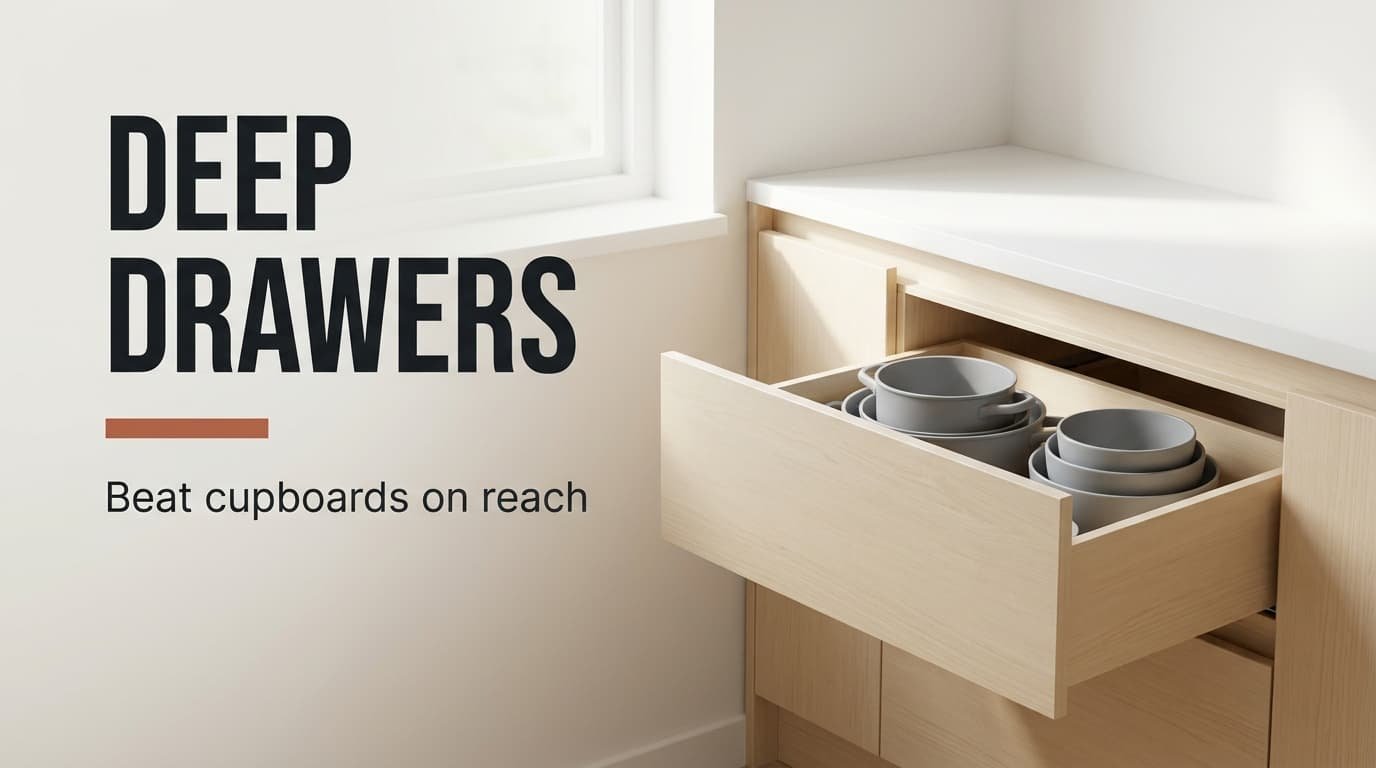
The back shelf of a base cupboard is where pans go to be forgotten. Deep drawers under the worktop turn that dead zone into a box you can look down into, and that is why cupboards are losing ground to them. Our invented kitchen has a run of 240 cm built from three base units, each 80 cm in width and 60 cm in depth. These numbers come from one invented room; measure yours before trusting ours. The sums come first, then who gains, then a verdict, one extreme version to avoid and a cardboard test you can do tonight.
Where the Idea of Deep Drawers Under the Worktop Began
Base cupboards copied the furniture that came before them, a box with a door and a shelf. A door opens a hole in the front, and the hole shows only what sits near its edge. Drawers existed too, but in chests they stayed shallow, because a wooden drawer on wooden rails jammed once it grew deep or heavy.
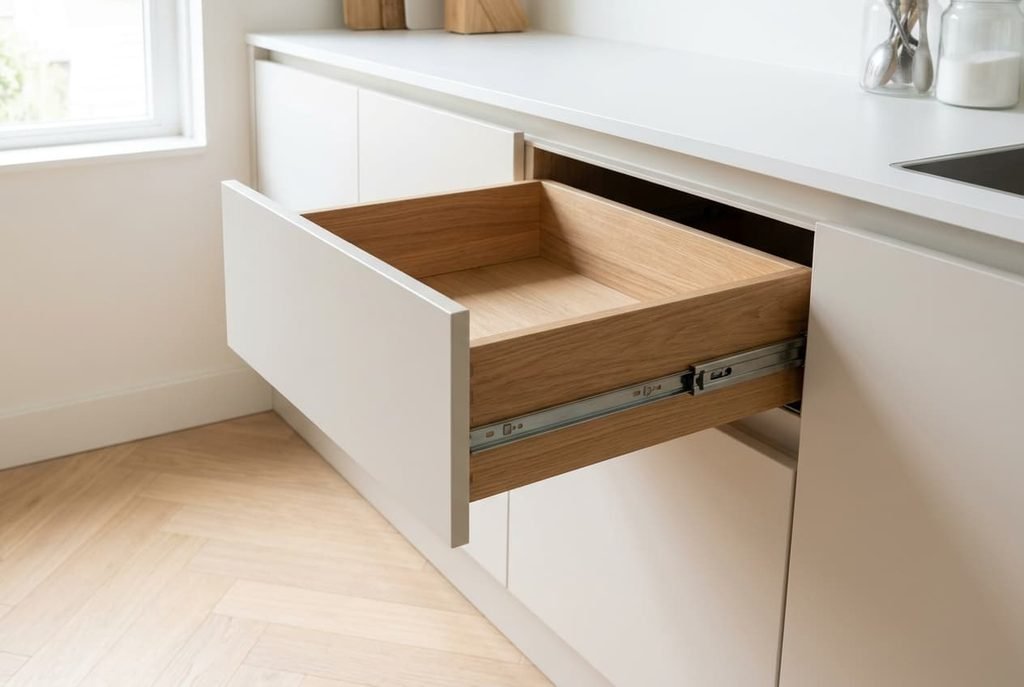
Metal runners changed that. A runner with rolling parts carries the load on wheels or balls instead of rubbing wood on wood. A drawer 50 cm deep can then slide out its full length and still hold a heavy stack of pans. Soft closing arrived with the same hardware, and the kitchen gained a drawer that behaves like a tray on rails.
The idea fits Dutch kitchens well. Narrow rooms are common, with perhaps 100 cm of floor between the two runs. A cupboard door 40 cm wide swings 40 cm into that gap and takes 40 of its 100 cm while it stands open, whereas a drawer stays square to the unit.
The next section turns both designs into litres.
What Deep Drawers Change in Litres and Centimetres
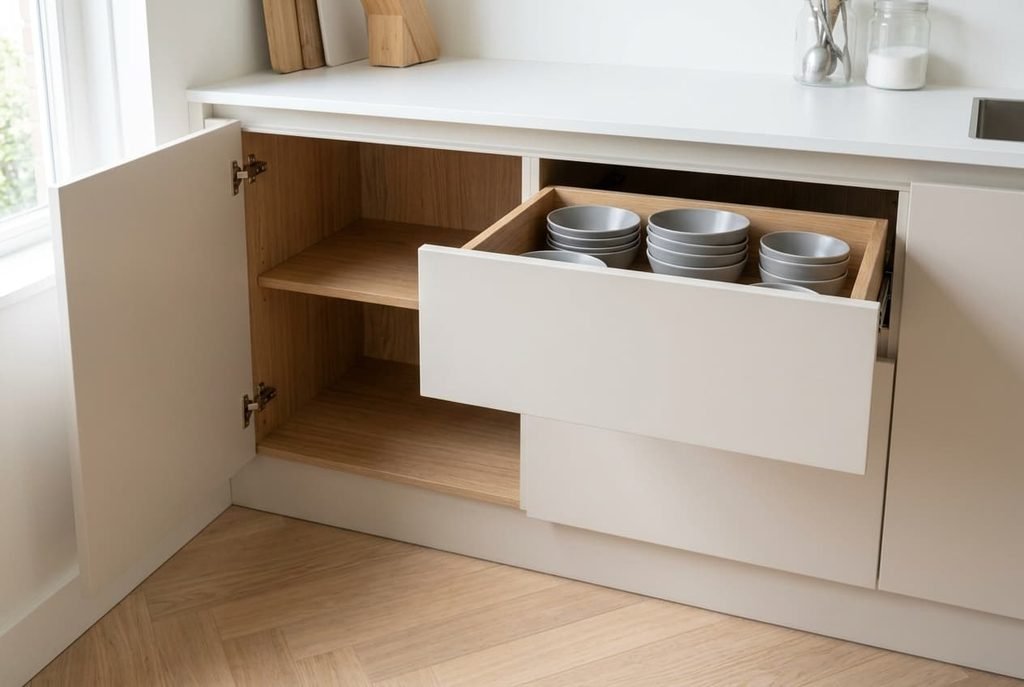
Start with the cupboard. An 80 cm unit has an inside of 76 × 56 cm and a clear height of 70 cm, which makes 0.76 × 0.56 × 0.70 = 0.298 m³, or 298 litres. From a standing position the hand finds only the first 25 cm of depth without stooping. That reachable zone holds 0.76 × 0.25 × 0.70 = 133 litres, which is 45% of the cupboard. The other 55% lies behind the front. Reaching it means kneeling and moving things aside.
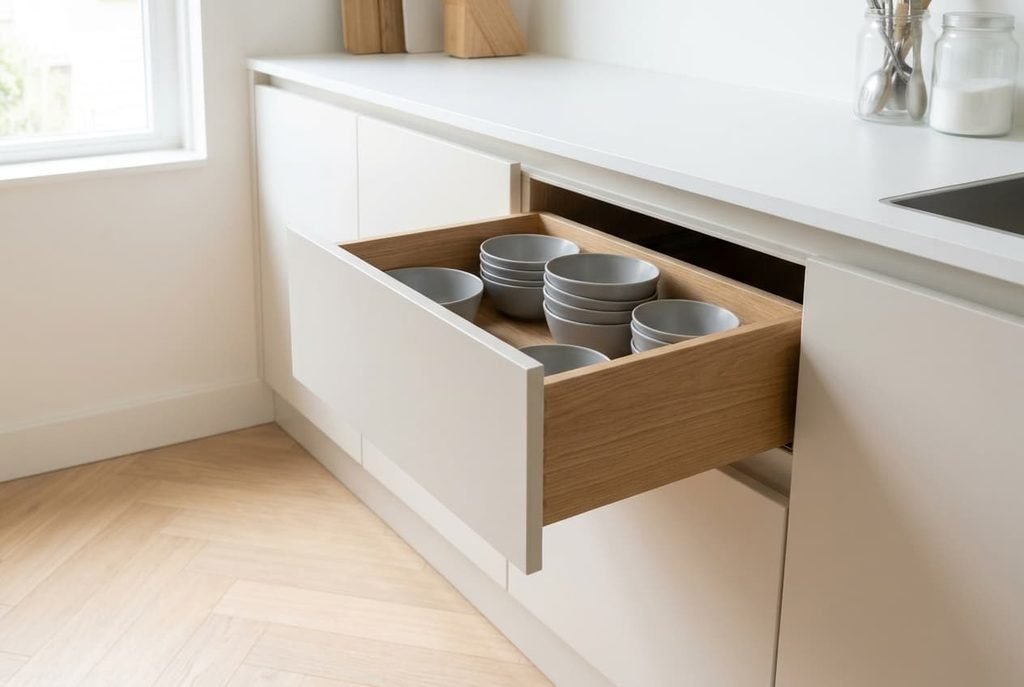
Now fit three drawers into the same unit. Each has an inside of 72 × 50 × 18 cm, giving 64,800 cm³, or 64.8 litres. Three give 194 litres. Deep drawers under the worktop hold about 65% of the cupboard’s volume, yet every litre of it is reachable, because the whole box slides out and you look straight down into it. The reachable volume climbs from 133 to 194 litres, which is 46% more.
Something is lost on the way, and you shouldn’t ignore it. Doors cost floor space too. A hinged door 40 cm wide traces a quarter circle with a 40 cm radius, covering π × 40² ÷ 4 = 1,257 cm², and nothing may stand there while it is open. Each runner uses up 1.3 cm of the width, while the drawer’s own sides and front take wood too. Tall things don’t fit either. A bottle of 33 cm or a pan with a high handle stands up in a cupboard and must lie down in a drawer. Remember 18 cm: anything taller wastes space.
Which Kitchens Gain Most From Deep Drawers
Gains concentrate where the lower units hold the daily kit. A household that cooks five evenings a week fetches about three pots per evening. Say a fetch from the rear of a cupboard takes 25 seconds. Kneeling and clearing are included. From a drawer it takes 5. The saving is 20 seconds × 3 × 5 = 300 seconds, or 5 minutes a week. Across 52 weeks that’s about 4.3 hours. These times are guesses, and your own stopwatch will correct them.
Reach matters more than time for some people. Anyone who dislikes kneeling, or who is tall, will find that a drawer brings the contents up to a standing view. A shared kitchen gains as well, because a drawer shows everything to every cook at once, and nobody has to ask where things are.
Losers exist. A drawer pulls out 55 cm, against the 40 cm swing of a door. In a passage of 100 cm, one open drawer leaves only 45 cm to walk through. Only one drawer can be open at a time. Units narrower than 50 cm do better with a door, and tall storage suits a cupboard.
Deep drawers pay back most in the units you open every day.
Sink units are a special case. The pipes run through the middle. The drawer therefore needs a cut-out at the back, and that costs volume.
Are Deep Drawers Under a Worktop Worth the Change?
Everything turns on what you reach for each week. If the lower units hold pots and bowls that you handle daily, then deep drawers under the worktop are a sound trade. You lose 35% of the volume and gain direct access to all that remains.
If you mostly store tall bottles and vases, they are a poor trade. Judge the change by what you reach for each week and not by how the fronts look, because a handsome front hides the same cluttered back shelf. In a rental, the landlord owns the units. A pull-out tray fitted inside an existing cupboard wins part of the gain without a replacement. Taken as a whole, the answer is a limited yes: pick drawers for the units you open daily and keep one cupboard for the tall things.
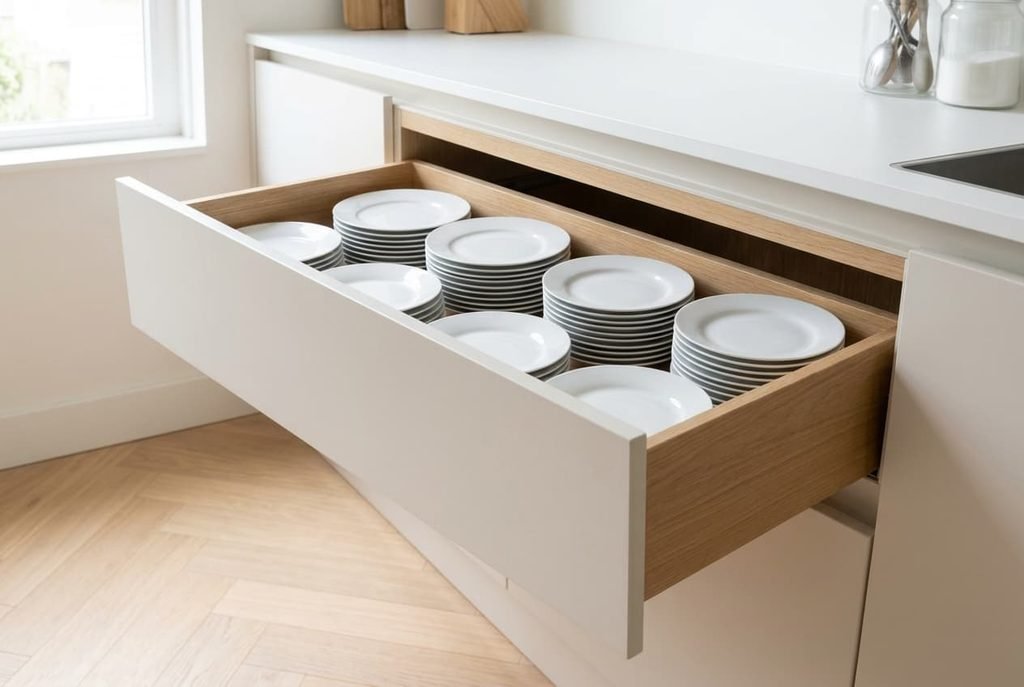
The Extreme Version Nobody Needs
The extreme version makes every base unit a drawer, including the one beside the oven, and widens them to 120 cm. A drawer that wide loaded with 40 kg of crockery turns the whole kitchen into a weight test. A single drawer at full extension carries its load far from the unit, and the mass sits about 27.5 cm out. That’s 40 × 0.275 = 11 kg·m at the runners. An 80 cm drawer with 15 kg produces 15 × 0.275 = 4.1 kg·m, which means the wide one stresses the hardware 2.7 times harder.
The failure is ugly. Runners bend and the front tilts. The crockery then meets the floor. A bent runner can’t be straightened, and the fix is a replacement set.
No ordinary kitchen needs this. Drawers of 80 cm or less, loaded below the runner rating with a margin of about half again, keep the benefit without the lever. Treat deep drawers as a tool for the daily units rather than a rule for the whole room.
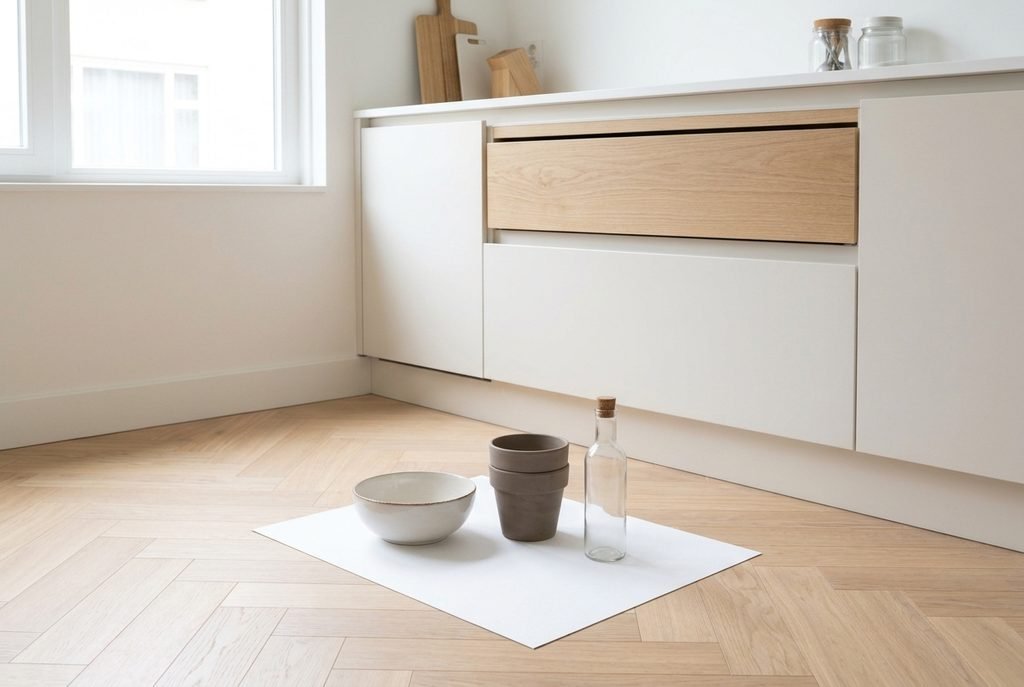
A Cardboard Test Before You Commit
Cut a sheet of card to 72 × 50 cm and place it flat on the floor. Empty your busiest lower cupboard onto it in one layer. Then measure the tallest item with a ruler. If over a third of the items stand taller than 18 cm, keep the cupboard, however fashionable the drawers look. If most of the items lie flat on the card, deep drawers under the worktop will serve you well.
Count the items as well. Fewer than twelve will fit a single drawer, and more than twenty call for two. Write the count and the tallest height on the card itself.
Photograph the card with everything on it. The picture reveals whether you own a drawer’s worth of pots or a cupboard’s worth of tall things. Try it on your busiest unit, then on a second one before deciding, since kitchens often need both kinds and the second unit may surprise you. Keep the card by the cooker for a week.
Questions Readers Keep Asking
Should I replace working cupboards with drawers?
Usually not. A cupboard that works costs nothing to keep, while drawers mean new units. A pull-out tray fitted inside an existing cupboard is a gentler step. Replace the cupboards only when the whole run is due for renewal anyway.
Who suits deep drawers best?
Households that cook most evenings and keep pots and bowls in the lower units. They also suit tall cooks and anyone who dislikes kneeling. A household that stores bottles and vases there will gain far less, because tall items waste space in a drawer.
How long do drawers last?
The runners set the lifespan. Drawers loaded well below the runner rating run smoothly for many years. Overloaded ones tilt and bind within a few seasons. Split heavy crockery over two shallow drawers rather than one deep one, and wipe the runners now and then.