Cane and rattan furniture does for a living room what a window does for a wall: it lets the eye pass through. That is the real change behind the revival, and it’s worth acting on for one or two pieces. A whole suite goes too far.
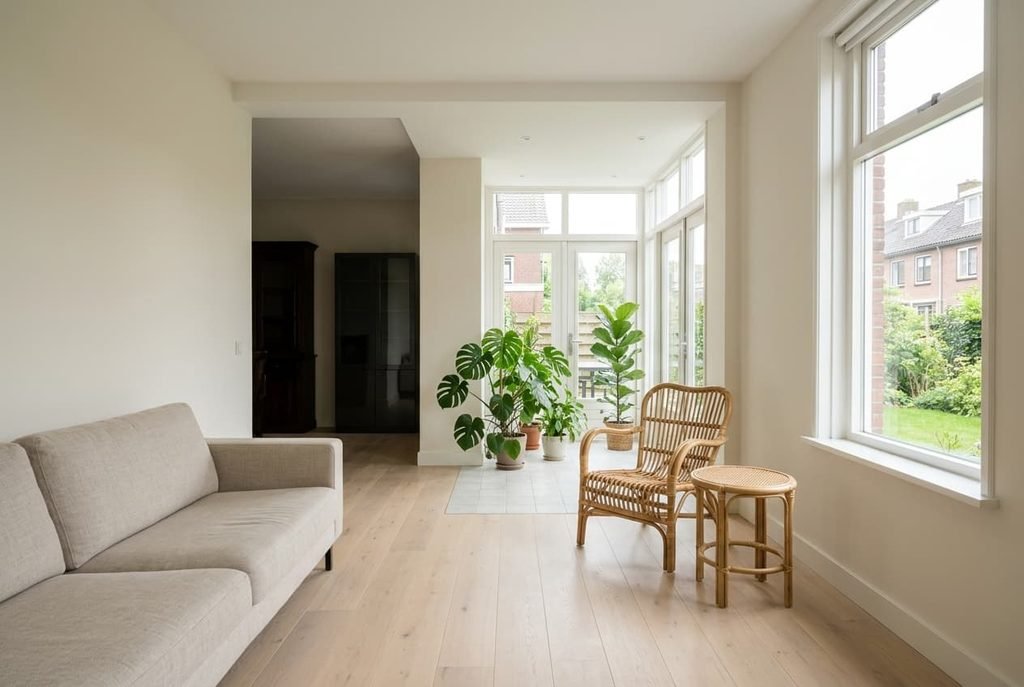
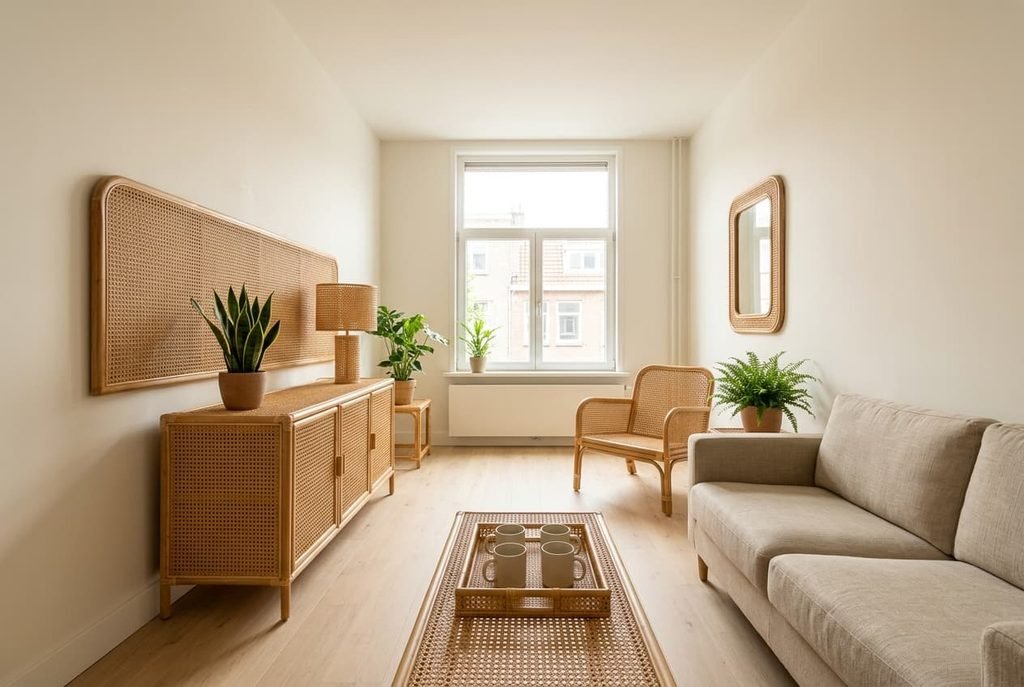
The room here is Dutch and measures 350 × 500 cm with a 250 cm ceiling height and a 180 cm window set in the short wall. The figures use an assumed weave and name no maker or price, so measure your own pieces before you trust a number.
Where cane and rattan furniture came from
Cane is the peeled skin of a climbing palm, woven into a web. Rattan is the stem itself, bent into poles. Both spent most of the century before the 2000s in conservatories and garden rooms. There light weight and tolerance of damp air mattered more than looking smart indoors.
The 2000s swung living rooms the other way. Upholstered seats, solid wood with a dark stain and glossy fronts took over. They hid dust and matched the heavy curtains of the time.
Three conditions brought the weave back indoors. For many renters rooms got smaller, so a piece that blocks less of the view cost less. Walls and floors turned pale and matt, which left a room short of texture. Lamps also moved low, and a woven surface throws a pattern of small shadows under that light. Open-plan layouts added a fourth: a piece you can see across lets a long room read as one space. The material itself hasn’t changed. The reason for choosing it has.
What changed in rattan and cane furniture: the opaque area
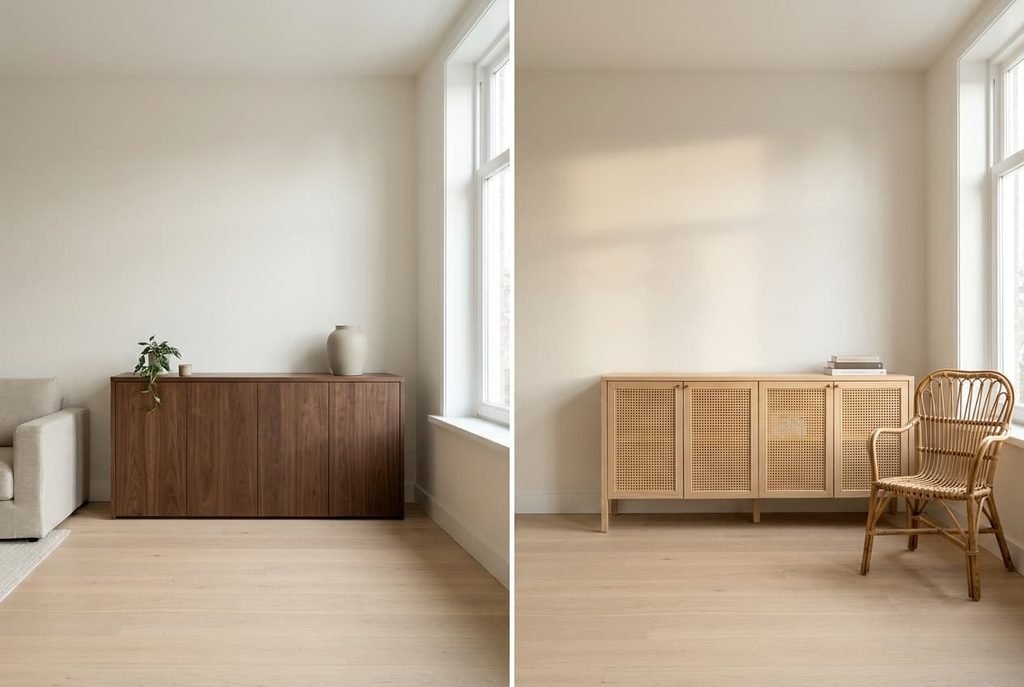
In the old pattern, every piece turned a solid face toward the room. In our living room, a sideboard front of 160 by 75 cm covers 1.2 m² of the 8.75 m² wall behind it, which is 13.7%. Every part of it is opaque. An armchair back of 80 by 90 cm adds 0.72 m². Together that makes 1.92 m² of surface you can’t see past.
The new pattern puts a woven face there. Take cane with 3 mm strands at a pitch of 9 mm. The gaps are 6 mm, so the open fraction is (6 ÷ 9)², or 44%. Then the sideboard front blocks 0.67 m² and the chair back 0.40 m², a total of 1.07 m². The opaque area falls by the open fraction of the weave, here 44%. The wall behind the sideboard is covered 7.6% instead of 13.7%.
Frames thinned alongside it. A turned leg of 50 mm gave way to a rattan pole of 30 mm, which is 40% less line weight against the floor. Colour moved the same way. Honey cane has an assumed reflectance of 40, while dark walnut sits near 10. The same lamp lights a cane front four times as well. Each of these is a measurable change you can check by holding a tape against a piece.
The weave also changes how a piece wears, since cane is woven damp and tightens as it dries.
Who it suits, and who it doesn’t
Cane and rattan furniture suits a pale, matt room that needs texture. Our room has 17.5 m² of floor, plus a window of 180 cm, so a see-through chair costs it little daylight. A living room whose sofa already hides a third of a wall gains more from an open-weave sideboard than a room with bare walls.
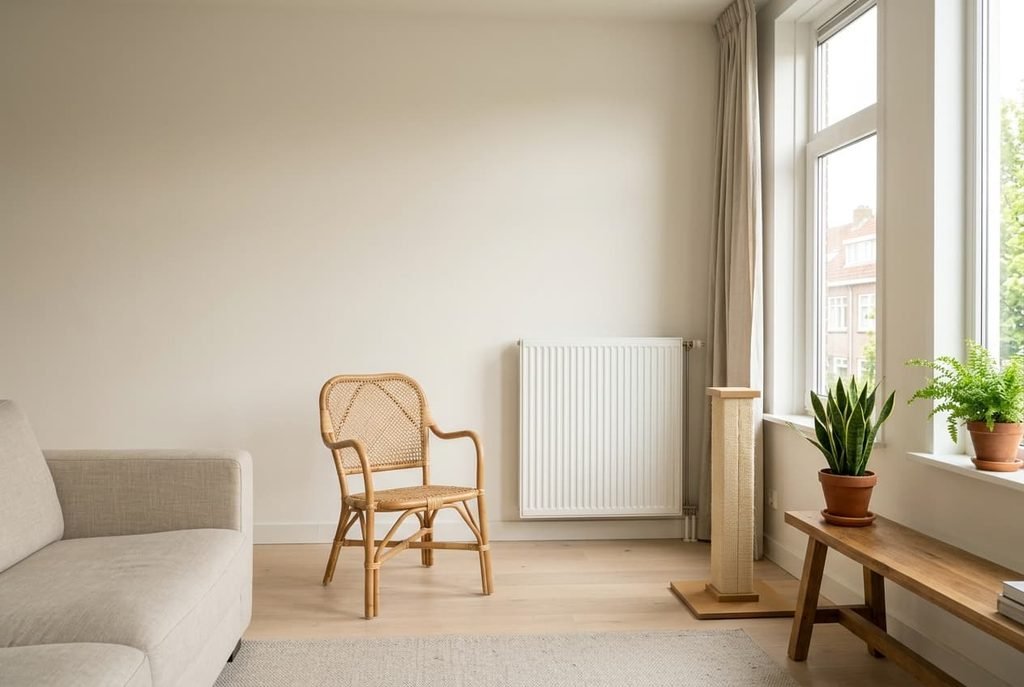
It suits a flat that nobody heats above a modest level. Radiators dry the strands, and a piece within 50 cm of a radiator splits sooner than one across the room. A south window does a different job: sun bleaches honey cane to a pale straw within a few summers, so keep it off the sill.
A home with a cat is a poor fit. Claws catch in 6 mm gaps and pull a strand out, and the damage spreads along the row. Dusty households fare badly too, since each gap collects fluff that needs a soft brush. Anyone wanting a sideboard that hides cables and clutter should look elsewhere, because a cane front shows 44% of what is behind it. A lined version, with fabric behind the weave, brings the hiding back but gives up most of the see-through effect. It’s a compromise rather than a cure.
Cane suits renters well, because a freestanding piece needs no fixings and leaves with you.
Is it worth adopting
Weigh cane and rattan furniture on the cost of going back. A freestanding chair or sideboard reverses as fast as you can carry it out. Cane doors fitted into a built-in wardrobe need a joiner to remove. A single freestanding piece is the low-risk way in, since it adds texture and costs you nothing in the structure of the room.
Value also depends on repair. A sagging panel can often be tightened by wetting the underside and letting it dry. A broken strand can be re-woven by a repairer. That makes cane a material that ages without a finish to fail. Nothing flakes or peels, and a faded patch simply looks like honey that has seen some sun.
A treatment dates when it’s tied to one tone or one moment. A weave in natural honey colour is unlikely to, since the colour is the material itself.
The version that will date fastest
The extreme end is cane on every surface in one honey tone: six pieces in a 17.5 m² room, from the sideboard to the tray. Three marks identify it. Every piece repeats the same weave. The colour never varies. No solid surface is left to rest the eye. The result looks like a catalogue page and stops looking like a living room. It also fixes your choices for years, because each new object must match the weave already there.
I’d skip it, because texture only works against something plain. A moderate version uses one or two woven pieces among solid ones. One open-weave sideboard against a matt pale wall keeps the opaque area of the room high enough to feel settled while borrowing the lightness. Pair it with a plain upholstered sofa and a stained oak table. A second woven piece should differ in tone and scale: a tight weave on the chair, an open one on the sideboard. Keep the woven share of the room to roughly one piece in five.
How to try it without committing
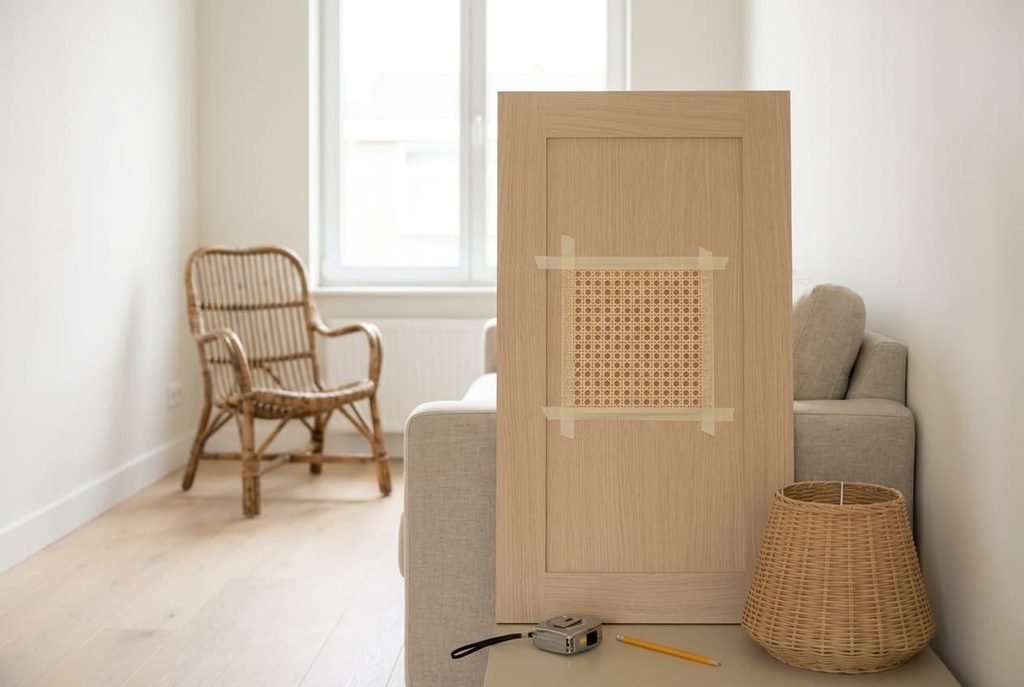
Tape a 30 × 30 cm square of webbing over a solid cabinet door and leave it for a week. At 0.09 m² it is 7.5% of the 1.2 m² front, and you’ll learn at once whether you like seeing the shapes behind it.
After that, borrow a second-hand chair for a month. Place it away from the radiator and the south window. Last, try a woven lampshade, which brings the shadow pattern for roughly what a bulb cover costs. Only after those steps should you consider a larger piece. Then buy it where you can look at the weave from the side.
Cane and rattan furniture is a real change with a measurable cause. One or two pieces carry it well. Leave the remaining pieces solid. Place the woven piece away from heat and sun, and wait a week before judging. The weave does the work, so a second one rarely adds anything. Ask what each piece lets you see before you buy it.
Questions readers keep asking
Should I swap my solid wooden sideboard for a cane one?
Only if you’re happy to see about 44% of what sits behind the front. Test a 30 × 30 cm swatch first. If you want to hide cables and clutter, add a solid inner panel or keep the wood. Keep the old piece until the new one has lasted a season.
Does cane furniture suit a home with a cat?
Rarely. Claws hook into 6 mm gaps and pull strands loose, and the weave unravels along the row. A solid wood or leather piece stands up to scratching better. If you still want cane, choose a firm back set high, and keep it out of the cat’s reach on a wall unit.
How long does cane furniture last in a heated living room?
The answer rests on how supple the strands stay, so I can’t give a number of years. Keep it 50 cm from a radiator and out of direct sun. A damp floor is a third hazard. A sagging panel can be wetted and tightened, and a broken strand can be re-woven.