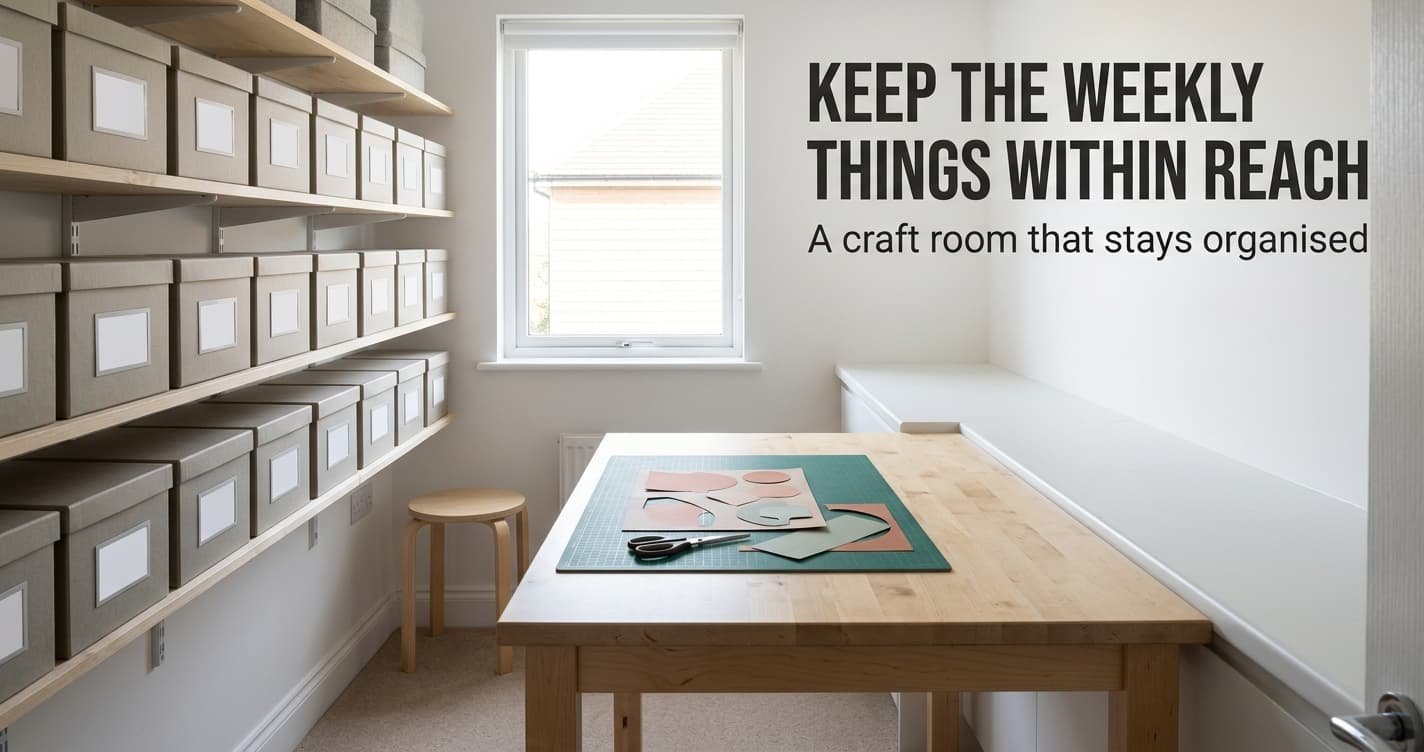
You clear the table on Sunday and by Wednesday it’s buried again, because the scissors live in a drawer and the thread lives in a box on the floor. A craft room that stays organised is built around distance. Anything you reach for every week has to sit within about 60 cm of your seat. Everything else can live further off. This guide uses a room 320 by 380 cm in the Netherlands, with a 250 cm ceiling.
The sums are simplified, and arm lengths vary, so treat the figures as the start of a tape test. Check your lease before you fix anything to a wall.
What a craft room that stays organised demands
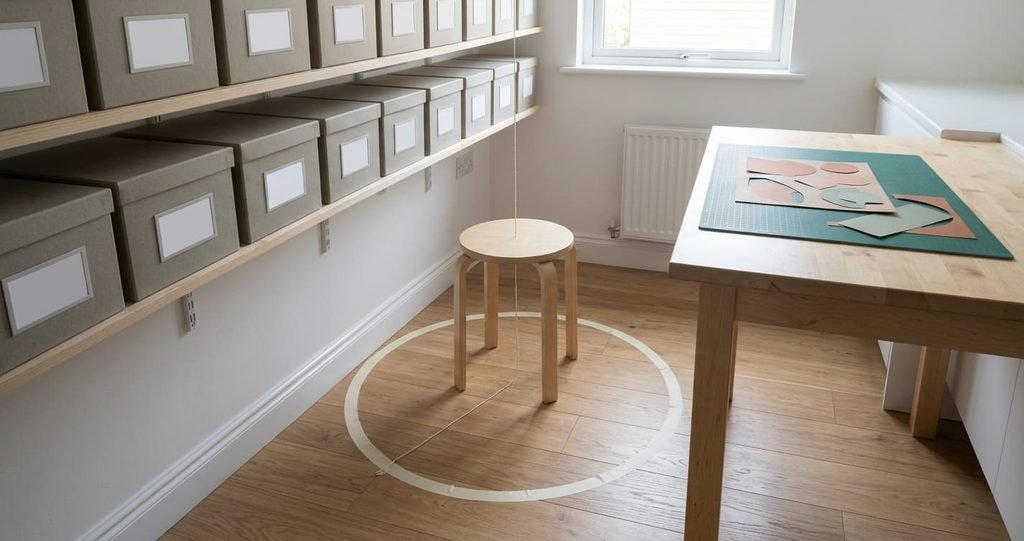
Start with your arm. Seated at a table, your forearm sweeps a comfortable zone about 40 cm from the elbow. A full stretch with a lean reaches about 60 cm. Past that you’re standing up. Call the 60 cm circle around your seat the ring.
The ring is smaller than it sounds. Take a shelf at shoulder height with its face 55 cm from your seat. Only the middle 48 cm of it lies inside the ring. The distance to the shelf grows as you look along it, and the sums give 24 cm either side (√(60² − 55²)). Bring the face to 45 cm and the usable width grows to 79 cm.
Ten centimetres of distance buys 31 cm of shelf.
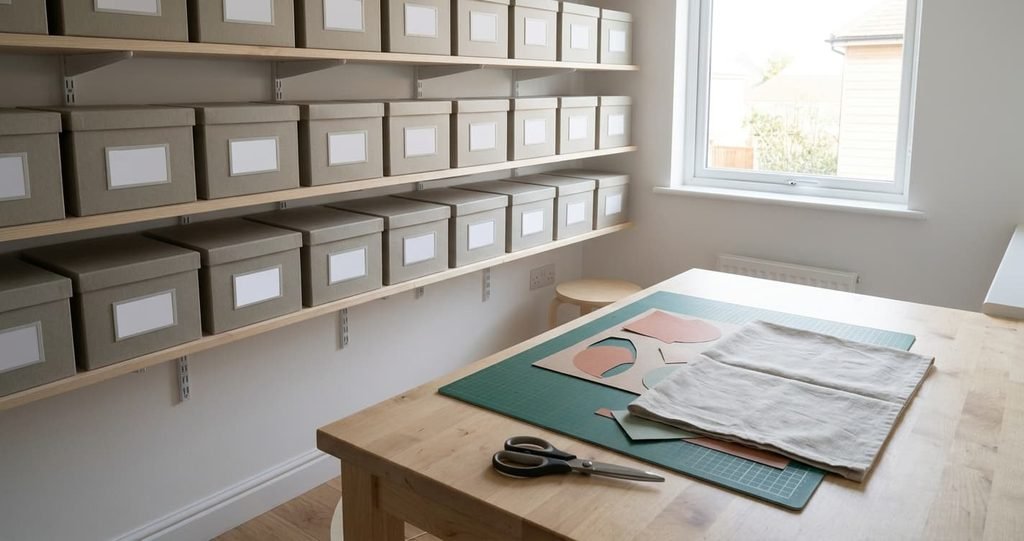
Then comes the table. A top of 160 × 75 cm holds a self-healing mat in A2 size (59.4 × 42 cm). In front of the mat go a 15 cm strip for tools and, at the edge, 18 cm for your forearms. Your seat centre sits about 25 cm from that edge, so the ring reaches 35 cm onto the table. That covers the tool strip, which ends 33 cm in. You work across the whole mat by leaning, so the ring measures fetching and not working.
Keep everything you use weekly inside 60 cm of where you sit, and let the monthly boxes live further away.
Four layouts that work
– Rental-friendly, 250 × 300 cm room: a table 140 × 70 cm in matt white laminate sits 70 cm from a pine shelf 30 cm deep. An 80 cm walkway runs beside it. A clamp lamp avoids drilling. At 70 cm deep, the table puts its front half inside the ring.
– Tight footprint, 200 × 260 cm: a birch plywood table 120 × 60 cm faces an open ash shelf 25 cm deep across a 70 cm pocket. A stool 35 cm across tucks under the table, so the pocket doubles as the walkway. An arm lamp clamps to the shelf.
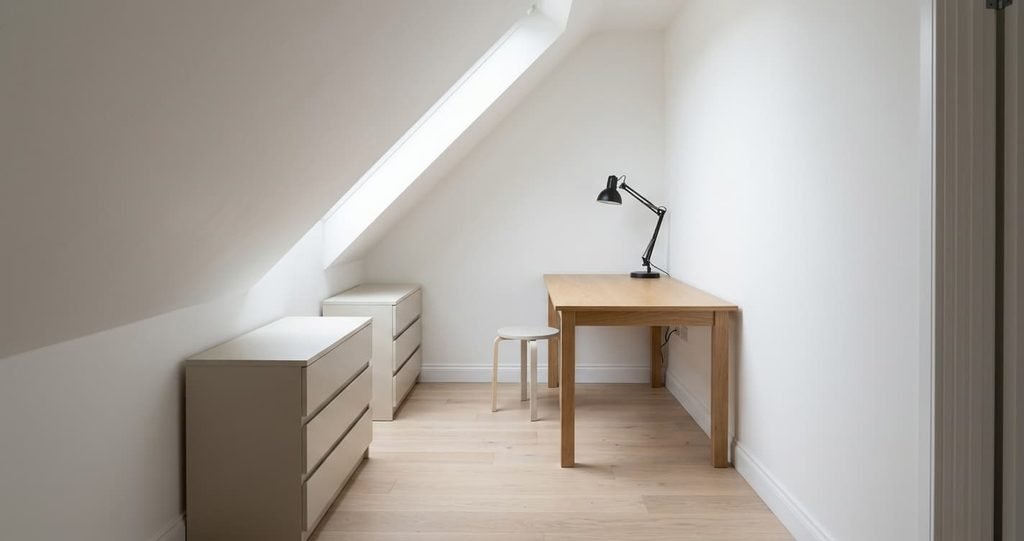
– Awkward shape, 300 × 400 cm attic with one 45° slope: drawer chests 40 cm deep and 80 cm high fill the first 40 cm in front of the 110 cm knee wall. Headroom there is under 150 cm, so nobody stands in it anyway. An oak veneer table 150 × 70 cm stands 110 cm out. The full-height side keeps a 90 cm path, and a task lamp sits on the table’s left.
– Full furnish, 320 × 380 cm: a pale ash shelf 30 cm deep stands behind a 70 cm pocket. Then come a birch plywood table 160 × 75 cm and a 100 cm aisle, with a cabinet 45 cm deep on the far wall. A counter 90 cm high suits cutting upright, and two spots aim at the table. Drawers pulled 40 cm out leave 60 cm of aisle.
Where people get this room wrong
A table deeper than 75 cm grows a dead strip at the back. The extra depth of a 90 cm table sits 115 cm from your seat, far past the ring, so whatever lands there stays forgotten for months. Cut the depth to 75 cm. If the table can’t shrink, give the strip to a lamp and a pen pot that you only glance at.
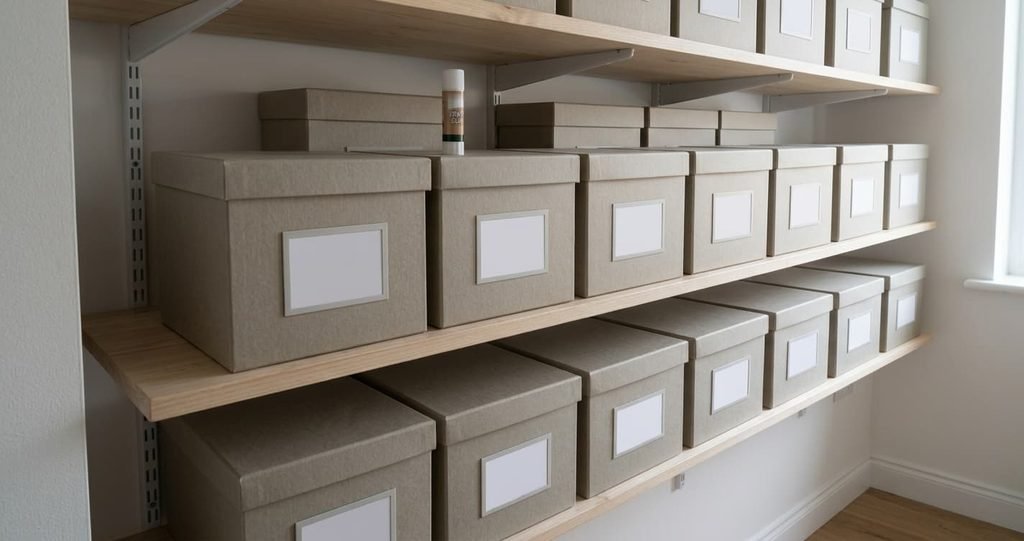
Shelves 40 cm deep hide a second row. A seated eye line can’t see the item behind another, so you buy a second tube of glue. Shelves 30 cm deep suit most boxes, and 25 cm suits jars and tins. Anything deeper wants a pull-out tray, which brings the back row forward. Label each box on its front edge, where your eye lands.
Carpet under the chair swallows beads. The pile hides anything small and drags at castors. You stay seated and make do with whatever’s within reach. A hard floor in sealed oak or light grey vinyl sweeps clean, and a dropped bead stays where it lands. Over carpet, a chair mat 100 × 120 cm does the same job.
A cutting mat stored beside the radiator starts to curl. Most mats are PVC, so heat softens them. A curled mat no longer guides a blade straight. Keep it flat on the table and clear of radiators and sunny windowsills. Hanging it from a hook can bend it as well, so flat storage wins.
When a craft room stays organised but never gets used
The standard advice is to clear the table every night and shut everything behind cabinet doors. It produces a craft room that stays organised and sits empty, because starting costs more than the day allows. Say you have 30 minutes after dinner. If fetching and laying out takes ten, a third of the slot is gone before the first cut.
Leave one project on the table overnight, on the mat and nowhere else. I’d argue for that over the clear-it-nightly rule. A started job costs nothing to resume, while a cleared table moves the setup to the moment you have least time. The mat zone covers about a fifth of the table (2,495 cm² of 12,000), so the rest stays clear.
Clear the table and you’ve also cleared the reason to sit down at it.
For weekly supplies, open shelves with labels facing out beat doors, because a door adds a step to every fetch. If the room doubles as a guest bedroom, the table has to clear whenever someone stays. How often that happens decides how much of this you can use.
Three things to try this weekend
1. Tape a 60 cm string to the middle of your seat and mark the circle it sweeps on the floor with masking tape. Any item you needed last week that lies outside the circle is a candidate to move in.
2. Tape a 15 cm strip 18 cm from the table edge, then lay a 59.4 × 42 cm card behind it. If the card hangs over the back edge, the table is under 75 cm deep and this layout won’t fit, so measure the overhang to see how much depth you’re missing.
3. Leave one project on the mat for three days and time the first cut each day, then clear it nightly for three more. The gap in minutes is your own setup cost, and it shows whether the overnight rule earns its place.
A craft room that stays organised is measured in centimetres from the seat. Put the weekly things inside the ring and leave one project where your hands can find it. Everything else can sit a few steps off, in boxes you open once a month. Table depth and shelf depth then settle themselves, which is why I’d tape the circle on the floor this weekend.
Questions readers keep asking
How big should a craft table be?
A table 160 × 75 cm suits most rooms. It holds an A2 mat of 59.4 × 42 cm, a 15 cm tool strip and 18 cm for your forearms. In a small room, 120 × 60 cm takes one mat. Depth matters more than length, because the back of a deeper table lies beyond 100 cm.
Should craft supplies go on open shelves or in closed cabinets?
Use open shelves for supplies you reach for weekly and closed storage for the monthly and yearly ones. A shelf 30 cm deep with labels facing out lets you see every box from your seat. Doors add one action to each fetch, so they belong on boxes you won’t touch often.
How much space does a craft room need?
A craft room that stays organised fits in 200 × 260 cm, with a table 120 × 60 cm and a shelf 25 cm deep. A room near 320 × 380 cm lets you leave a project out and still pass it. Under 155 cm of width the shelf and table can’t share a 70 cm pocket.