Compose a room from the spot where you use it. When a nursery looks perfect but is hard to use, someone arranged the room for the view from the doorway, and it gets used from other places. That makes the fault a matter of reach, light and placement. Each can be measured.
The room in mind measures about 260 by 330 cm and holds a chest of drawers and an armchair, with the window on the short wall. Reach and light matter most after dark, when the room is dim and you’re tired. Every figure below is a typical value for adults, so check it against your own height.
Why a nursery looks perfect but is hard to use
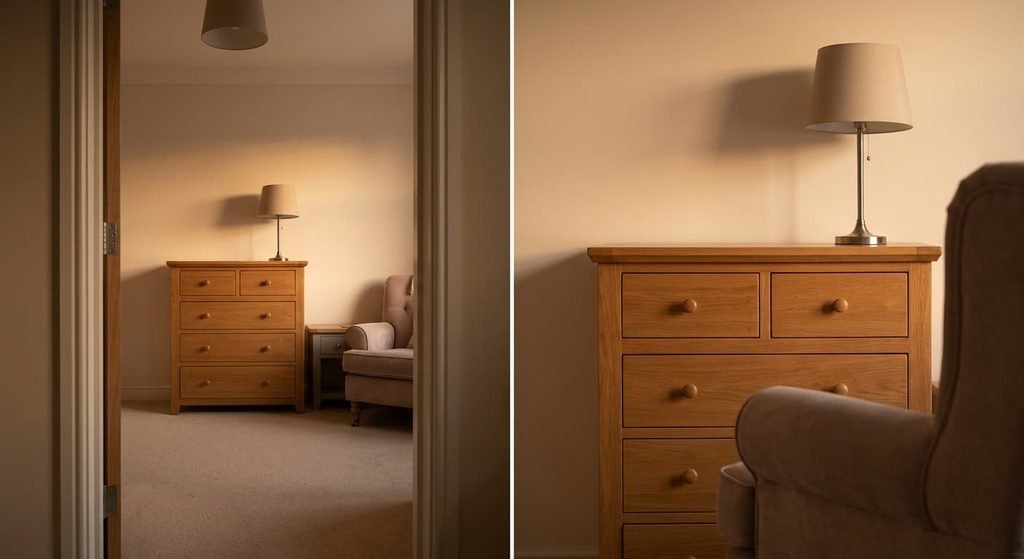
People photograph and judge a room from the doorway, one standing viewpoint with the eye at about 150 cm. From there every front faces you and every lamp shows. The whole wall is visible at once. A seated parent sees something else, with the eye at about 110 cm and the lamps behind or beside. A person at the chest sees the top two drawers and little else.
Three faults come from that gap. Reach goes wrong when the pieces chosen for the doorway view put daily items too low or too high. Light goes wrong when lamps of different colour temperatures are mixed, because a doorway photo flatters each lamp. Placement goes wrong when the pretty wall faces the door instead of the person working.
The doorway also hides depth. A chest 45 cm deep looks tidy face-on, and it takes 45 cm of the floor beside it. A floor lamp that looks elegant at the door can stand right in the seated line of sight, which makes its bulb the brightest thing in the room.
The usual misdiagnosis is a shortage of storage. It leads to another unit. That adds floor area and shadows, and it leaves all three faults in place.
A nursery that looks perfect yet is hard to use: which fault?
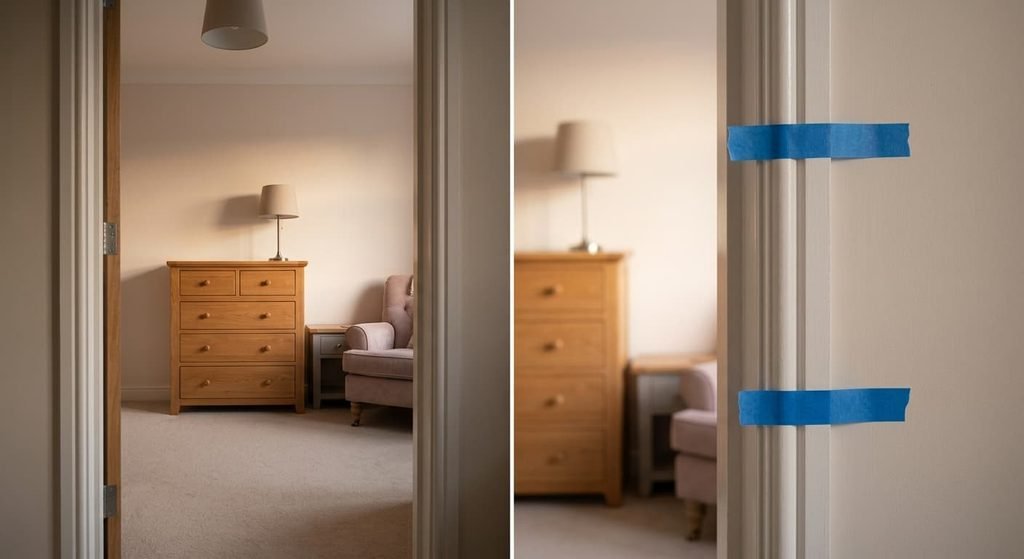
Take two photographs. Shoot the first from the doorway at 150 cm. Shoot the second seated in the armchair, with the phone at about 110 cm, facing the chest.
Then check three things, one for each fault. Put two strips of tape on the door frame at 75 and 145 cm. In the seated photo, mark every item you reach for daily that sits below the lower strip or above the upper one. Two or more means the reach fault. A very tall or short person should shift both strips by the same amount.
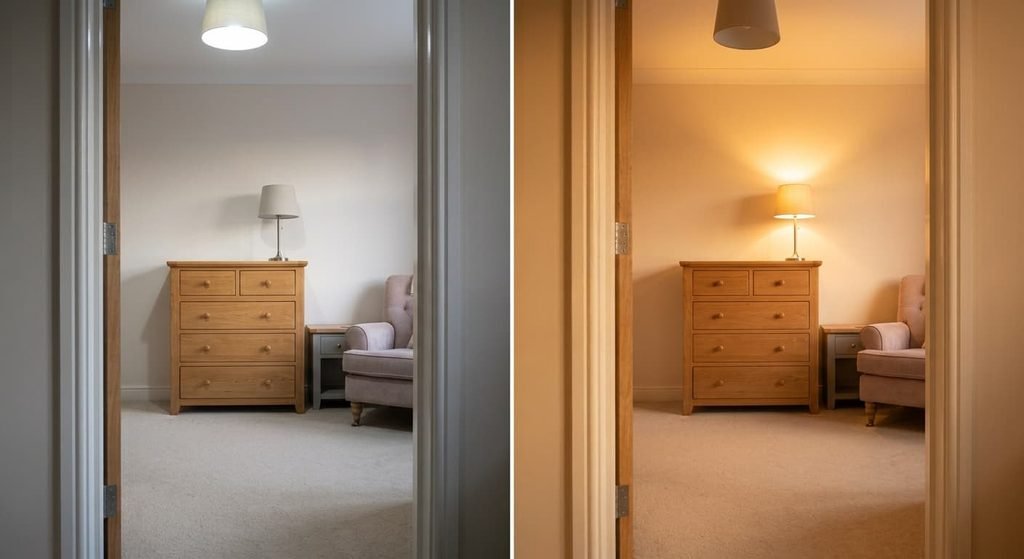
Next, read the kelvin number printed on each bulb box or on the bulb itself. Two numbers more than 1,000 K apart mean the light fault. Examples are 2700 and 4000.
Finally, look at what sits behind the chest in the seated photo. A styled shelf with many small objects there points to placement.
Keep the photographs, because the fix you need is the one they show.
The faults, diagnosed
Reach
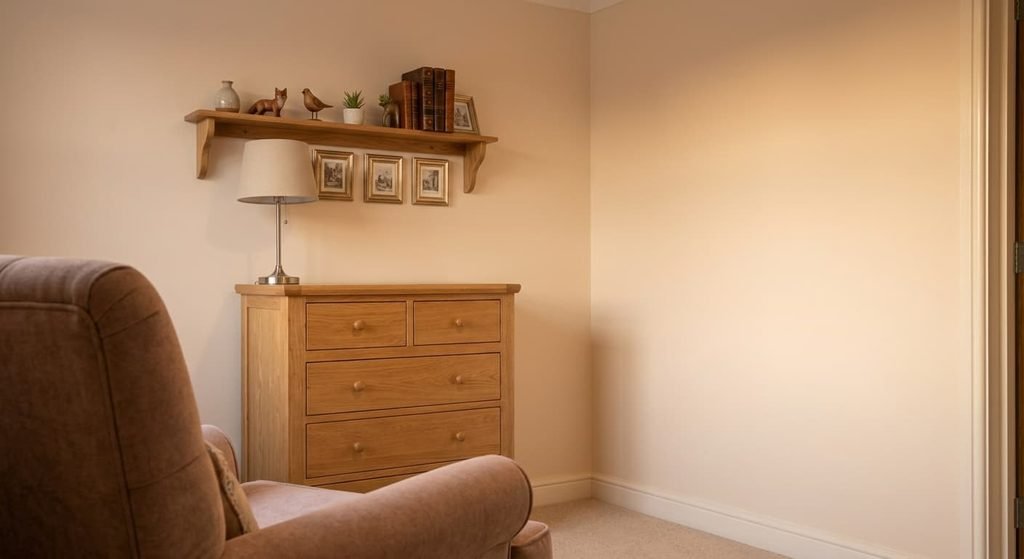
“You keep crouching or stretching for the things you use most.” The cause is scale: the daily items sit outside the reach zone of roughly 75 to 145 cm from the floor. That’s knuckle to shoulder height for most adults. A chest 70 cm tall or a shelf at 170 cm looks balanced at the doorway and works against the body. On a chest 110 cm tall with five drawers, the top two handles sit at about 99 and 77 cm, inside the zone, while the bottom handle sits at about 11 cm and costs a stoop every time. Move the daily items into the top two drawers first, which costs nothing. Then rearrange the hooks to 120 to 140 cm. Buy only if a piece can’t be raised, for example by fitting longer legs.
Light
“The room changes colour every time you switch a lamp on.” The cause is mixed colour temperatures. A ceiling light at 4000 K makes oat walls look cooler and greyer, while a lamp at 2700 K turns the same walls warm and yellow. Daylight at about 5000 K adds a third tone by day. Bulbs of 2700 K and 4000 K both look plain white in a shop, and they only disagree once they share a room. List every bulb’s kelvin figure and unscrew the odd one out. Then use lamps of one temperature at night and leave the ceiling light off. If a bulb needs replacing, choose 2700 K for all of them. That costs the price of the bulbs.
Placement
“The prettiest wall is the one behind you when you work.” The cause is placement: the focal point sits on the doorway wall, while the working position faces a plain or busy one. Swap the frames to the wall in front of the chair, which costs nothing. If a styled shelf stands behind the chest, move it to the doorway wall and leave the working wall bare. A dozen small objects within arm’s length compete for attention, though many people find a bare wall easier to work against, and that is a preference rather than a law. A single new print is the only purchase, and many rooms need none.
What to check before you add anything else
Prevention is cheap, because a nursery that looks perfect but is hard to use got that way one purchase at a time. Before the next piece goes in, run three questions that mirror the faults. Where will the things you use daily sit, and does that fall inside the 75 to 145 cm zone? What kelvin figure does the bulb show, and does it match the others in the room? And which wall will you face while you use it?
Write the answers on a card and tape it inside a wardrobe door. A purchase that fails any of the three goes back before it’s unpacked. One test settles most cases: stand where you’ll use the piece and look at it. If you have to look up or down to reach it, move it before you buy more.
The fix that isn’t worth doing
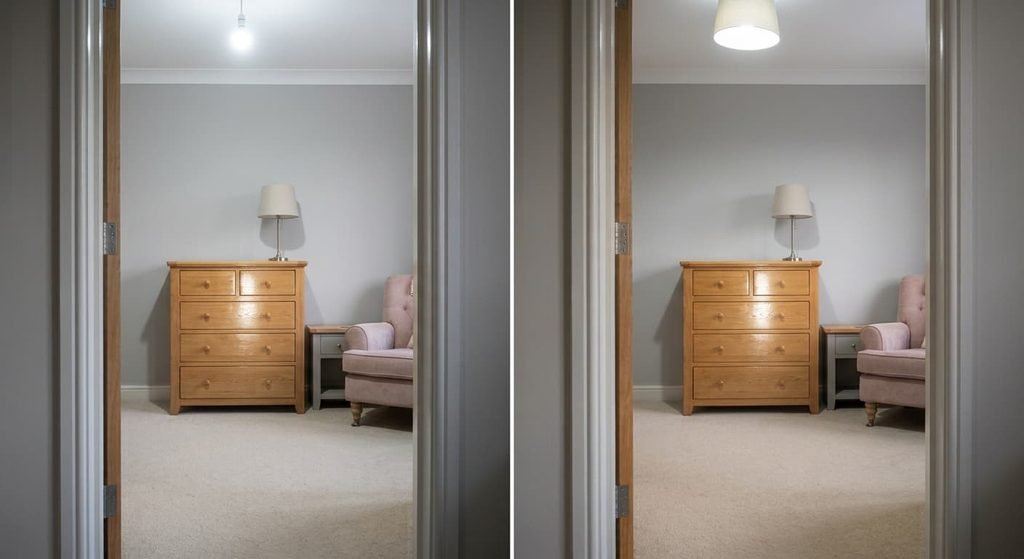
A brighter ceiling bulb is the usual response to a nursery that looks perfect but is hard to use at night, and it trades one fault for another. More lumens at 4000 K or higher throw glare onto glossy fronts and cool the oat walls toward grey. The room becomes brighter without becoming easier, because the cause was never the amount of light.
If the cause is the light fault, fix the temperature match first. If it’s reach, brightness changes nothing, since the item is still too low or too high. You get a better view of the same problem. A dimmer on the warm lamp points in a better direction, since it lets you set the level for the hour, though it can’t repair a mismatch of temperatures.
A pretty room can still be a hard one to work in.
The mechanism is a gap between the doorway view and the places where you use the room, so compose from the working positions and keep daily items between knuckle and shoulder height. Let every bulb share one colour temperature, and photograph the room from the chair as well as from the door. Those two photographs show faster than any list which of the three faults you have, and most nurseries that look right and feel wrong need two moves rather than a refit, both within a single evening. The seated photograph, read against the doorway one, is the single check to run if you have time for only one.
Questions readers keep asking
Why does my nursery look good in photos but feel awkward?
You take photos from the doorway, while you use the room from the chair and the chest. The awkwardness comes from one of three faults. Each has its own family of causes. Take a second photo from the chair and compare. The gap between the two images shows which fault applies.
What is the quickest fix for a hard-to-use nursery?
Move the daily items into the 75 to 145 cm zone, then match every bulb to 2700 K. Both take under an hour and need almost no spending. Do them before buying storage, because storage added to a room with these faults makes them harder to see.
Can you fix a nursery that looks perfect but is hard to use without renovation?
Yes. All three faults come from where things sit and which bulbs are fitted, and neither needs building work. Moving contents and swapping frames cover most cases. New bulbs handle the rest. Only a piece that can’t be raised may need a purchase.