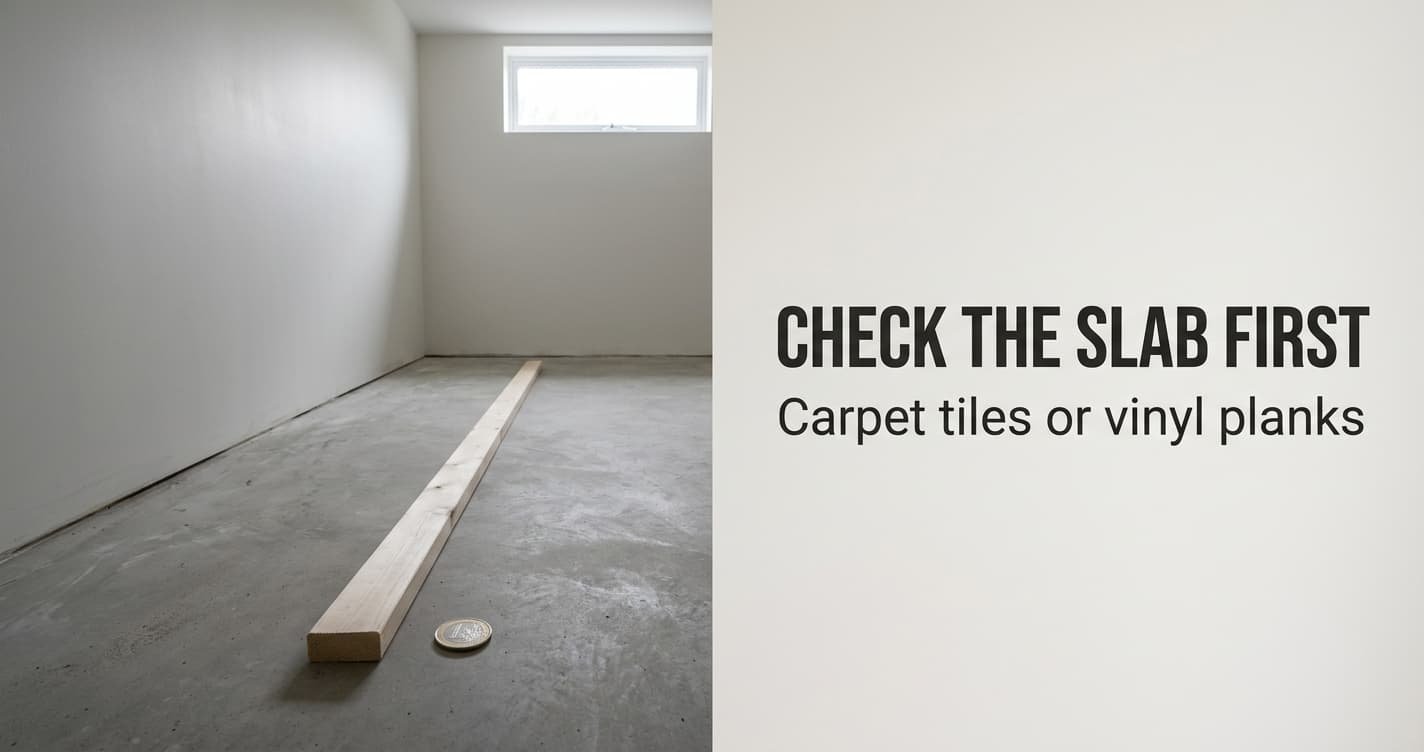
Which basement floor forgives a slab that isn’t flat? Carpet tiles usually do, because a textured face hides ridges that a smooth plank shows. This guide weighs carpet tiles or vinyl planks on two things you can measure in an afternoon: how flat the concrete is, and how much height the new floor takes. It assumes a room 300 by 450 cm with a door you want to keep. Whether the slab is dry is a question for the maker’s sheet, and this guide leaves it there. Take vinyl planks when the slab passes the check below. Take carpet tiles when it narrowly fails.
The slab check behind carpet tiles or vinyl planks
Concrete is rarely flat. A pour that looks level can carry dips of 5 mm over two metres, and both floors react to them. Makers of click-lock planks commonly ask for no more than about 3 mm of deviation over 1.8 to 2 m. Carpet tile makers set a figure of their own, so read your product’s sheet before the check.
The two floors fail in different ways. A rigid plank bridges a dip and flexes at its locking edge whenever someone crosses it, and the lock is the part that wears. Under raking light, a smooth face also shows a ridge as a line of reflected light. A carpet tile has a textured face and a backing that compresses, which is why the same ridge tends to vanish.
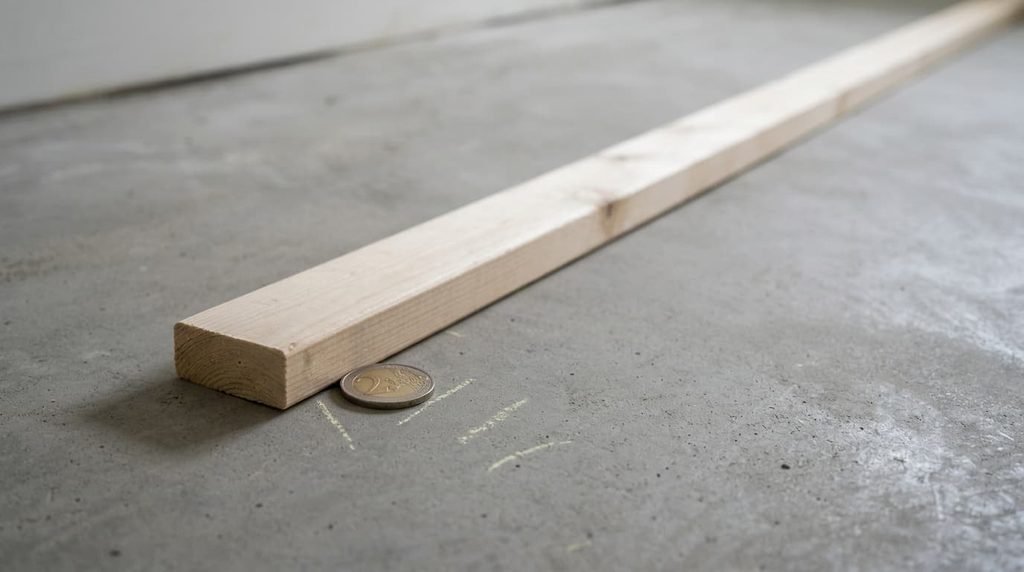
Run the check with a straight 2 m length of timber or a spirit level. Lay it on the slab and slide coins under it at the low point. A 2 euro coin is 2.2 mm thick, so one that slides under already uses most of a 3 mm allowance. Two stacked coins make 4.4 mm, and that spot fails. Test six places: each of the four walls, then the middle, then one diagonal. Chalk each failure so you can count them. I’d run the check before choosing a colour, even if a plank in a shop has already won you over.
The slab votes first.
Vinyl planks or carpet tiles, side by side
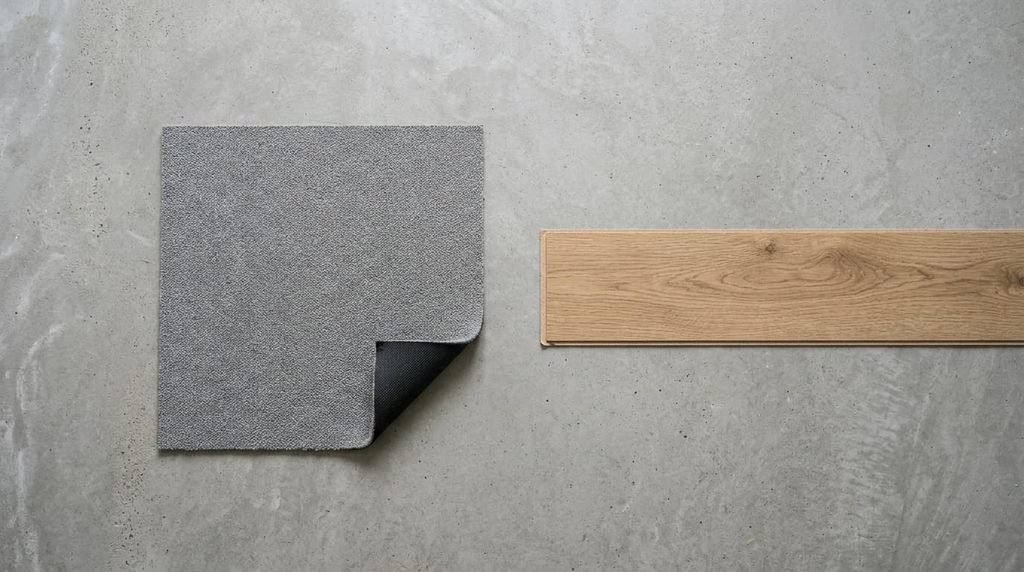
| Property | Carpet tiles | Vinyl planks |
|---|---|---|
| Small ridges in the slab | Textured face hides them | Smooth face shows them as lines |
| Typical thickness (check the sheet) | About 5 to 8 mm | About 4 to 8 mm, often with underlay attached |
| How it is laid | Loose or on adhesive tabs, cut with a knife | Click-lock and floating, with a gap left at every wall |
| Gap at the walls | Often none; the sheet says | About 6 to 10 mm, hidden by the skirting |
| Replacing one damaged piece | Lift a single 50 by 50 cm tile | Lift the rows back to the plank, unless it is glued |
| Everyday cleaning | Vacuum, and lift one tile to wash it | Sweep and mop |
| Footfall sound | Soft and quiet | Harder and louder |
The thickness row surprises most readers, because the two floors overlap almost completely. Height therefore decides only at the door, which comes later. The first row and the repair row do the sorting. The slab check settles the first, and the second favours the tile.
Laying hides a further difference. Planks lock into one rigid sheet that has to start straight along the first wall. Tiles are independent squares, so a wall that bows by a centimetre costs them nothing, and they can start from the middle of the room and finish with equal cuts at both walls.
Where carpet tiles win
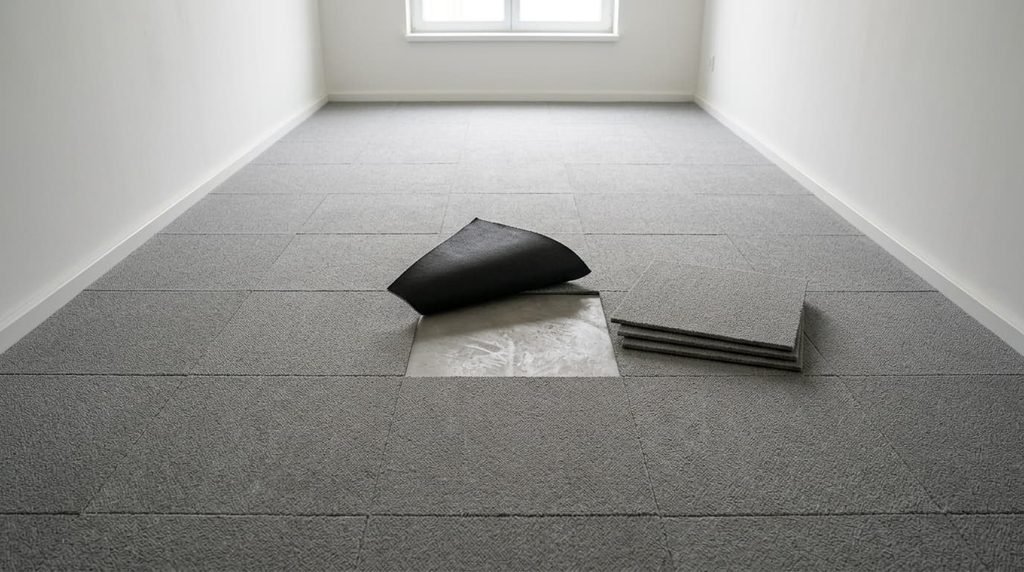
Carpet tiles win on a slab that is almost flat. The face hides a ridge, and the backing takes up a dip of a millimetre or two. They also win on repair. A burn mark or a stain means lifting one 50 by 50 cm tile and dropping in a spare. A square room of 300 by 450 cm takes 54 whole tiles. Order four extra and keep them from the same batch, since dye lots differ slightly between boxes.
Laying is forgiving too. A utility knife cuts the edge tiles, and the arrows printed on the backs show which way the pile runs. The sheet says whether to follow them.
The costs are plain. A loose-laid tile can creep at a doorway. Adhesive tabs or a threshold strip hold the edge. Spills sink into the pile and need blotting quickly. A wheeled chair also drags through the pile, which a hard mat under the desk prevents. The floor never looks as crisp as a plank.
Where vinyl planks win
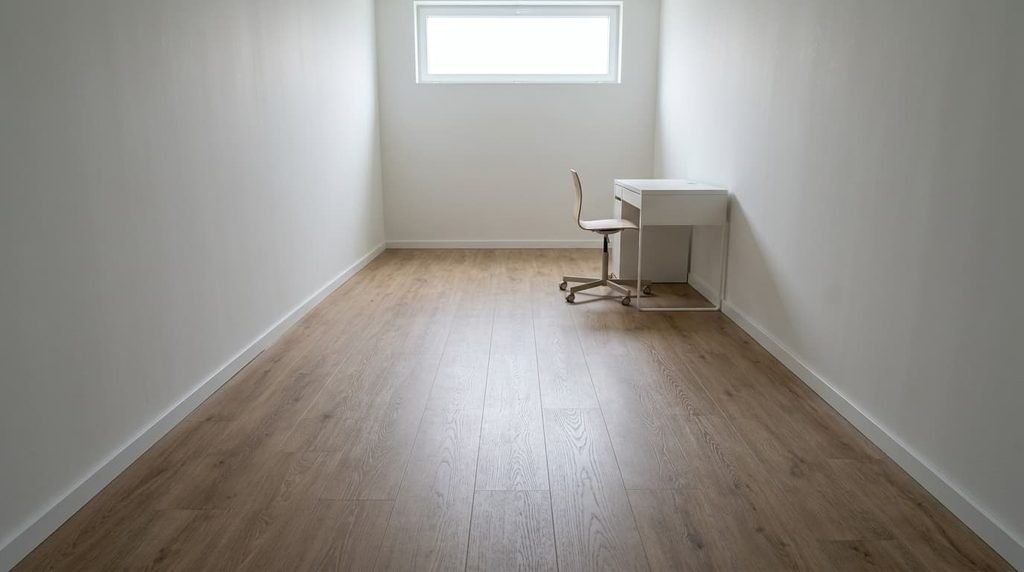
Vinyl planks win on a flat slab and a wish for a hard, wipeable surface. Wheeled chairs roll across them, a mop clears a spill in one pass, and a wood-effect print reads as a finished floor from the stairs. Click-lock planks also go down without glue, so the work is quick and the slab stays bare underneath. A spill by a bar or a sink corner is a wipe rather than a blot, and the surface never needs a vacuum. Order about 10% extra for end cuts: 13.5 m² becomes 14.9, so round up to 15 m².
A plank is only as flat as the slab beneath it.
The costs are in the edges. Every wall needs its 6 to 10 mm gap, and the skirting has to hide it. A fixed unit such as a built-in bookcase can’t pin down a floating floor that needs room to move, so the sheet shows how to finish around it. Footsteps sound harder on vinyl, though a rug over the seating area softens them.
When neither floor is right
Choosing carpet tiles or vinyl planks assumes the slab is workable. If two coins slide under at any spot, neither floor is ready to go down. Patch the low spots with a levelling compound first. The tin states the thickness it takes and its curing time, so follow it before running the check again.
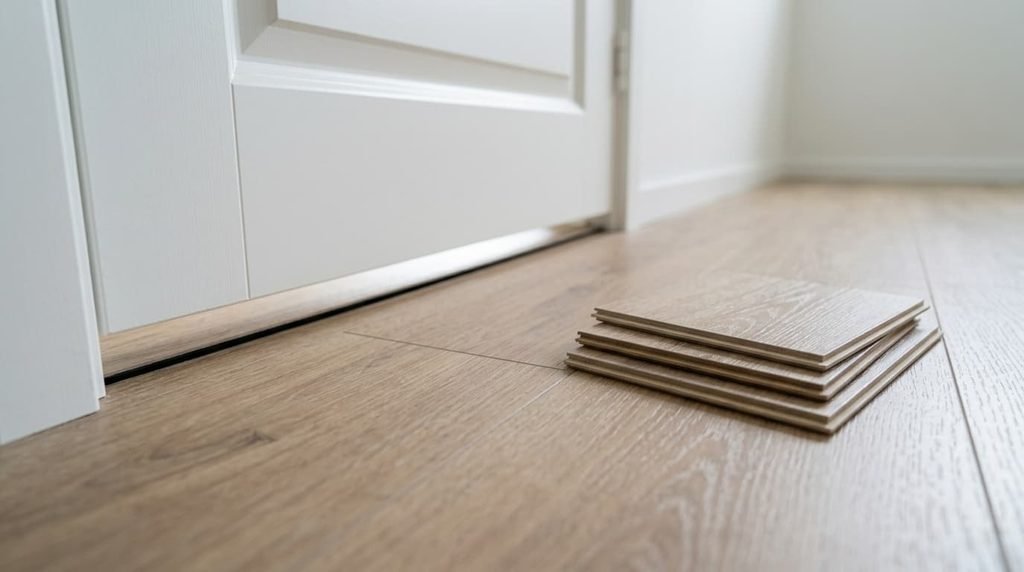
The second case is the door. Say the gap under the leaf is 12 mm. A carpet tile of 7 mm leaves 5 mm, and a plank of 6 mm with underlay attached leaves 6 mm. A plank of 8 mm with a second 3 mm underlay on top makes 11 mm and leaves 1 mm, which catches on the first uneven patch. An extra layer under a plank that already has its own can also leave the floor spongy, so skip it unless the sheet asks. Trim the leaf when the sum runs short, or pick the thinner floor.
A third route is to leave the bare slab as it is. A large rug then covers only the seating area.
How to decide in thirty seconds
If no coin slides under at any of the six places, take vinyl planks for a hard surface or carpet tiles for a soft one, and let your use decide. When one coin slides under at a few spots but two never do, take carpet tiles, because the face and backing absorb what a plank would show. If two coins slide under anywhere, level that spot first. Then run the check again.
Measure the gap under the door last. A floor 11 mm thick leaves 1 mm of a 12 mm gap, and a thinner floor leaves more. Then confirm the sheet’s figures for carpet tiles or vinyl planks against what you measured.
The slab sorts carpet tiles or vinyl planks before colour does, long before the first box arrives. A flat floor lets either one work, so your habits decide. A nearly flat floor points to the tile, while a floor with deep dips needs the compound first, whichever surface you like. I’d run the ten-minute coin check this weekend, before any box is ordered, since it costs nothing.
Questions readers keep asking
Do carpet tiles or vinyl planks need a flat slab?
Both do, within the figure on the maker’s sheet. For click-lock planks that is commonly about 3 mm over 1.8 to 2 m. Beyond it the locking edges flex and the joints can open. Patch the low spots with a levelling compound first, then lay the floor.
Do carpet tiles need adhesive on a basement floor?
Not always. Many are laid loose or on adhesive tabs, so one tile can still be lifted alone. The product sheet says which method it expects, and tabs are easy to add later if a tile creeps. Vinyl planks differ, since they float on a gap instead of sticking down.
How many carpet tiles fit a room 300 by 450 cm?
A square room takes 54 whole tiles of 50 by 50 cm, because the floor is 13.5 m² and each tile covers 0.25 m². Real walls are rarely square, so order 58 and keep the spares from the same batch for repairs.