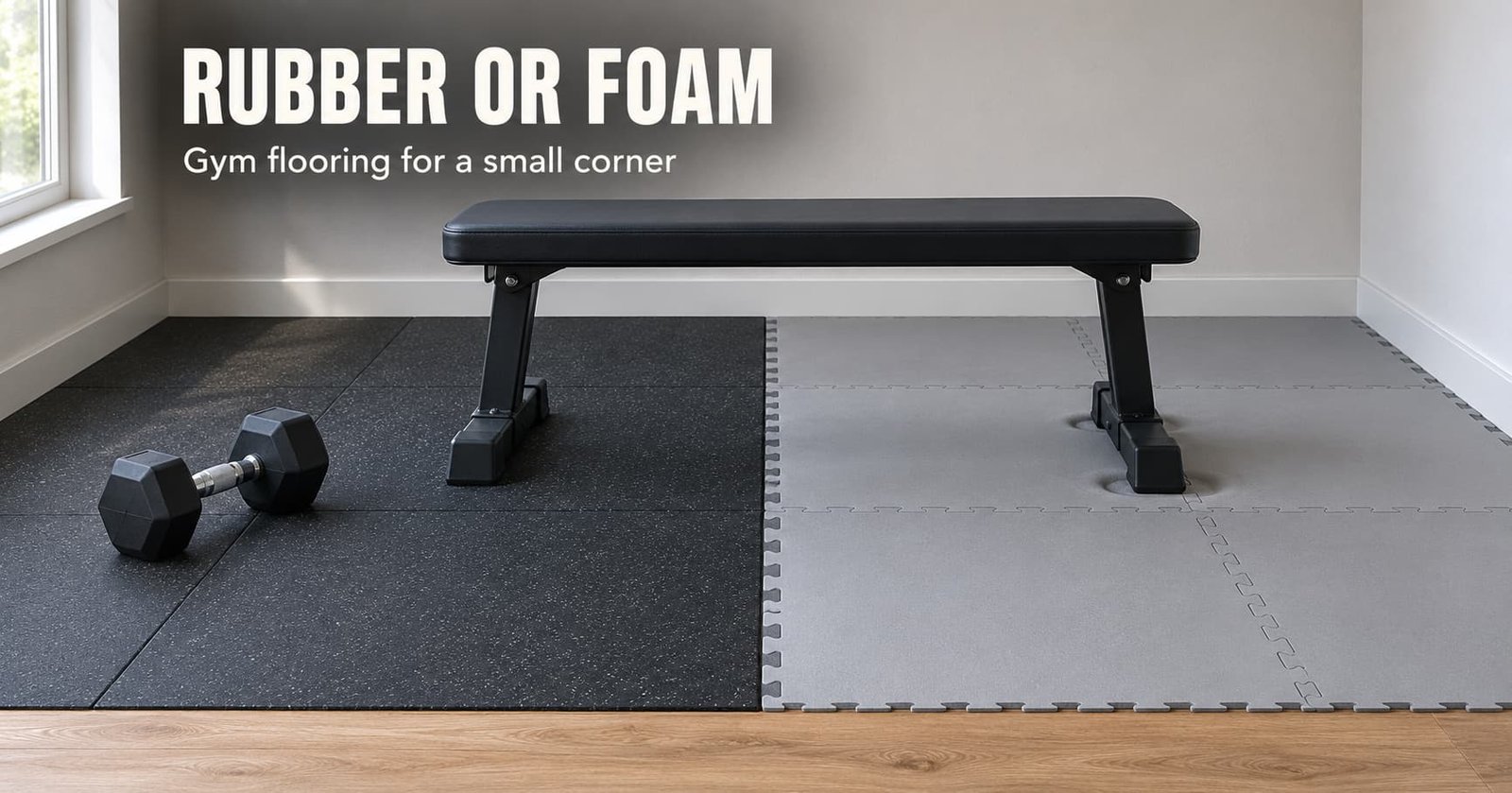
Rubber or foam gym flooring comes down to what hits the floor: rubber shrugs off a dropped dumbbell and a bench foot, while foam compresses under both and stays dented. Foam wins on weight and comfort under bare knees, so floor work on a sound floor belongs on foam.
The deciding property is recovery under a concentrated load, meaning how far a surface sinks beneath a 5 cm bench foot or the edge of a 10 kg dumbbell, and how much of that dent has returned by tomorrow. Rubber returns almost all of it. Foam keeps a share of every dent it takes.
What actually separates rubber or foam gym flooring
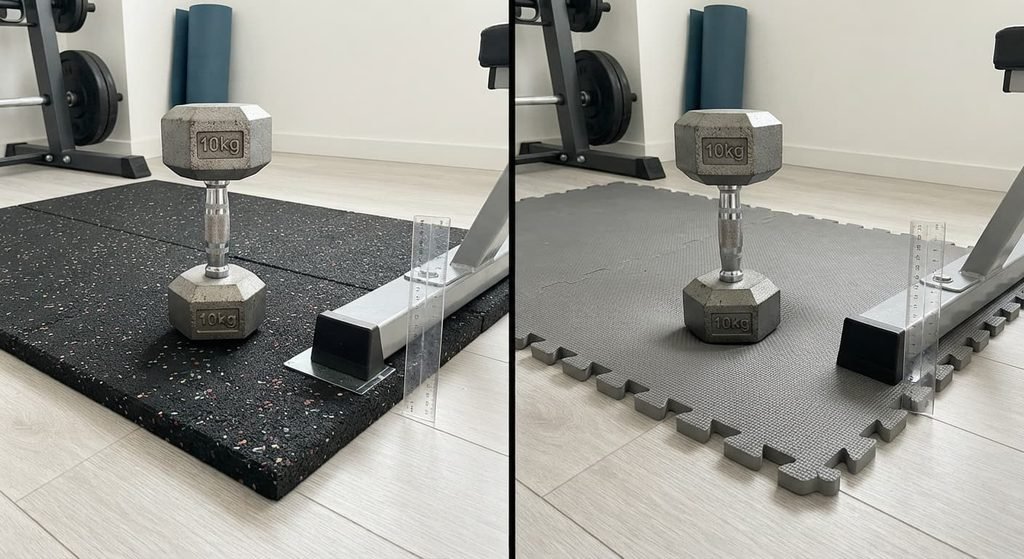
Compression under a concentrated load is the whole difference. A bench foot of 5 × 5 cm carrying a 100 kg lifter puts about 25 kg on 25 cm², roughly 1 kg on every square centimetre. Dense rubber of 10 to 20 mm spreads that load into the sub-floor and springs back, while EVA foam of 10 to 12 mm squashes thin and keeps a permanent dent, which engineers call compression set: the shape a material holds after the load is gone.
A dropped dumbbell uses the same mechanism with a shorter, sharper hit. A 10 kg dumbbell released from 50 cm lands with about 50 joules, and a foam tile bottoms out against the laminate beneath it before it can absorb that energy, whereas a 15 mm rubber tile spreads the impact across a wider patch of floor.
When you compare rubber or foam gym flooring by thickness, a thicker foam tile cushions a drop for longer, yet a bench foot still leaves its dent in 20 mm of foam, because compression set belongs to the material and thickness only delays it. Judge a surface by how much of a bench-leg dent returns overnight, and ask for an offcut of each to test it: stand the bench foot on the sample for a day and measure what remains the next morning.
Foam keeps the dent, and rubber gives most of it back.
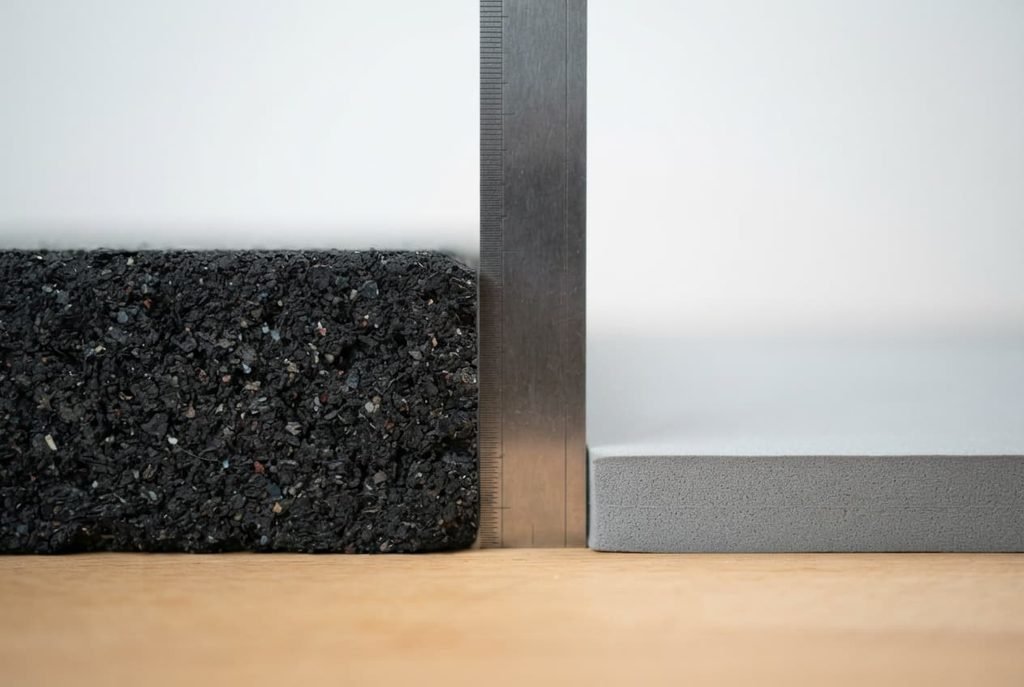
Rubber or foam flooring, head to head
| Property | Rubber, 15 mm | Foam, 12 mm |
|---|---|---|
| Under a bench foot | Recovers most of the dent within a day | Keeps a permanent dent where the foot stood |
| Dumbbell dropped from 50 cm | Spreads the impact across a wider patch | Bottoms out against the sub-floor |
| Thud heard in the flat below | Reduced by the added mass | Barely changed by the thin layer |
| Weight per square metre | About 15 to 18 kg | About 2 kg |
| Smell when new | Sulphur note for days to weeks | Faint, fades within days |
| Tile joints under lunges | Heavy tiles stay put | Puzzle edges creep open |
| Marks on vinyl or laminate | Dark rubber can leave a faint mark over months | Rarely marks the floor beneath |
Weight is what surprises people most, and it’s easy to miss on a product page: a 4 m² corner of 15 mm rubber weighs 60 to 70 kg, which matters on an old timber floor or a narrow walk-up staircase, while the same area of foam weighs less than one 10 kg dumbbell. That gap also decides whether a surface stays put under a lunge without tape, how many trips up the stairs the delivery takes, and whether a landlord’s floor can carry it, so check the weight per square metre before you order.
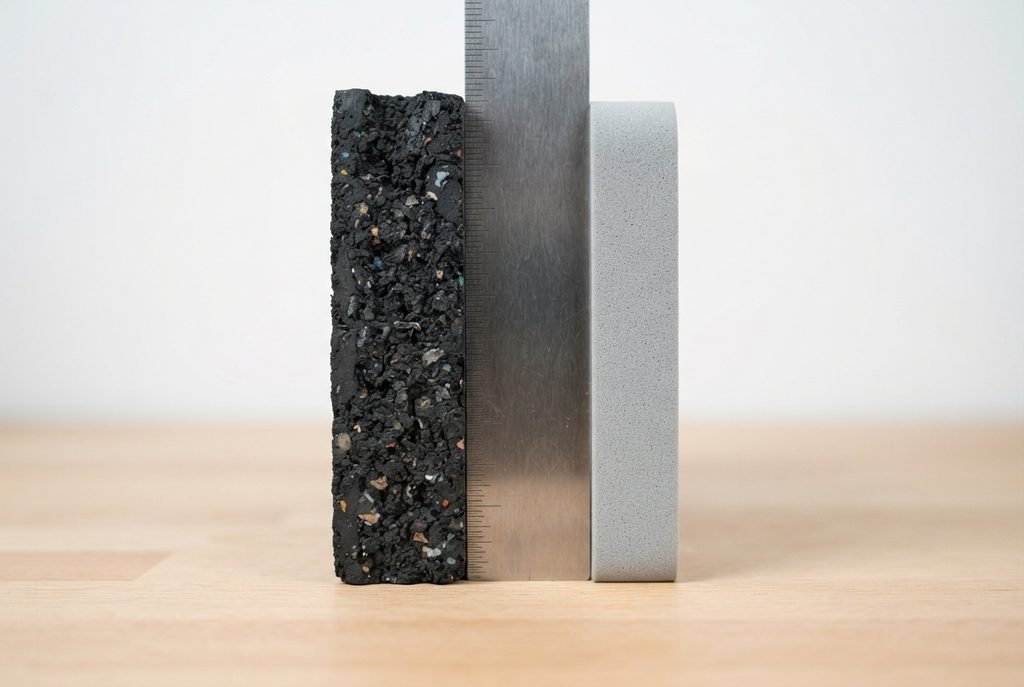
Where rubber wins
Rubber suits any corner where a bench stands on the floor or a heavy dumbbell gets set down hard, such as a spare room with adjustable dumbbells of 10 kg and more. The dense material spreads the weight and hands back a level surface, so the bench still sits flat in month ten. Mass also trims the thud that reaches the flat below, though a timber-joist floor carries vibration that a mat can’t fully stop, which is why a neighbour’s verdict after three test drops outranks any thickness figure.
Households with children and a dog favour it as well, since a 15 mm tile shrugs off claws and a tipped dumbbell rack. The unglamorous reason is stability: heavy tiles lie in place with no tape and no gripper, and one damaged tile lifts out without disturbing the rest. Two costs deserve a mention. New rubber smells of sulphur for days to weeks, so air the room. Dark rubber can leave a faint mark on vinyl over months, so lay a single test tile in the corner first.
Where foam wins
Foam suits floor work: stretching and bodyweight sets on knees and forearms, where comfort under bare skin matters more than load. It also suits a corner above an old timber floor with a weight limit, because a 4 m² area adds only about 8 kg, and a rented room, because the tiles lift without a trace and need no adhesive. Closed-cell foam also feels warmer than rubber on bare feet over a cold concrete screed, since it conducts heat away more slowly. It’s also the gentler surface for a household with a toddler: an elbow or head meets a soft layer, and a loose tile weighs too little to hurt a foot.
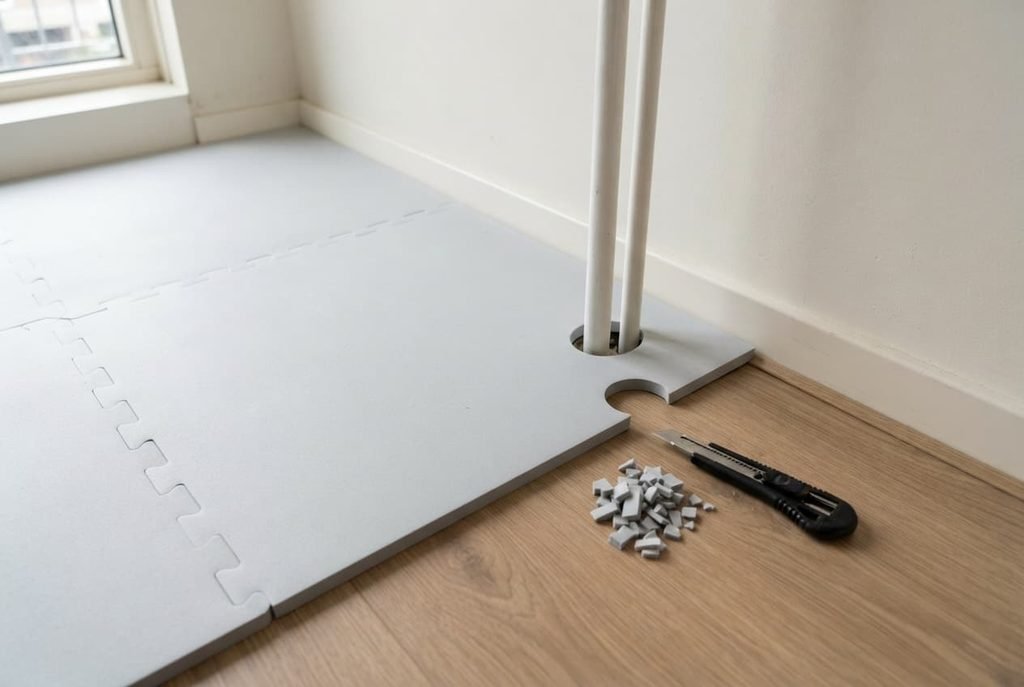
The unglamorous reason is repair and fitting: foam cuts round a radiator pipe with a craft knife in minutes, and replacing one ruined tile typically costs less than replacing a rubber one. The limits aren’t subtle. A dumbbell of 10 kg and more bottoms it out, the puzzle edges open under lunges unless the perimeter is taped, and a bench foot leaves a dent that stays.
When neither is right
The question of rubber or foam gym flooring doesn’t arise with low-pile carpet or sealed ceramic tile in the corner and 12 kg or less in hand. Carpet over a screed already cushions a set-down, and ceramic takes a controlled set-down but chips under a drop, so the real exposure is one patch where weights land, not the whole square. How much a carpet cushions depends on its underlay, which a floor plan doesn’t show: press the edge of a 10 kg dumbbell into the corner and watch whether a ring dent lasts longer than a minute.
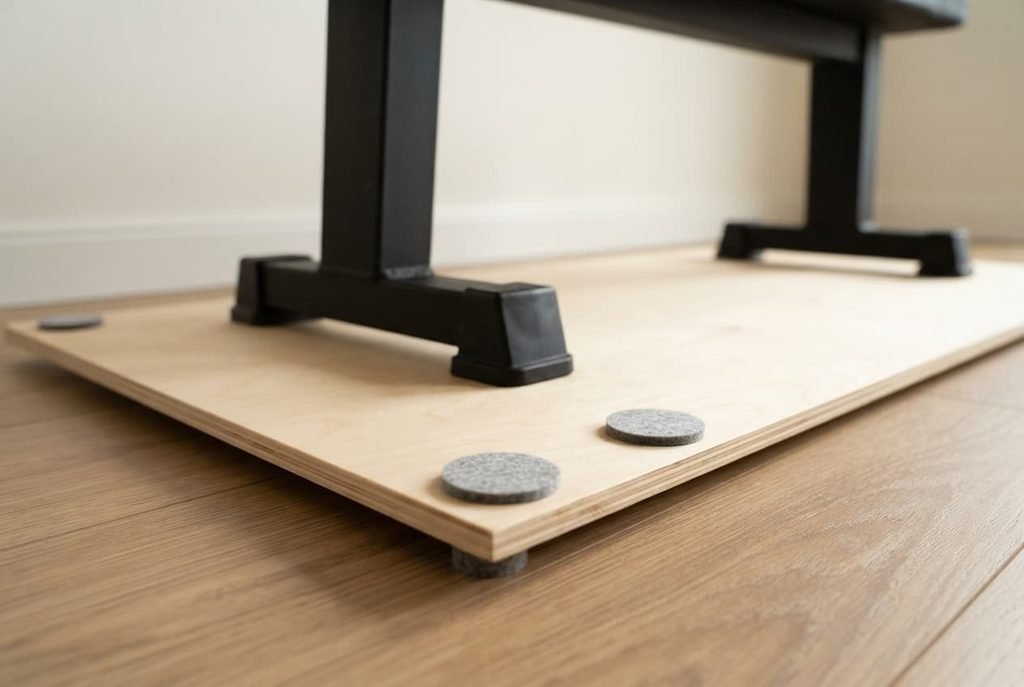
Where heavy weights land, a sheet of 18 mm plywood under the bench and the weight zone only spreads the load across more floor than a bare foot would, and it costs less than covering 4 m² with either material. On laminate, glue felt pads under the board to protect the surface.
Keeping the floor you have is a legitimate answer.
How to decide in thirty seconds
If a bench or dumbbells of 10 kg and more stand in the corner, take rubber. Rubber or foam gym flooring under heavy weights settles on the bench-foot dent and the 50-joule drop, both of which favour a dense surface. A single test tile shows whether it stains your floor.
If you do floor work on a sound floor, or the corner sits over an old timber floor, take foam and keep dumbbells under 5 kg. A 4 m² set weighs about 8 kg, lifts without a trace at the end of a tenancy, and you’ll lay it in the time it takes the kettle to boil twice.
Rubber earns its weight where something heavy lands, and foam earns its lightness where only bodies do. Run the overnight dent test on one offcut of each, since a single morning shows you what a thickness number can’t. If neither passes in your corner, a board under the bench and the floor you already own is a fair third answer. One night with an offcut costs nothing and protects a floor you can’t easily replace.
Questions readers keep asking
How long does rubber gym flooring last compared with foam?
Dense rubber tiles stay level for many years because they recover from point loads, while foam tiles dent under bench feet within months and their joints open under lunges. Durability depends on load: under light bodyweight work foam lasts far longer than it does under a loaded bench.
How do you clean rubber and foam gym floors?
Sweep, then wipe either surface with a damp cloth and a few drops of mild washing-up liquid. Solvent cleaners swell rubber and soften foam, so skip them. Let the floor air-dry before anything rolls over it. New rubber needs a ventilated room for days while the smell clears.
Which gym flooring suits a flat with downstairs neighbours?
Choose rubber of 15 mm or more, because its mass reduces the thud of set-down weights more than thin foam does. Impact noise travels through timber joists far better than through concrete, so let the household downstairs hear three controlled drops before you commit to the whole square.