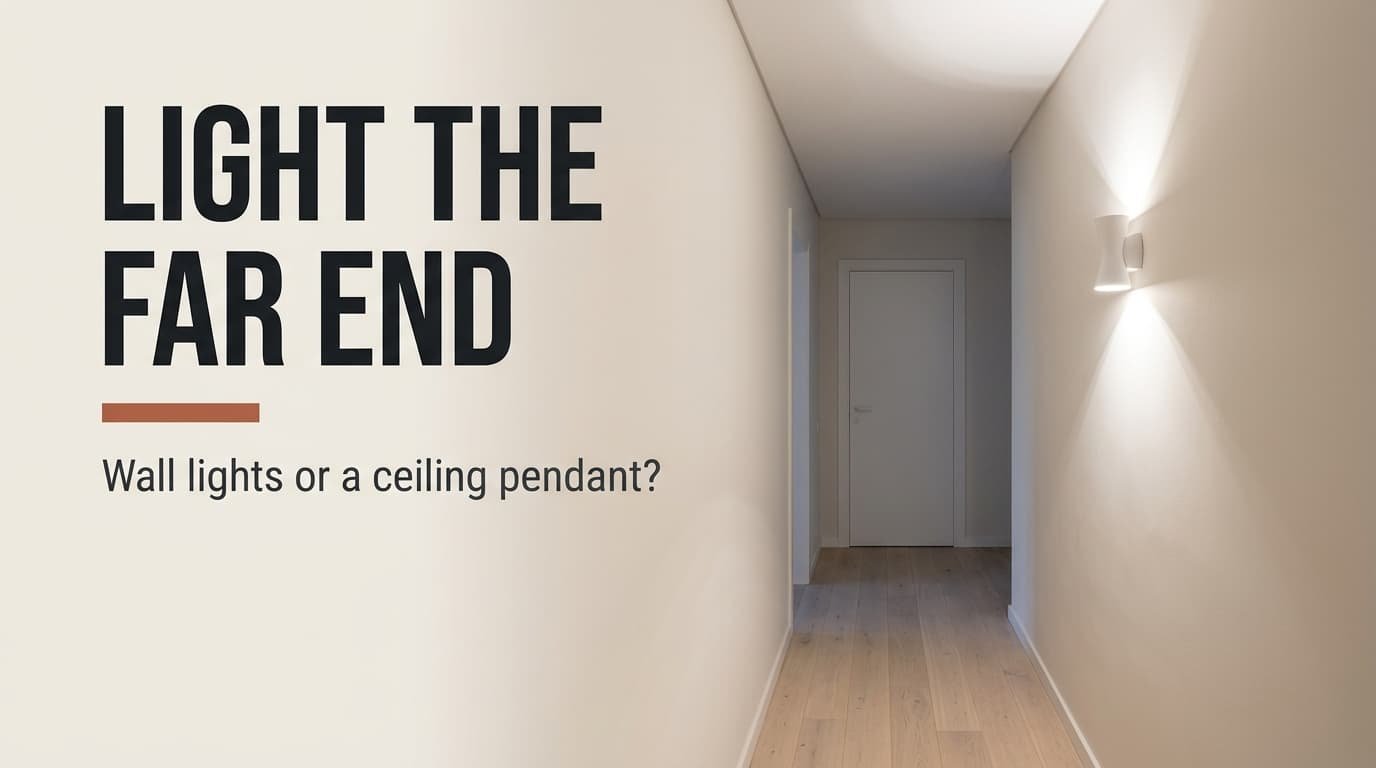
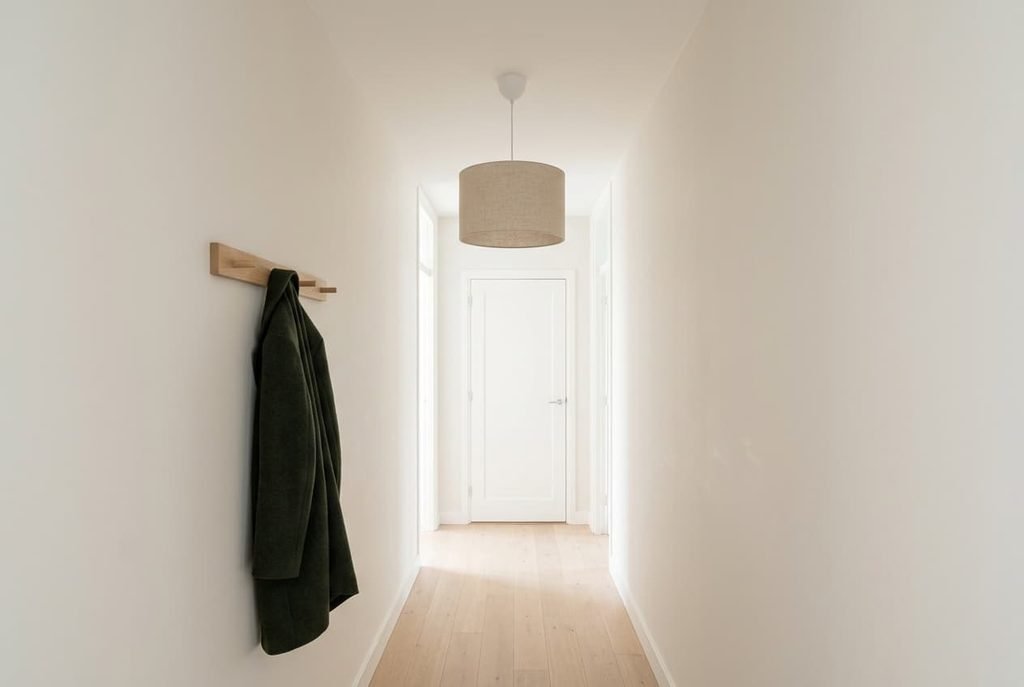
A pendant in a low hallway can’t hang below 200 cm, the clear height of a doorway, and that limit matters more than the shade you pick. The example below is a Dutch rental hallway of 450 by 110 cm under a 230 cm ceiling. There, a ceiling pendant for a low hallway leaves each end at 31% of the brightness under the lamp. Past 300 cm take wall lights, and below it take the pendant.
Length makes the call because light weakens when it meets the floor at a slant. Three wall lights lift each end of our hallway to 58%. Replace its numbers with yours as you go.
The one property that decides a ceiling pendant for a low hallway
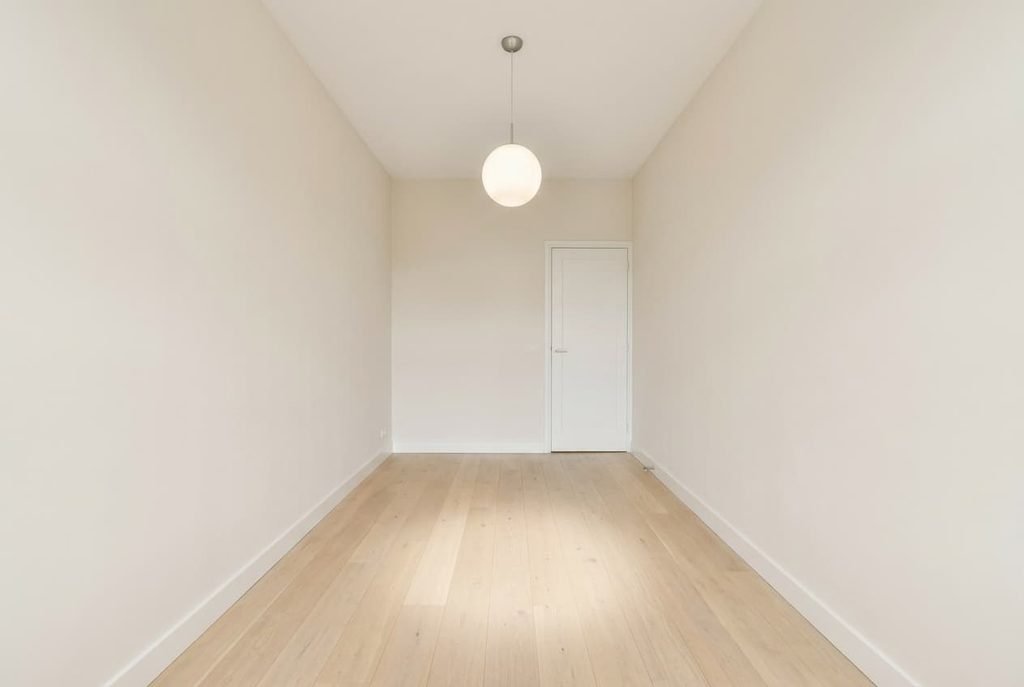
The property is how steeply the light reaches the hallway’s far end. Brightness on a floor under a small source falls as the cube of the cosine of the angle off vertical. In plain terms, light arriving at a slant is weak. Take our pendant, whose bottom edge hangs at 205 cm. The hallway’s end lies 225 cm along the floor, so the straight line to it measures 304 cm. Divide 205 by 304 to get 0.674, then cube it for 0.306, or 31%.
The ends are where you notice it first.
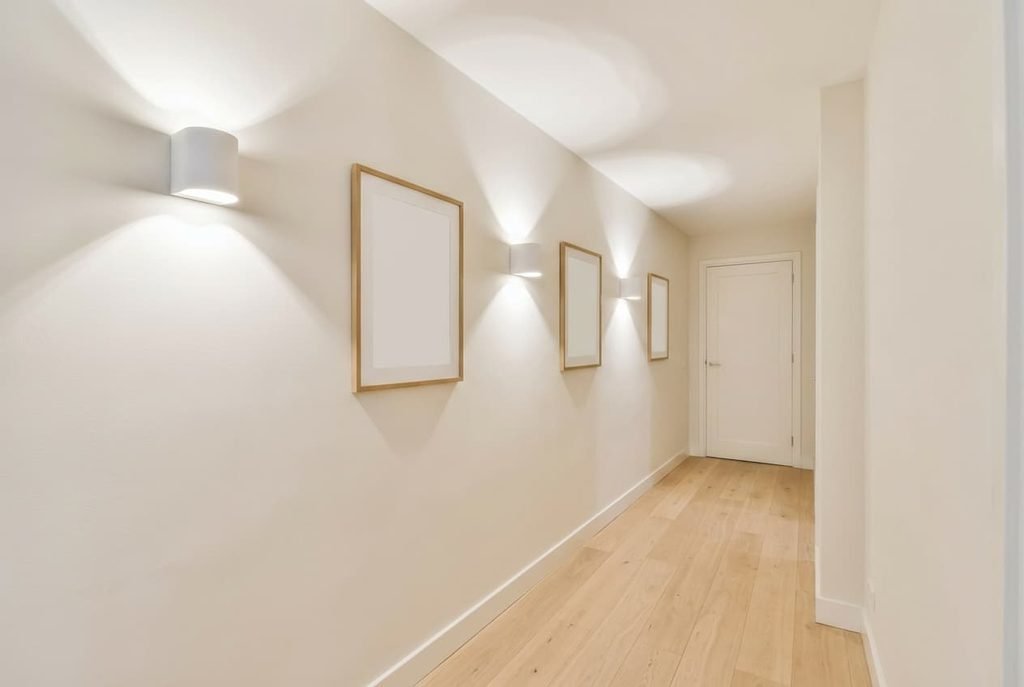
Raising the lamp helps, which is why a low ceiling hurts. Each 10 cm you lose from the lamp’s height costs about 2.5 points at the ends. A flush fitting at 230 cm gives about 36% at each end. Under a 260 cm ceiling the same hallway would give about 43%. Three wall lights at 165 cm, spaced 150 cm apart on one wall, keep the ends at 58% of the brightest point. Every stretch of floor sits close to one of them. These figures treat each light as a single point and ignore bounce off the walls. A meter would read differently, so use them to compare options.
Head to head
| Question | Wall lights | Ceiling pendant |
|---|---|---|
| Floor brightness at each end of 450 cm | About 58% of the peak with three fittings | About 31% from one pendant at 205 cm |
| Space taken at head height | Fittings project roughly 10 to 15 cm from the wall | Bottom edge at 205 cm, 5 cm clear of the 200 cm doorway line |
| Light on the ceiling | An up-and-down fitting washes a low ceiling | Opal glass lights the ceiling around it, while an opaque cone leaves it dark |
| Work in a rented flat | Needs a new cable to each fitting (in the wall or along it) | Reuses the existing ceiling point |
| Changing a lamp or dusting | At hand height, no steps | Above 2 m, so it needs steps; dust settles on the shade’s upper face |
| Glare along the hallway | Bare lamps sit at eye level in the line of sight | Sits above the line of sight |
The glare row catches most readers off guard, since a bare lamp at 165 cm sits exactly where a long look down a tunnel-like hallway lands. Concealing the lamp behind a deep shade matters more than the fitting’s style.
Where wall lights win
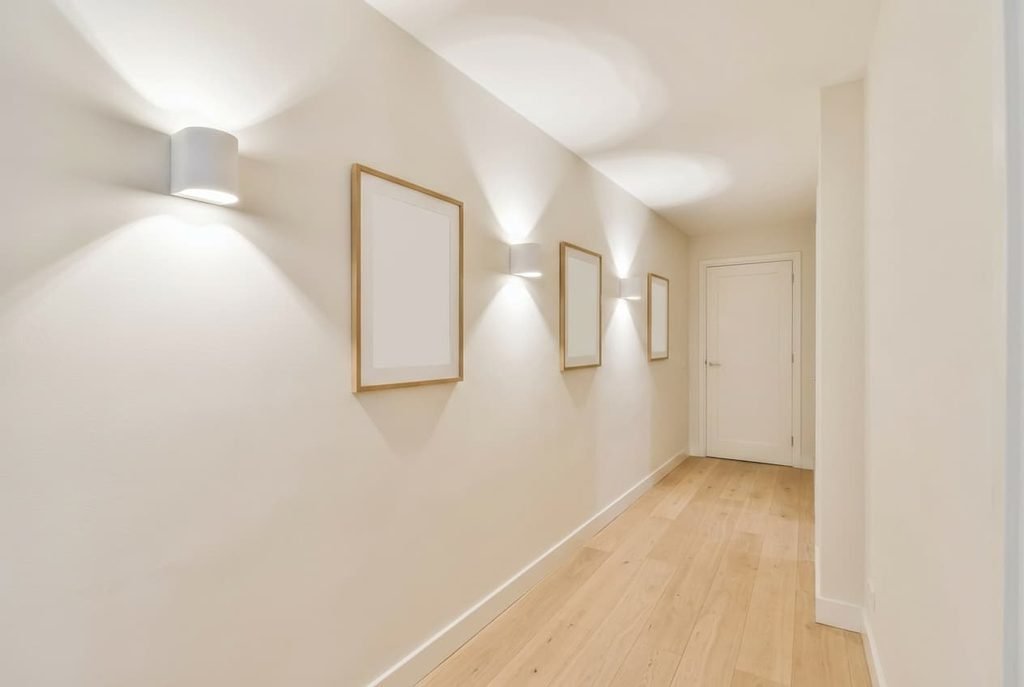
Wall lights beat a ceiling pendant for a low hallway longer than about 300 cm. Three fittings in our 450 cm example hold each end at 58% of the peak, almost double the pendant’s 31%.
They also win where a wall carries a mirror or a row of frames. Light that grazes a wall shows its surface, while a pendant lights the floor and leaves the wall in its own shade. On floor light alone, two flush fittings do a little better at 62%, so the walls tip the choice.
The plain practical reason is the lamp. A fitting at 165 cm is within hand reach, so a new bulb takes seconds.
The cost is rhythm. A typical up-and-down fitting throws light about 40° either side of vertical. With 65 cm from fitting to ceiling, that makes a pool 109 cm wide at the top. Spaced 150 cm apart, three fittings leave 41 cm of dimmer wall between pools. In a long hallway that reads as pattern, and in a short one it reads as blotches.
Where a ceiling pendant in a low hallway wins
A pendant wins below about 300 cm, where one source reaches both ends. At 300 cm long the same pendant keeps each end at 53% of the brightness under it. The eye reads that as an even hallway. A pale ceiling lifts that figure further.
It wins in a rental. The ceiling point and the switch already exist, and nothing is cut into the plaster. When the tenancy ends you refit the original shade in ten minutes, whereas a wall light leaves a cable chase to fill and repaint.
It also wins where doors open into the hallway. A sconce beside a door swing stands in the way of every opening door and every passing coat. The pendant stays above all of that.
Its repair story is short too. One fitting means one cable to check and one lamp to replace.
The limit is the 200 cm line, which on a 230 cm ceiling leaves 30 cm for canopy and cable.
When neither is right
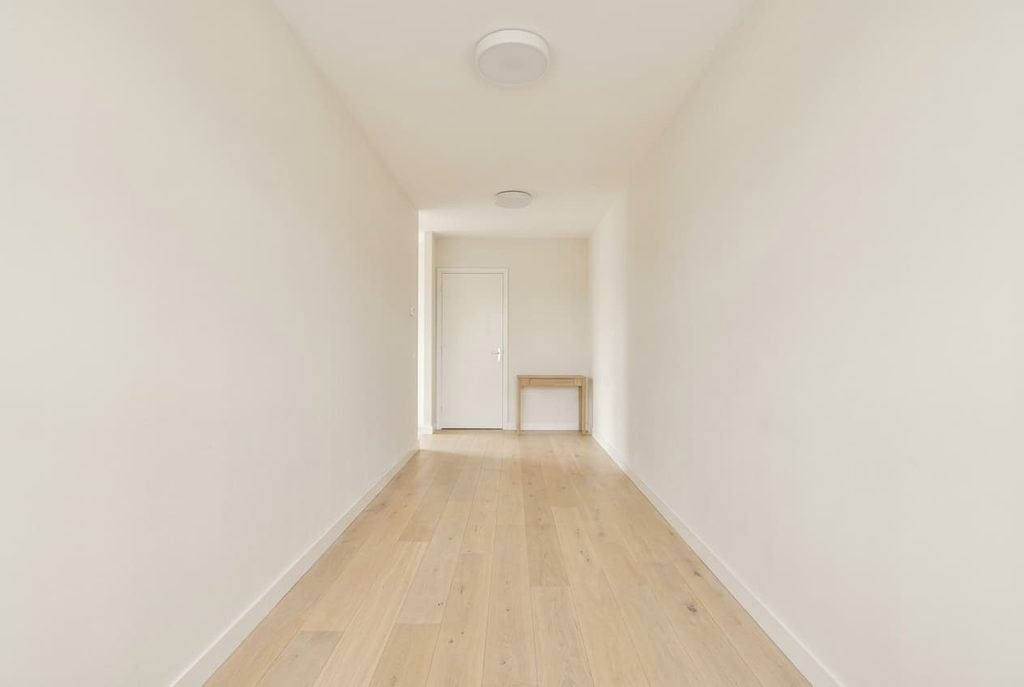
Keep the flush fitting you already have when the hallway is 300 cm or shorter and nothing in it looks dim. A flush fitting at 230 cm holds each end of a 300 cm hallway at 59%, against a pendant’s 53%. Sitting higher flattens every angle.
Hanging a ceiling pendant for a low hallway lower, to put more light on the floor, does the opposite. At 205 cm the ends get 31%, and at 230 cm they’d get 36%. Each centimetre of drop steepens the angle to the far end. I’d defend measuring the hallway before choosing a style, against the habit of matching a pendant to the sofa.
In a long hallway with bare walls, put two flush fittings at a quarter and three quarters of the length. The dimmest point holds 62% of the peak. It beats one pendant for one extra ceiling point.
These numbers shift with your wall colour, and your walls are hidden from me. Pale walls return light to the far end and lift every figure above, while dark walls take it away.
How to decide in thirty seconds
Measure the hallway end to end with a tape measure, then record the number before you consider any shade. Then follow one branch.
If it runs longer than 300 cm and a wall carries a mirror or frames, take wall lights. Plan one fitting every 150 cm at about 165 cm height, which gives three in our 450 cm hallway. Choose shades that hide the lamp.
If it’s 300 cm or shorter, take a ceiling pendant for a low hallway, hung with its bottom edge at 205 cm. Centre it along the hallway so that no point lies more than 150 cm from it. A 230 cm ceiling then leaves 25 cm of drop.
Length decides between wall lights and a pendant because light weakens as it meets the floor at a slant. Past 300 cm the pendant’s ends fall below half its peak, and wall lights bring them back near 58%. Under that line, a single pendant is enough, as is a fitting you already own. A tape measure takes one minute, and the shade can wait.
Questions readers keep asking
Do wall lights wear out faster than a hallway pendant?
Not in the wiring, since both are simple. The surface treatment differs. Wall lights sit at shoulder height. Coats and bags brush them, so the finish scuffs first. A pendant sits out of reach but gathers dust on top of its shade. Lamp life depends on the lamp you fit, not on where it hangs.
How often should you clean a hallway pendant?
Twice a year suits most homes, because dust settles on the shade’s upper rim, out of sight from below. Check one beside the front door every few months, since that spot collects more. Wipe a glass shade with a dry cloth and brush a fabric one softly.
Which suits a rented hallway with a 230 cm ceiling?
Usually a pendant, because the ceiling point already exists and nothing is cut into the plaster. Hang the bottom edge at 205 cm and keep the hallway under 300 cm for even light. In a longer rental hallway, plug-in wall lights with the cable run along the skirting board avoid chasing the wall.