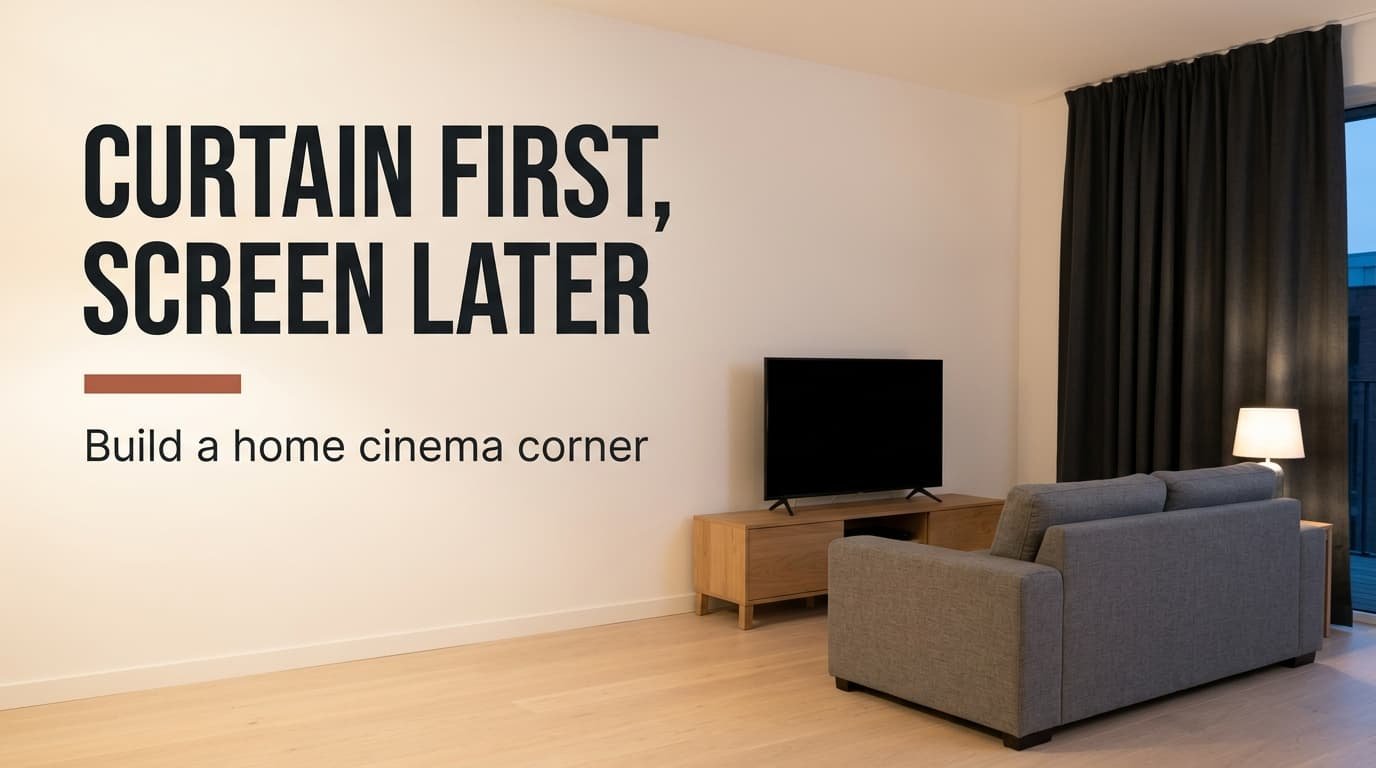
A blackout curtain lifts a living-room picture nearly four times over, while a screen with double the contrast lifts it by 9%. That sets the order for a home cinema corner in a living room: the curtain first, a unit at the right height second, then lamps. Dark matt paint comes fourth and a cable channel closes the list.
Our setting is a Dutch living room measuring 4.2 by 5.5 m with one window. The screen measures 144 cm by 81 cm and is watched in the evening. You’ll find no prices here, since they go stale within months.
What to buy first for a home cinema corner in a living room: the rule that decides where money goes
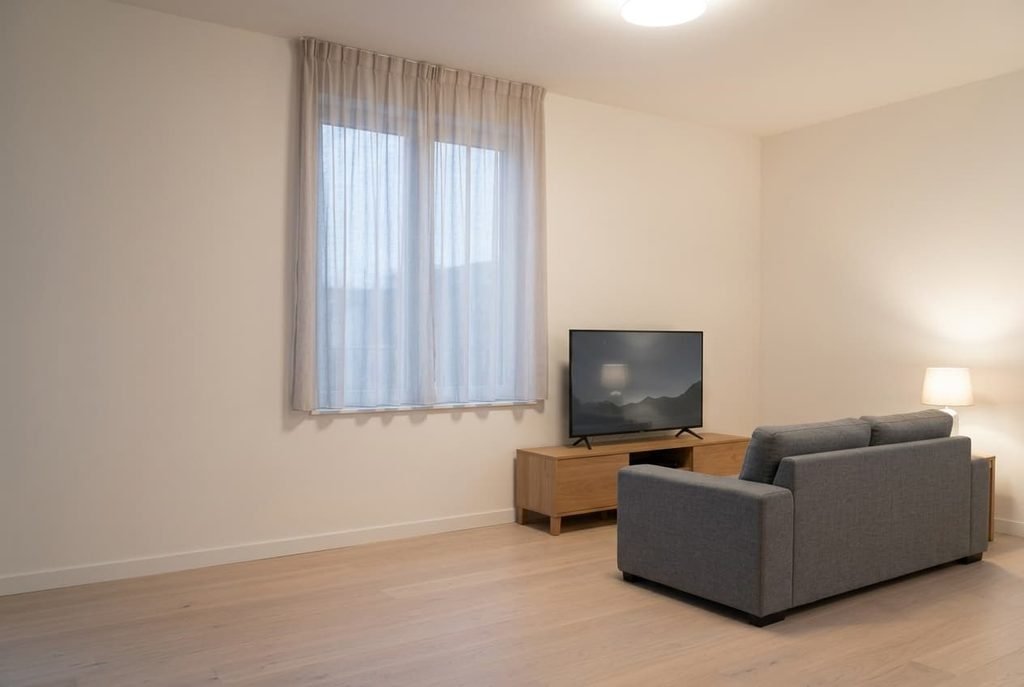
Room light falls on the glass and bounces back, which lifts the screen’s blacks until a dark scene looks grey. Whites barely move, since 1.27 nits adds half a percent to 250. Blacks change a great deal, since 1.27 nits is five times the screen’s own 0.25. The picture’s effective contrast is the white level plus the reflected light, taken over the black level plus the reflected light. A nit is one candela per square metre, the unit screens use for brightness. The reflected light in nits is the glass’s reflectance times the room’s lux on the screen, divided by pi. Our screen shows 250 nits white and 0.25 black, a native contrast of 1,000 to 1, and its glass reflects 4%.
On an ordinary evening the screen gets 100 lux: 60 from the window at dusk and 40 from lamps bouncing off pale walls. That gives 1.27 nits of reflection and a contrast of 165 to 1. Buy first whatever removes the most room light from the screen, because every later purchase is capped by that number. Cut the light to 15 lux and the same screen reaches 567 to 1.
The room sets the ceiling on every picture.
Furnish a home cinema corner in your living room: the list in buying order
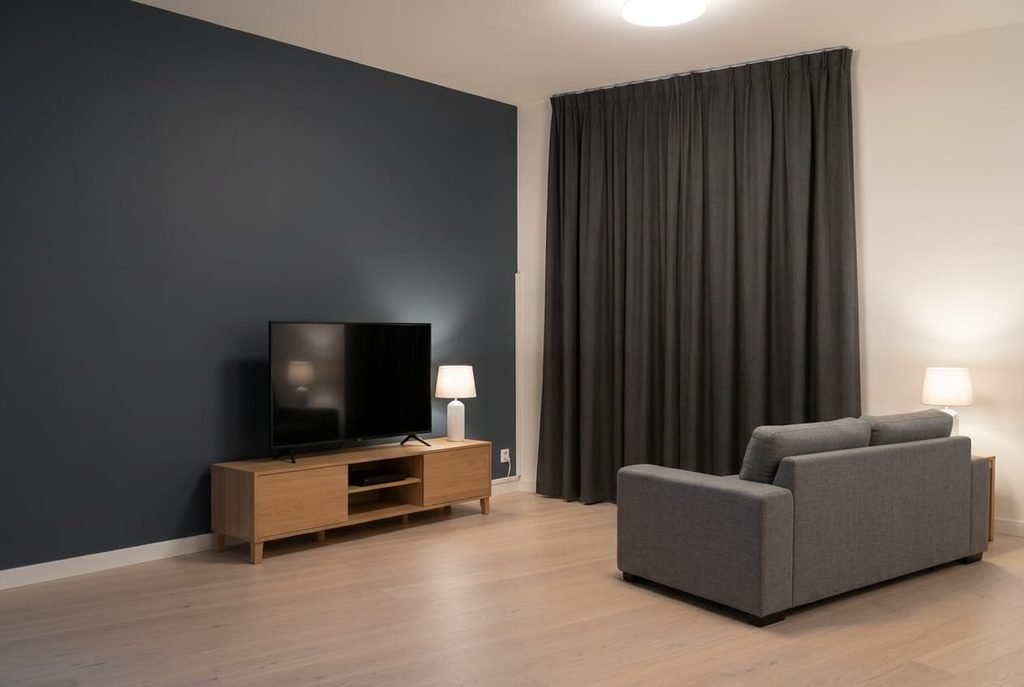
1. A blackout-lined curtain on a rail 20 cm wider than the window on each side falls to the floor. Position one goes to it, since the window supplies 60 of the 100 lux, and the curtain cuts that to 3. Contrast rises from 165 to 314. Tier: MID, as the lining layer decides how much light passes. A bad one has a seam gap at the rail edge, which leaks a bright band.
2. A media unit measuring 160 by 40 by 55 cm, with a solid carcase. It sits second because the screen’s centre should land near seated eye level. Its half-height of 40.5 cm plus 55 cm and about 4 cm of feet puts the centre at 99.5 cm. No software corrects a screen set too high. Tier: BUY CHEAP, as only the dimensions matter. A bad one has a 12 mm top that bows between its ends under the screen’s load.
3. Two dimmable table lamps stand beside the seats, aimed down, each with an opaque shade and a warm bulb. They replace the ceiling light, so the bounced light falls from 40 lux to 12 and contrast reaches 567. Tier: MID, because the bottom of the dimming range decides the result. Watch for a thin white shade that throws a bright patch on the screen, or a dimmer that jumps from off to bright.
4. A matt dark-toned finish on the wall behind the screen and the walls beside it. A reflectance near 10% halves the remaining bounce to 6 lux and takes contrast to 686. Tier: BUY CHEAP, since the matt surface does the job and a plain tin gives it. The fault is a satin sheen, which mirrors the lamps back at the screen.
5. A paintable cable channel 30 mm wide and 180 cm long, fixed from the unit to the socket. It comes last because it changes how the corner looks while leaving the picture alone. Tier: BUY CHEAP. The weak version has tape that lifts within a few months, so choose one with screw fixings.
Where to spend, and the one purchase to cut back
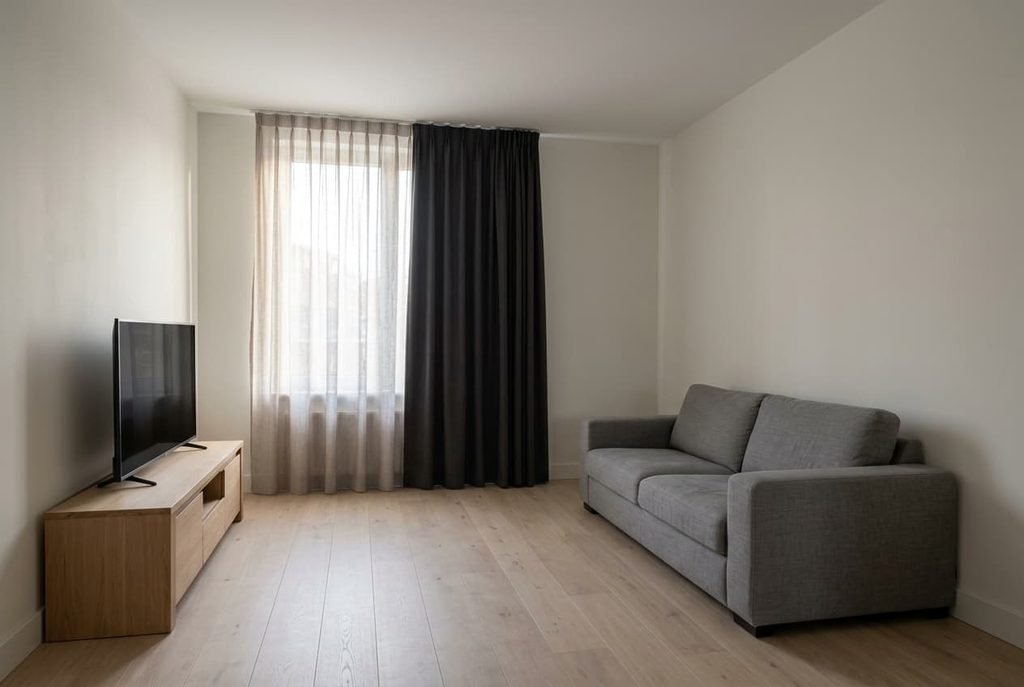
In a home cinema corner in a living room, spend on the curtain’s lining and the lamps’ dimmer. Many curtains sold as thermal still pass light through the weave. The coated or triple-woven lining is what stops it. A lining that blocks the light completely holds the curtain’s job for years. A dimmer that fades smoothly at its lowest setting lets you watch with a trace of light on. Neither shows in a shop photo, so test them in the shop with a phone torch. Paint is the other cheap win, since the pigment sets the reflectance and a plain matt tin at 10% does the job.
The media unit is the purchase to cut back, even though a unit seems like the foundation of the corner. People pay for veneers and soft-close drawers. Only three numbers matter: the 55 cm height, a width of 160 cm and a top thick enough not to sag. I’d defend a plain carcase in any finish against the habit of treating the unit as the showpiece, because the picture can’t tell the difference.
Put the saving into the lining. That one choice is worth more than the unit’s whole finish.
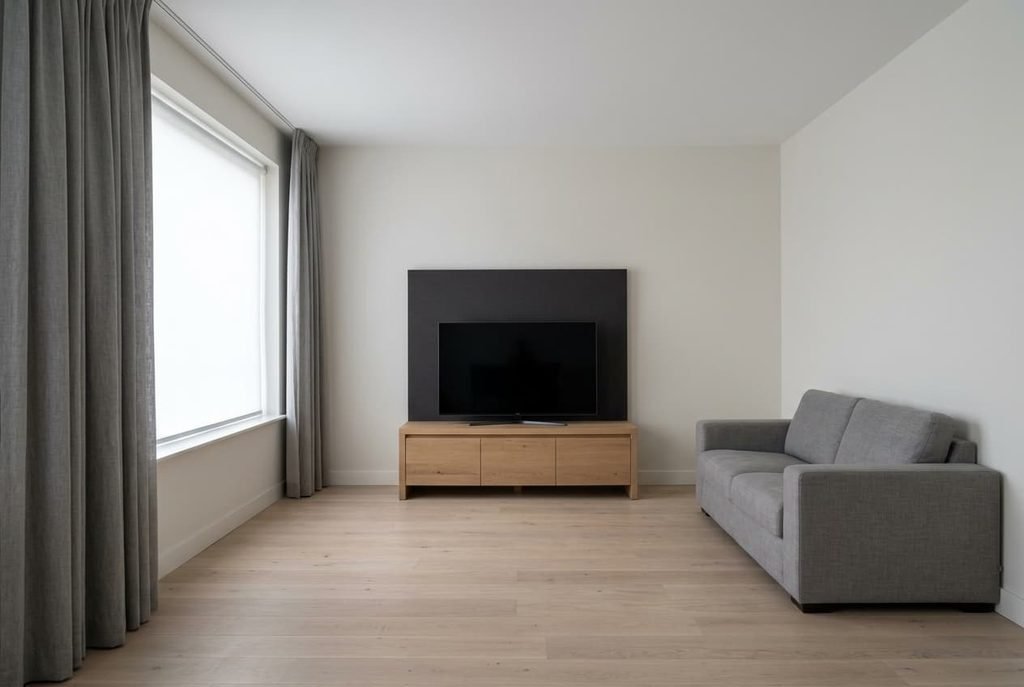
What this order assumes, and when it breaks
This order for a home cinema corner in a living room assumes evening viewing and pale walls, with one window. In June the light lasts past 22:00 in the Netherlands, so the curtain does most of its work late, and the lamps barely matter. If you watch in daytime, add a roller blind inside the window recess. A 1 cm gap at the edge of a curtain admits a bright strip that the screen picks up.
If you rent and can’t paint, hang a dark matt cloth panel 150 by 100 cm behind the screen. It takes the central bounce down and costs nothing in the deposit. A projector breaks the order more sharply, since its screen is a pale surface that shows every lux. For a projector the curtain’s lead grows.
How bright your window is at 9 pm stays unknown to me, so measure the lux on the screen with a phone app before and after the curtain.
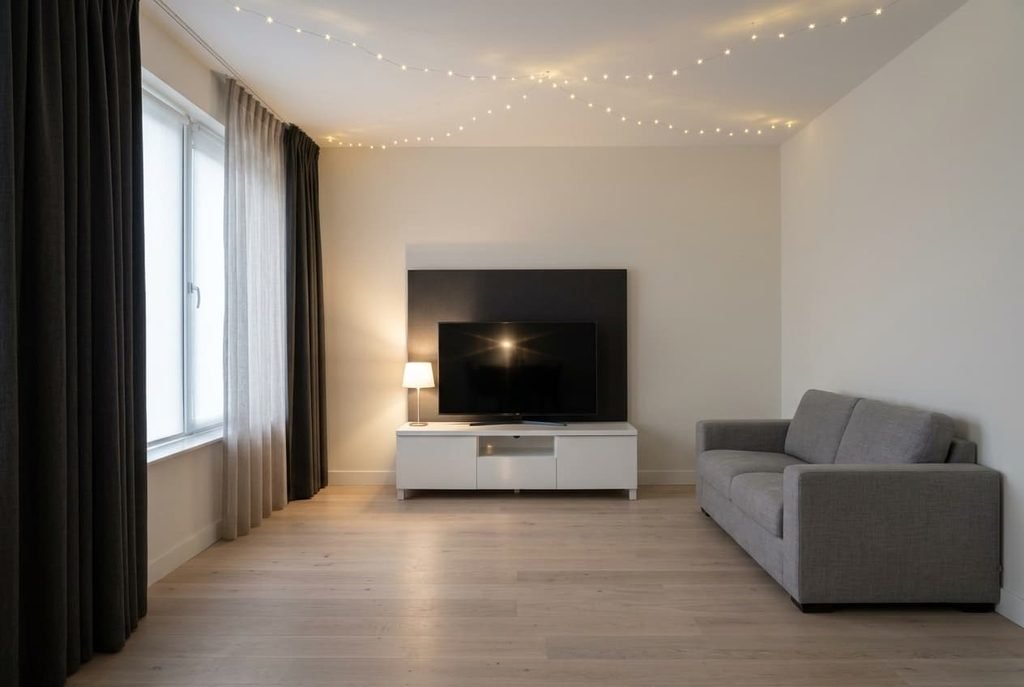
What to skip entirely
A higher-contrast screen bought to fix a bright room tops the skip list. At 100 lux, doubling the native contrast lifts the effective figure from 165 to 180, or 9%. Light control gives 3.8 times as much for the curtain alone. A bigger screen comes later still. At 300 cm our 144 cm screen already fills 27° of your view, and a wider one means turning your head for no extra contrast.
A gloss-finish unit comes next, since it mirrors the lamps. Reclining cinema seats take 90 cm of depth for a comfort the sofa already gives. A second sheer layer beside the curtain lets through roughly 70% of the room’s light, so it dims the room without cutting the bounce.
Skip the starry ceiling too. It adds light in a room you’re trying to darken.
The first purchase for a home cinema corner in a living room is the blackout curtain, because room light caps the contrast of every picture the screen can show. After it, set the unit’s height so the screen’s centre sits near eye level. Then tame the lamps. Paint and cables come last. Each step costs less than the screen upgrade people reach for first, and each lifts the picture further. Measure the lux before and after the curtain, since the number settles the argument.
Questions readers keep asking
Do I need to buy a new screen before anything else?
No. A new screen is the last upgrade. In our room a curtain takes the contrast from 165 to 314, while a screen with double the native contrast reaches only 180. Fit the curtain and the lamps first, then judge what the picture still lacks.
How many pieces does a cinema corner need?
Five cover it. Curtain and unit lead, then the lamps, then paint, then the channel. The first three do most of the work, and the last two refine it. In a rented flat you can drop the paint for a cloth panel and still keep the order.
How do I judge a blackout lining in a shop?
Hold a phone torch behind one fold of the fabric and look from the front. A good lining shows no bright points and no glow along the seams. Check the rail edge too, because a curtain that leaves a 1 cm gap lets a bright strip through at the side.