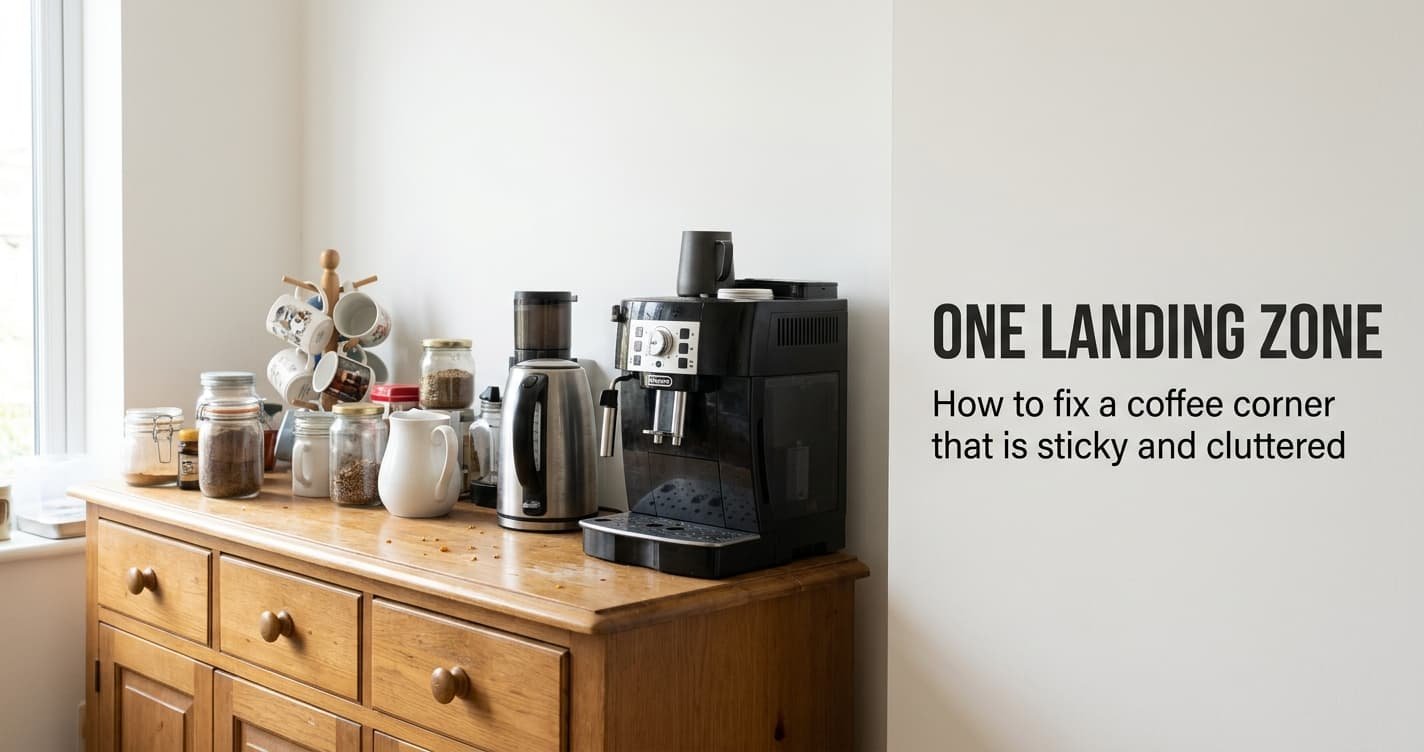
A wiped surface that stays sticky is being fed faster than it’s cleaned. To fix a coffee corner like that, give every wet item one place to land, then wipe in two passes. Both steps cost nothing, and between them they resolve most cases. The clutter has its own cause, and one photograph from across the room shows it. Each fix below names its cost and its limit.
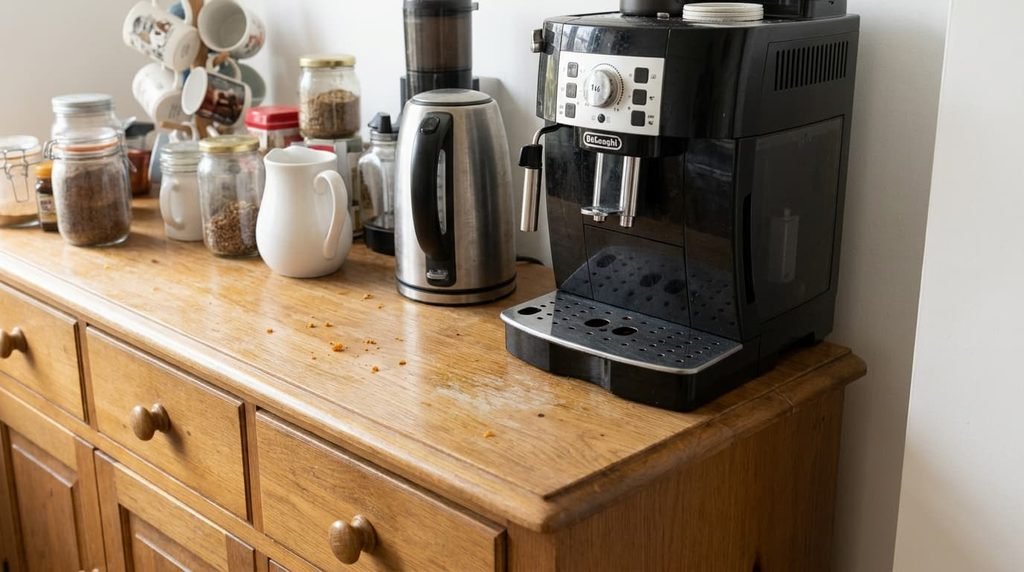
The corner here is a dresser top of 130 × 38 cm at 85 cm, in a Dutch kitchen-diner. It carries 17 items today. The drink volumes are assumed, and every figure is a round estimate.
How to fix a sticky coffee corner: why it happens
Stickiness is a residue problem. Water evaporates. The sugar and milk solids in a drip stay behind. One drop is about 0.05 ml. Say each brew puts 12 drops on the top. They come off the spoon and the cup base. The jug and the filter holder add the rest. Two brews a day make 1.2 ml, or 8.4 ml a week. If a tenth of that is sugar and milk solids, about 0.8 g is left on the top every week.
The cloth is the carrier, so the cloth is the first fix.
A damp cloth spreads the residue it can’t carry away. It lifts a little and lays the rest as a thin film across everything it touches. That film is why a top wiped last night feels tacky under a fingertip this morning. Oiled wood adds a second problem, since it soaks the film in and keeps the mark after the surface dries. Clutter works through the eye. Seventeen objects show as seventeen outlines from 2 m, and each edge reads as one more thing to tidy. The same items also hide roughly 20% of the top from the cloth, since 17 items at roughly 60 cm² each cover 1,020 cm².
Confirm which version you have
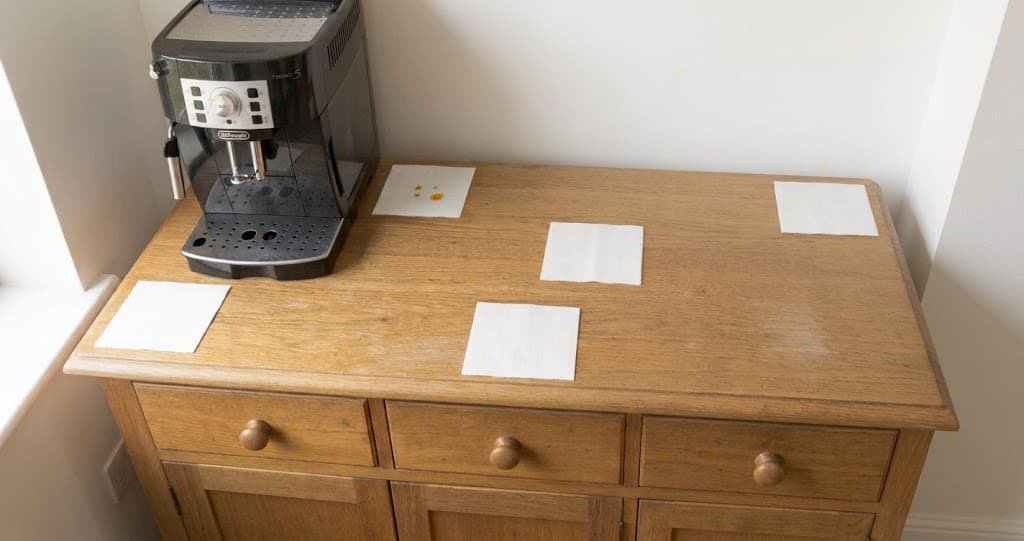
Lay a square of kitchen paper flat on the top for ten seconds, then lift it. Repeat the lift at four places. Try the machine end first. Then try the centre. Finish at the far end and the front edge. A patch that clings only by the machine points to drips. Every spot sticking means the cloth is spreading the film. A front edge alone points to hands and sleeves.
Next, press a clean dry fingertip on the jug handle and the sugar-jar lid. A tacky feel there means hands carry the residue, and no top-surface fix reaches it. Wash those two items weekly.
Then photograph the corner from 2 m and count the outlines. Ten or fewer reads as calm. Seventeen reads as clutter whatever the tidiness underneath. That count shows how far you must go to fix a coffee corner by sight. Last, put one drop of water on a bare patch of the top and leave it for five minutes. A darkened surface means the top is porous and holds the film. A bead that stays round means the film sits on top and wipes away.
Four fixes for a sticky, cluttered coffee corner, in order
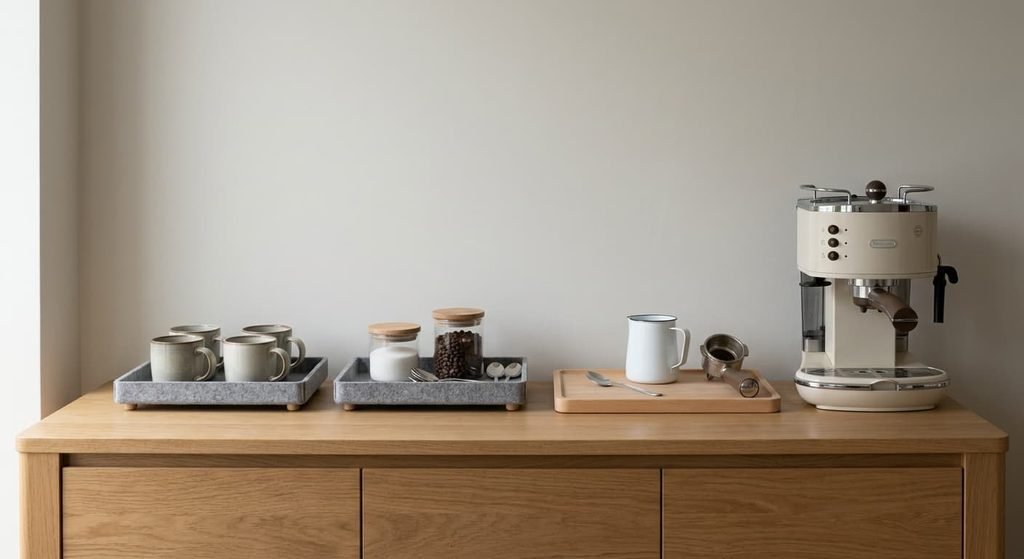
Give every wet item one landing zone. This addresses where drips fall, and it costs nothing: a chopping board or plate of 30 × 20 cm from the kitchen. Put it at the end the cup travels toward, within 15 cm of the machine. The spoon and the jug land there, and so does the used filter holder. That confines the residue to 600 cm², which is 12% of the 4,940 cm² top. What it can’t do is lift film already there, and the board becomes the sticky patch unless it goes in the sink every evening. Choose a board with a lip, since a flat plate lets a pooled drop run off its edge onto the top.
Wipe in two passes with two cloths. This addresses the cloth spreading residue, and it costs nothing. The first cloth is wrung out and rinsed under hot water twice, which dissolves the film. The second is dry and lifts the moisture before sugar can set again. Rinse the first cloth again halfway, since by then it holds the film it lifted. Start at the far end and finish at the landing zone. Wring the second cloth until no drop falls from it. The limit is that a cloth reaches nothing under the 17 items. Lift the machine and the jars once a week.
Group the dry items on two trays. This addresses what the eye counts, and it’s a purchase: two trays of about 25 × 15 cm, plus lidded jars for sugar and beans. One tray holds four mugs. The other holds sugar and beans. Seventeen outlines drop to six. The machine and kettle make two. The board adds a third. Two trays and a jar of tea bring it to six. Each tray stands on four small feet, so a cloth passes beneath. The limit is that trays stop no drips, and a lid handled with sticky fingers turns tacky too.
Have a non-porous panel set flush into the wet zone. This addresses a top that soaks up the film, and it needs a tradesperson to cut and fix a panel of 40 × 25 cm in a sealed material. The recess matches the panel’s thickness. It then sits level and the cloth glides over the join. The limit is its size. It protects 1,000 cm², a fifth of the top, and nothing outside it. Keep the machine’s cup stand on the panel, since that is where most drips fall.
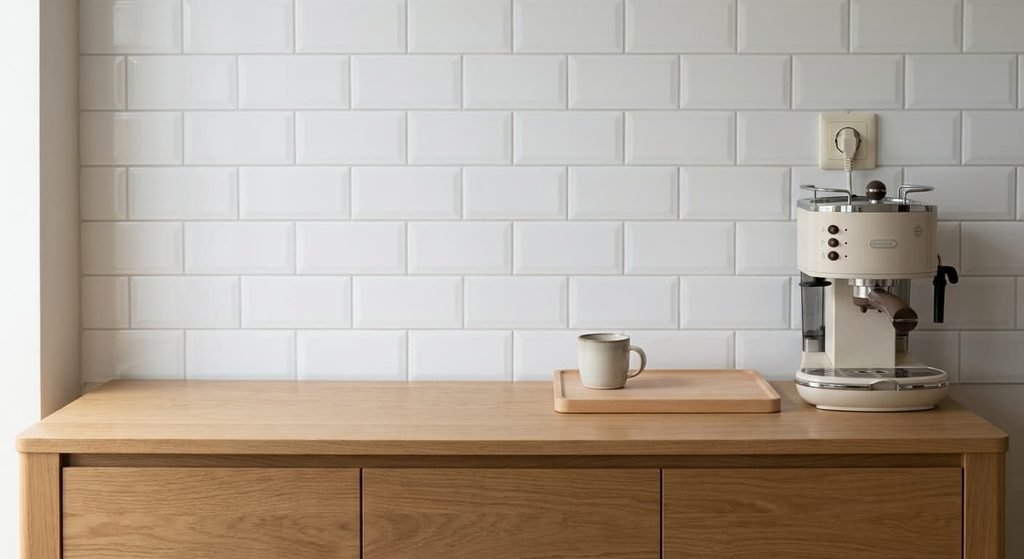
What this corner’s own build means for you
The socket decides where the machine stands, and the machine decides the path a cup travels. If it sits at the right end, every cup crosses the top from right to left. To fix a coffee corner around this layout, the landing zone has to lie on the cup’s route, because a zone at the wrong end gets ignored within a week.
A fixed socket is a fixed drip path.
The top’s depth fixes the tray size. At 38 cm, a tray of 25 cm leaves 13 cm behind it, and nothing deeper will fit beside a machine 36 cm deep. A porous top can’t be made non-porous without refinishing it. If your drop test darkened the surface, the stain stays. Only a sealed patch or a new finish changes that. How far your own top soaks is the one thing this page can’t see.
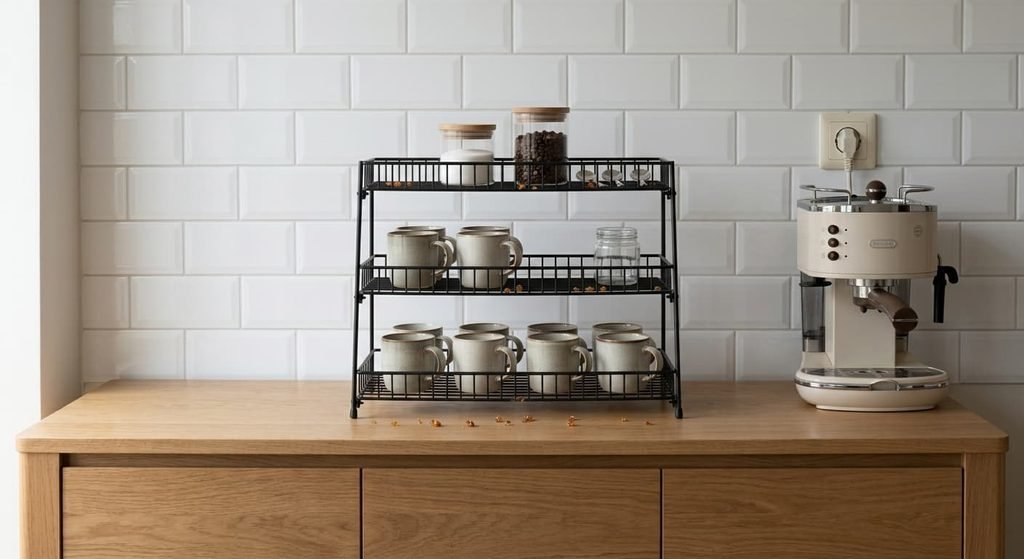
The fix that doesn’t work
A tiered stand with several compartments looks like the answer and multiplies the problem. A three-tier stand 30 cm across and 15 cm deep has 1,350 cm² of shelf, which is three times the 450 cm² it covers on the top. Each shelf catches drips from the one above and needs its own wipe. Its rails and joints hold residue that no cloth reaches. A tray of 600 cm² gives the drips one place and the cloth one job.
A stronger spray cleaner fails the same way. It cuts the film faster, but the cloth that applies it still spreads what it lifts, and the top feels tacky again by morning. Hot water and two cloths match it at no cost. I’d keep the stand for a shelf of dry jars and leave it out of the wet zone.
A coffee corner turns sticky because drips land everywhere and the cloth spreads them. It turns cluttered since the eye counts every outline. To fix a coffee corner for good, give the drips one landing zone and wipe in two passes, then group the dry items on trays. Run the paper test this weekend, since it names your cause before you spend anything. Repeat it after a week.
Questions readers keep asking
Can a coffee corner stay clean with several brews a day?
Yes, if the drips have one landing zone and the cloth works in two passes. Ten brews a day only raise the count of drops to 120. They still land on 600 cm² of board, and a daily rinse clears them. Without the zone, ten brews spread them over the whole top.
How much does it cost to stop a coffee corner getting sticky?
The first two fixes cost nothing, since most kitchens own a board and two cloths. Trays and lidded jars are a modest purchase. A panel set into the top is the one fix that needs a tradesperson, and it protects a fifth of the surface. Start with the free pair and repeat the paper test after a week.
Why is the area around the coffee machine always sticky?
Every cup and spoon passes there on its way to the mouth. Most drips fall there for that reason. Steam adds a thin film of milk and sugar on nearby surfaces. A damp cloth then spreads it outwards. Lift the machine and wipe underneath once a week.