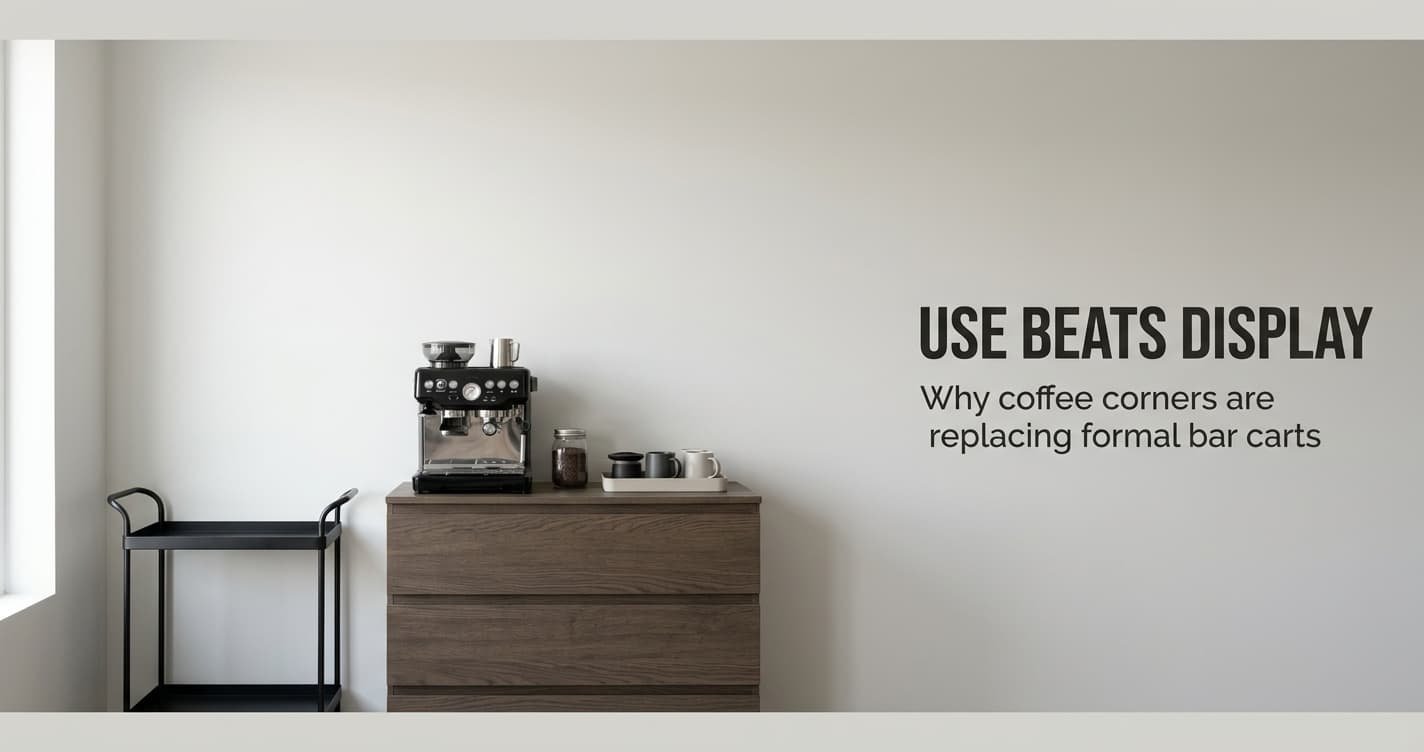
The complaint is familiar. The cart looks right and gets used twice a month, while the coffee things crowd the kitchen counter every morning. If you brew at home far more often than you pour for guests, the swap pays off. That’s the household where coffee corners are replacing formal bar carts.
Count the change instead of sensing it. Every figure below comes from a Dutch row-house living room that opens onto the kitchen. The cart measures 70 × 40 cm and the chest of drawers 100 × 45 × 90 cm. No brand or price appears here, since neither would hold for a season.
How the formal bar cart earned its wheels, and why it lost its job
The trolley solved a carrying problem. A dozen bottles weigh about 13 kg, because a full 70 cl bottle comes to roughly 1.1 kg. Glasses add more. One rolling trip from the dining room replaced four trips by hand. Thirteen kilograms is heavy to carry and easy to roll, and that’s the whole case for castors. Tiers at 30 and 76 cm kept bottles low and glassware high. Glass or polished metal suited a room that was cleaned for the evening. For much of the past century, many European living rooms kept a set hour for drinks. The cart came out for it.
Several changes ended that job. Open-plan layouts put the tap within four metres of the sofa. The trip across the house shrank to a few steps. Compact machines of about 5 kg gave homes a hot drink that could stay out on a surface all day. Households also hosted fewer formal evenings.
The wheels were built for a trip that now rarely happens.
What changed once coffee corners started replacing formal bar carts
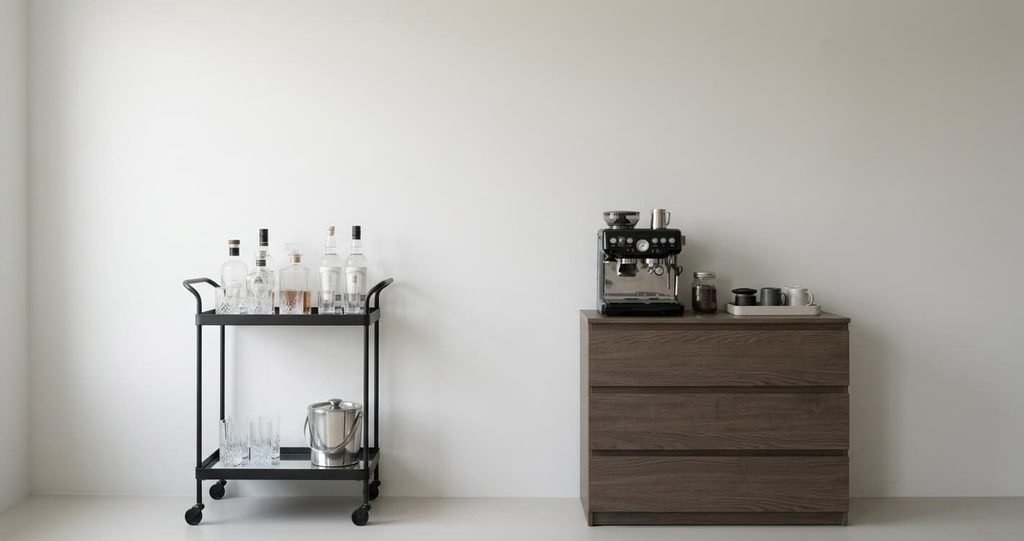
The change, stated once: a trolley at 76 cm, set up about 24 times a year, has become a fixed surface at 90 cm, used about 340 times a year. A household that hosts twice a month sets the cart up 24 times. A coffee on every day except 25 spent away makes 340 uses. That ratio is near fourteen to one. Every difference below follows from it.
Height moves first. The cart’s top tier stands at 76 cm, 14 cm below a kitchen worktop at 90 cm. Pouring from there costs nothing. Filling a 1.8 L water tank at 76 cm means a stoop every day.
Floor area grows. A cart covers 70 × 40 cm, or 0.28 m². A chest 100 × 45 cm needs 0.45 m², which is 61% more floor. That extra area buys a standing place the cart never offered. A machine with its bean jar and four mugs can stay put for 340 days.
The wheels lose their purpose. A castor 5 cm across climbs a step of about a quarter of its diameter, as a rough rule. That’s roughly 1.2 cm. A 2 cm door threshold, common between a living room and a hall, stops it. A machine lead of about a metre then ties the cart to one socket anyway.
Display turns into stock. The cart shows twelve bottles on glass in the open. The chest keeps them in a drawer 40 cm deep, laid on their sides, which frees the top for daily kit. That top gets wiped 340 times a year. Matt wood or laminate replaces the glass.
Who gains from replacing a formal bar cart, and who doesn’t
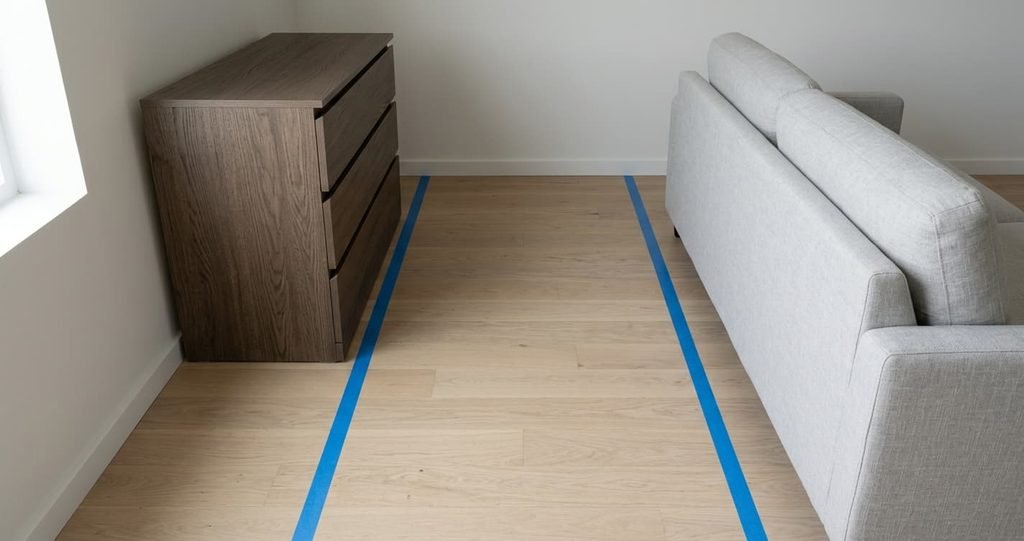
The swap suits a household that brews at home five or more days a week and hosts drinks less than once a month. It suits a passage 135 cm wide or more beside the wall. The chest takes 45 cm, and a person needs 90 cm to walk past. It also suits a wall within a metre of a socket, since the machine’s lead sets the position.
The cart earns its wheels only when somebody pushes them.
A cart can ask for ten minutes of setting up. Twenty-four evenings a year absorb only four hours of it. A daily coffee can’t. Ten minutes, 340 times, would eat nearly 57 hours, so a daily kit has to stay out and ready.
A weekly host carries a dozen bottles and a tray of glasses across the room 52 times a year. That’s the job the wheels were built for. Where the passage is 120 cm wide, 75 cm is left past a chest that stands 45 cm out. People turn sideways there. A tea drinker, or anyone who brews at the kitchen counter, would put only a tray on the chest top. Where your nearest socket sits is the one fact this page can’t see. A distance over a metre can overrule everything above.
Is a coffee corner worth the swap
The swap earns its place when you already own a chest or sideboard 85 to 90 cm high. The swap then takes an afternoon and adds no cost. Nothing gets built in. The machine and tray lift off in a minute. I’d retire the cart from coffee duty even when it was a gift, because wheels are the one feature a daily surface never uses. Replacing formal bar carts with a plain top at 90 cm keeps every option open.
The look dates through commitment. A worktop cut for one machine ties the room to a single appliance. So does a panel sized to this year’s casing. Machines change size by several centimetres from one design to the next. A plain top at 90 cm outlives all of that and serves a plant or a pile of post later.
The version that will date fastest
Taken to its limit, replacing formal bar carts means a café counter rebuilt at home. Two or three devices stand side by side. A menu board hangs above them, with a rail of syrup bottles to one side. At 180 × 45 cm the counter covers 0.81 m², which is 80% more floor than the chest. Most of it holds things you use weekly or never. A living room also lacks a water source and a second socket, so the build ends up looking like a prop. Each device ages at its own rate, so the wall looks dated the day the first one is replaced. The menu board gives it away, since nobody writes a menu for a household of two.
The moderate version holds one machine and one jar of beans. Four mugs stand on a tray 30 × 20 cm, with a drawer for the rest. The set uses 0.45 m² and survives a change of machine.
How to try it without committing
Test it for two weeks: put the machine and four mugs on a surface 85 to 90 cm high. Leave the cart where it is. Brew only at the new spot, and tick each day on a card taped beside it. Ten ticks from fourteen days means the corner works. Then check the passage. Mark the floor with tape 45 cm out from the wall, and make sure 90 cm stays free beyond the tape. This weekend, set last month’s coffee days against your hosting evenings. Five to one or more favours replacing formal bar carts in your own room.
A trolley earns wheels by being pushed. A machine earns a fixed place by being used every morning. Count both numbers once and the choice makes itself. At five to one or higher, give the machine a surface at 90 cm. Keep the cart for party nights and let the wheels rest. A closer count calls for the two-week trial first.
Questions readers keep asking
Do I need to get rid of my bar cart?
Only if it has no job left. Keep it where you host. Leave the bottles and glasses on it. If guests visit for drinks only now and then, a drawer holds the same bottles. The cart can then go to a hallway as a plant stand, or to a friend who entertains weekly.
Is a coffee corner right for a small living room?
Yes, when you can spare 45 cm of depth and keep a 90 cm walkway. That calls for 135 cm or more between wall and opposite furniture. A narrower chest of 80 × 35 cm fits a machine plus a tray where the gap is 125 cm. Below that, brew in the kitchen. Keep the living room clear.
Will a coffee corner still look right in five years?
Yes, when the surface stays plain: a chest at 90 cm with one machine and four mugs. Machines and mug sets change, and each swap takes a few minutes. What dates is the café counter with its menu board and rows of syrup bottles.