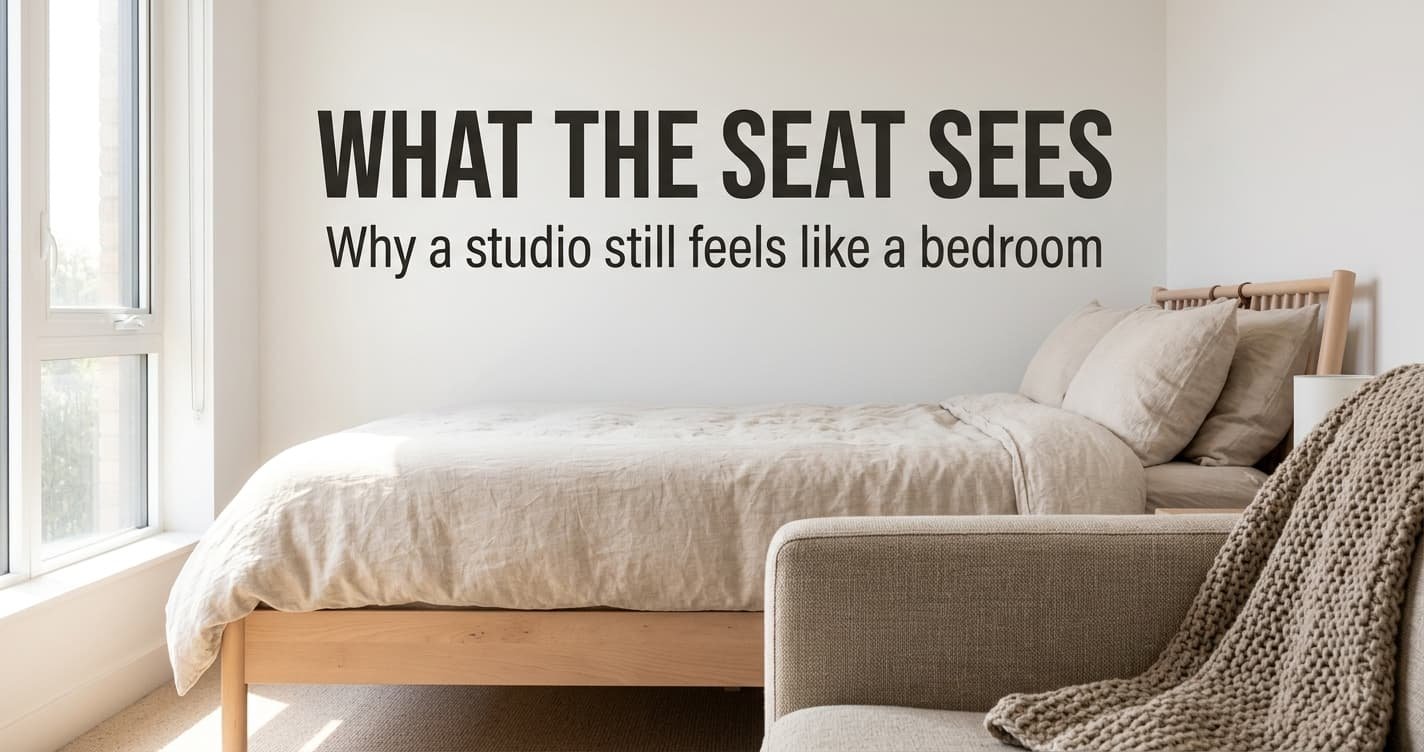
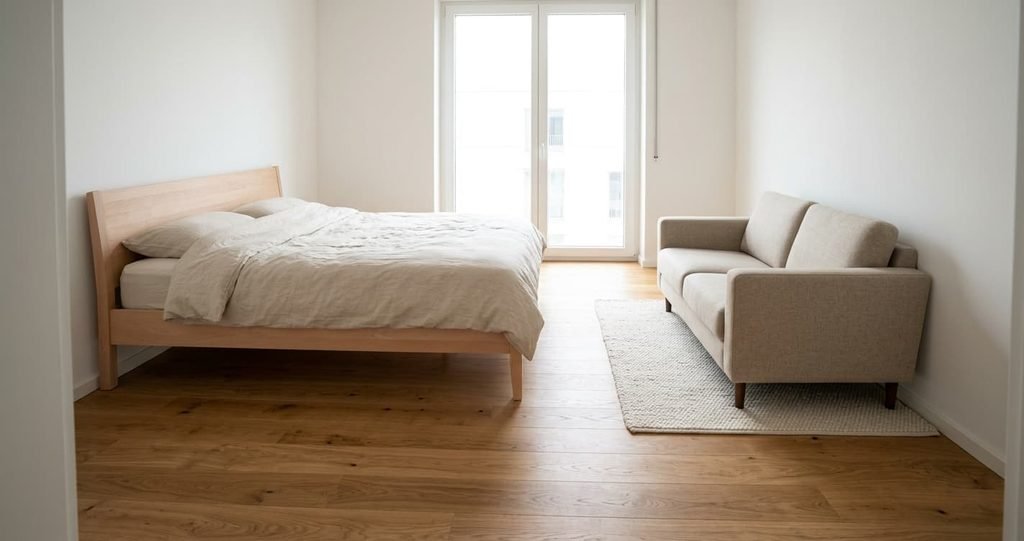
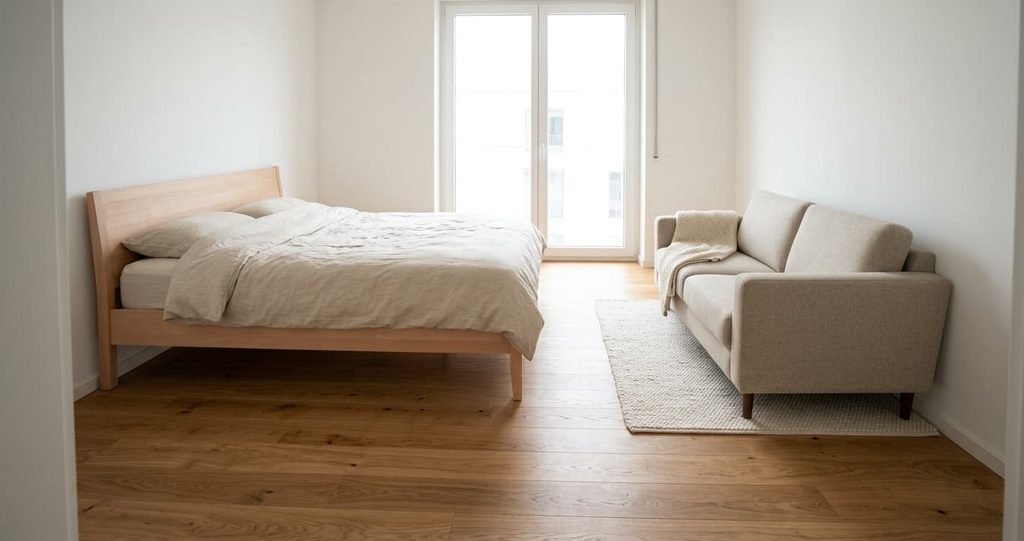
A two-seat sofa of 150 by 85 cm faces a bed of 140 by 200 cm, and the bed owns more than twice the floor. That lopsided pair is why your studio still feels like a bedroom, even with a sofa in it. The cause is proportion and finish, properties of the room that you can measure and change.
This studio measures 340 by 580 cm, which is 19.7 m², with a ceiling of 250 cm, in the Netherlands. Three faults follow, each with a different cause, and in each entry the free fix comes before the purchase.
Why a studio feels like a bedroom with a sofa in it
A room is read as the job whose signals add up fastest. Three signals carry most of the weight. Footprint is how much floor a job owns. Finish is what its surfaces feel like under your hand. Facing is what the main seat or bed points at.
The bed sends all three clearly. Its footprint is 2.8 m². Its finish is linen and wool. Everything near it faces it or turns away from it.
The sofa side sends them faintly. A sofa of 150 by 85 cm owns 1.28 m², which is 46% of the bed’s floor. Upholstered in wool, it shares the bed’s finish. And it faces the bed, so sitting down means looking at the sleeping side.
The usual misdiagnosis is blaming the bed for what the sofa side lacks. Take the bed away and the room would still have no living side to read. Write the three signals for each job on an empty plan. Give floor in square metres. Count the soft and hard surfaces, then note the direction faced. The side that scores lower on each one loses, and you can predict this fault before a single piece arrives.
How to tell why it reads like a bedroom
Three looks will separate the causes, and none needs a tape measure. Stand in the doorway and photograph the room. Compare the shapes on the screen. Check whether the bed’s shape could hold the sofa’s shape twice over. Then see whether the sofa with its table and any chair merges into a mass clearly smaller than the bed. If both are true, footprint is your fault. This is the one check the photo answers best, because shapes compare more easily on a screen than in the room.
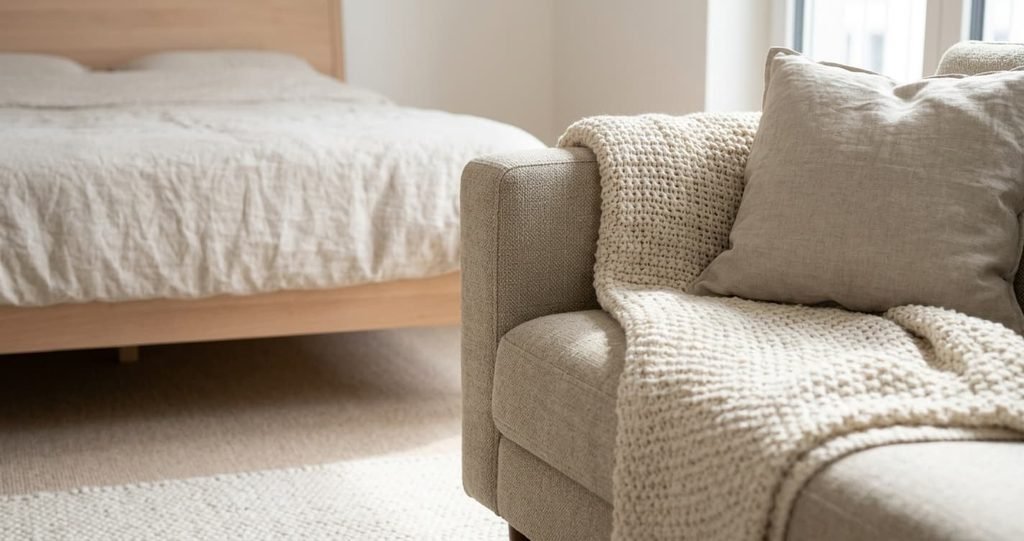
Now sit on the sofa. Sweep an arm around you at full stretch and list what your fingers meet. If nearly everything is fabric, finish is your fault. A hard top counts as one hard surface. A wooden arm counts too.
Finally, look straight ahead from where you sit. If the first large object you see is the bed or a blank wall, facing is your fault. Most studios fail two of the three. Note which ones before you read on, because each fix below addresses one cause and leaves the others alone.
The three faults, diagnosed
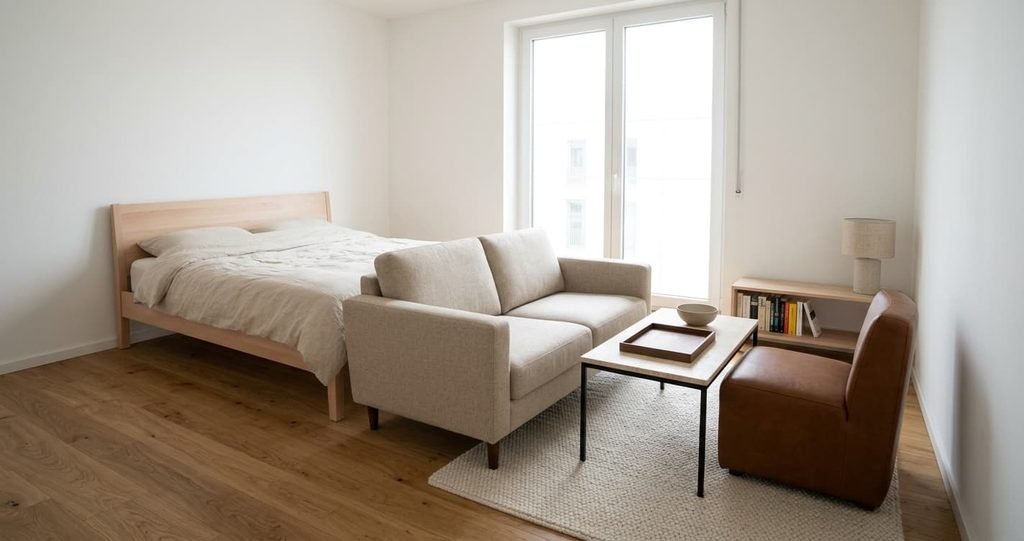
“The sofa looks like a guest seat next to the bed.” The cause is footprint, the first reason a studio feels like a bedroom. The sofa owns 46% of the bed’s floor, and a seat under about two thirds of it reads as an accessory, going by a rule of thumb of mine. Slide the table and any chair against the sofa so their outlines sit within 40 cm of each other. A low table of 90 by 50 cm adds 0.45 m² and lifts the cluster to 62%. An armchair of 75 by 80 cm adds 0.6 m² and reaches 83%. Moving them costs nothing. Without either piece, buy a table first. A larger sofa can wait. The doorway photo shows the change at once, as one mass instead of three small shapes. The limit is spacing, because scatter the pieces again and the 83% disappears.
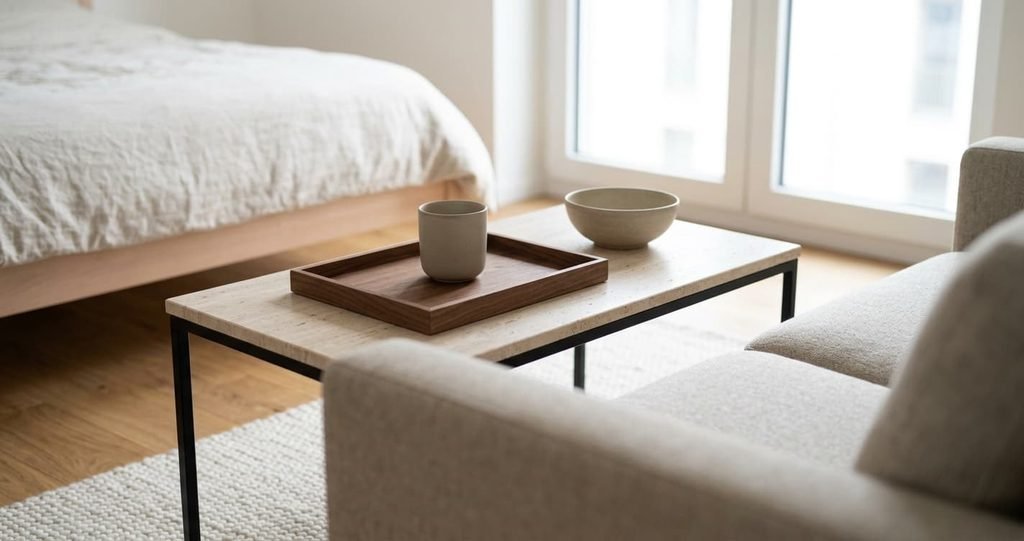
“Everything within reach is soft.” The cause is finish. Linen on the bed and wool on the sofa belong to one family. A throw and a rug join it, and one family reads as one job. Carry hard things into arm’s reach of the sofa. A wooden tray or a ceramic bowl will do, and so will books stacked on a stool. Swap the sofa throw for a different weave from the bedding. Aim for two hard surfaces among the six within reach. Those moves cost nothing. The purchase that settles it is a table with a hard top at 40 to 45 cm, in timber or stone. The limit is that finish alone changes nothing about floor, so a hard tray won’t help a sofa that still faces the bed.
“Sitting there, the bed is all you look at.” The cause is facing. A seat gets its job from what it points at, and this one points at the sleeping side. Turn the sofa a quarter turn to face the window or the longest free wall. That is free. Its back then faces the bed, which stops the sofa watching it. Give the new view something to rest on next, such as a low shelf of 120 by 35 cm with books and a lamp, which costs little. Turning the sofa has a limit, since it leaves the sofa’s share of the bed’s floor exactly where it was.
What to check before you add anything else
Before the next piece comes in, ask three questions. The first is whether it adds floor to the living side. A new rug under the bed or a second bedside table adds to the sleeping side only, and widens the gap you’re trying to close.
The second is whether something hard is within reach of the sofa afterwards. Another cushion fails that test, while a tray passes it. A hard object beside the seat also gives you somewhere to put a cup, which a soft one can’t.
The third is where the seat will point. Place the piece with the sofa’s front in mind, and hold off on buying anything that leaves the sofa facing the bed. Check these before you shop and a studio that feels like a bedroom won’t slip back into it.
None of the three questions needs a purchase.
The fix that isn’t worth doing
Buying a bigger sofa first is the remedy most often repeated. A sofa of 210 by 95 cm owns about 2.0 m², which is 71% of the bed’s floor. The cluster built from a table and chair you may already own reached 83% without spending anything.
A bigger sofa spends the largest sum on one cause, and the studio is left paying for the wrong fix. It also arrives in the same kind of wool, so the finish stays what it was. It leaves finish and facing untouched, and a larger wool sofa facing the bed repeats both faults at a bigger size. Its extra 0.7 m² of floor also comes out of the living side’s walking space. I’d buy a hard-topped table before a bigger sofa, since the table moves two causes at once.
The sofa can come later.
Three signals decide whether a studio feels like a bedroom, and the sofa side loses on each by default because the bed sends them first. Sit down and look straight ahead, then touch what is within reach to learn in half a minute which cause is yours. Make the free moves in the order of the diagnosis, starting with the one your own check flagged. Then buy the single piece that moves the most causes at once, usually a table with a hard top, and stop there until the doorway photo shows two clear jobs in one room instead of a single sleeping one.
Questions readers keep asking
What makes a studio read as a bedroom?
The bed sends clearer signals than the sofa side. It owns more floor, its surfaces are all soft, and the seating faces it. Raise the living side on those three and the room splits into two jobs. Start by merging the sofa with a table and a chair into one cluster.
What fastest stops a studio from feeling like a bedroom?
Turn the sofa to face the window or a free wall, then put one hard-topped object within reach. Both take minutes and cost nothing if you own a tray or a stool. They change what the seat points at and what the hand finds, which the eye reads at once.
Can this be fixed without renovating or buying much?
Yes. Placement and finish cause all three faults, and the walls play no part. Merging the pieces into a cluster, swapping a throw for a different weave and rotating the sofa cost nothing. A table with a hard top is the only purchase most studios need.