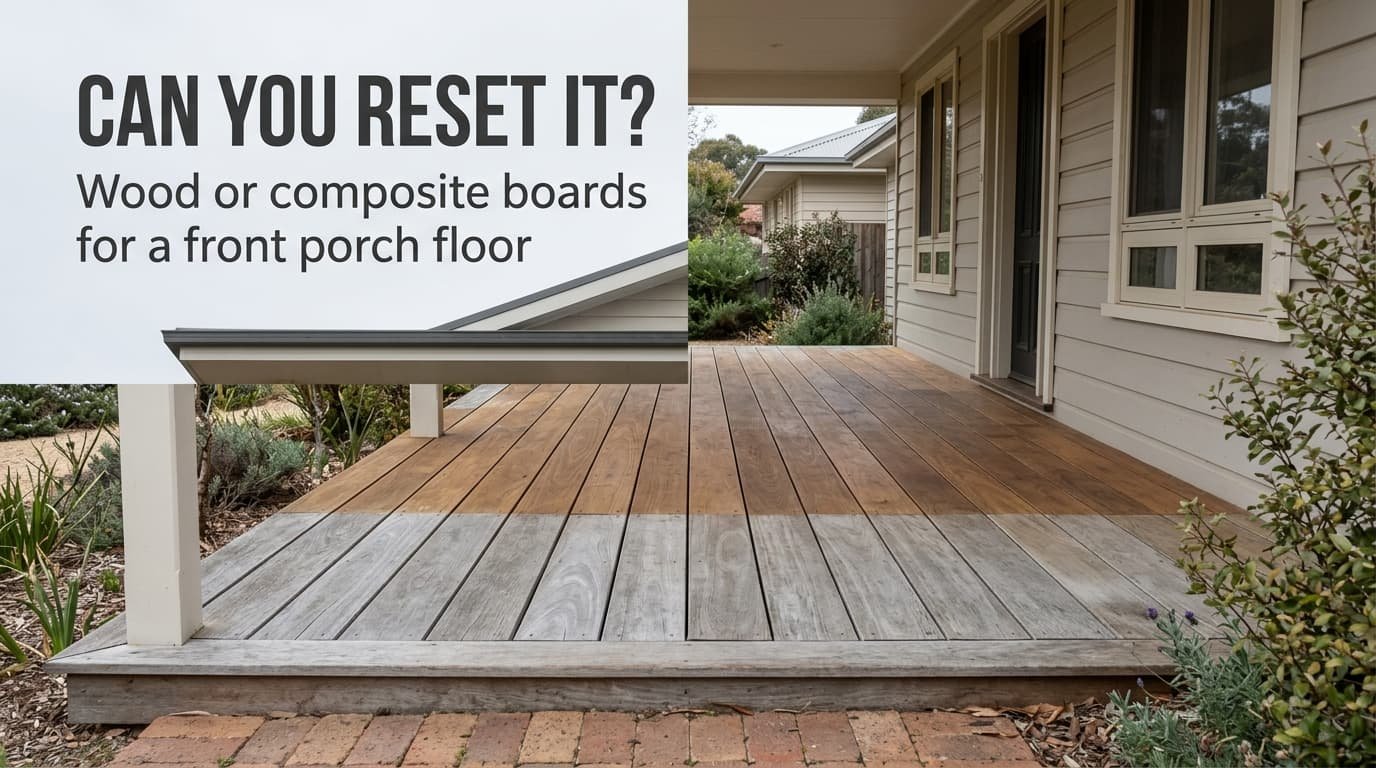
“We oil the boards every spring, and the porch still looks tired by autumn.” That complaint comes from a floor that weathers unevenly. Take wood if you’ll sand and recoat the open front every year or two, and take composite if you’d rather wash and leave it. Wood or composite boards come down to a single question about the surface: can it be reset after it weathers?
The sums use a Dutch terraced house with a roofed porch of 240 by 150 cm on a concrete slab. Board sizes are typical dimensions and no particular range. Cost is left out, so the comparison rests on properties you can check.
The property that decides wood or composite boards
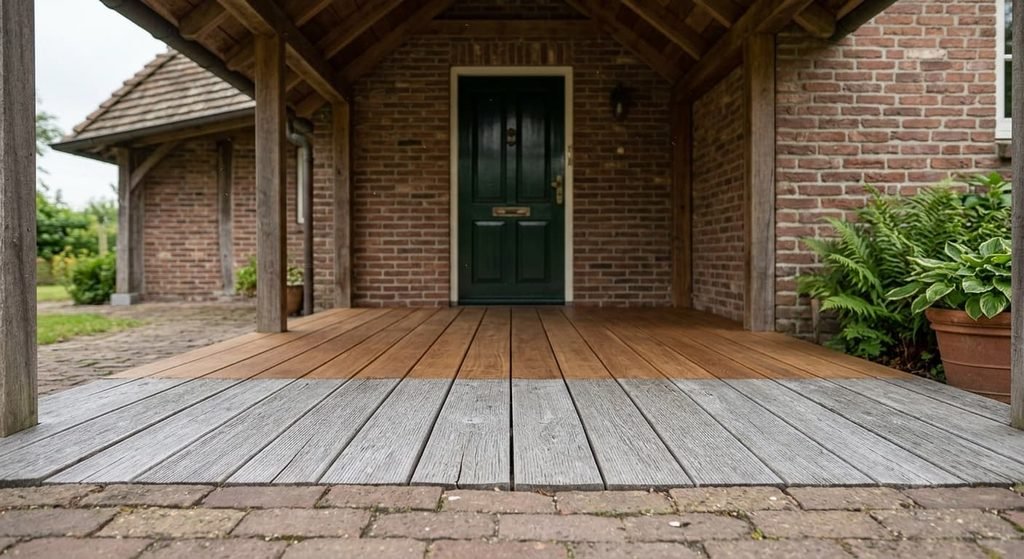
A roofed porch weathers unevenly. Rain and low sun reach the open front 50 to 60 cm, while the rest of the 150 cm depth stays shaded and dry. After two seasons that difference shows as a line across the floor.
Wood and composite answer it in opposite ways. Wood weathers a lot: exposed boards grey and roughen while sheltered ones keep their colour. Composite weathers little, fading a shade at first and then settling. A wood surface can be reset by sanding and recoating, and a composite surface can’t be reset at all.
Picture a floor of ten boards. Each is 240 cm long and 14 cm wide. The front four take the weather, and the six behind them hardly do. Sanding takes about a millimetre or less from a wood board and pulls the front back toward the rest. A faded composite board stays faded, and a scratch through its outer shell stays a scratch.
Everything else hangs off that.
Wood asks for labour and gives back control. Composite saves the labour and gives up the control.
This also explains why the usual comparison misleads. Averaged across the whole floor, the two materials look alike after the first year. They part company at the front four boards. Wood moves most there, and composite moves least.
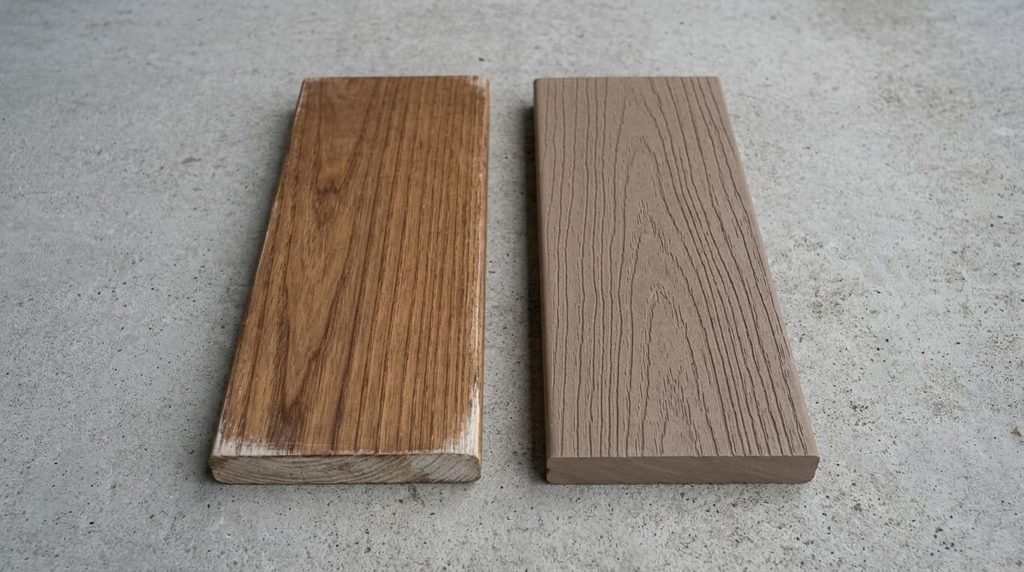
Wood against composite boards, head to head
| Property | Wood | Composite |
|---|---|---|
| Weathering at the open edge | Greys in sun and rain unless recoated; sheltered boards keep their colour | Fades a shade at first, then settles; exposed and sheltered boards stay close |
| Resetting the surface | Sand back and recoat | Can’t be sanded; wear in the outer shell stays |
| Movement | Swells and shrinks across the width with moisture, by a few millimetres on a 14 cm board | Grows along the length with temperature, about 1 mm per metre for a 25 °C swing |
| Replacing one board | A new board weathers into its neighbours | A new board looks brighter than faded neighbours |
| Surface in direct sun | Stays cooler, especially in pale species | Runs warmer, especially in dark shades |
| Routine care | Recoat exposed boards every year or two | Wash; shaded boards grow algae |
| Fitting around obstacles | Cut with ordinary tools, and a slip spoils one board | Cut the same way, yet every cut end needs the maker’s gap and clips |
The row that surprises people most is resetting, because composite’s lack of sanding is usually sold as relief. It also means a faded patch or a deep scratch stays for the life of that board, whereas wood lets you start again with a sander.
Where wood wins on a porch floor
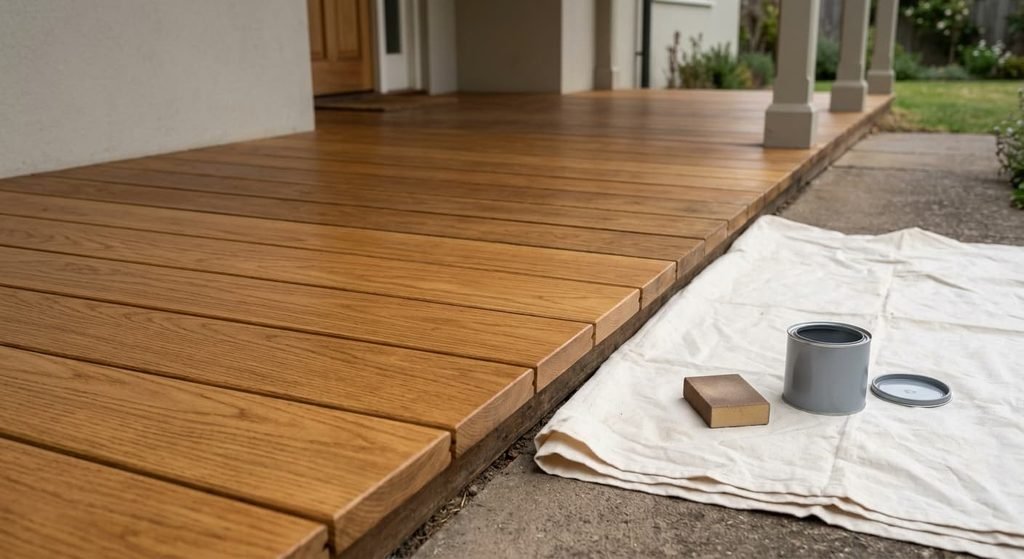
Wood wins where the open front takes the weather, because weathered boards can be brought back. Sand the front four and recoat them. The line then fades toward the shaded six. Thermally modified ash and larch both take this treatment, and neither needs a board lifted. Use a fine grit along the grain and recoat within the day, before bare wood collects dirt. That is why wood or composite boards need judging at the front edge, and the floor as a whole tells you little.
Wood also forgives awkward geometry. A porch with a post or a pipe in the way is cut and fitted with ordinary hand tools, and a mistake costs one board. The plain reason is easy repair. You swap a dented or stained board for a new one that weathers into its neighbours within a season or two. The floor never ends up with one bright stripe.
Wood costs time. Plan an afternoon every year or two for the exposed boards, and accept that the front edge greys between coats. Boards swell across their width, so a 5 mm gap between them lets water drain away.
Where composite wins on a porch floor
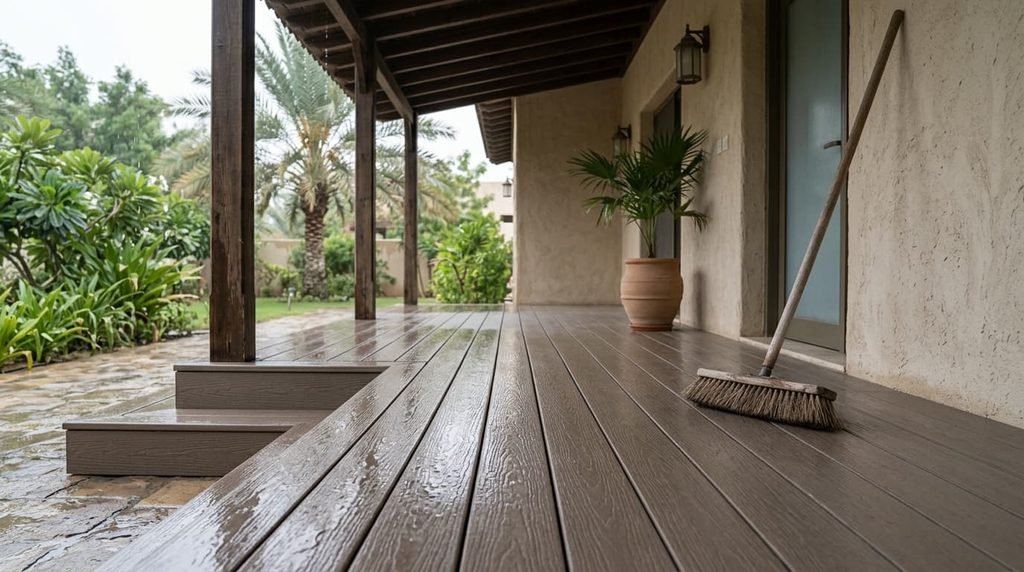
Composite wins on a porch that stays damp. Shade and a north-facing front keep wood wet longer than it can dry, and that moisture invites rot and algae. A composite board keeps its colour close across the floor, so a shaded porch never develops a line to repair.
It also wins for households that won’t recoat. A floor washed once or twice a year with a brush and water holds its look without an afternoon of preparation. The unglamorous reason is consistency. Boards from one batch share one colour and one size, so all ten lie the same in every row.
Many composite boards are grooved underneath and sit on clips that hold each board and set the gap, so the clips matter as much as the boards. Composite still needs care. Shaded boards grow algae, and every board grows in length with warmth: a 240 cm board gains about 2.4 mm across a 25 °C swing, so leave the maker’s gap at each end. Dark shades also run warmer underfoot in direct sun.
When neither is right
Wood or composite boards both sit on joists above a ventilated void, so they raise the floor by about 7 cm, a 4.5 cm joist plus a 2.5 cm board. The inward-opening door and its threshold were set for the slab. A floor 7 cm higher either blocks the leaf or leaves a step up at the doorway.
The slab already does the job the joists would do.
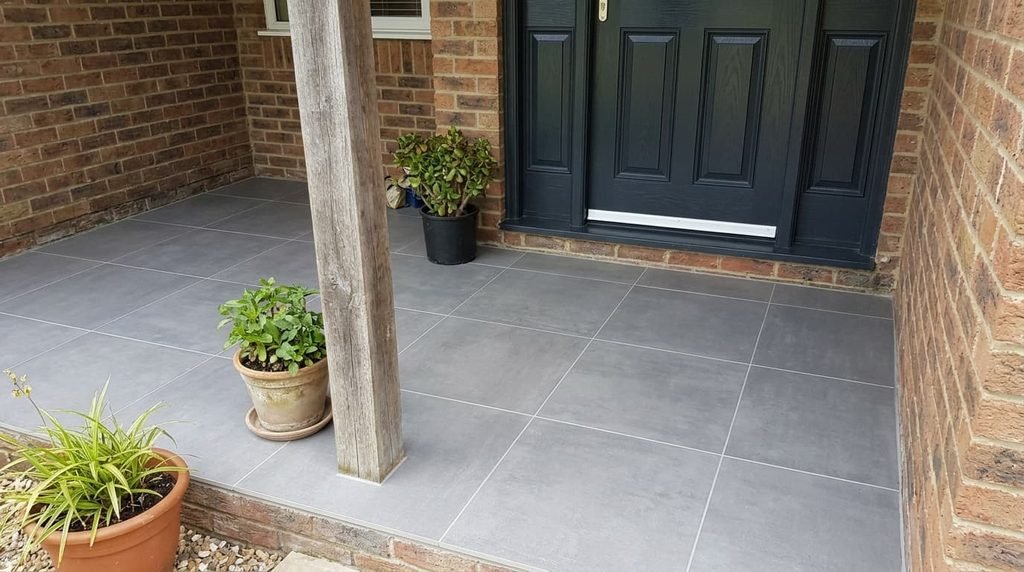
Matt porcelain tiles laid on the existing slab are the third option. They add about 2 cm with adhesive, keep the doorway as it is and need no void. Choose a tile rated for frost, and give the slab a fall of 1 to 2% away from the door so rain runs off. Tile makes a hard, cold floor with no give underfoot. You can’t lift it board by board when a pipe needs reaching. A cracked slab, or one that holds water at the door, needs repair before any surface goes on it, and the slab’s condition is beyond what I can judge remotely.
How to decide in thirty seconds
If the open front takes rain and you’ll sand and recoat every year or two, take wood. Lay ten boards with a 5 mm gap and a ventilated void, and sand only the front four. Expect the front edge to need attention first.
If the porch faces north or stays damp, and you want to wash it and leave it, take composite. Lay the same ten boards, leave the maker’s end gap, and brush the shaded boards twice a year. Expect the front edge to hold its colour with little help. How fast your porch dries between showers isn’t visible from here, so watch the shaded boards after a wet week.
Wood or composite boards reduce to one question: can you reset the surface? You can sand and recoat wood, which suits a sunlit porch with a weathered front edge. Composite holds its colour and resists restoring, which suits a damp porch you’d rather wash than sand. If the slab is sound, tile it. That skips the joists and keeps the doorway at the height the door was built for.
Questions readers keep asking
Does wood or composite last longer on a porch floor?
Both last for many years when the floor drains and the void under it stays ventilated. Wood lasts longest where you can recoat it, because exposed boards stay protected. Composite lasts longest where its outer shell stays intact, since wear in the shell can’t be repaired. Check the maker’s stated service life.
How much maintenance does a porch floor need?
Wood wants sanding and recoating on the exposed boards every year or two, plus brushing off leaves. Composite wants washing once or twice a year. Either way, keep the gaps between boards clear, because blocked gaps hold water against the boards and shorten the life of both materials.
Which floor suits a north-facing porch?
Composite usually suits it better, because shade keeps wood damp and invites rot and algae. Wash the boards twice a year to keep algae off. If you prefer wood, choose a durable species such as larch. Keep the void ventilated, and expect to recoat more often.