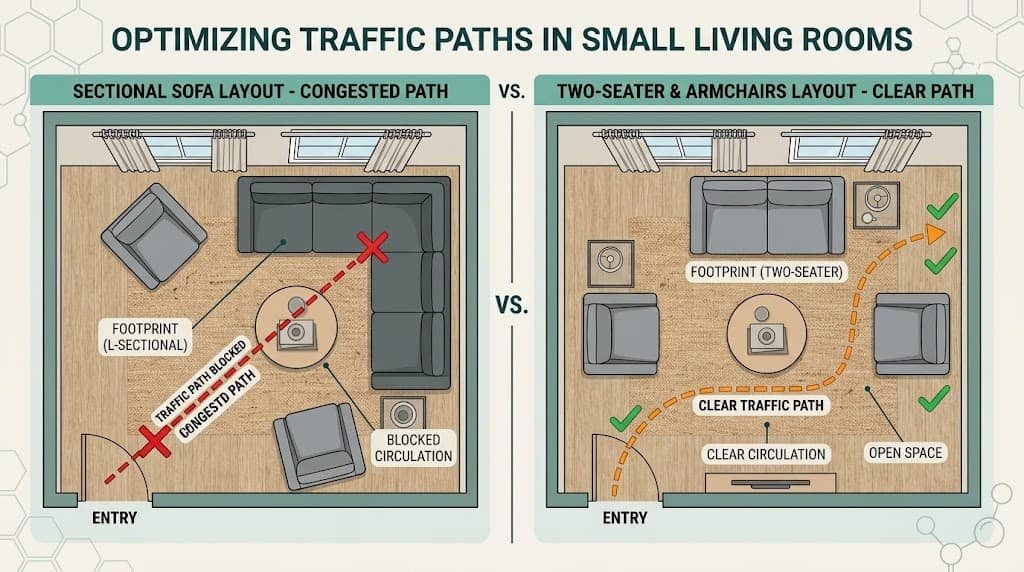
The right seating for a small living room isn’t decided by which piece looks bigger or smaller in a showroom – it’s decided by how each option behaves against the room’s actual traffic path and sightlines once it’s home. A sectional and a two-seater solve genuinely different problems, and picking based on square footage alone misses what actually determines whether either one works.
The one property that decides it
The deciding factor is how each seating type interacts with your room’s main walking path – the route people actually take to cross from the entry to the far side of the room, day to day. A sectional occupies a fixed, continuous footprint that the walking path has to route around entirely; a two-seater occupies less continuous floor space but doesn’t inherently define a single seating zone the way a sectional does.
This single difference cascades into almost everything else about how each option performs in a small room – how much floor stays genuinely open, how flexible the layout remains over time, and how the room reads to someone standing in the doorway. A room where the walking path already has an obvious, unavoidable route tends to tolerate a sectional far better than a room where several equally plausible paths currently exist, since a fixed L-shape effectively decides that ambiguity for you rather than working around it.
Head to head
| Sectional | Two-Seater | |
|---|---|---|
| Floor footprint | Large, fixed shape | Smaller, flexible placement |
| Walking path impact | Often forces one route around it | Leaves multiple paths open |
| Seating capacity in limited space | Higher per square metre | Lower, but pairs easily with chairs |
| Visual weight in a small room | Heavier, one large mass | Lighter, one distinct object |
| Flexibility to rearrange later | Low – L-shape limits placement | High – fits many wall layouts |
| Typical best fit | A room with one seating zone | A room serving multiple functions |
The row that surprises people most is walking-path impact. Many assume a sectional automatically feels more cramped simply because it’s larger, but the real issue is narrower than that: a sectional genuinely works in a small room when its L-shape follows a wall the traffic path was never going to use anyway, and genuinely fails when it sits in the room’s only viable route across.
Where the sectional wins
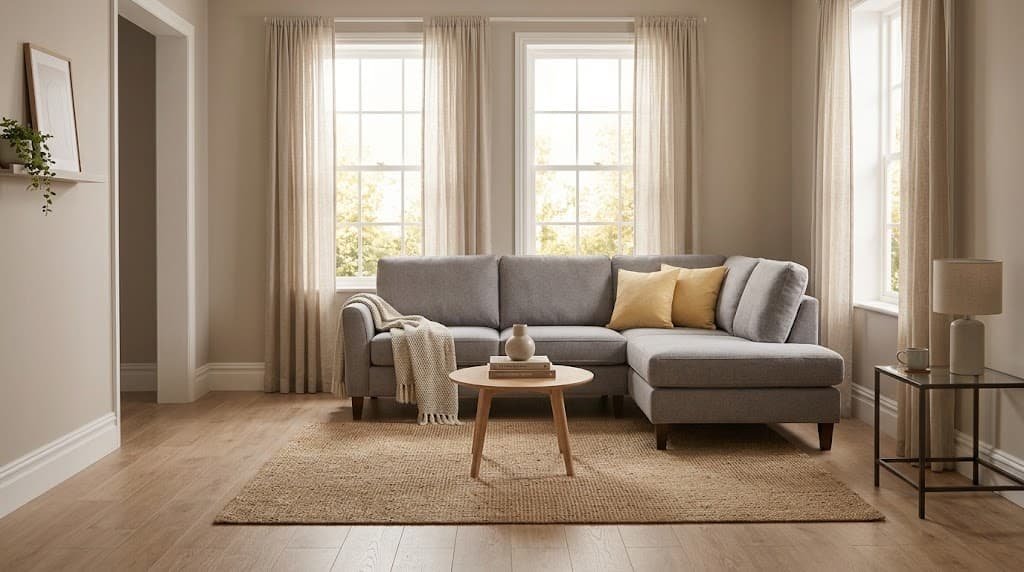
A room with one dominant function – watching television, a single conversation area – benefits from a sectional’s ability to seat several people within a footprint that a sofa-plus-chairs arrangement often can’t match in the same space. The unglamorous reason: a sectional also tends to eliminate the small awkward side tables and extra chairs that multiply visual clutter, consolidating seating into one coherent shape instead of several scattered pieces.
A household that regularly hosts more people than the room’s other furniture comfortably seats benefits particularly from this consolidation, since a sectional’s continuous seating surface accommodates a group without the gap-filling improvisation that scattered chairs often require. The corner a sectional typically occupies is also frequently a corner that struggles to serve any other function well in a small room anyway, meaning the trade-off costs less usable flexibility than it might first appear to.
Where the two-seater wins
A room that has to double as a walkway, a home office corner, or an occasional dining space benefits from a two-seater’s smaller, more flexible footprint, since it doesn’t lock the room into one fixed seating zone the way a sectional’s L-shape does. The unglamorous reason: a two-seater is also considerably easier to move entirely out of the room for an occasional different use, which a sectional’s bulk and shape make genuinely impractical.
A household that changes its furniture arrangement seasonally, or one that regularly hosts different activities in the same room on different days, benefits from this same portability in a way that’s easy to underestimate until it’s actually needed. The corner a two-seater vacates when moved also tends to remain genuinely usable for something else entirely, which a sectional’s fixed L-shape structurally cannot offer in the same room.
What people get wrong when comparing them
The most common mistake is comparing seating capacity per pound spent, treating the sectional as simply “more sofa for less floor space efficiency lost.” This misses that the traffic-path problem doesn’t scale linearly with size – a sectional that’s only slightly too large for a room’s available unused wall can create a disproportionately worse walking-path problem than the size difference alone would suggest, because the L-shape either fits the available wall configuration or it genuinely doesn’t.
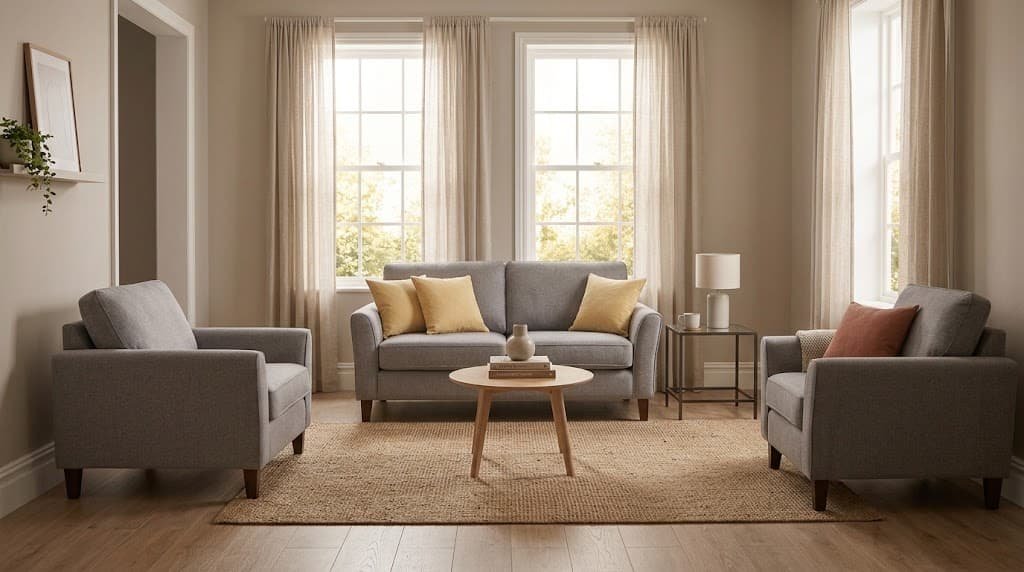
A second common mistake is assuming a two-seater automatically preserves more open floor space simply because its footprint is smaller on paper. If a two-seater ends up paired with two armchairs and a coffee table to compensate for lower seating capacity, the combined footprint of all four pieces can end up occupying more total floor space, spread across more individual objects, than a single well-placed sectional would have.
When neither is right
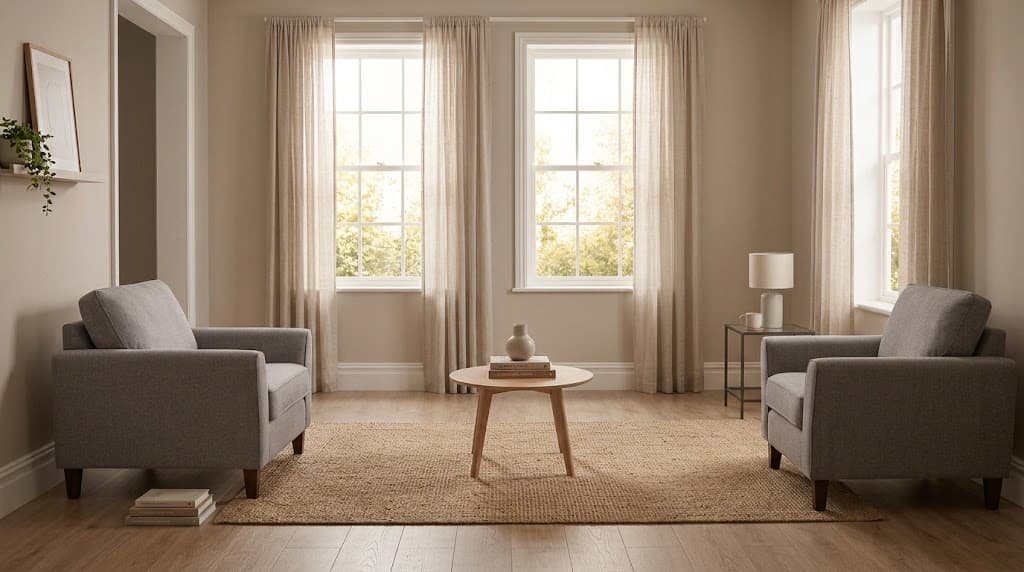
A pair of matching armchairs instead of either a sectional or a two-seater often serves a small living room better than committing to either fixed shape, particularly in a room with an irregular or multi-purpose layout.
Armchairs can be repositioned individually rather than as one fixed unit, which matters specifically in rooms where the ideal seating arrangement might need to change from week to week. For a reader prioritising genuine flexibility over maximum seating capacity, this is a real third option worth considering deliberately, not settling for accidentally after ruling out the other two.
How to decide in thirty seconds
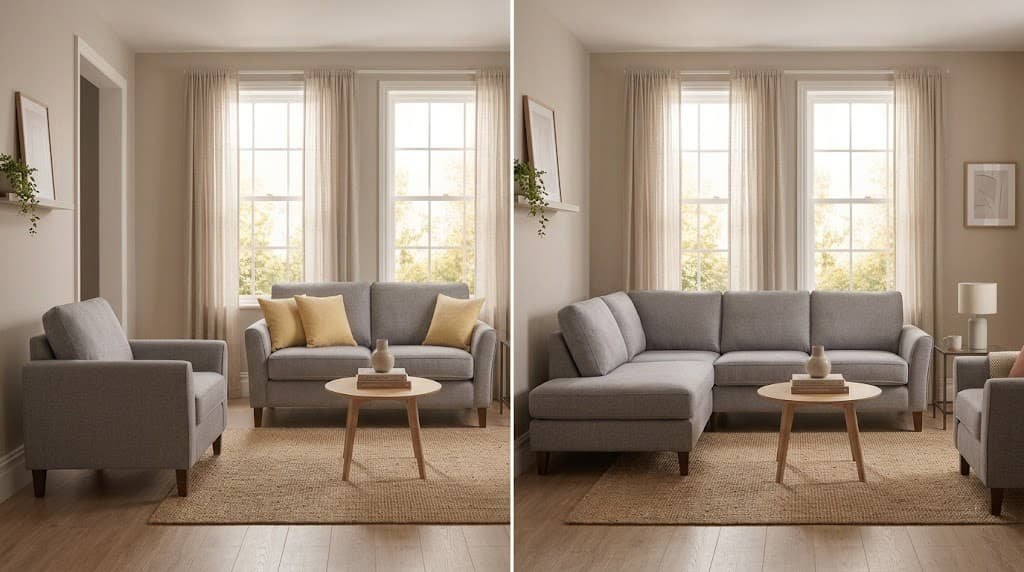
If your room has one dominant, unchanging seating zone that the walking path never has to cross, take the sectional. The traffic-path problem that makes sectionals risky in small rooms simply doesn’t apply once that zone is genuinely fixed and out of the way.
If your room needs to flex between different uses over time, take the two-seater. Its smaller, more moveable footprint accommodates changing needs in a way a sectional’s fixed shape structurally cannot.
What changes the answer later
A change in household size – particularly gaining a regular second household member who needs their own seating – shifts the calculation toward a sectional even in a room where a two-seater previously worked, since the added seating need often outweighs the flexibility a two-seater offered.
Moving to a different property with a different room shape resets this decision entirely rather than simply transferring the previous choice, since the traffic-path analysis genuinely depends on that specific room’s layout, not on general preference for one seating type over another.
The real decision isn’t which piece looks more impressive in a showroom – it’s whether your room’s traffic path can accommodate a sectional’s fixed footprint or genuinely needs a two-seater’s flexibility. Match the choice to that constraint, and the seating capacity question tends to resolve itself.
Questions readers keep asking
Does a sectional always make a small room feel more cramped?
Not inherently – it depends specifically on whether the sectional’s shape follows a wall the room’s traffic path wasn’t using anyway. A sectional placed correctly against an underused wall can feel less cluttered than a two-seater paired with several additional chairs.
Is a two-seater always the more practical choice for a small living room?
Not necessarily – a two-seater alone often seats fewer people than a room actually needs, which can lead to adding extra chairs that end up creating more visual clutter than a single well-placed sectional would have.
Can I fit a sectional in a room under a certain size?
There’s no fixed minimum size – it depends entirely on whether the room’s traffic path can route around the sectional’s footprint without forcing people through the seating area itself. A smaller room with one clear unused wall can work; a smaller room with traffic crossing through the middle generally can’t, regardless of the room’s total square footage on paper.