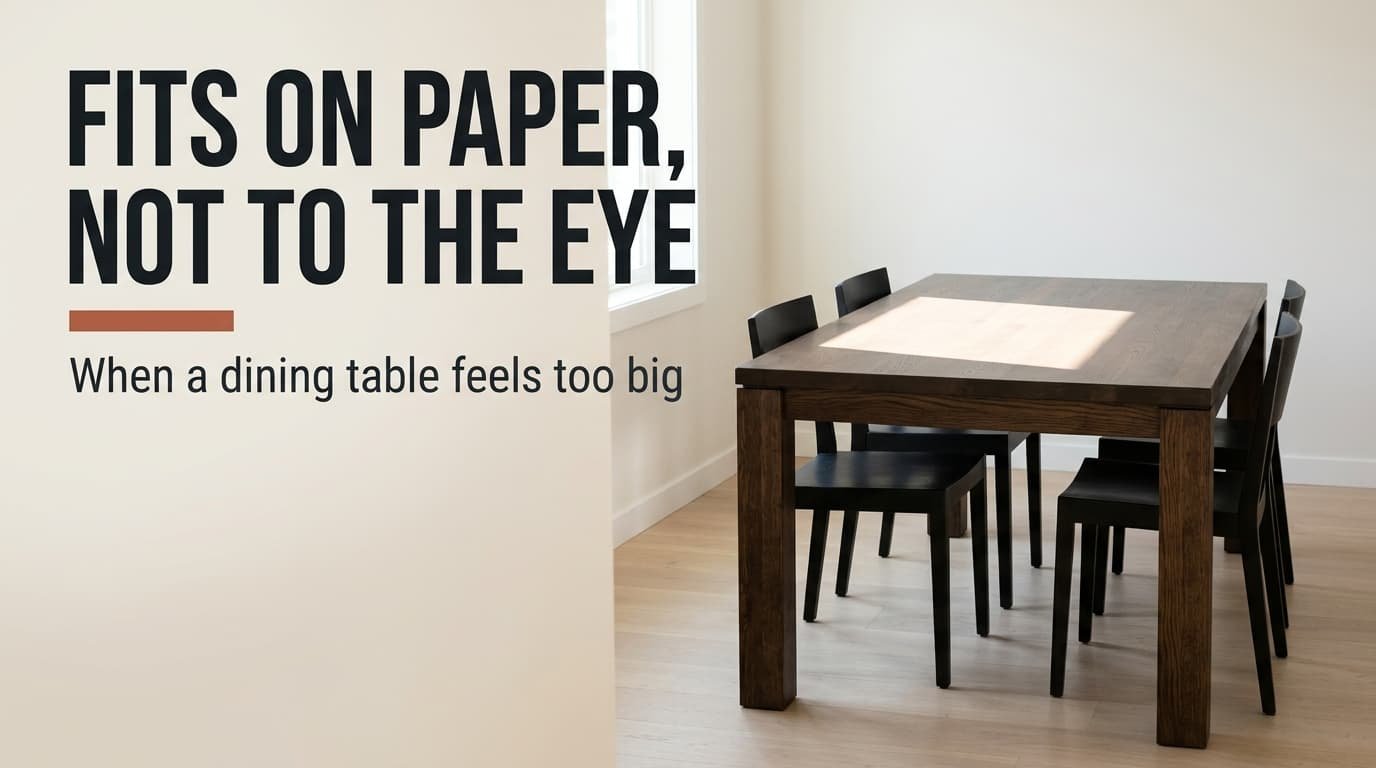
Why does a dining table feel too big for the room when every aisle clears? You see it from the doorway: one heavy block with a bright patch across the middle. That’s a problem of visual mass and glare. Taste and floor area play no part.
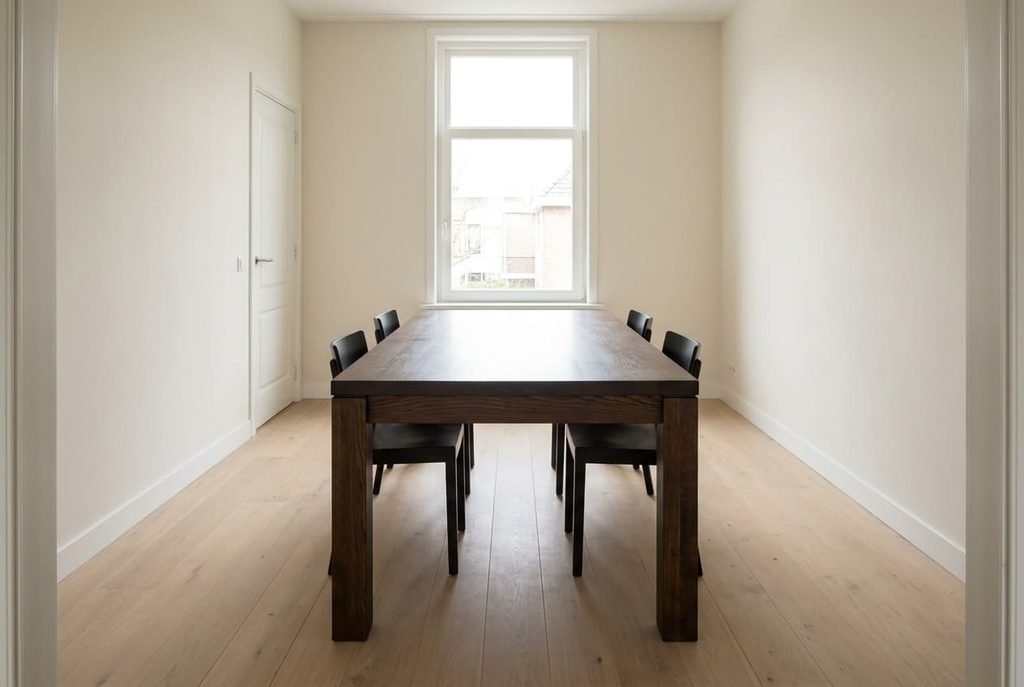
Our Dutch room measures 390 by 450 cm. Its ceiling stands at 250 cm, a window fills the far wall and the table is satin-lacquered, 200 by 100 cm. It passes the usual test, since 100 cm of table plus two 90 cm aisles needs 280 cm of the 390 available.
What actually makes a dining table feel too big for the room
The eye judges a table by what it sees: the edge band and the bright reflections, plus the lines it makes with the walls. Floor area underneath plays no part. The room isn’t too small for the table, so measuring it again will not help.
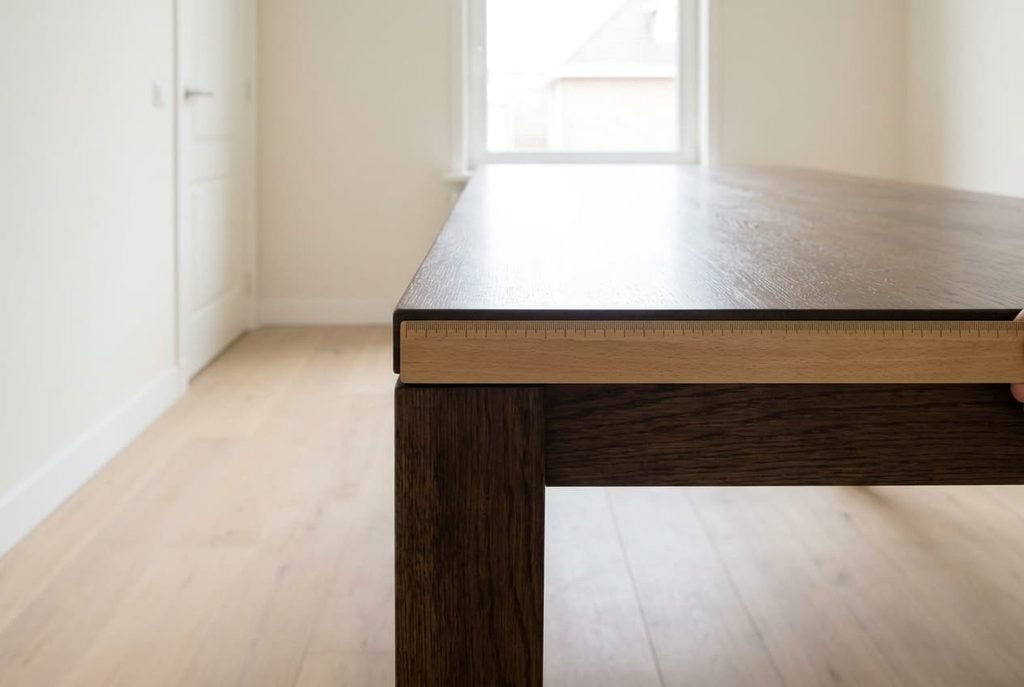
Take the band first. A top 45 mm thick on an apron 110 mm deep shows 155 mm of solid edge, which is 21% of the 75 cm height. Along a 200 cm side that’s 0.31 m² of visible slab. A top 25 mm thick on a 40 mm apron shows 65 mm, or 9%, and 0.13 m². The eye reads the first as a block and the second as a plane on legs.
Then the shine. From the doorway at eye height 155 cm, the window’s reflection lands on the top between 160 and 379 cm from the door. A table spanning 125 to 325 cm carries that bright patch on 165 cm of its 200. A lacquered surface reflects about 20% of light at that slant, five times the 4% it returns when you look straight down.
Last comes alignment. A centreline 18 cm off the window’s centre reads as a slip, because the eye lines the two up at once.
How to tell which fault you have
Stand by the door with your eyes at normal height. Look at the table before anything else. These three looks tell you which fault makes your dining table feel too big for the room.
Does it read as one thick slab? Crouch to the edge and hold a ruler against it, then add the top’s thickness to the apron’s depth. Above 20% of the table’s height, mass is your fault. Squinting helps too: if the table turns into one dark rectangle with no gap under it, the band is doing the damage.
Does a pale window-shaped patch sit across the centre of the top? Move your head 30 cm sideways. If the patch slides with you, you’re looking at a reflection and not a stain.
Finally, trace a line down the table’s length and carry it to the far wall. If it misses the window’s centre by 10 to 25 cm, alignment is the problem.
Failing two looks means two faults, and the fixes work independently.

Three faults, diagnosed
Every entry gives the symptom and its cause. The fix and its cost follow. Free changes lead the list, because a good share of what makes a dining table feel too big for the room responds to a move.
The table looks like a solid block, even though it’s only 200 cm long. The cause is visual mass: 0.31 m² of slab edge facing the door. Taking out the extension leaf, when one exists, costs nothing. It shortens the side to 160 cm and the slab to 0.25 m². Turning the table through 90° is a rearrangement. It puts the 100 cm end towards the door and halves the slab to 0.155 m². The aisles still clear, but check that the chairs tuck in and the light cable still reaches. That purchase means a table with a slim top and a recessed apron, which cuts the slab to 0.13 m².
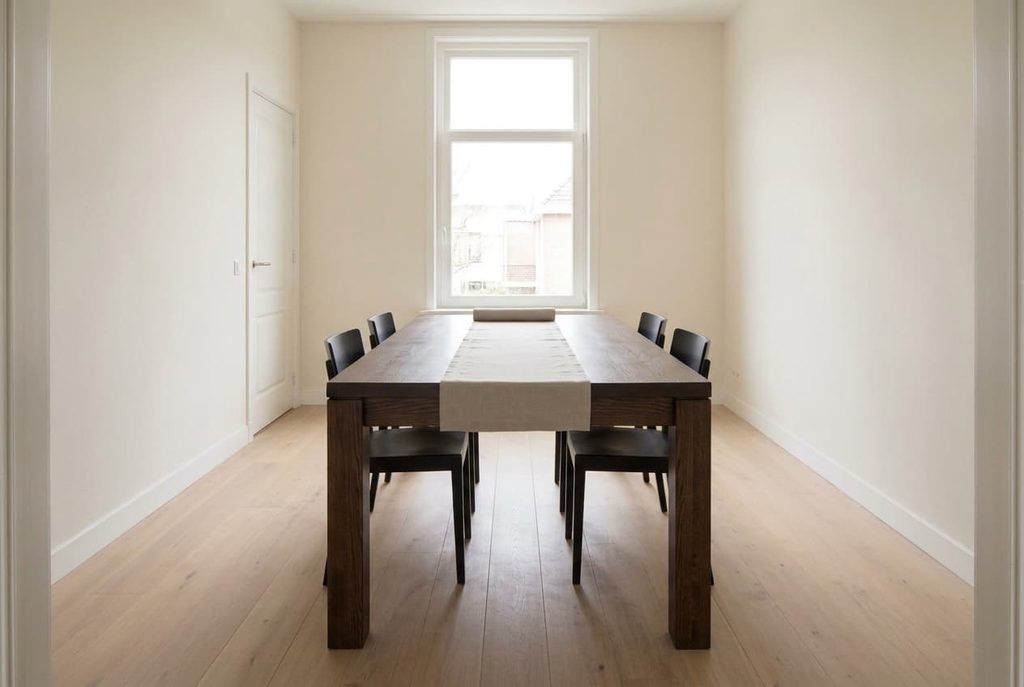
A bright rectangle sits across the centre of the top, and it makes the top look wider than it is. Here the cause is the window’s mirror image on the lacquer, which spans 82% of the top. Lowering a blind to 150 cm is free: it moves the patch’s start to 232 cm and shrinks it to 46% of the top. A linen runner 40 cm wide down the centre breaks the patch where it’s brightest, for the cost of a rearrangement. Replacing the lacquer with a low-sheen oil finish is the purchase, since matt surfaces scatter the light instead of mirroring it. Mark the blind cord at 150 cm so you can repeat the setting every morning.
The table seems slightly crooked to the room, and you can’t name the reason. Here the cause is a near-miss in alignment. Eighteen centimetres is too big to look accidental and too small to look deliberate. Sliding the table until its centreline meets the window’s centre is free. If the door blocks the slide, centre it on the door instead, which is a small rearrangement. Check the door swing first, since 18 cm can bring a chair back into its arc. The purchase is a rug 240 by 170 cm, which sets the table inside an edge it can align with.

What to check so a dining table never feels too big for the room again
Before buying another piece, test it against the three causes. Add a top’s thickness to its apron and divide by the height. I’d keep the result near a tenth, a figure that’s a personal rule of thumb and not a standard. Look at its finish in the doorway light, because a glossy surface on the window axis will carry the patch. Tape the centreline on the floor and check it against the window centre.
A fourth check is for chairs, since high backs add their own mass. Stand them in line and see whether they form a second wall.
Your own room sets how strict each check needs to be. A north-facing window gives a dimmer patch, and a table beyond 379 cm from the door never meets the reflection at all.
The fix that isn’t worth doing
People reach first for buying a smaller table, and the sums show why that disappoints. A 160 by 80 cm top cuts the footprint by 36%, from 2.0 to 1.28 m². The slab on its side still measures 0.25 m², only 20% less. The patch and the near-miss alignment stay exactly as they were. It can’t make a dining table feel too big for the room any less, because the footprint was never the problem, whatever the tape measure says.
You also lose the seat you needed. The room didn’t need a smaller table. It needed less slab at the doorway and less mirror on the top, plus a line to hang the table on.
The footprint was never the real fault in this room.
Mass and reflection explain most of this fault, with alignment as the third factor. Treat each, and the same table will look smaller without losing a single seat. The quickest test is to stand beside the door frame with a ruler in hand. The ruler reads the band against a fifth of the height. A 30 cm shift of your head separates a reflection from a stain. Tape on the floor shows the slip. Start with the free changes this evening: lower the blind, take out the leaf if you have one, and slide the table to meet the window. Look again from the doorway before you spend anything, then decide what remains.
Questions readers keep asking
Can a table look too big even if the aisles are wide enough?
Yes. Aisle width is a footprint test, and the eye judges the table by its visible edge and its reflections, plus its alignment with the walls. A table with a 90 cm aisle all round can still read as heavy. Thick solid edges do it. A large bright patch does the same.
What’s the quickest free fix for a table that feels too big?
Turn it through 90° if the aisles allow, so the short end faces the door. That halves the visible slab in our example, and it costs nothing. If you can’t turn it, lower a blind to cut the reflection. Check the result from the doorway before you decide.
Will a tablecloth make a big table look smaller?
Usually not. A floor-length cloth adds a vertical band the full height of the table and hides the legs, so the slab grows. A runner 40 cm wide does more, because it breaks up the bright patch and leaves the edge visible. Choose a matt linen over a shiny fabric.