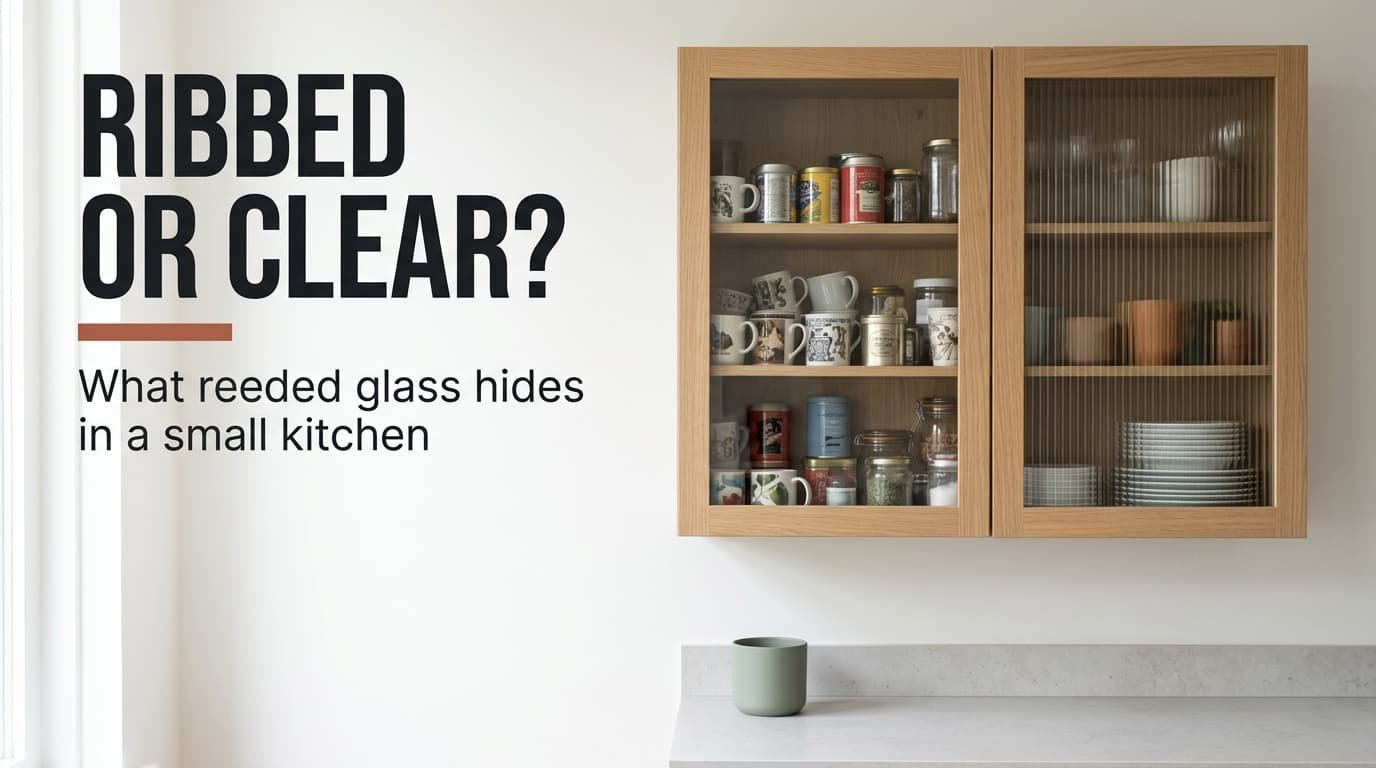
Run a thumbnail across reeded glass and you feel ribs about 8 mm apart and 3 mm deep. That small object explains why reeded glass is replacing clear glass in small kitchen cabinet doors: each rib bends what lies behind it. Mugs and tins turn into soft colour while the door keeps its light. The effect is real and measurable. It hides the back of a shelf and leaves the front readable. The figures use a Dutch kitchen with wall cabinets of 60 cm width and 30 cm depth, so measure your own doors before you trust them.
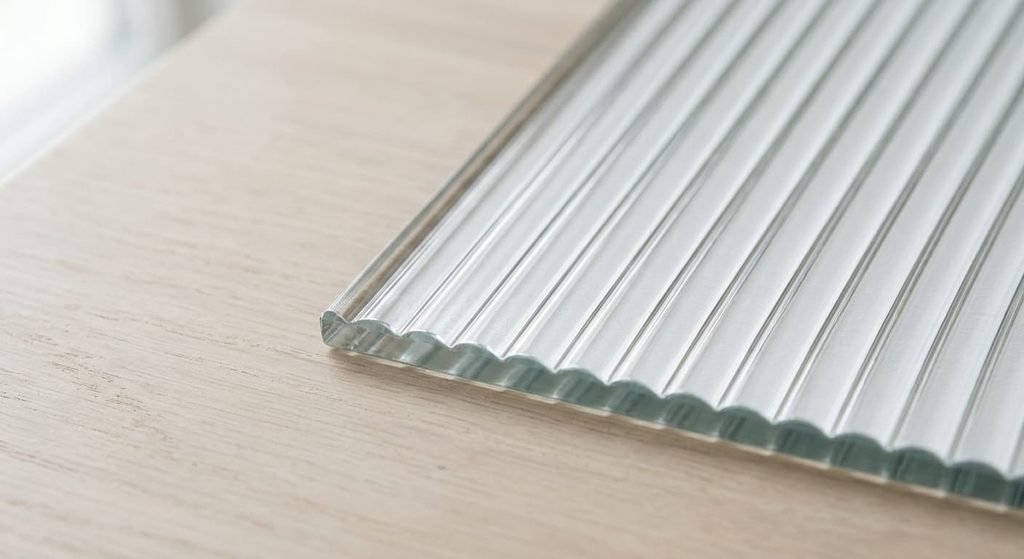
Where the ribs came from
Ribbed glass is an old material, and it has long served wherever light should pass and a clear view shouldn’t. Bathrooms and office partitions used it for that reason. Kitchens stayed with plain panes, because a cabinet door was meant to show what the cabinet held. A pane the size of a door is also easy to swap, which let the idea spread from rooms where it was already familiar. That made the choice low-risk, because the panel could change while the cabinet stayed.
Then kitchens changed jobs. Cooking now shares one room with the table and the desk, and the wall cabinets sit in plain sight of the sofa. A clear door turns every shelf into a display, and a small kitchen has little spare tidiness to put on show.
Reeding arrived as the half-measure. The door keeps its glass and its glow, and the contents lose their outline. The change came by degrees. Wide, coarse ribs came first. Finer ones followed, and each version felt less jarring than the one before.
What actually changed as reeded glass is replacing clear glass
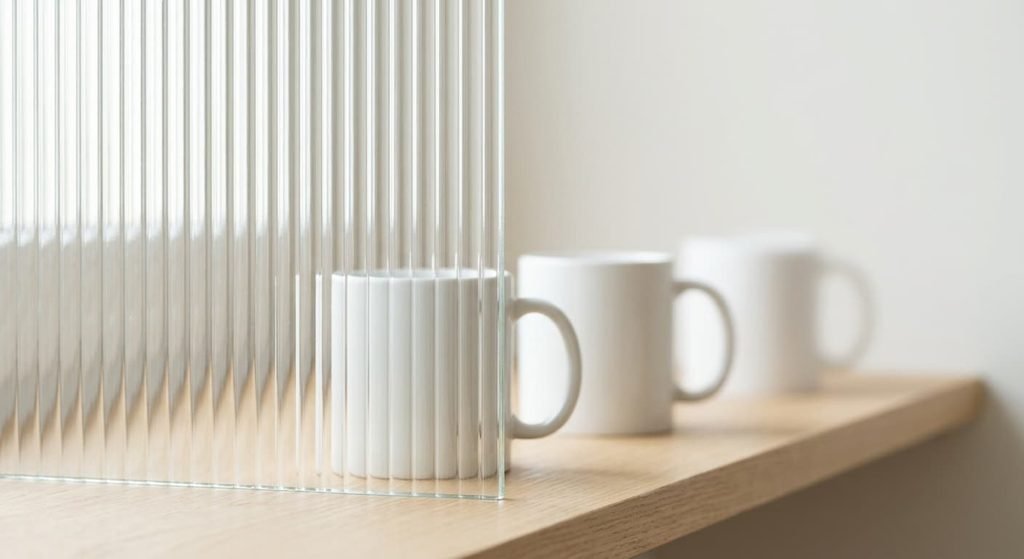
Behind plain glass, an object keeps its shape at any depth. Behind ribs 8 mm apart, each rib shifts the image sideways, and the shift grows with distance. In the example it is 0.2 cm for every centimetre behind the pane, so smear = 0.2 × d. A shape stays readable while the smear is under a quarter of its width.
Take a mug 8 cm wide. A quarter of its width is 2 cm. It reads while 0.2 × d is under 2, which means d is under 10 cm. At the back of a 30 cm shelf the smear is 6 cm, and the mug’s 8 cm width spreads into a 14 cm blur of colour. A dinner plate 26 cm wide survives much deeper. A quarter of its width is 6.5 cm, so it stays readable out to 32 cm, which is the whole shelf. Run the sums the other way round and the rule is short: divide a quarter of the object’s width by 0.2. A cup 6 cm wide reads out to 7.5 cm, and a jar 10 cm wide out to 12.5 cm. The 0.2 rate is an example, since real ribs vary, so a sample at your own distance beats any table.
So the share of a 30 cm shelf where an 8 cm mug stays readable falls from 100% to 33%, and the plate’s share stays at 100%. Small things dissolve first, and large flat things stay crisp.
Light still passes the pane in both cases, so the outline is what changed and the glow stays.
Who it suits, and who it doesn’t
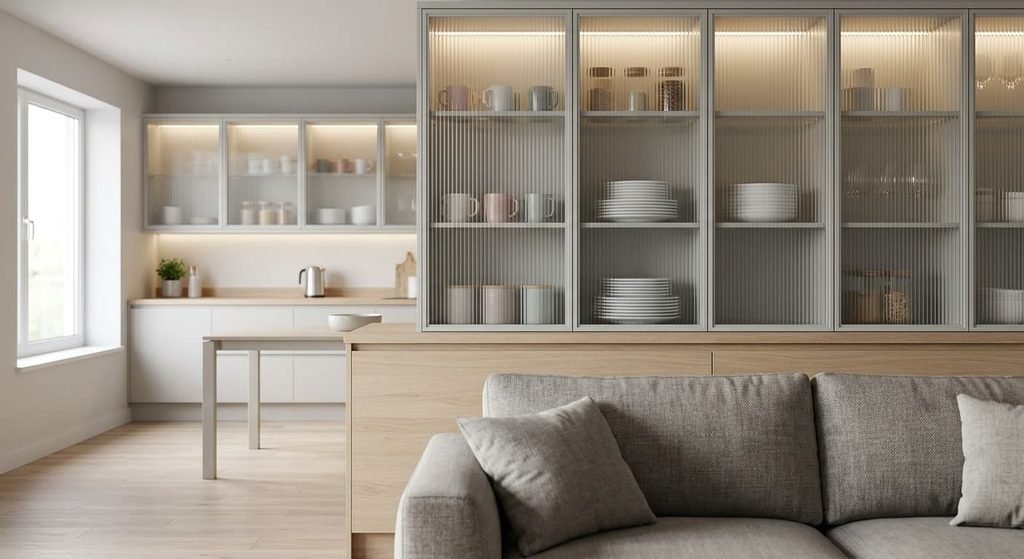
Where reeded glass is replacing clear glass, it suits a kitchen that opens onto a living area, with cabinets at eye level and mixed everyday crockery behind them. The mugs and jars sit in the back two thirds of the shelf, so they turn to colour, while a stack of plates keeps its shape. Spice jars and tins 6 to 10 cm wide fall inside the 7.5 to 12.5 cm zone from the sums, so they read only in the front row. Cabinets seen mostly from 3 m or further gain the most. Distance blends the ribs into one soft surface. A pale interior helps. White or pale grey paint inside the cabinet makes the ribs glow.
It suits a collection badly. Eight small glasses shown in a row need every outline, and the ribs remove them beyond 10 cm. A very dark interior also hurts, because the pane then reads as a black panel and the smear has no colour to carry.
Shelf depth matters most. A shallow cabinet of 15 cm gives a smear of only 3 cm at the back. A mug is still half readable. You gain little and pay the same. Check the shelf depth first, because depth sets the smear more than any other number
.Replacing clear glass: is reeded glass worth it
Change the glass only when a door is being replaced anyway or its shelves sit untidy at eye level, and treat everything else as optional. A working clear door has years left. Six doors with panels of 44 by 54 cm need 1.4 m² of new glass, plus a day of fitting and removal. Weigh that against a tidier look you can test first with film for a week.
Reversal costs differently. A film peels off and leaves the door as it was. New glass is permanent. If you move, the next kitchen may suit clear glass better, and the reeded panels stay behind with the old one.
The moderate move is film on the existing pane, which gives the same smear for a fraction of the effort. It also lets you compare. Peel it from one door and set that door beside its neighbour the same day.
The version that will date fastest
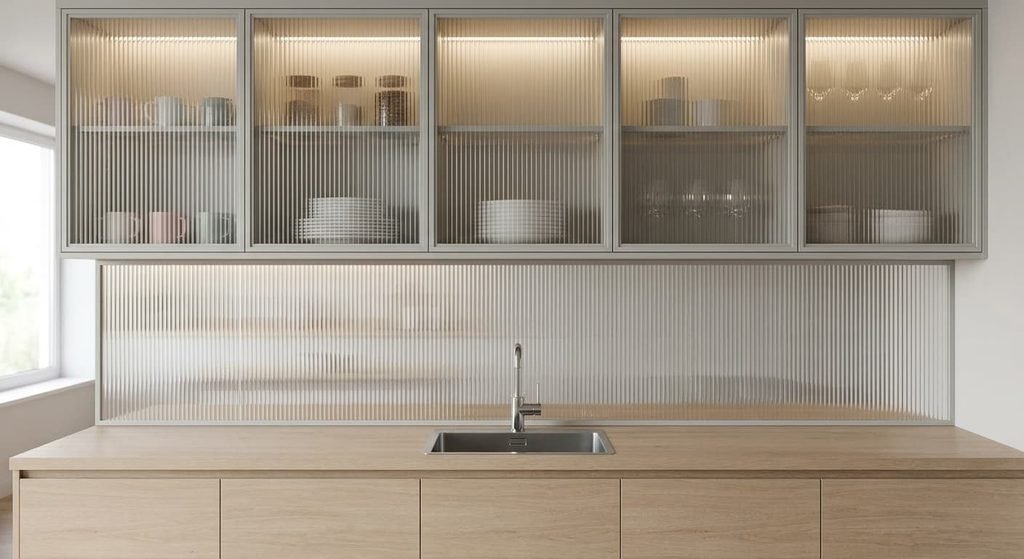
As reeded glass is replacing clear glass, the far end of the trend is an all-ribbed kitchen, with reeded doors and a reeded splashback. Every surface repeats the same blur. Nothing is plain, so nothing reads as a contrast, and the room looks like a single idea.
Three things age it. Ribs 8 mm apart and 3 mm deep stretch the surface path. A rounded groove of that size measures about 10.7 mm along its curve over 8 mm of width, which makes 1.34 times the wiping length, and grease settles in the grooves. A splashback needs wiping daily, so the cost repeats. The look also fixes the room to one idea, and the next idea has to start from bare walls.
My view is that the splashback does the most damage, since it’s the one surface that meets grease every day. I wouldn’t recommend any of it.
The moderate version keeps ribs on a few eye-level doors and plain surfaces everywhere else.
How to try it without committing
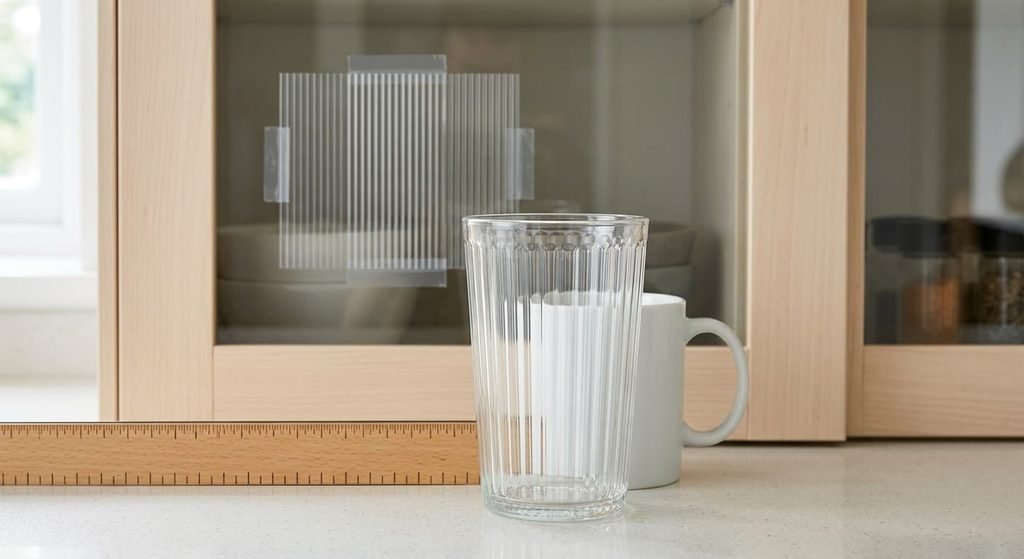
Hold a fluted tumbler or tape reeded film on one door for a week, then test the depths. Move an 8 cm mug back from 5 cm behind the glass to 25 cm, standing 2 m away at each step, and photograph each step from the same spot. Note the distance where the mug stops reading as a mug. In the example it should be near 10 cm. Then put a stack of plates at the back and see that they stay crisp. If your tidy front row looks calm and the back row turns to colour, the effect works in your cabinet.
Reeded glass is replacing clear glass because a small kitchen shows its shelves to the whole room, and ribs trade outline for glow at a measurable depth. Buy it when a door needs replacing anyway, or try film first. Keep the rest of the kitchen plain, and measure before you commit. Test one door first, and check the shelf depth before you order any glass.
Questions readers keep asking
Is it worth swapping clear glass for reeded?
Only if a door needs replacing anyway or its shelves look untidy from the room. The gain is that the back two thirds of a 30 cm shelf turns to colour for small items. Try film for a week before deciding. It costs little and peels off cleanly.
Does reeded glass suit a small kitchen?
Often, yes, when the kitchen opens onto a living area. Ribs 8 mm apart hide small mugs and jars beyond about 10 cm while keeping the door’s glow. Shallow 15 cm cabinets gain little, so check the depth of your shelves before you decide.
Will reeded glass go out of style?
Nobody can forecast that. The geometry behind it doesn’t date, though: ribs trade outline for glow at a measurable depth. The all-ribbed kitchen is what ages quickest, because it fixes every surface to one idea. Keep ribs to a few doors and leave the rest plain.