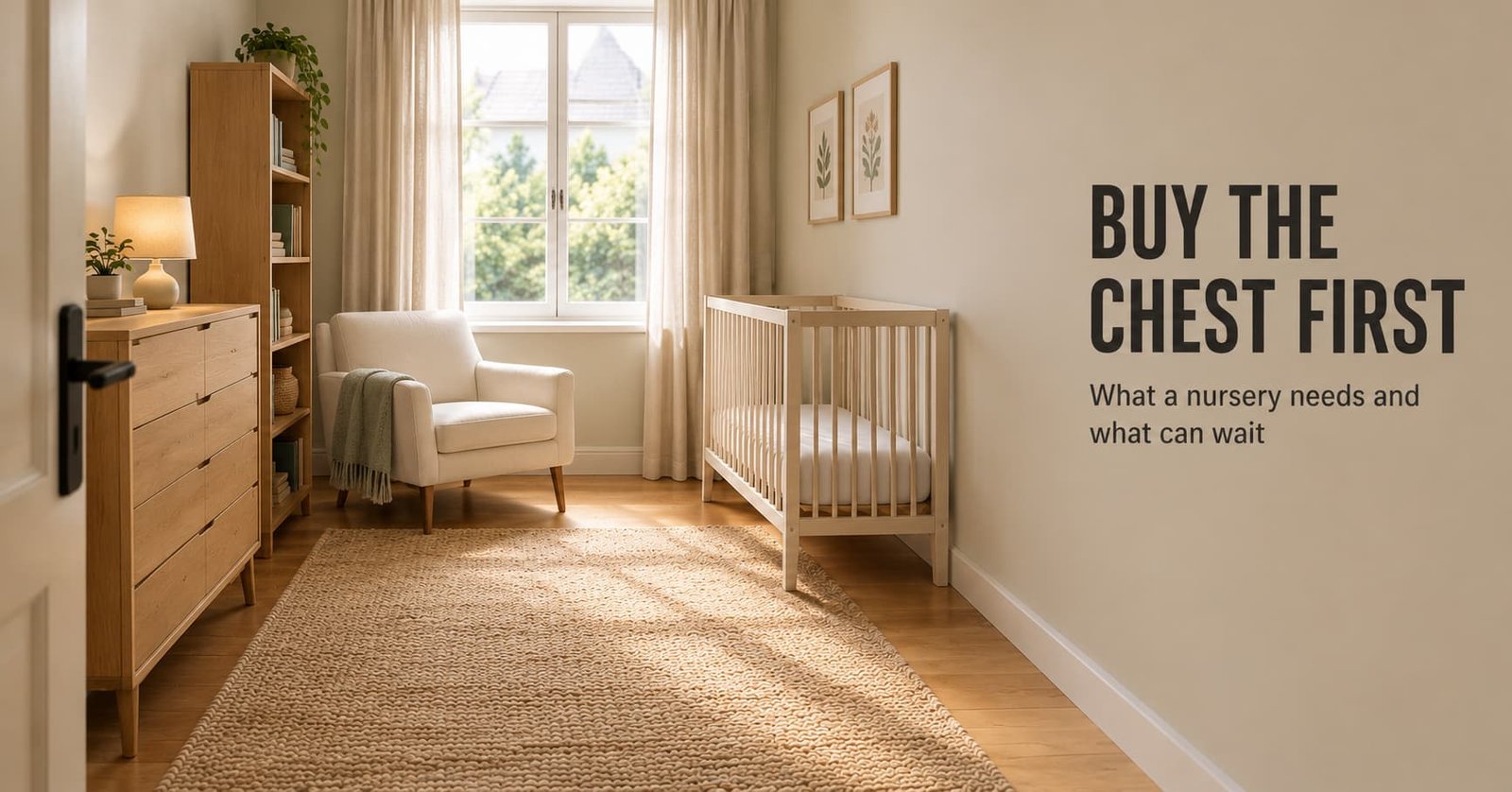
Buy the furniture for a ten-year-old first. What a nursery needs before anything else is a solid chest of drawers. It is still in daily use when the child starts school. Lined curtains come second and a shelf third. A rug and a pair of prints finish the list, and everything themed can wait.
This list assumes a room about 280 by 340 cm that stays the child’s room for years. Prices date within a season, so none appear here. Instead every item gets a test of its build that you can run in a shop. The order matters more than the amount.
The rule behind what a nursery needs
A baby outgrows a room in months, while the room carries on for a decade or more. That gap sets the rule: divide each outlay by the years the item stays in the room. A chest kept for twenty years costs a twentieth per year of what the same sum costs on bedding kept for one. It can cost far more and still be the cheaper piece. Run the sum for every piece before it goes in the basket. Take the years it will stay, then divide the outlay by that figure. Pieces that stay two years or fewer belong at the cheap end, whatever they look like in the shop.
The second half of the rule is about reversal. Wall colour changes in an afternoon, while a failed chest means a van and a refund. Money goes first where a mistake is hardest to undo. I’d choose the wall colour last. Do it once the chest and curtains are in the room. Wood and fabric fix their colours, and a tin of paint can be matched to them. The reverse order asks cloth to match paint, which is the harder match.
Paint follows the furniture.
What the nursery needs, in buying order
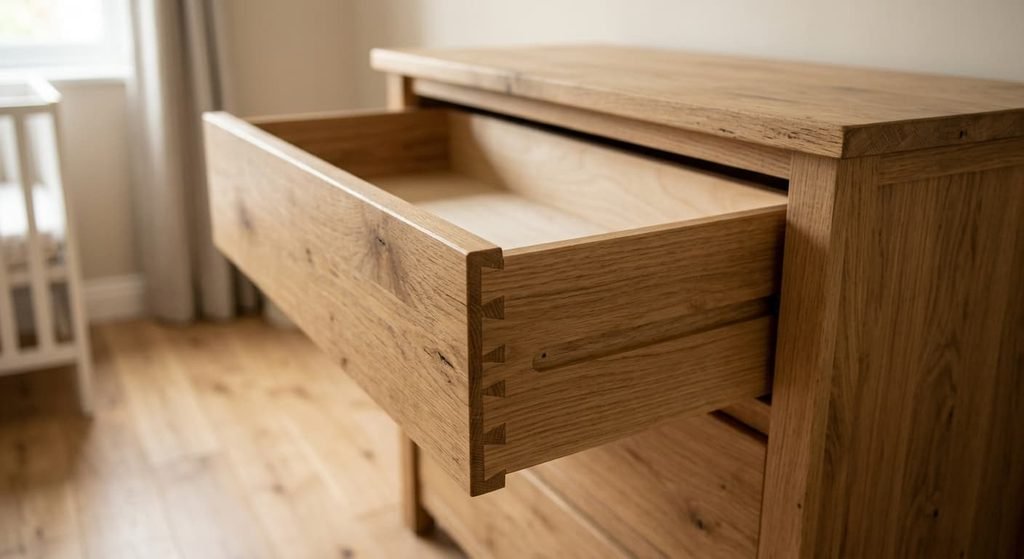
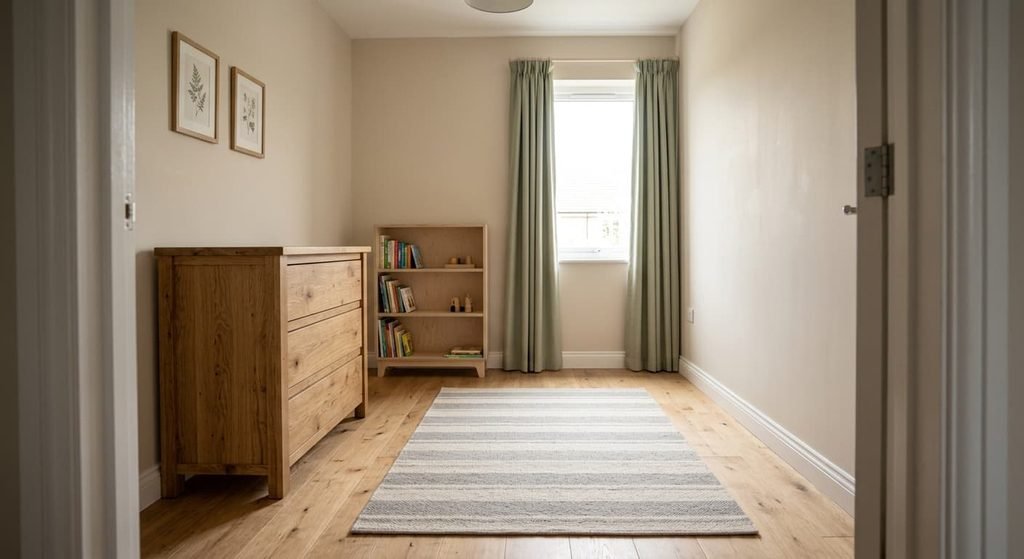
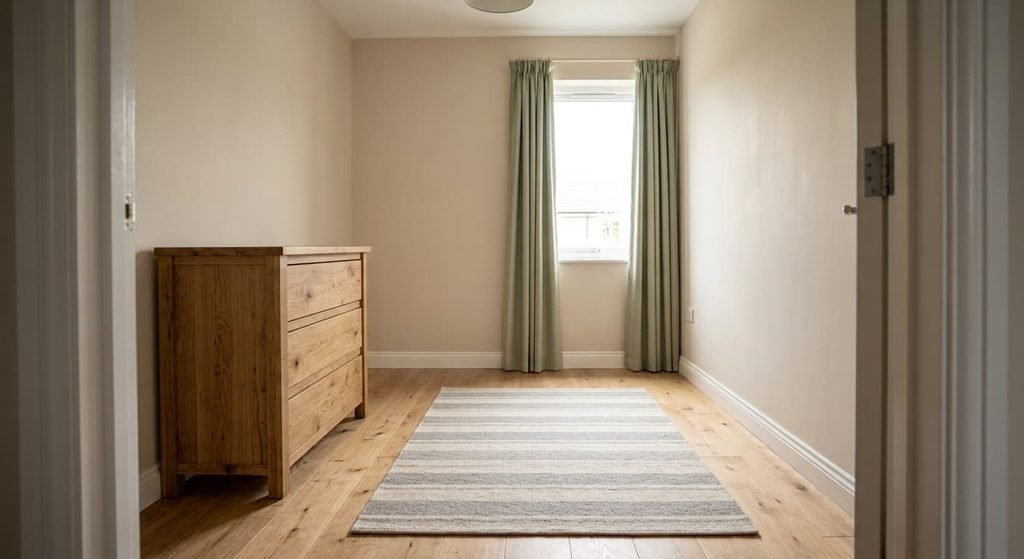
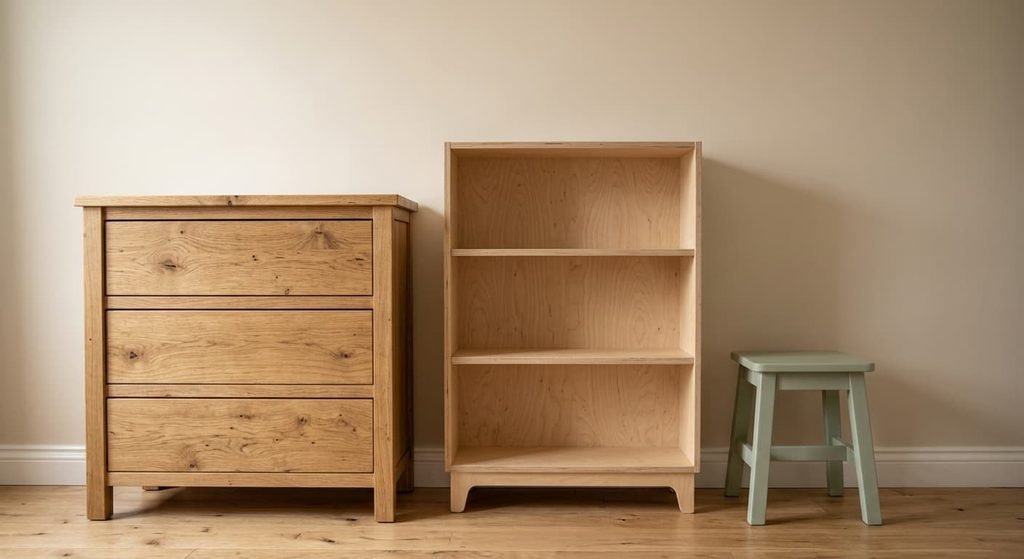
1. A solid chest of drawers about 100 cm wide and 45 cm deep. It has a plywood or solid-wood carcass and drawer boxes joined at the corners by dovetails or dowels. It comes first because it holds the room’s clothes now and becomes the child’s dresser for twenty years. Tier: BUY ONCE, since joinery decides whether drawers still slide in year ten. A bad version has drawer bottoms of thin hardboard stapled into a groove. Another has plastic runners that snap under one overloaded drawer.
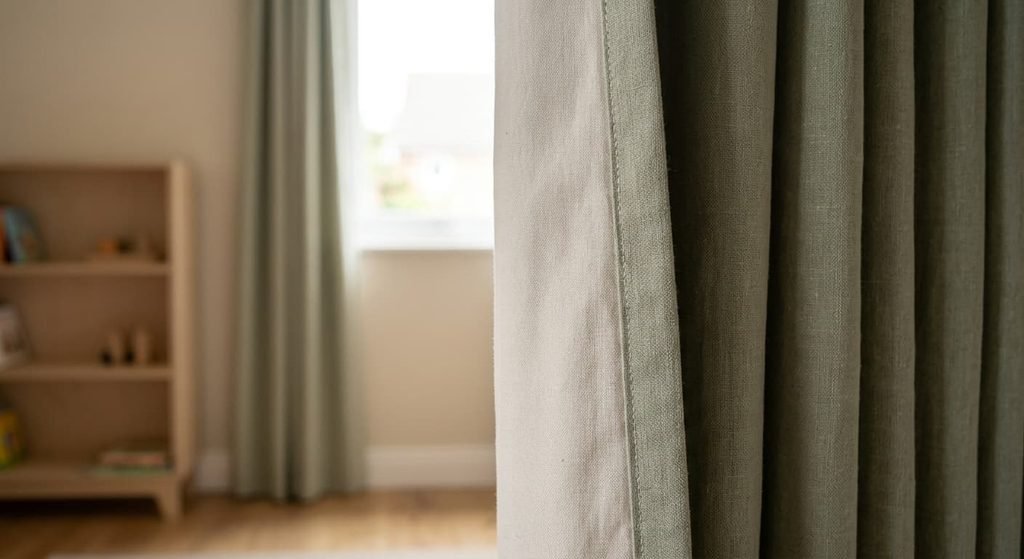
2. Lined curtains on a track that reaches 20 cm past the window frame on each side. The cloth is cut to twice the track’s length. They sit second because they set the room’s colour by day. They are awkward to change once the walls are done. Tier: MID, since the lining is the part that wears. A bad version has a lining sprayed on as a coating that cracks along the folds. Another is gathered to only 1.2 times the width and hangs flat.
3. An open bookcase of plywood or solid wood with shelves at least 18 mm thick, sized about 80 by 30 cm. It sits third because it carries books and baskets from the first year to the teens. It also needs the chest’s position first. Tier: MID, because thickness is what you are paying for. A bad version has 12 mm shelves that bow within months, or a fibreboard back panel held by a few nails.
The layers that go on top
4. A low-pile flat-weave rug in a wool blend, 160 by 230 cm. Centred in a room 280 by 340 cm, it leaves 60 cm at the sides and 55 cm at the ends. It follows because it needs the furniture’s footprints before it can be sized. Tier: MID, since wool blends keep their shape. A bad version has a latex backing that flakes or a dye that bleeds onto a damp cloth.
5. Two framed prints, hung together on one wall in wood frames with a rigid backing. They come last because they depend on every colour already in the room. Tier: BUY CHEAP, since swapping them as the child grows is the point. A bad version has a card backing that warps, or a print on thin paper that curls in the frame.
Where to spend and where not to
Put the money into the chest and the curtain lining. Both are judged by construction you can see. Compare a dovetailed drawer box with one held by staples, and a lining woven into the cloth with one painted onto it. Each lasts a decade or more if it is made properly, so the per-year sum from the rule favours them. A drawer box held by staples tends to loosen within a few years, while a dovetail holds by the shape of its interlocking pins. A woven lining keeps its drape and its opacity after many washes. Coated linings start to flake at the first fold.
One item moves down the list. Readers expect to buy a dedicated changing unit. Yet the chest top with a flat mat on it does the same job. The unit is a second chest that the room stops needing within a couple of years. Put the outlay into the chest underneath.
The middle holds the bookcase and rug, along with the curtains. They earn better materials but never the top tier. Prints are the cheapest item and the first to change.
The joinery tells you more than the price does.
What this order assumes, and when it breaks
The order assumes three things. You may fix a track to the wall, the room fits a rug of 160 by 230 cm, and the child will keep the room. A renter breaks the first. Swap the track for a tension pole that sits inside the window recess and move the colour into the rug.
A box room 200 by 230 cm breaks the second. On the floor, a rug of 120 by 170 cm leaves 40 cm at the sides and 30 cm at the ends. Use a chest 80 cm wide in place of the 100 cm one.
A nursery that reverts to a guest room in two years breaks the third. Then the chest still comes first, since a guest room needs one too. The prints and rug can be cheaper. Whatever your plan, what a nursery needs depends on the years the room will be used. Hold a lining sample against the window at midday before you order, because I can’t see how bright your window is.
What to skip entirely
What a nursery needs least is a matched nursery furniture set. Pieces sold together share one finish, and that finish then rules every later purchase. A set also repeats one wood tone from wall to wall, which flattens the room. Buy the chest on its joinery and let the other pieces differ.
Themed bedding and wall decals come next. They fix a character or a colour that the child will have outgrown within a year. Decals can also lift the paint when removed. A child-sized chair is the last to go, since it fits for only a short span. A shelf cut into a themed shape holds fewer books than a plain one and dates faster.
The first purchase is a chest of drawers that will still work when the child is ten. Lined curtains come next. A bookcase and a rug follow, then two prints. The themed items wait until the room has settled. I’d keep the first month’s list to the chest and the curtains, then let the room show what it is missing. Most rooms ask for far less than the catalogues suggest. The pieces that remain are the ones the child grows up beside.
Questions readers keep asking
How many pieces does a nursery need?
Five cover what a nursery needs: a chest of drawers, lined curtains, a bookcase, a rug and a pair of prints. Each piece covers a large surface or carries the room’s storage or light. More than five adds clutter to a room 280 by 340 cm. The extras date faster than the child grows.
What should you buy first for a nursery?
Buy the chest of drawers first. It’s the biggest piece and the hardest to change, and it’s still in use after ten years. Choose it on its joinery and runners. Leave the wall colour until the chest and the curtains are in the room.
How do you judge a chest of drawers by hand?
Pull a drawer fully out and look at its corners. Dovetails or dowels mean a strong box, while staples mean a loose one. Then press the drawer bottom with your thumb: a thick panel stays flat, and thin hardboard flexes. Finally, check that the runners hold a loaded drawer without wobbling.