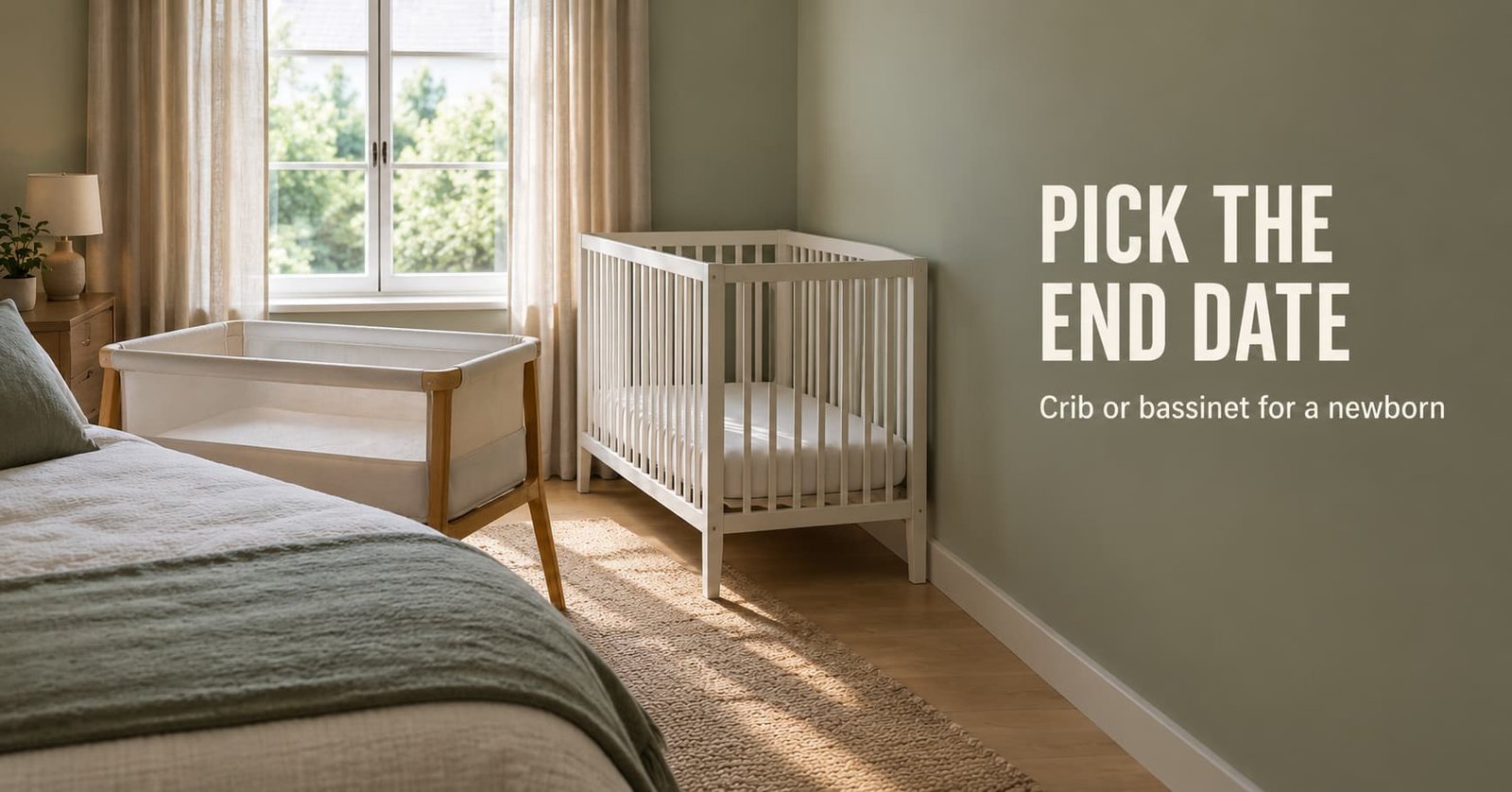
Pick the bed by the day it runs out. For a crib or bassinet for a newborn, that day is the whole decision. A bassinet is usually outgrown at about five months, while a crib lasts into toddlerhood. Take the bassinet when the bedroom is small, and the crib when you want one bed to cover everything.
The NHS advises keeping a baby in your room for the first six months, which is longer than most bassinets last. This guide assumes a Dutch bedroom 300 cm wide with a 160 cm bed. It says crib for what the UK and Europe call a cot.
The date that decides crib or bassinet for a newborn
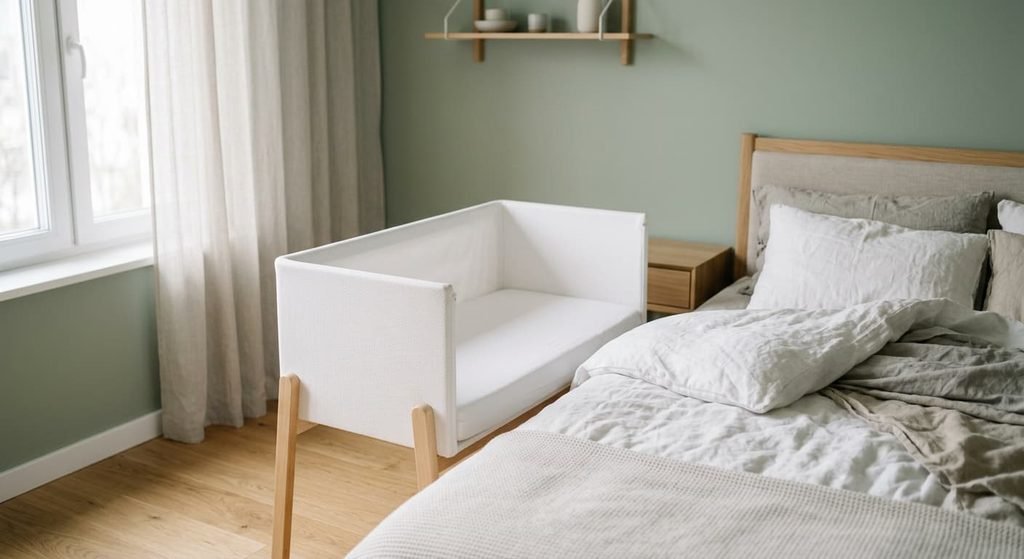
Two clocks run at once. The first is the advice to keep the baby in your room for six months. The second belongs to the bassinet. It ends at about five months or at the first roll or push up on hands and knees, whichever comes first. The maker’s weight limit can end it sooner, and it’s commonly printed between 7 and 9 kg. Safety regulators in the United States and Australia both publish these conditions. A crib carries no such ceiling until the child can climb out.
The sums are short. With a due date of 14 March, five months ends on 14 August and six months ends on 14 September. That leaves a month when the bassinet may already be outgrown and a second bed has to exist. A baby who rolls early widens the gap. The bassinet’s last night is set by the earliest limit on its label. I can’t see your baby’s growth from here, so treat five months as the latest date and the label as the final word. A bassinet that matches your bedroom still has a last night, and finding it takes one pencil and a calendar.
My own ranking puts the crib first wherever the floor allows it, even though a bassinet feels like the natural newborn bed.
Bassinet or crib for a newborn, side by side
| Property | Bassinet | Crib |
|---|---|---|
| Safe-sleep limit | About five months, or sooner if the baby rolls over or pushes up | Until the child can climb out or outgrows it |
| Covers a six-month room-share window | Only if no age limit or weight limit arrives first | Yes |
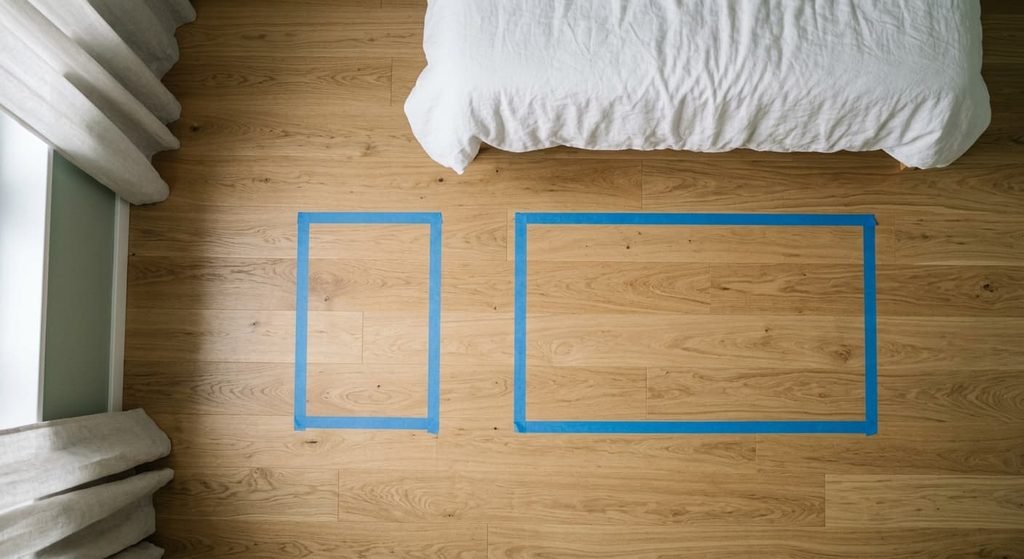
| Typical footprint (check the maker’s figure) | About 75 × 45 cm | Around 135 × 75 cm, about three times the floor |
| Moving between rooms | Light enough to carry or wheel from the bedroom to the living room | Stays in one room unless you take the frame apart |
| EU standard to look for | EN 1130 | EN 716-1, with the mattress to EN 16890 |
| Cleaning | Fabric sides, often with a cover that comes off for the wash | A fixed frame with rails to wipe; the sheet is the part you wash |
| Sleep surface | The mattress supplied, with nothing added | A firm, flat mattress that fits with no visible gap |
The surprising row is the second one. A bassinet is sold as the newborn bed, yet its limits can arrive before the six months of room-sharing are over. A second bed belongs in the budget from the first day. Only the crib covers the window outright, and the footprint row shows what that costs in floor.
Where a crib wins
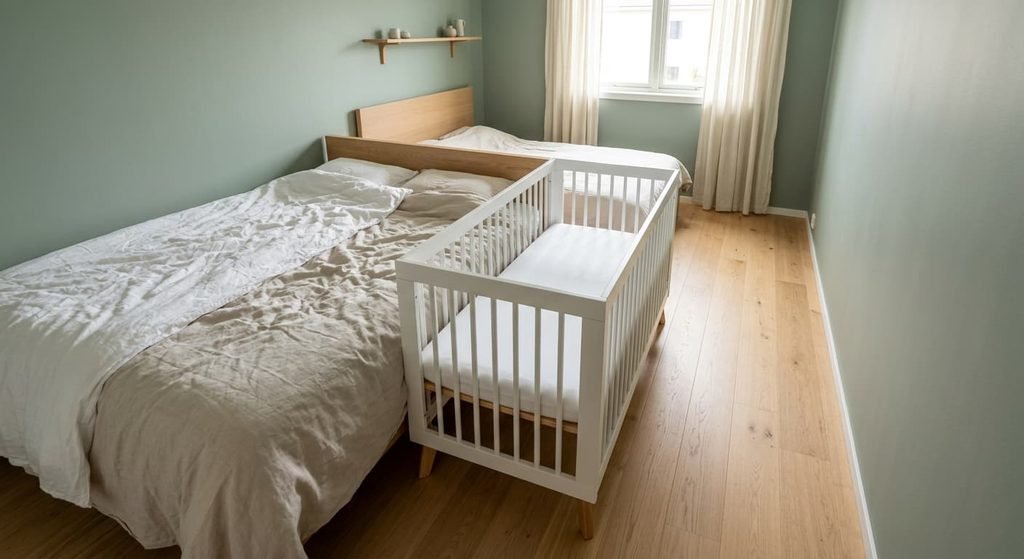
The crib wins on duration. One purchase covers the whole room-share window and carries on into toddlerhood. There’s no changeover in the weeks when the baby starts to push up. The mattress and fitted sheets stay the same, and so does the spot beside your bed. A tired parent has one decision fewer to make in a hard stretch.
It also wins in bigger bedrooms. In a room 300 cm wide with a 160 cm bed, 140 cm remains beside it. A crib 75 cm wide leaves 65 cm. That’s five more than the 60 cm an adult needs to walk through without turning sideways, so it fits with almost nothing spare. It takes about 1 m² of floor, three times a bassinet’s 0.34 m².
The unglamorous reason is the second child. A crib that meets the current standard can serve for years. The same frame takes the next baby once the mattress has been checked.
Floor is the crib’s one real cost.
Where a bassinet wins
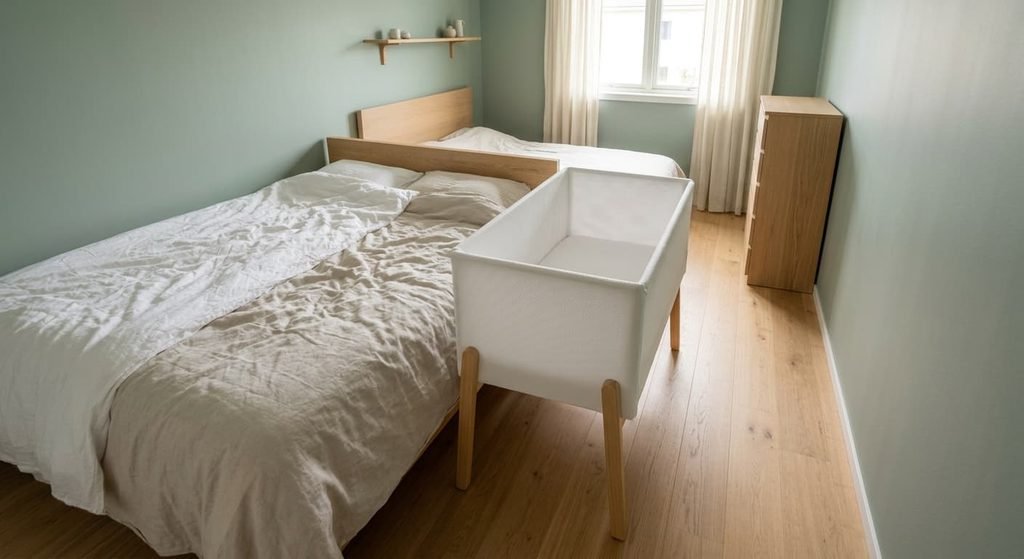
The bassinet wins on floor. In a Dutch flat with a bedroom 270 cm wide, a 160 cm bed leaves 110 cm. A bassinet 45 cm wide leaves 65 cm to walk through. A 75 cm crib leaves 35 cm, which is a wall in practice. Choosing a crib or bassinet for a newborn in that room takes no thought, because the small bed is the only one that fits beside you.
It wins on mobility too. A light bassinet follows you from the bedroom to the living room. A daytime nap happens in the same bed and in your sight. Nobody has to buy a second sleep space for the downstairs.
The unglamorous reason is how easily it leaves the house. After five months it goes to the next family or into a car boot. It never sits in a spare room as furniture you have to store. Its cost is the calendar: you must buy or borrow the next bed before the limit arrives.
When neither bed is the right call
Neither bed has a safety edge. A crib that meets EN 716-1 is as safe for a newborn as a bassinet that meets EN 1130. Both depend on the same rules: the baby on the back, a firm flat mattress and nothing else in the bed. The belief that a smaller bed protects a smaller baby is false.
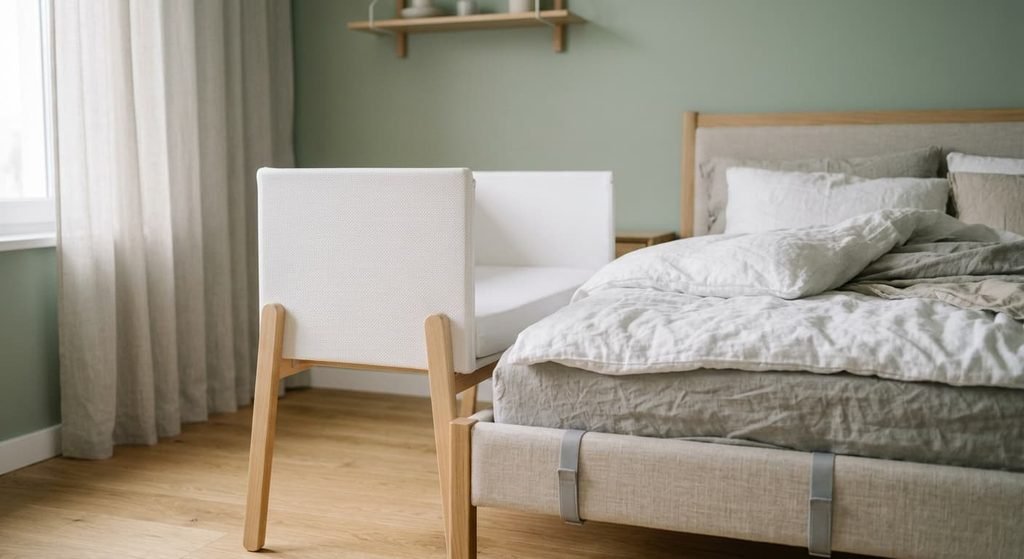
A third route is a bedside sleeper. It’s a small bed with one side lowered, attached to your own bed so the baby lies at your level. It sits against the bed, so no walkway has to be kept between the two. Check its own limit, because some stop at the same five months as a bassinet. Close the gap between the two mattresses exactly as the instructions show. A baby born early or with a health condition is a case for the midwife or health visitor, who decide what the bed must do.
How to decide in thirty seconds
If the free floor beside your bed is at least 135 cm, take the crib. That’s a 75 cm crib plus a 60 cm walkway. It covers all six months and carries on afterwards, so you buy one bed. Measure with a tape before you settle crib or bassinet for a newborn, because the bedroom wall wins every argument.
If the free floor is under 135 cm, take the bassinet. Write its last night in your diary today: five months after the due date, or the first roll, whichever comes first. Buy or borrow the next bed before that date, and keep the label where you can find it.
A bassinet buys a few months of small and light. A crib buys the full stretch and asks for a metre of floor. I’d count the floor first and the calendar second. Most households find the answer announces itself within five minutes of measuring. That happens long before they open a shop page, and the bed they end up with suits the room as well as the baby.
Questions readers keep asking
How long can a baby use a bassinet?
Usually until about five months, but the earliest condition ends it. Stop when the baby pushes up on hands and knees or rolls over. Sitting unaided and reaching the maker’s weight limit end it as well, whichever arrives first. Read the label on your model. Limits differ, and a larger baby can reach them sooner than the calendar suggests.
Can a newborn sleep in a full-size crib from day one?
Yes, if the crib meets its standard. The mattress must be firm and flat, and it should fit the frame with no visible gap. Lay the baby on the back in an empty bed: bumpers and pillows stay out, as does loose bedding. The empty look of a large crib is correct, and size doesn’t change the safety rules.
Is a crib or bassinet for a newborn better in a small bedroom?
The bassinet, usually. It takes about 0.34 m² against a crib’s 1 m², and it leaves a walkway when the floor beside your bed is under 135 cm. Plan the second bed before its limit arrives, since the room will need one around month five.