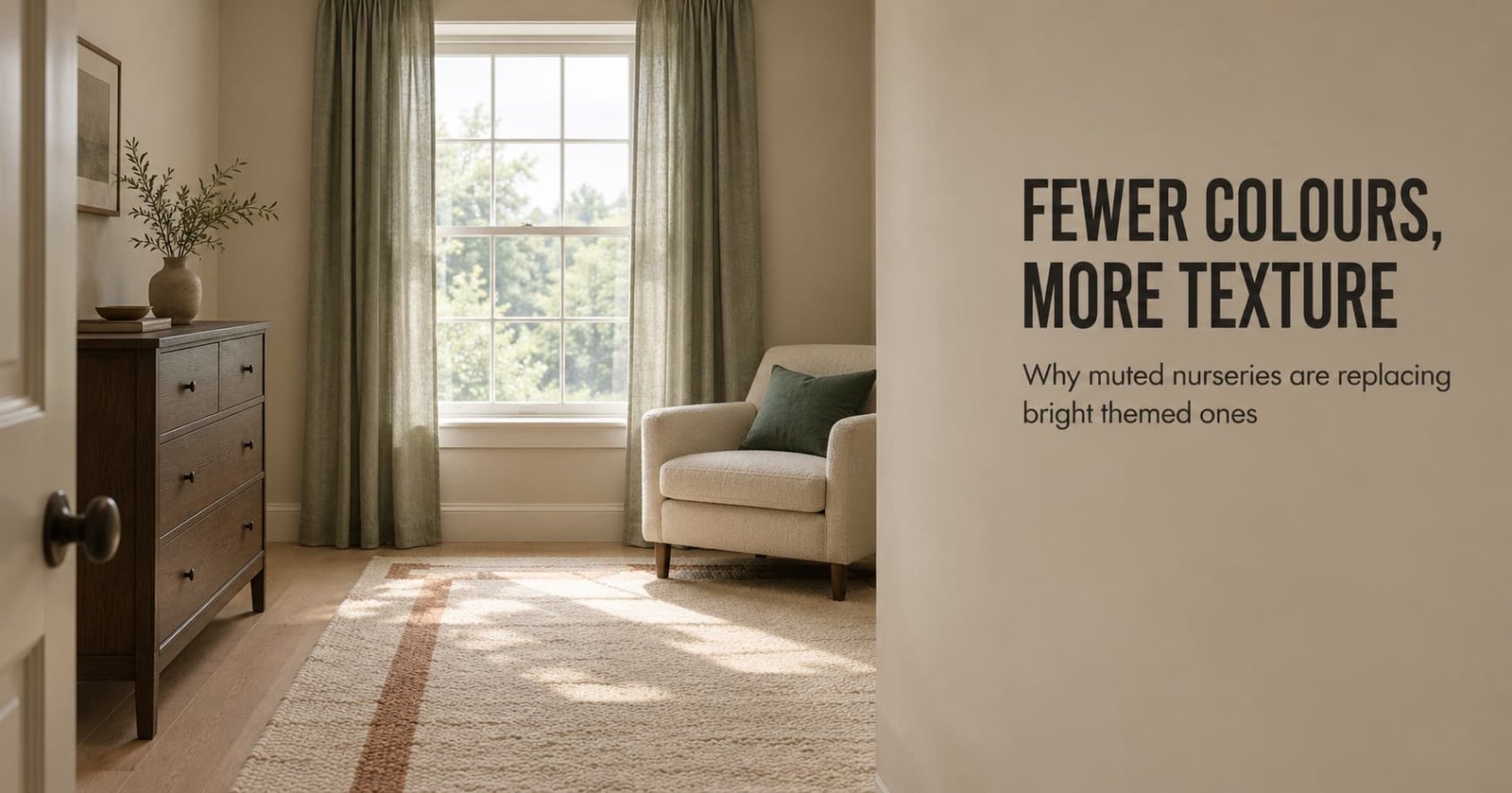
A bright themed nursery asks the room to tell a story. A muted one asks it to hold still while the textures talk. The shift is real, and you can measure it: muted nurseries are replacing bright themed ones because they use fewer colours and repeat a theme on fewer surfaces. Adopt the moderate version with three or four tones and one dark anchor. Skip the all-beige extreme.
The room in mind here measures about 250 by 310 cm and has one window under a 2.5 m ceiling. It describes only what you can see in the room.
Where the themed nursery came from
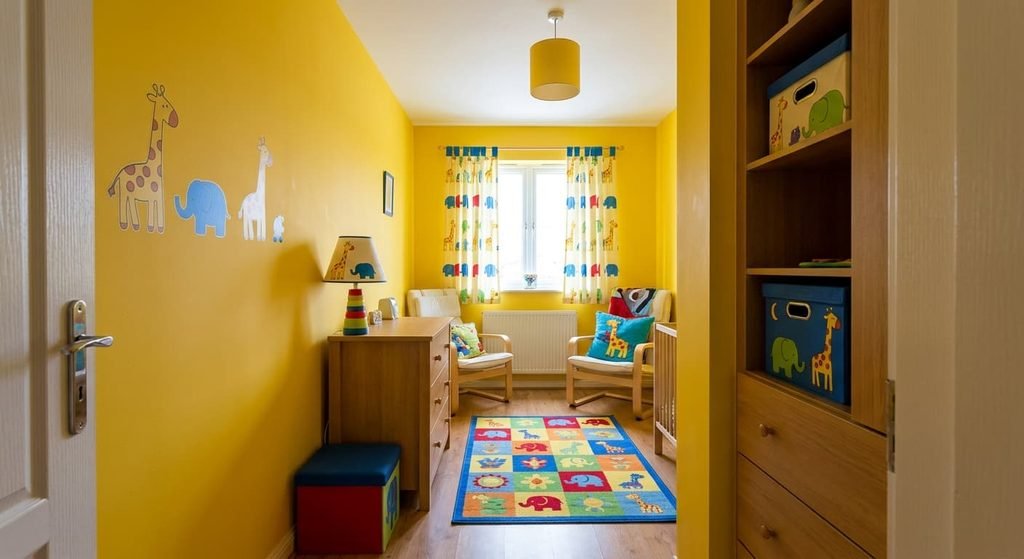
Through the 2000s a nursery was often bought as a scheme. A theme such as animals or boats arrived as a set of matching items. Each came in saturated primaries or sugary pastels. The theme repeated on the walls and curtains, then again on the lamp and the storage. The logic was convenience: one shop visit settled the room.
Three conditions help explain why that scheme loosened over the past decade. A nursery now has to serve as a child’s bedroom for many years, so a theme that suits a baby stops fitting at four. Textured natural materials, from linen to oak, became easy to buy at every budget. And a tin of low-saturation paint costs no more than a loud one, which removed the price reason for a themed scheme. The scheme also had a cost that showed later. A baby outgrows a theme faster than a room outgrows its walls, and matching pieces rarely suited any other room in the house. A cartoon animal repeated on six surfaces can’t be partly kept.
What actually changed as muted nurseries are replacing bright themed ones
Count the colours and the themed surfaces. The change typically runs from five or six saturated colours and a theme on six surfaces to three or four low-saturation tones and a theme on one. Saturation is how far a colour sits from grey, and the new palette sits close to it: oat, clay, sage, warm white.
Pattern shrinks as well. A bright scheme repeats one motif of 10 to 15 cm across the curtains and the cushions as well as the wall, while the muted scheme keeps pattern to a single stripe or check on one textile. Walls usually sit in a warm off-white or a light oat rather than a primary.
The second change is where the variety comes from. A bright room varies by hue, so a yellow wall meets a blue rug and a red curtain. A muted room gets its range from texture and lightness, with bouclé against smooth oak, linen against wool.
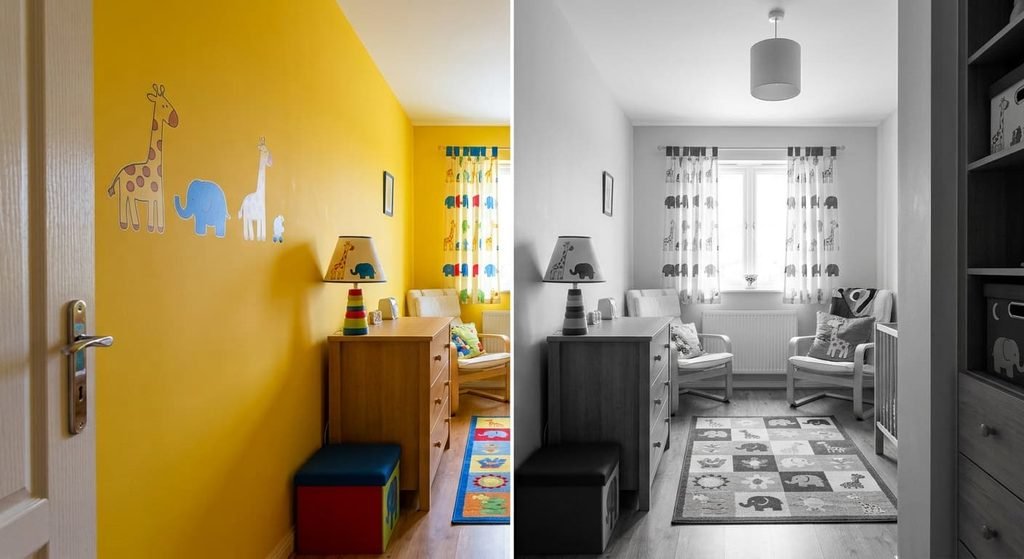
Try a photograph test to see the difference. Turn a picture of the room to black and white. Many saturated hues share a similar lightness, so a bright themed room tends to flatten into one grey mass, while a muted room keeps its edges because the oak is darker than the wall and the wool is lighter than the floor.
Black and white is the honest test.
The third change is replacement count. Each themed surface needs replacing when the child outgrows the theme, which makes six replacements in the old scheme against one in the new. Walls move from a decal and a mural to a framed print or nothing. Furniture moves from painted colour to natural wood.
Who it suits, and who it doesn’t
Daylight and length of use decide who gains where muted nurseries are replacing bright themed ones. A room that stays the child’s bedroom for eight or ten years suits it. So does a household expecting a second child. Oat and oak carry over where a cartoon character does not. A renter gains too, because the colour lives in textiles that move with you. Decent daylight gives low-saturation tones something to work with. An east- or south-facing window helps most. A room that later doubles as a study needs no redecoration.
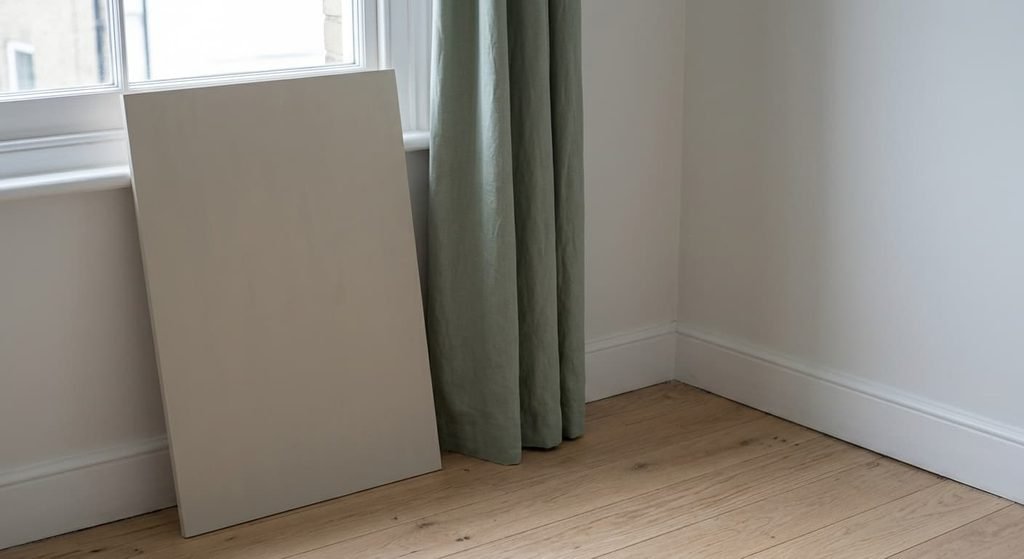
It doesn’t suit a north-facing room with one small window. Muted tones have little colour to begin with, so weak daylight makes them read grey and flat. Test a large painted sample on the wall at three points in the day before you commit. I can’t see how much light your room gets, so this test matters more than any rule here.
It doesn’t suit a parent who wants a room that makes a bold first impression. A muted scheme gives that up, and a room without a point of view can look generic. It also doesn’t suit a child old enough to choose a theme, since a child who loves boats will notice the absence. A very small room with no dark piece in it can also go flat, which the black-and-white photo shows straight away.
Are muted nurseries replacing bright themed ones for good?
The answer is yes for walls and furniture along with the large textiles. It is no for the whole room. It’s worth doing in the surfaces that cost the most to change, because a muted base lets a cheap bright item come and go without redoing anything.
Reversibility is the test. A painted wall changes in an afternoon, a rug can be swapped in an hour, and a coloured cushion costs little. The colour moves into cheap items, so keeping the room current costs one new cover a year rather than a new scheme. The commitment that is expensive to undo is built-in joinery or a feature wall finished in one fashionable tone.
A finish tied to one moment dates fastest.
I won’t forecast which tone will look tired. Longevity depends on the share of the room tied to one look and how easily that look comes out.
The version that will date fastest
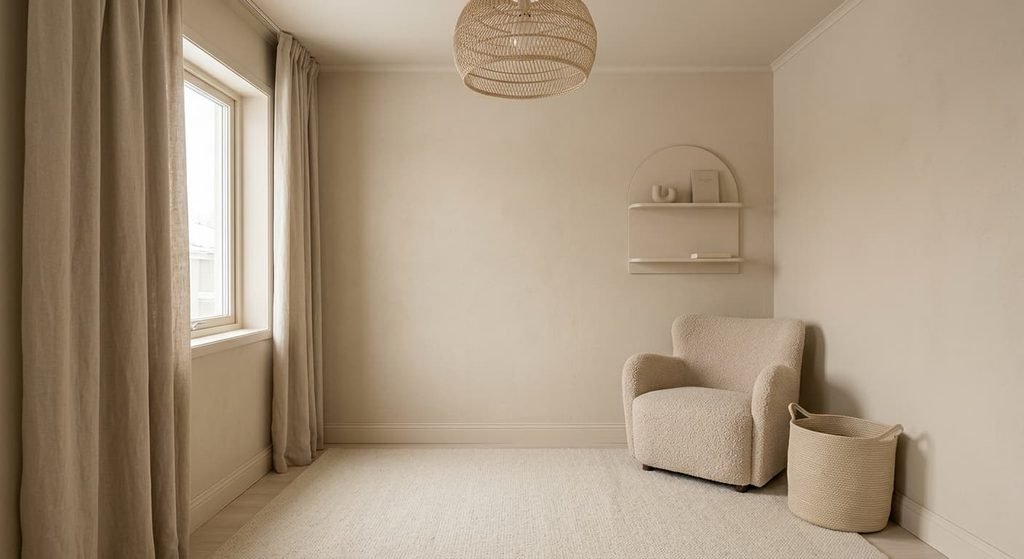
Where muted nurseries are replacing bright themed ones, the extreme version is a single beige tone on every surface, from the walls to the rug to the chair, usually with the same bouclé texture throughout. Its marks are easy to spot. No surface is darker or lighter than the next, so the black-and-white photo is a flat grey sheet. One trendy feature such as an arched shelf or a rattan ceiling light holds all the personality. It carries a date too.
I’d defend a firm view: beige on beige is a theme as well, with beige in the role the cartoon animal used to play. It repeats one idea on every surface, which is exactly what the old scheme did.
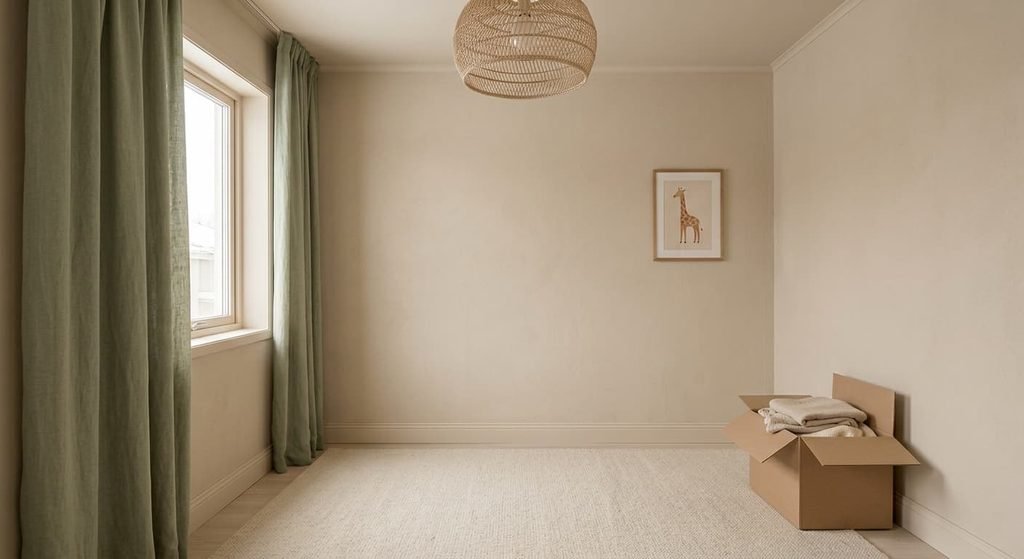
The moderate version has three or four tones and at least one dark anchor, such as a deep green curtain or a dark oak chest. The room then reads in black and white, the textures differ from piece to piece, and nothing in it is tied to one season.
How to try it without committing
Start by taking down all but one themed item for a fortnight. Keep the one you like best and box the rest. If the room feels bare, you’ve learned how much theme you need. If it feels clearer, you have your answer for free.
Next, paint an A2 board in the muted tone and move it around the room across a day. Boards cost little and reverse completely. A board also lets you judge the tone against the real floor and curtain as well as the window. Finally swap one large textile for a muted one: the rug or the curtains. Keep everything else as it was.
A muted nursery is a room with fewer ideas, each used once. Count the colours and count the themed surfaces, then check the black-and-white photo. If those three come out well, the room will outlast the child’s tastes for a good many years. It also gives you a base that takes one bright toy or one loud rug without a fight, which is how most people end up wanting it.
Questions readers keep asking
Should you repaint a bright nursery?
Only if the walls are the loud part. Photograph the room in black and white first. If the textiles carry the colour, swap them. The paint can stay. If the walls are saturated and the room has one window, repaint one wall in a muted tone and see how the light behaves.
Do muted nurseries suit a north-facing room?
Not always. Low-saturation tones read greyer in weak daylight, so choose a warmer one such as oat or clay rather than a cool grey. Paint an A2 sample and watch it at three points in the day. If it looks flat at all three, add the colour through a rug and curtains instead.
How long will a muted nursery stay in style?
Muted nurseries are replacing bright themed ones partly for this reason: the colour lives in items you can swap, so the room outlasts any one taste. The look dates when every surface shares one tone and one texture. Keep a dark anchor and varied textures, and the room needs a new rug or a repainted wall rather than a rebuild.