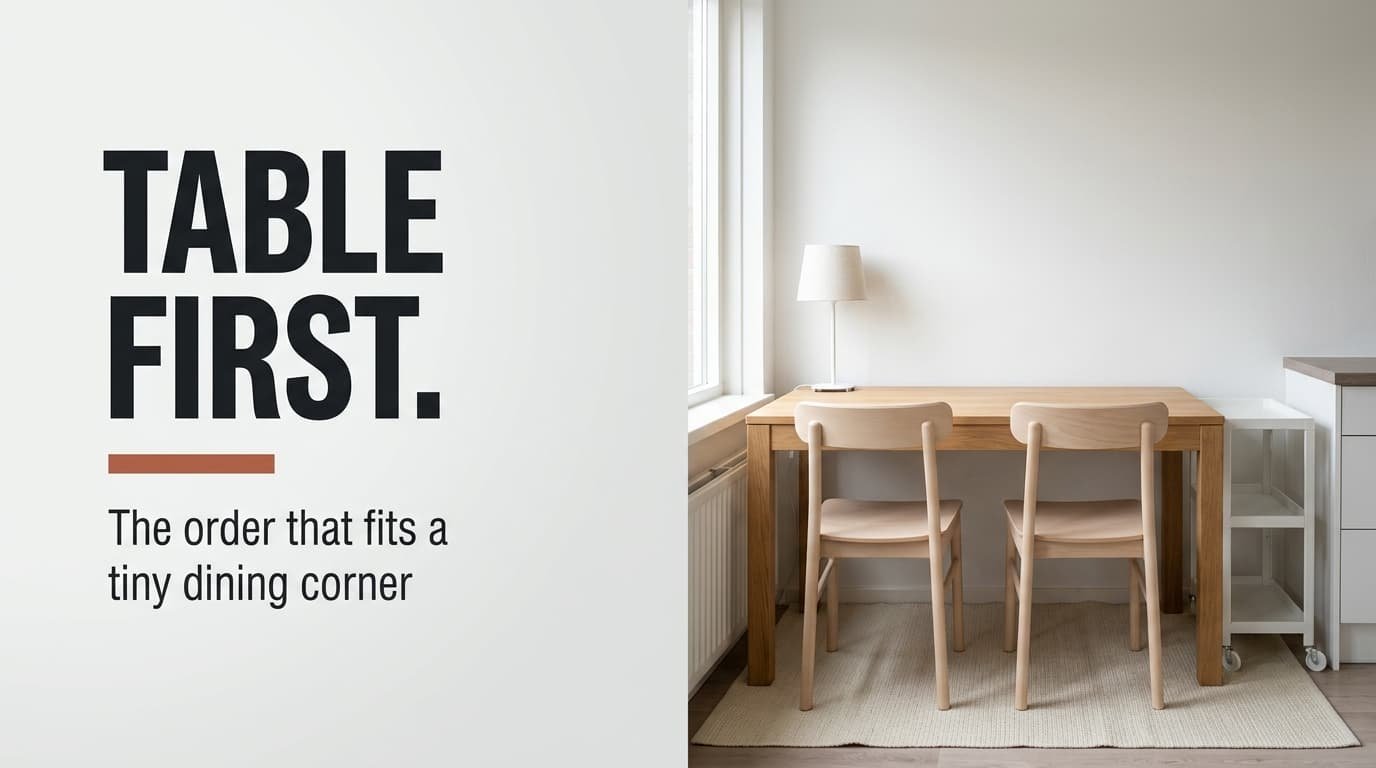
Which piece decides a dining corner in a small rented kitchen? The table, and only after one subtraction. The usual advice starts with chairs. That puts the wrong piece first, because the chairs inherit whatever space the table leaves. Buy the table first. The chairs come next, and the small pieces come last.
The kitchen here is Dutch, 270 by 380 cm, under a 250 cm ceiling, and a 60 cm worktop run along one long wall. I’ve left out prices because they go stale quickly, so each piece is judged by how it’s built.
The rule that decides a dining corner in a small rented kitchen
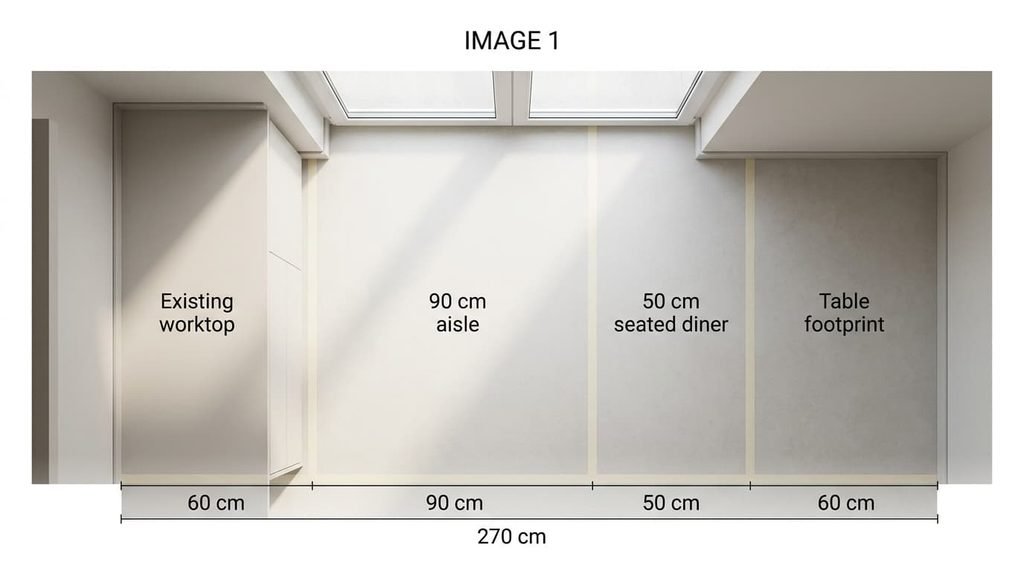
Width is the budget, and the fixed things are the bills. Buy first the piece whose size is whatever remains after the fixed things come off the width, and let every later piece fit what that purchase leaves. Start with 270 cm. The worktop run takes 60 cm. Keep a 90 cm aisle, the smallest gap I’d accept for carrying a pan past a seated diner. That leaves 270 − 60 − 90 = 120 cm.
A diner needs about 50 cm beyond the table edge, which is a 45 cm chair plus room to sit down. So the table can be at most 120 − 50 = 70 cm deep. A 60 cm table leaves 10 cm of slack, and that slack is the whole margin for every later purchase.
Length works the same way. The window end of the room is 150 cm long. A table 120 cm long seats two at 60 cm each. A trolley 30 cm wide takes the last stretch, so 120 + 30 = 150 and nothing is left over. The table comes first because its depth and length fix what everything else may be.
Dining in a small rented kitchen: the corner list in buying order
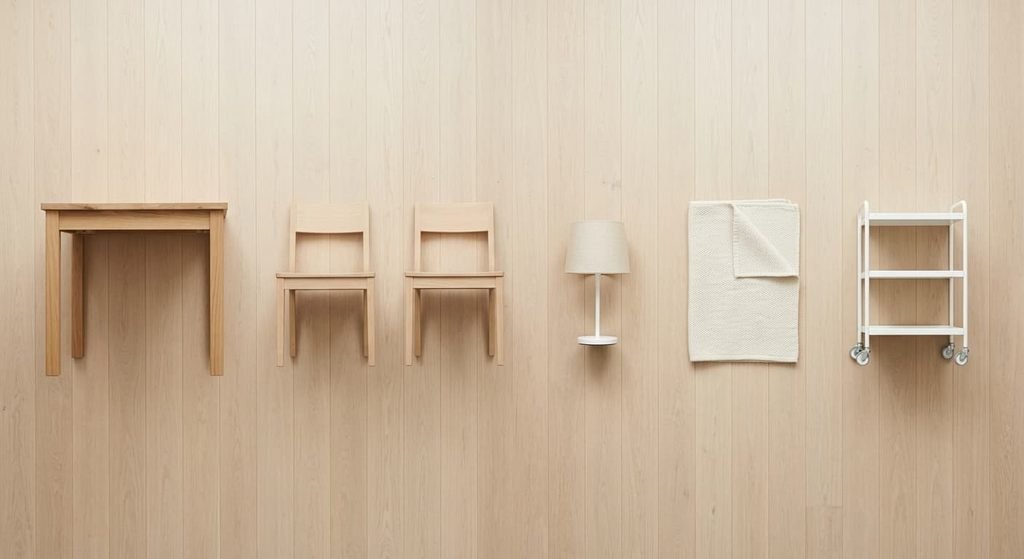
1. A table 60 cm deep and 120 cm long, 75 cm high, with a 22 mm top on a four-sided apron frame, placed in position one, since it takes the slack and fixes the length. Tier: BUY ONCE. The top is leaned on and wiped daily, and hot pans land on it for years. Watch for a 12 mm top on four bare legs. It twists sideways when someone leans an elbow on one corner.
2. Two chairs 41 cm wide, with a seat 45 cm high and 42 cm deep, the frame held by glued dowel joints, so each chair tucks fully under the top. Second, since the table’s 10 cm of slack decides how deep a chair may be. Tier: MID, since the joints take sideways load at every meal. Watch for stapled joints, or a seat 48 cm deep that swallows 6 of the 10 cm of slack.
3. A table lamp 30 cm tall with a cable of at least 1.8 m, so it can stand at the window end instead of on the table. Third, since it needs the table’s final position and the nearest socket. Tier: BUY CHEAP, since nothing hides in a lamp except its cable. Watch for a cable of 1 m, which pulls the lamp onto the top and takes 20 cm of its 60 cm depth.
4. A washable mat 70 by 130 cm under the table, 5 cm wider than the top on every side. Fourth, since it takes its size from the table and nothing else. Tier: BUY CHEAP, as a mat shows its weave and edges in a shop. Watch for a latex backing that bonds to a vinyl floor. It marks the vinyl at move-out, which costs you in a rented flat.
5. A trolley 30 cm wide and 60 cm high on castors of 5 cm. Last, since it takes whatever length the table leaves. Tier: BUY CHEAP, as it carries only small things. Watch for castors under 4 cm, which stall on tile joints.
Where to put the money, and the piece to cut back
Spend on the table top and its apron frame. They carry every daily load and can’t be checked once the piece is in your kitchen. A thin top looks fine in a shop until a corner twists under a hand. The mat and the trolley are bought cheap, since both are easy to replace and neither carries any weight.
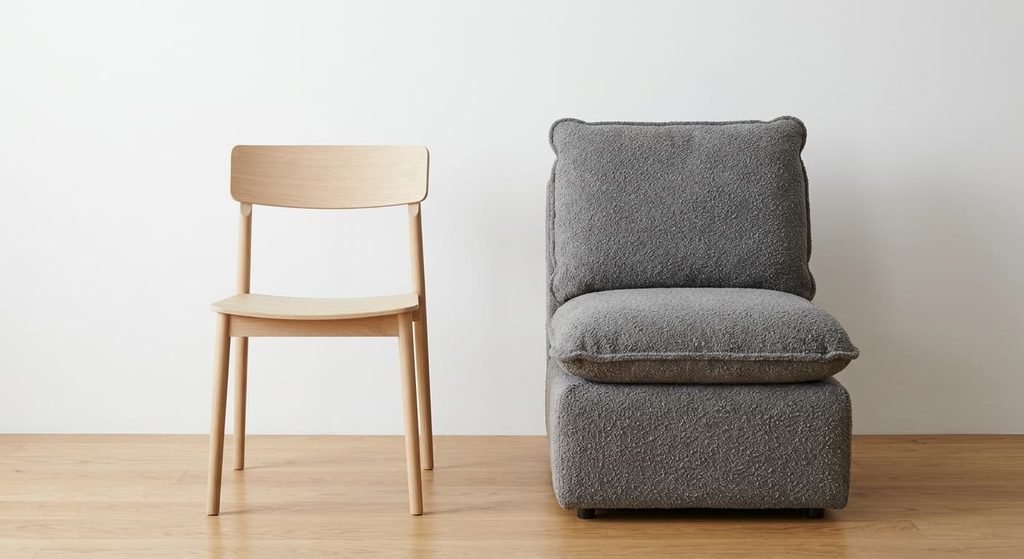
Of the five, the chairs are the purchase to cut back in a dining corner in a small rented kitchen. Plain frames do their whole job here, and each comfort feature spends slack you only have 10 cm of. Padding on the seat adds 3 cm of depth. Upholstery over the back adds 4 cm more, which leaves 3 cm of the 10. A hard seat with a gently curved back serves a 25-minute meal perfectly well. It tucks under the table with room to spare.
Pick chairs by their measurements and their joints, and leave padding to cushions you can add later. A pair of plain chairs at the lower tier loses nothing that a loose cushion couldn’t restore.
What this order assumes, and when it breaks
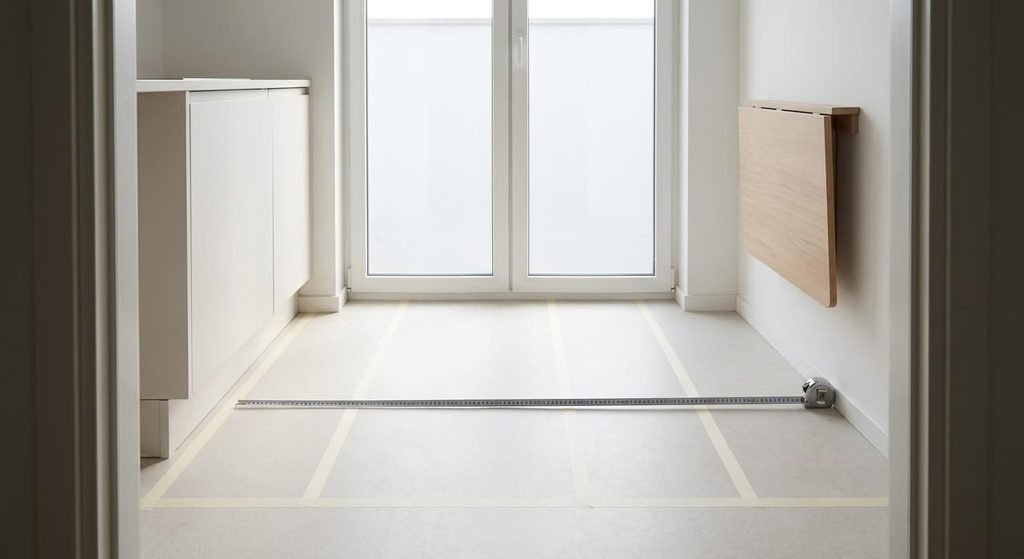
This order assumes a kitchen 270 cm wide, a wall you can’t drill and a 90 cm aisle you won’t give up. Measure your own width, subtract 60 cm for the worktop and 90 cm for the aisle, then take the 50 cm a diner needs. The rest is your table depth. Tape the table and chairs out on the floor, since tape shows the aisle better than numbers do.
At 250 cm the sums give a table 50 cm deep, the narrowest that holds a plate and a cup. Below that the list collapses, and a table that folds flat against the wall suits better than a fixed one. At 300 cm the table can grow to 100 cm deep and the slack to 40 cm. A bench can then replace the chairs, and the order is unchanged. In a dining corner in a small rented kitchen, the aisle is the number to question first.
The material of the floor decides whether the mat in position four is safe to use at all.
What to skip entirely
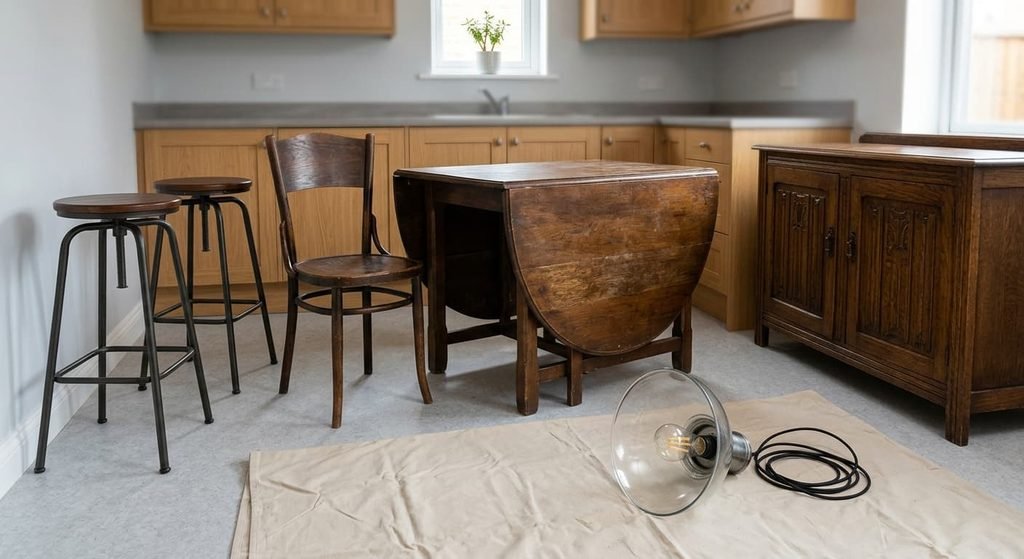
A third chair for guests tops the skip list. Another place at the table needs another 50 cm of length, and the window end has 30 cm spare. Extension leaves come next. The moving parts bind, and the extended top overruns the aisle by 40 cm. Bar stools at the worktop also earn nothing, because the worktop edge is the cook’s side of the aisle. Sideboards need 40 cm of depth the room hasn’t got. A pendant needs a drill and a landlord’s permission, so skip it. Runners along the aisle collect crumbs and move underfoot, and the mat in position four already covers the diners’ side.
Everything above waits for a bigger room.
The rule says buy the table first, and the budget shows why: a dining corner in a small rented kitchen is a sum, and the table is the term that sets all the others. I’d back that order against the chairs-first habit. A mistake with a chair costs one swap, and a mistake with the table costs the whole aisle. Measure your width this weekend. Do the subtraction, then let the answer decide the table before you open a single shop page.
Questions readers keep asking
Which pieces does a small dining corner need?
Five pieces suit two diners: a table and two chairs, plus three small cheap extras. Only the table is bought once, and only the chairs sit in the middle tier. A sixth piece usually means a third chair, which this room can’t hold.
Should you buy the table or the chairs first?
The table. Its depth is whatever your width leaves after the worktop and the aisle. The chairs must fit the slack that remains. With 10 cm of slack, a chair seat of 42 cm fits. One of 48 cm swallows 6 cm of that margin. Measure first, then pick.
How can you judge a small table before buying?
Check the top thickness at the edge, then look underneath for a four-sided apron frame. Lean an elbow on one corner and watch for twist. A 22 mm top on an apron frame stays square, while a 12 mm top on four bare legs flexes. Take a tape measure, since thickness is quicker to read than finish.