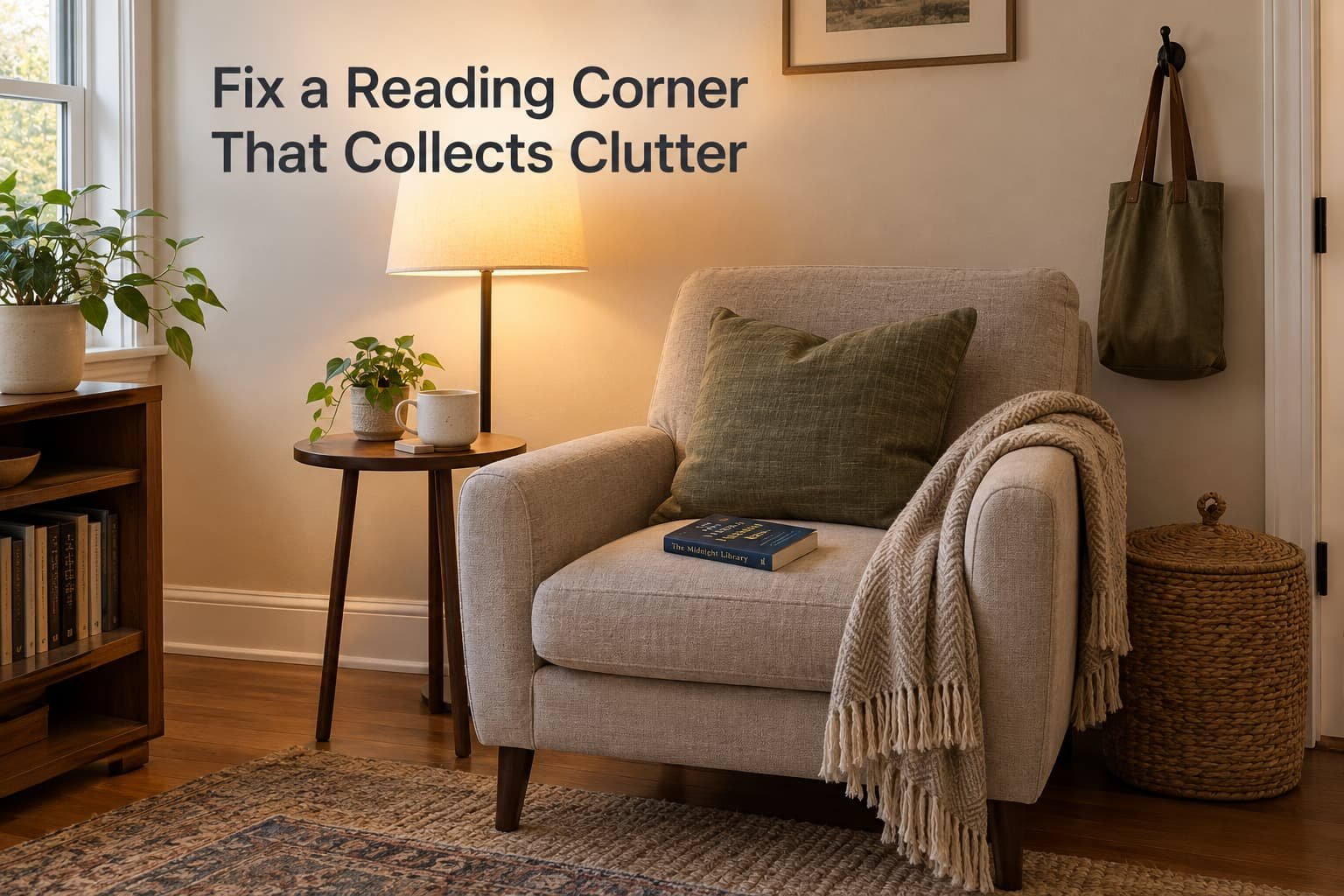
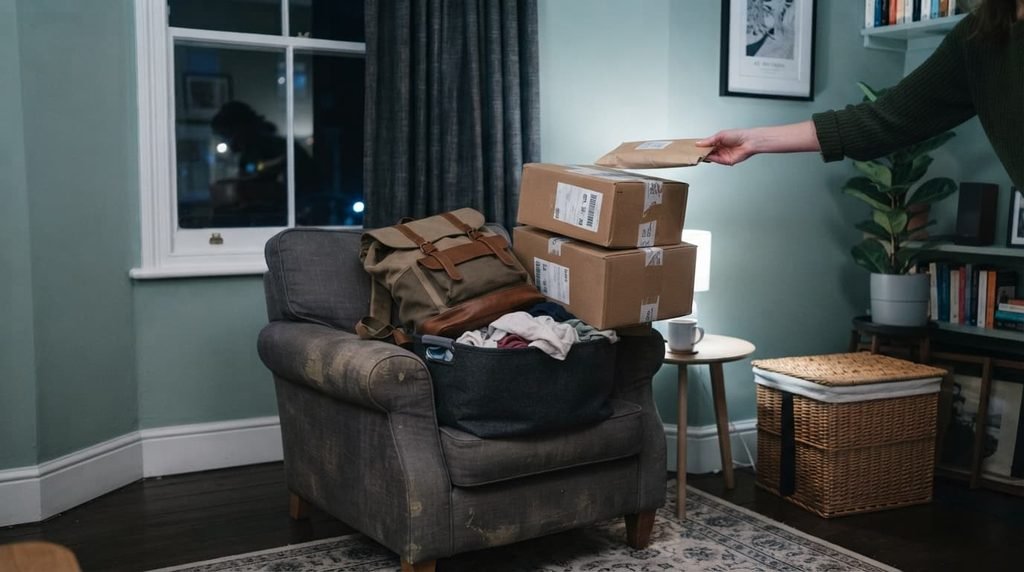
Every reading corner starts the same way: one good chair, one lamp, a stack of books you mean to get to. A month later the chair is holding a laundry pile, a parcel and somebody’s bag, and the books are underneath. Nobody decided to make the corner a dumping ground. It simply became the nearest empty surface at the moment someone’s hands were full. That is useful to know, because it means the fix is about where things land, not about anyone’s discipline.
What is actually happening
Things land wherever putting them down takes the least effort. An empty seat or a bare side table is the easiest answer to “where do I put this for a minute?”, especially when the corner sits on a path people already walk, near a door, a staircase or the kitchen.
Two forces make it worse. First, the objects that land there usually have no proper home, so they keep coming back. Second, every flat surface acts as an invitation in proportion to its size: the wider the table, the bigger the pile.
Once a pile forms, the corner stops looking like a place for reading, which makes the next item even easier to add. Breaking that loop means giving the stray items a better landing place and shrinking the invitation.
Spot what lands there
Before buying or moving anything, find out what actually arrives. For one week, take a quick photo of the corner at the same time each evening. A photo log reveals the pattern far better than memory, and the pattern is usually short: three or four kinds of object account for most of the mess.
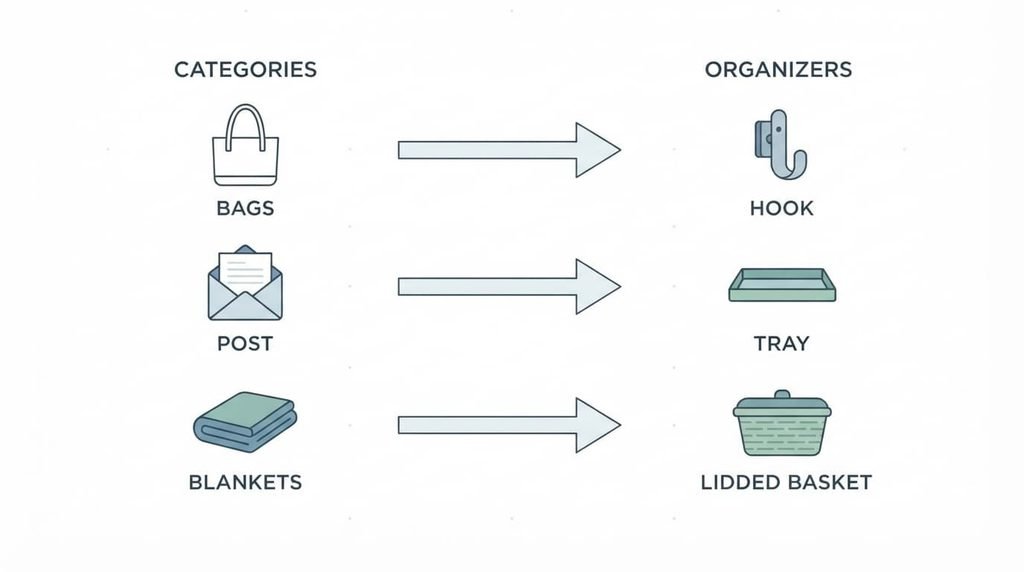
Do not tidy before taking the photo, because the point is to see the corner as it really is on an ordinary evening. Look at what shows up. Bags and coats mean there is no hook nearby. Post and parcels mean there is no tray. Blankets and cushions mean the corner is the household’s spare storage. Laptops and papers mean someone is working there. Each category needs its own small answer.
The fixes, in order of effort
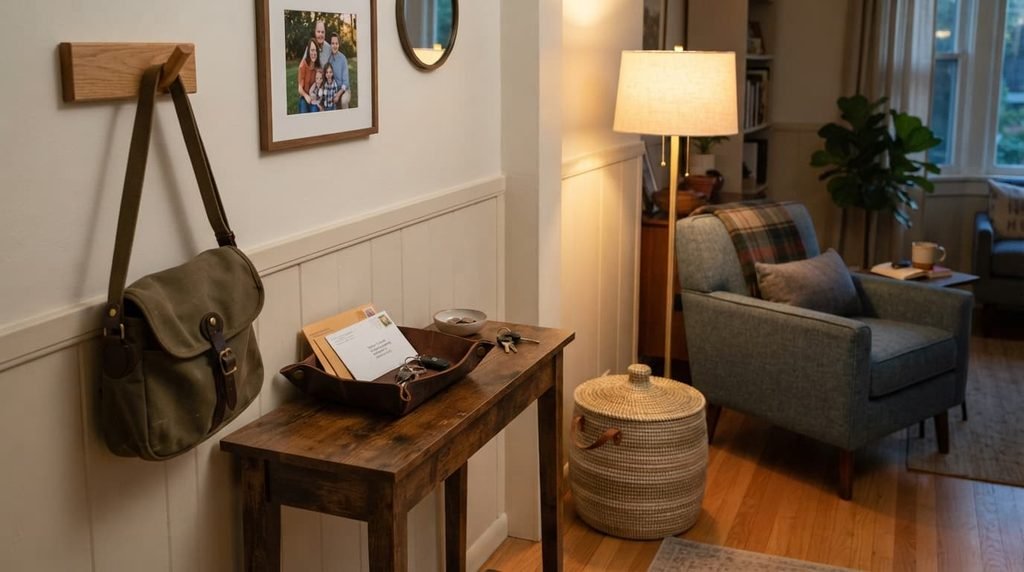
1. Give the three most frequent arrivals a home within a few steps. A hook for the bag, a tray for post, a lidded basket for blankets. If the right place is closer than the chair, people will use it without being asked.
2. Make the seat look taken. Place a book you are actually reading on the seat and fold a throw over the arm. A seat that already holds something deliberate reads as occupied and attracts fewer casual drops. Try it for a couple of weeks and see whether it works in your household.
3. Shrink the flat surfaces. Swap a wide side table for a small round one or a narrow wall-mounted ledge. Surfaces collect clutter in proportion to their area, and a surface big enough for a coffee cup and one book leaves no room for a pile.
4. Add one closed container as the official overflow spot. A lidded basket beside the chair gives the daily overflow, such as magazines and spare cushions, somewhere acceptable to go. Empty it once a week.
5. For wall shelves or any fixing that needs drilling, use the right fixings, and consult a licensed professional if you don’t know what runs inside the wall. Drilling blind into a wall can hit wiring or pipes, so this is not a step to guess at. A qualified installer can check, and can also advise which fixings suit your wall type.
A two-minute reset that keeps it working
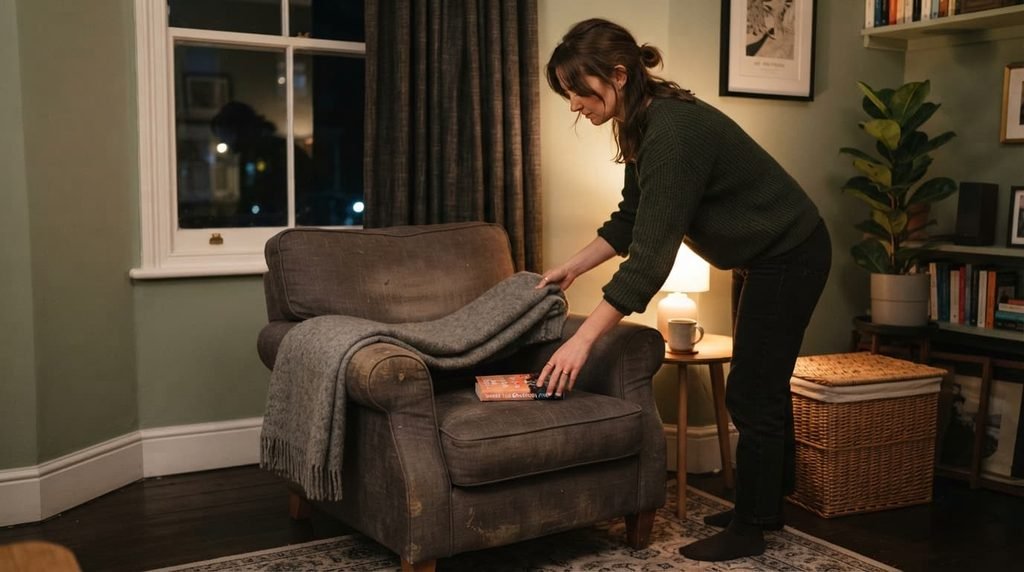
Design does most of the work, but one small habit holds it in place. At the end of the day, spend two minutes returning the throw to the arm of the chair, putting the current book back on the seat, and moving anything from the overflow basket to its proper home if the basket is filling up. Because the landing places are now close, the reset really does take about two minutes. If it takes much longer, that is useful information: it means one category of object still has no proper home, and it is the one to solve next.
What isn’t worth doing
Buying a bigger bookcase or more storage furniture before you know what is landing there isn’t worth the money.
Storage without a defined purpose becomes a new surface, and new surfaces collect the same pile in a different place. The week of photos tells you what you actually need to store, and that is almost always smaller and cheaper than a new piece of furniture.
What people get wrong
The first mistake is treating this as a discipline problem. If the corner sits on a path that people walk with full hands, expecting everyone to resist the nearest flat surface is a plan that fails quietly. Changing the design works; lecturing does not.
The second is removing the chair to stop the piling. That solves the pile and destroys the reading corner along with it.
The third is hiding the pile in a decorative basket. A basket with no sorting rule becomes a tidy-looking dumping ground, and it hides the signal that tells you what needs a proper home.
What changes if your situation is different
If children are involved, give toys and school bags a low basket they can reach themselves. Anything higher than a child’s reach will end up on the chair.
If several adults share the home, agree on one tray per person for post and keys, placed away from the corner. A shared pile has no owner, and an unowned pile does not get cleared.
If the corner is also a workspace, keep a single box or folder for laptop and papers so that work packs away in one move, and the corner returns to reading at the end of the day.
If the corner is directly on the main route through the room, consider moving the chair and lamp a metre out of the traffic line before buying anything. A small shift often removes half the problem.

The one thing to check before you commit
Before you spend on baskets, hooks or ledges, look at your week of photos and write down what appeared most often. Buy only for those items. This is the cheapest and most overlooked step, because it replaces guesswork about what the household drops with a record of what it actually drops.
Questions readers keep asking
Is it a bad sign if my reading corner doubles as a landing spot?
It is a sign that the corner sits in a convenient place, which is also what makes it a good reading spot. The aim is to give the stray items a better place nearby, not to move a corner that works.
Do open baskets work as well as lidded ones?
Open baskets are easier to use but show the contents, so they gather mess faster. A lid makes the basket look finished and discourages casual dropping, which suits the overflow spot beside the chair.
How long before the corner stays clear?
Give the new arrangement a few weeks of ordinary use. Habits change when the easiest option changes, and it takes a little while for the household to adjust to the new landing places.
Should I put the lamp somewhere else to keep the corner clear?
Not for this reason alone. The lamp’s position matters for reading, and the clutter problem is better solved by what you do with the surfaces and the seat than by moving the light.