A painted arch can replace a headboard for one tin of paint and an afternoon, which is why painted arches behind a bed keep appearing in small bedrooms. The change is measured in centimetres, then come the reasons given, and then what the swap costs. A simple tape test closes the piece, and the most extreme version gets a caution late on. Every figure belongs to a sample bedroom in Eindhoven with a plain wall 360 cm in width and 250 cm in height. Check your wall’s size before starting, and ask your landlord before painting if the flat isn’t yours.
Painted Arches Behind a Bed: The Short Version
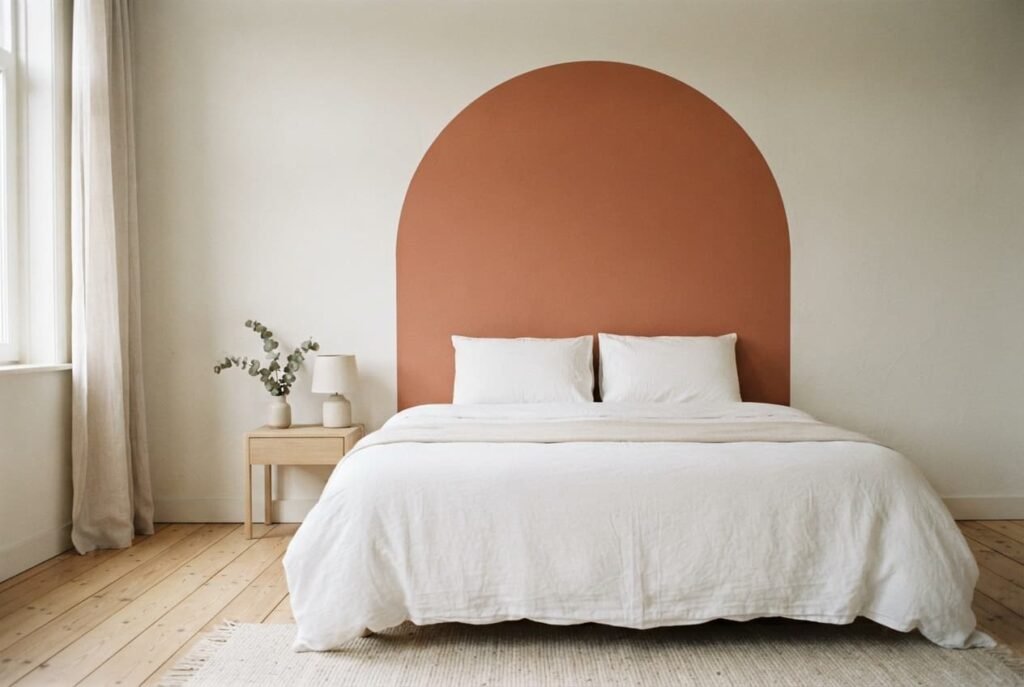
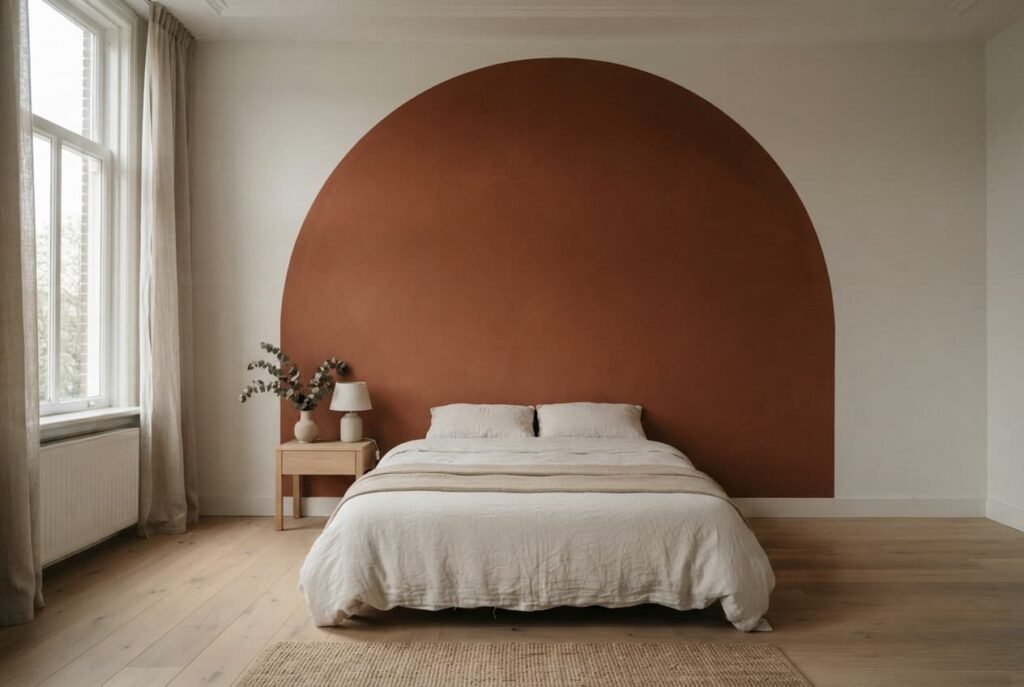
An arch of paint is a flat shape on the wall: a rectangle that rises from the skirting to a spring line, topped by a half circle. In the sample room the arch is 180 cm wide, which is the 160 cm bed plus 10 cm on each side. The spring line is the height where the curve begins, 100 cm here. With a radius of 90 cm for the half circle, the top lands at 190 cm. A padded panel of 170 × 110 cm, standing 8 cm out, is the headboard it replaces.
Both frame the head of the bed. What separates them is height and depth, plus texture. The paint adds no depth. It climbs 80 cm higher and feels like the wall, because it is the wall. The shape needs only a string and a pencil, plus some tape. It can be one flat colour or two tones.
The look takes one wall and spares the others.
What Changed on the Wall, in Numbers
Start with area. The padded panel covers 170 × 110 = 18,700 cm², or 1.87 m². The arch covers a rectangle of 180 × 100 = 18,000 cm² plus a half circle of ½ × π × 90² ≈ 12,723 cm², which totals 30,723 cm², or 3.07 m². With painted arches behind a bed, the coloured area behind the pillows grows from 1.87 m² to 3.07 m², a rise of 64%.
Share of the wall tells the same story. The wall measures 360 × 250 = 90,000 cm², or 9 m². The panel takes 21% of it, and the arch takes 34%.
Depth changes in the opposite direction. The panel stands 8 cm out, which holds the bed at 208 cm from the wall. In a bedroom that is 3 m deep, that leaves 92 cm at the foot. Paint is flat, the mattress touches the wall, and the foot gap becomes 100 cm.
Height shifts too. The panel ends at 110 cm, while the arch reaches 190 cm. That leaves 60 cm of plain wall above the curve.
The edge matters for the work involved. Two straight sides of 100 cm plus a curve of π × 90 ≈ 283 cm give 483 cm of line to cut in with a brush.
Paint is the last number. At a sample coverage of 10 m² per litre per coat, two coats over 3.07 m² need 0.61 L, which a single 1 L tin covers.
Why Painted Arches Appear Behind a Bed
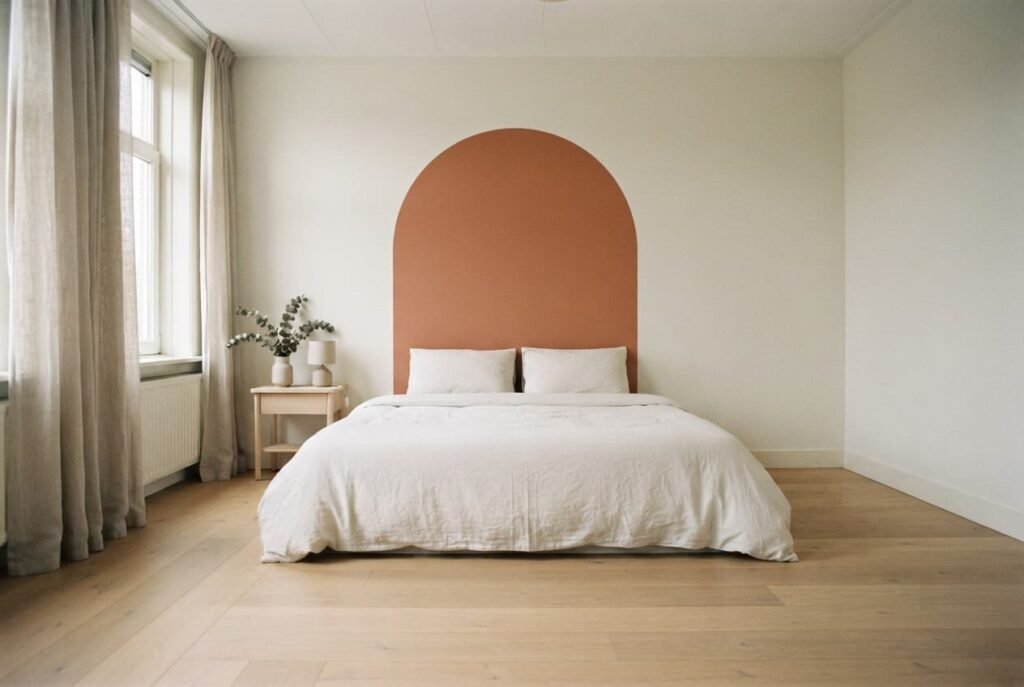
Room depth comes first. Getting 8 cm back at the foot matters when a bedroom is 3 m deep, and in a Dutch flat the bedroom is often the smallest room. A 200 cm bed leaves a clear route past it only when nothing sticks out at the head.
Carrying matters too. A padded panel of 170 × 110 cm doesn’t turn easily on a steep Dutch stair, and many flats are reached only by stairs. A tin of paint climbs them in one hand.
Shape counts for a lot. Most bedrooms are boxes with straight walls and a flat ceiling, plus square furniture. A curve breaks that rhythm, and the eye follows it up and round.
Change is another reason. Taking the look away means painting over it in the wall colour, which is a day’s work. Fixing a headboard to the wall also means drilling, and a rented wall may not allow it. A wall-mounted headboard leaves screw holes, while a freestanding one needs somewhere to live afterwards.
Colour helps as well. One deep shade behind the pillows lets the bedding stay plain, and the room needs no extra pieces.
Cleaning is the last reason. A painted wall wipes down in one pass. Stitching and seams on a padded panel hold dust.
What You Give Up
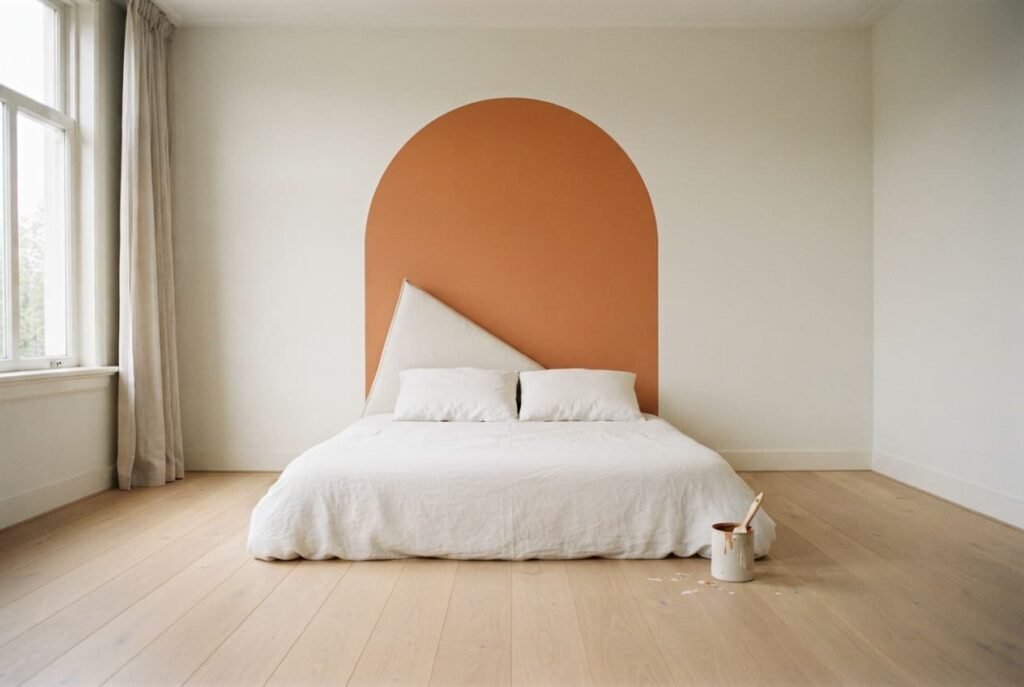
A painted wall can’t hold you up. Sitting up to read means adding a back cushion or a wedge pillow, because bare wall offers no padding and feels cold on the shoulders. A wedge 10 cm thick pushes the bed’s head 10 cm out again, which cancels part of the depth you won.
Marks are the second cost. Hair and pillows rub the wall at head height, along a strip some 60 cm across. Matt emulsion shows grease quickly. Choose a scrubbable finish and keep a small pot for touching up.
The third cost arrives when you leave. A dark arch over a pale wall needs two or three coats to hide, plus a day’s drying between each. Tenants need consent beforehand, plus a plan for repainting.
Choosing painted arches behind a bed also commits you to the bed’s position. Shift it 20 cm sideways and the arch looks wrong, even though the wall hasn’t changed.
The Extreme Version
At its limit, the arch spans the whole 360 cm wall. The half circle then has a radius of 180 cm, and the spring line sits at 70 cm, which lets the top touch the 250 cm ceiling. That’s 360 × 70 = 25,200 cm² plus ½ × π × 180² ≈ 50,894 cm², which comes to 76,094 cm². An arch spanning the entire wall reaches 7.6 m² of paint, which is 85% of the wall.
Two coats need 1.5 L, and a string 180 cm long has to hold its pencil steady through the whole curve. A slip of a centimetre shows from the doorway. The bed fills only 160 cm of the width, which leaves 100 cm of colour on each side that belongs to a table or nothing at all.
Worst of all, a deep shade on 85% of the wall makes the bedroom feel like a box you lie inside. The original idea was a frame for the head, and this version frames nothing.
A modest arch and a clear margin of wall do the job.
Who It Suits
Painted arches behind a bed suit rooms where the bed is 160 cm wide and the wall is at least 240 cm across, which gives 30 cm of plain wall on each side. They suit people who read in a chair rather than propped up in bed, and flats where a headboard has nowhere to stand.
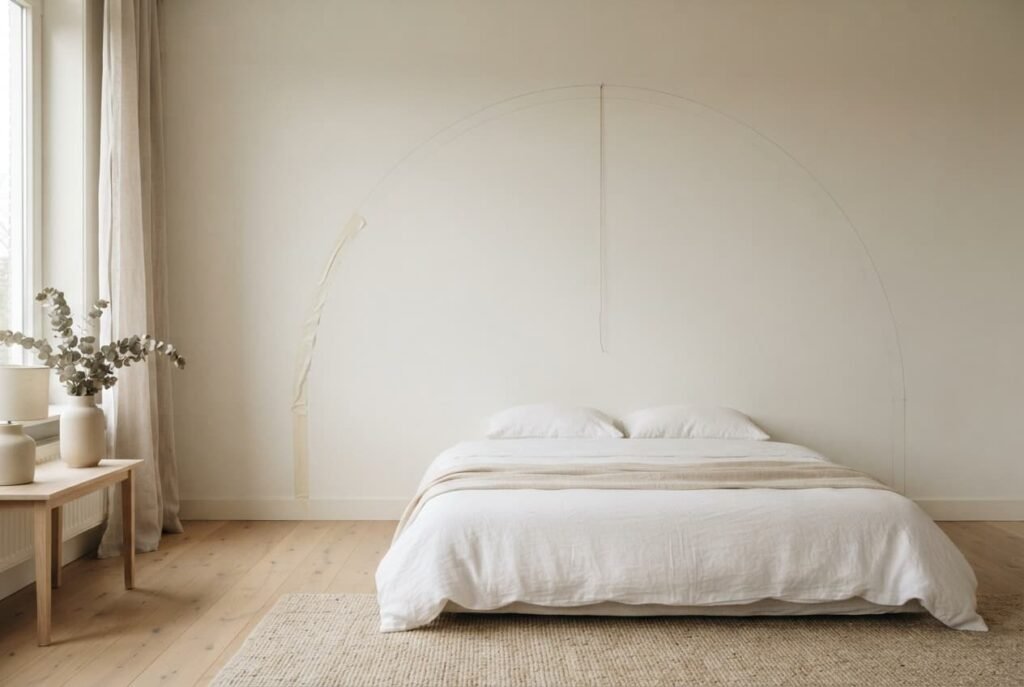
Mark it out in tape ahead of any paint. Pin a string where the curve begins on the centre line, tie a pencil at 90 cm and draw the curve. Leave the tape on for a week, and view it in morning light and under the evening lamp.
If you still like the shape after a week, paint it. Cut in along the tape with a brush and apply two coats. Lift the tape while the last coat is still slightly tacky. If you don’t like it, remove the tape. Nothing has changed except your opinion. Write the radius and spring height on the tin lid for later touch-ups.
Questions and Answers
Should I keep my headboard or paint an arch instead?
Keep it if it’s sturdy and you sit up in bed. An arch earns its place when the headboard eats floor space or won’t fit through the door. Tape the outline beforehand, and decide after a week of seeing it in different light.
Which bedrooms gain most?
Small bedrooms with a plain wall at least 240 cm across gain most, especially where a padded panel would push the bed 8 cm into the room. Rooms with sloping ceilings, large windows behind the bed or no clear wall gain little.
How long will a painted arch last?
The finish ages in step with the wall around it. Scuffs at pillow height appear soonest, and a small pot of the same colour mends them. Whether the shape stays fashionable is for your own eye to judge. Decide by whether you enjoy the wall.